White Hat Link Building Service That Protects Rankings
Your site earns 100% manual, Google-compliant backlinks through editorial outreach,
building lasting authority that survives every update without putting your domain at risk.

Manual editorial outreach
Google-compliant tactics
No PBNs or link schemes

4.8/5
Trusted by agencies
and brands worldwide.
Manual Outreach
100%
Campaign Dashboard
DOMAIN RATING
+23 points
ORGANIC TRAFFIC
3,200 → 26,200
CORE UPDATES PASSED
100% stability
EDITORIAL PLACEMENTS
156 unique domains

Average Placement DR
40 – 95





Service Overview
What White Hat Link Building Actually Means
White hat link building is earning backlinks through manual outreach, editorial relationships, and content that publishers genuinely want to link to. The difference between white hat and black hat is clear. Black hat covers everything that Google flags, such as PBNs, link exchanges, paid placements as editorial, and low-quality networks.
Google’s SpamBrain detects manipulative link patterns, and core updates target unnatural link profiles. Sites built using shortcut link building often lose rankings with every update, but sites built on white-hat methods keep growing.
For most businesses, white hat is the sustainable path. Real outreach may take more time, but ranking gains stay. You’re investing in authority, not in the positions that vanish with the next update.
Three things that define a strong white hat link:

Editorial Integrity
The link appears within the content publishers reviewed and approved based on content quality, not in a sponsored block, footer, or sidebar.

Real Publication
The hosting site has genuine traffic, audience, and a clean backlink profile that signals credibility.

Manual Outreach
Each placement comes from one-to-one outreach, not automated emails, link exchanges, or marketplaces.
How We Work
How Your White Hat Campaign Works
A safe, transparent workflow built on manual outreach and editorial
standards that Google rewards.
Your campaign starts with a health check of your existing backlink profile before any new links are built. Your campaign runs the audit through Ahrefs, Semrush, and Google Search Console to identify any toxic links, suspicious patterns, or anchor text issues that could trigger penalties. Most teams partner with a dedicated link building agency to run these campaigns end-to-end.
Cleanup is done first, if needed. You’ll see which links are at risk, why they’re flagged, and whether to disavow them. New link building starts once your profile is in a safe space.
Your team builds the prospect list using strictly white hat criteria. Every site is checked manually to determine organic traffic, real readership, content quality, link profile health, and editorial standards.
Removal of sites that fail the checks. No DR-only filtering, no PBNs, no marketplaces. You only see prospects that meet the same standards Google uses to define authoritative sources, with complete transparency into why each one made the list.
Every placement requires content that the publisher genuinely wants to publish. Your writing team creates topics, angles, and assets that align with the publisher’s editorial standards, audience interests, and coverage.
The content should be a standalone. Editors approve it because it’s useful to readers, rather than being packaged with a payment for a link. This makes the placement white hat; the content earns its spot, not the deal behind it.
Your outreach specialists contact editors and publishers directly. Every email is personalized and tailored to a specific, recent piece in that publication. Without mass automation, outreach templates to 500 sites.
Each conversation focuses on editorial fit, not link requests. Publishers respond because the pitch shows a genuine understanding of their site, not because it offers payment. This is a slower process than automated outreach, but it’s the only mode that holds up under Google’s scrutiny.
When a placement goes live, your team verifies it against the white hat standards, the link appears in the main content, the anchor text is placed naturally, the page is indexed, and the dofollow attribution is correct.
Anchor text is reviewed for risk of over-optimization. If a placement has the wrong anchor or appears in a sponsored block, your team corrects it or replaces it. You don’t have to pay for placements that don’t meet white-hat standards.
You receive a detailed monthly report covering every live placement, anchor text used, domain rating, editorial context, and indexation status. The report shows exactly how each link was earned, including the history of outreach when relevant.
Every link is monitored after placement. If a publisher’s quality drops, an article gets removed, or a site shows signs of becoming unsafe, your team flags it and arranges replacements. White hat focuses on long-term link quality

Expected Results
Outcomes that White Hat
Link Building Delivers
When a link is earned through genuine editorial standards, your authority
compounds into rankings and traffic that holds through every update.
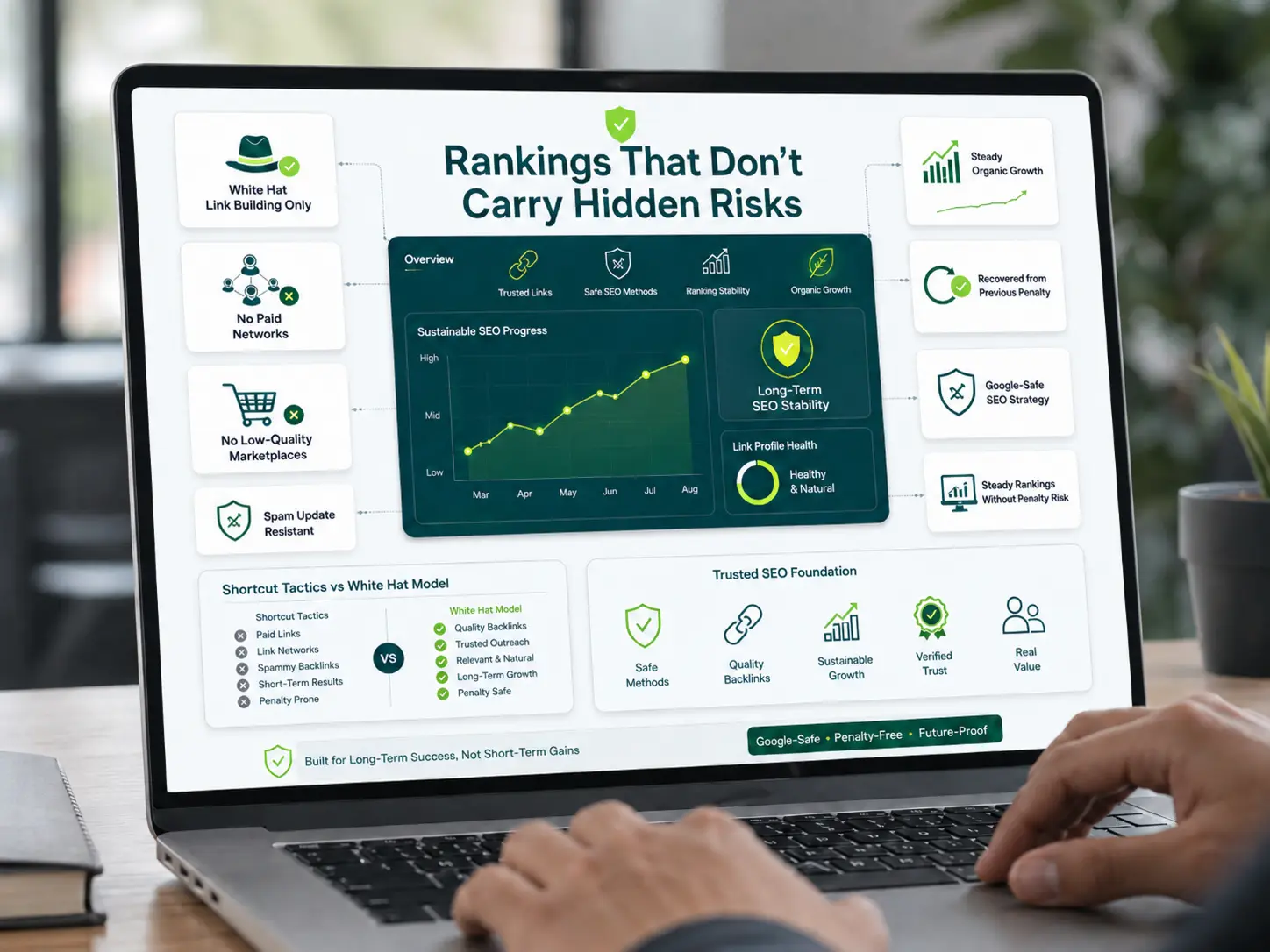
Rankings That Don’t Carry Hidden Risks
Most rankings are tied to link building losses because they come from sites that grew through shortcut tactics, paid networks, or low-quality marketplaces. White hat campaigns avoid that risk entirely.
The result: Your rankings move up steadily without the penalty that comes with manipulative tactics. One ecommerce client recovered from a previous penalty and grew organic traffic by 220% within seven months by switching to a white hat link building model.
It’s not just about the fastest growth on paper, but it’s about the only growth that lasts. White hat clients are less likely to experience an overnight loss in rankings when Google introduces a spam update.
Visibility that Holds Through Every Core Update
Google introduces updates several times a year. Each update targets sites with unnatural link patterns, low-quality content, or manipulative SEO tactics. Sites built with shortcuts lose visibility after every update.
White hat link building is designed to survive these updates. Every placement matches Google’s definition of an editorial link, including real content, an audience, and a reason to exist. SpamBrain and the border spam detection systems don’t flag links earned this way because there’s nothing to flag.
Clients with white hat campaigns often hold or improve rankings during every core update, while competitors lose visibility.

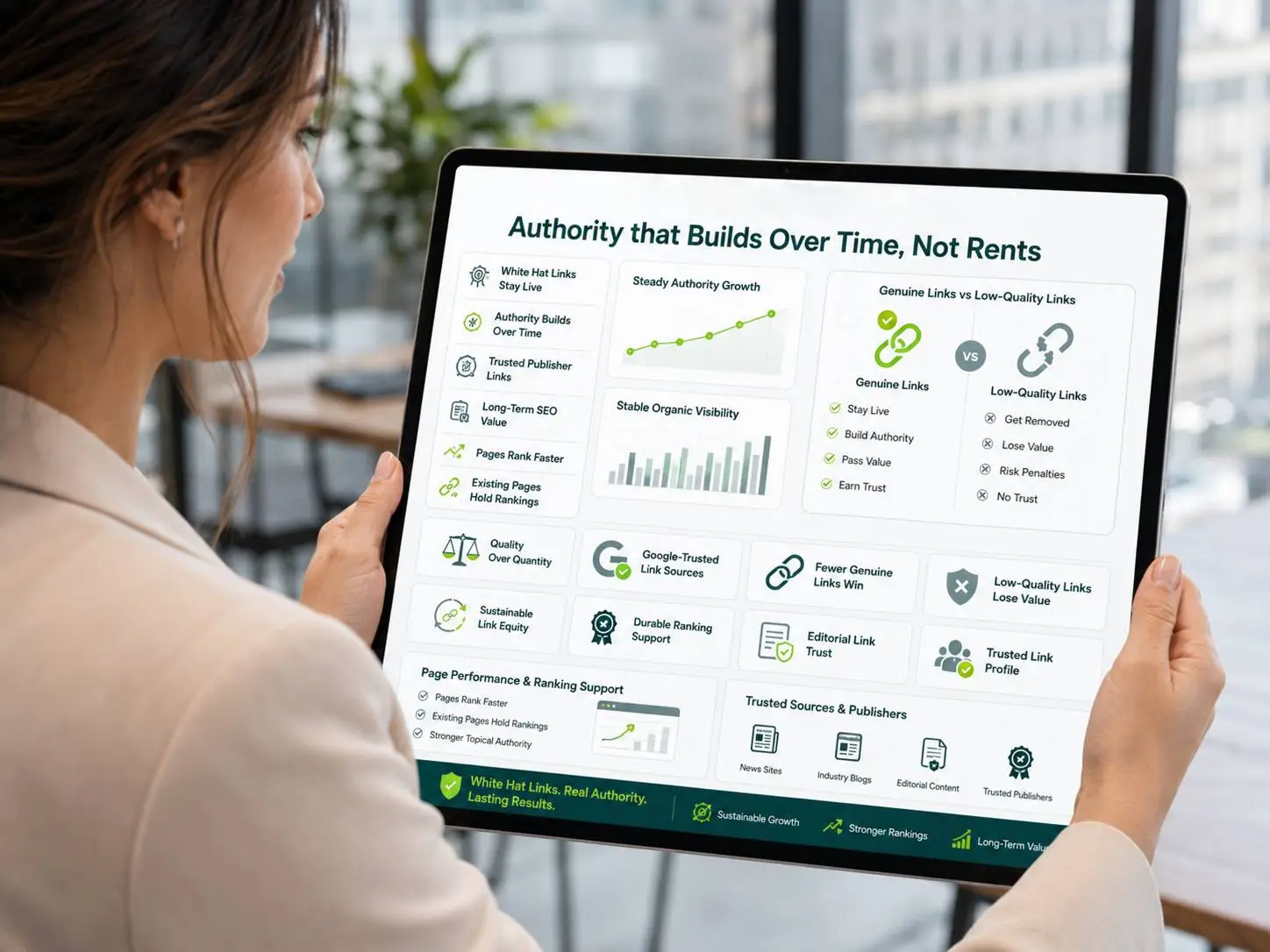
Authority that Builds Over Time, Not Rents
Every white hat placement adds a real link to your profile. Unlike links from paid networks, these stay live and continue to work as long as the publisher’s site remains active.
That value is built over time. Your site’s authority grows steadily. New content ranks faster, and existing pages hold rankings, because the links pointing to them come from sources Google actually trusts.
Data from Ahrefs consistently show that pages with fewer, genuine links outrank pages with more links from low-quality sources.
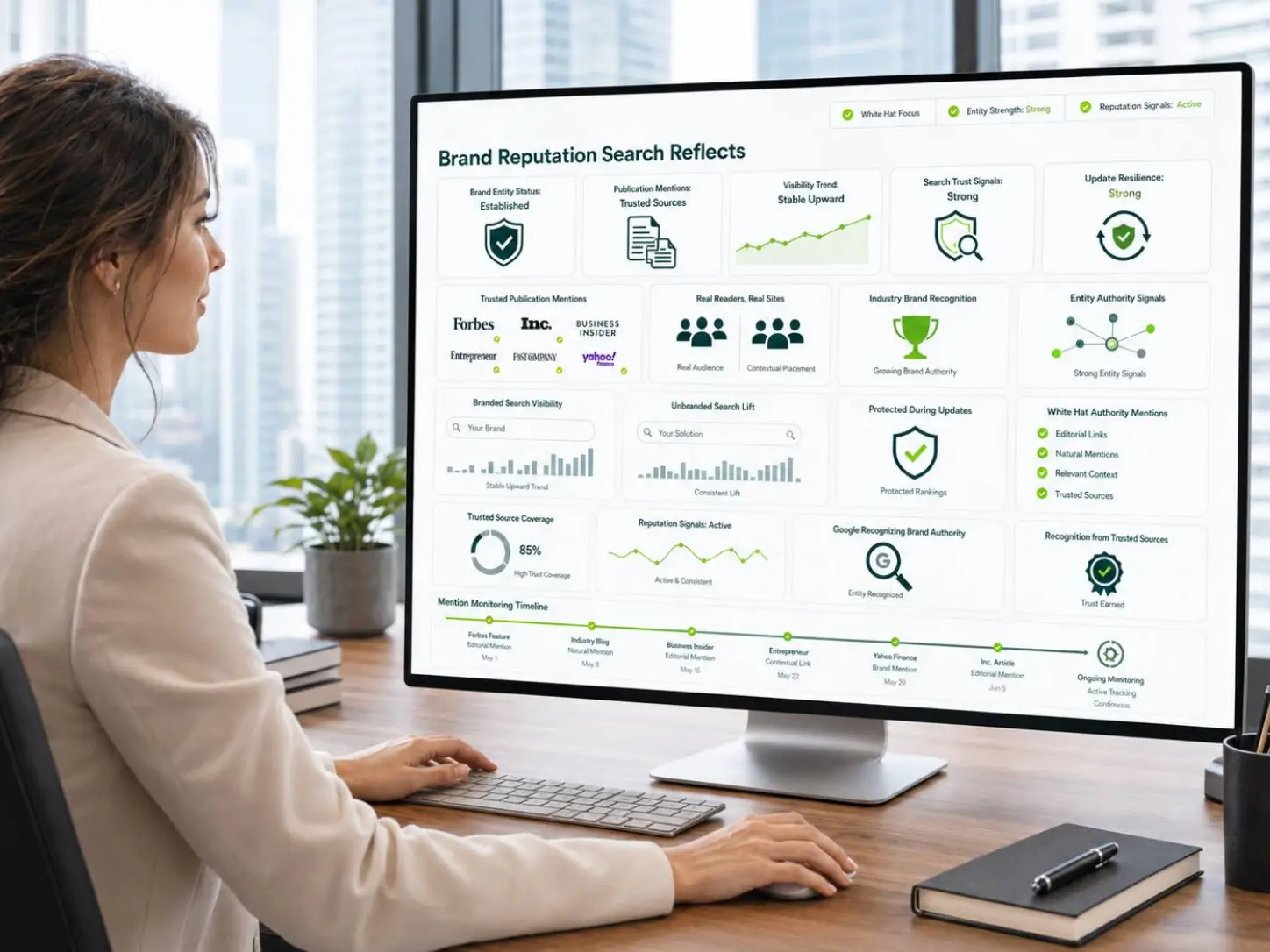
Brand Reputation Search Reflects
White hat placement appears in publications your audience already reads. Every link doubles as a brand mention in front of actual readers, building recognition along with SEO value.
Search engines pick up signals. When your brand is consistently mentioned by trusted sources in your industry, Google starts recognizing it as an established entity. That entity status protects rankings during updates and boosts visibility for both branded and unbranded queries.
This is the return of white hat work. Real readers see your brand on real sites, and Google sees the same authority signals at the same time.
Client Success Stories
What Clients Say About Our
White Hat Link Building
Reviews from leaders who gained lasting authority through safe, editorial link building.

4.8/5 

5/5 
Rating on Google



We gained a manual penalty from a previous agency. The audit was thorough, the cleanup was ethical, and the new white hat campaign brought our rankings back stronger than before the penalty.

VP Marketing
Healthcare

Every placement came with a complete editorial backstory. We could see the publication, the editors, the topic angle, and the placement negotiation. The transparency is what kept us with them through three contract renewals.
Head of SEO
B2B SaaS

We‘ve been through four core updates since starting with Outreach Desk. Every single update has either held our rankings steady or moved them up. That stability is what white hat actually delivers.
Marketing Director
Financial Services
Service Framework
Investment, Timeline, and
Deliverables
Every white hat link building campaign is tailored to your industry, competitive landscape, and growth goals. Here’s what shapes your investment:

Number of links Per Month
Most campaigns run between 8 and 30 editorial placements monthly.

Target Domain Rating Range
Placement on DR 40-60 sites costs less than placement on DR 70+ sites.

Content Requirements
Most placements require original content development, and existing assets need work to support new opportunities.

Campaign Duration
Most clients observe ranking movements in 3-4 months, with compounding gains over 6-12 months.
Directional pricing
Pricing and scope are shared as requested, tailored to your specific coverage needs, community mix, and growth goals. Custom proposals are available after an initial strategy call, outlining an approach built around your requirements, including community coverage, contribution approach, tracking, and a month-by-month roadmap aligned to your goals.
What You Get
See Every Placement, Every Editor,
Every Decision
Complete transparency on how each link was earned, where it lives,
and why it meets white hat standards.

Live Link URLs
You get direct access to every live placement with complete editorial context, so you can verify each link at any time.

Outreach Transparency
You can see how each placement was earned, including the publisher, editorial angle, and outreach approach.

Anchor & Target Mapping
You see the anchor text used for each placement and the destination page, with a complete review to avoid over-optimization.

Compliance Summary
You get a clear summary confirming that every placement meets white hat standards, with monthly health checks across the entire profile.
Our Approach
A Safety-First Approach that
Survives Every Update
You get links built on transparent editorial standards, rather than
shortcuts that put your domain at risk.
| Factor | Automated Link Services |
 |
|---|---|---|
| Outreach Method | Mass automation, marketplace listings, or pre-paid networks. |
100% manual outreach to real editors with personalized pitches tied to specific recent content. |
| Site Vetting | Filter by DR alone; sites often have purchased traffic or thin content. |
Manual quality check on traffic, audience, content, link profile, and editorial standards. Strict pass/fail. |
| Placement Type | Sponsored sections, footer links, sidebar widgets, or unrelated content blocks. |
In-body editorial placements only, inside content the publisher genuinely wanted to publish. |
| Risk Profile | Penalty risk on every update; rankings can collapse overnight. |
Zero exposure to known spam patterns. Built to survive every core and spam update. |
| Transparency | Limited reporting; the outreach process is hidden behind vague “we have relationships” language. |
Complete transparency on each placement, including publisher, editor, outreach angle, and approval process. |
Who We Help
Industries We Support With
White Hat Link Building
Regardless of your industry, including the most regulated and risk-sensitive
industry, you get links that meet the strictest editorial standards.











Technology &
Innovation

Consumer
Brands
Common Questions
Frequently Asked Questions
Clear answers on how local citations affect rankings,
and what to expect from a managed campaign.
Build Links That Don’t Put
Your Site at Risk
Your strategist will audit your profile, plan your campaigns,
and earn links that survive every update.
4.8/5
Trusted by agencies
and brands worldwide.