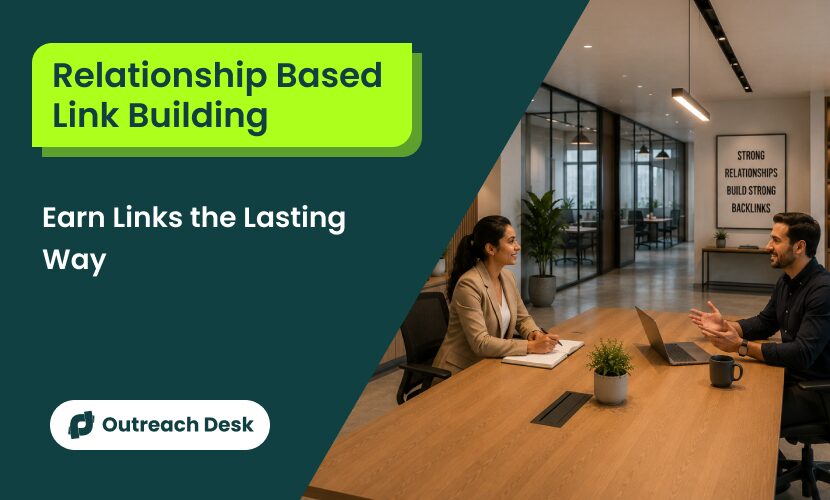
You keep hearing the same advice. Real links come from relationships, not from cold templates.
Relationship-based link building starts before any pitch goes out. You become a recognizable, useful person in your niche first. The link comes later, as one moment in a longer conversation, not as the whole point of the contact.
It’s not link exchanges. It’s not vague networking. It’s a sequence with stages, behaviors, and a 30-day starting plan you can run with zero existing contacts.
The Short Version
- Relationships are the layer beneath every other link tactic; links are the outcome of real connections.
- Warm pitches outperform cold templates because templates with merge fields aren’t personalization; they’re mail merge.
- Publisher relationships move through four stages: Cold, Warm, Active, and Compounding.
- The hardest part isn’t the first link. It’s the 60- to 90-day silence after it that kills most relationships.
- 3 to 5 hours a week and a 30-day starter plan get you a working pipeline from zero contacts.
- Real results show up in months 3 to 6, with compounding payoff at month 12 and beyond.
What Relationship-Based Link Building Really Is (and What It Isn’t)
Relationship-based link building earns backlinks by building real working ties with publishers, editors, and creators in your niche before you need anything from them.
When you have something worth linking to, the email gets read. The link is the outcome. The relationship is the work.

This is what relationship-based link building looks like in practice.
Instead of reaching out to strangers only when you need a backlink, you build real relationships with publishers, editors, and creators before you ask for anything.
You share useful resources, stay in touch, and become someone they recognize and trust.
So when you finally have something worth linking to, the conversation feels natural. You do not need a hard pitch, endless follow-ups, or fake personalization.
The person already knows you, understands your value, and is more open to including you as a resource.
The link becomes the outcome. The relationship is what makes it possible.
What It Isn’t
It isn’t a link exchange. Exchanges barter links between two sites. Relationship-based link building doesn’t trade links; it earns them on their own merit.
It isn’t generic networking. You’re not collecting LinkedIn connections or showing up on every podcast going. You’re building specific working ties with the small set of people whose audiences overlap with yours.
It isn’t passive content marketing. Content earns links through search and shares. This earns them through direct, named human contact. One waits. The other works.
The shortest version: it’s the difference between asking a stranger for a favor and asking a colleague.
The Math: Why Warm Pitches Outperform Cold Templates
Warm pitches outperform cold templates because editors process them differently. A cold pitch lands as one of forty in the inbox that morning, all sounding the same.
A warm pitch lands as a message from someone the editor recognizes, often someone whose work they’ve already seen.

The data reflects this. BuzzStream’s 12,000-campaign study tracked only emails sent with merge-field templates. Those are the templates that just slot in someone’s first name and company.
The average reply rate: 16%. Add personalization that actually references the recipient’s recent work, and that rate climbs by 10.7% points. Reference a shared past moment or earlier promotion, and it climbs another 2.3.
Read that gap again. Merge-field templates aren’t personalization. They’re mail merges dressed up to look personal, and editors know the difference within about two seconds.
The lift gets bigger the longer the relationship has been growing. By the time you reach the Active stage (more on those in a moment), reply rates change.
The publishers you’ve been quietly building with stop hovering near average. They start landing well into the majority territory. At that point, you aren’t pitching anymore; you’re following up on a conversation that already started.
The Four Stages of a Publisher Relationship
Every publisher relationship moves through four stages: Cold, Warm, Active, and Compounding. Knowing which stage you’re at with each person tells you exactly what to do next.

| Stage | What it means | What you do next |
|---|---|---|
| Cold | The publisher doesn’t know you exist | Become visible through substantive engagement with their work |
| Warm | The publisher recognizes your name from comments, shares, or mentions | Send a no-ask check-in; hold off on any link request |
| Active | A real exchange has happened (a reply, a link, a guest piece) | Maintain the relationship with monthly value-first touches |
| Compounding | Two or more links over time, with no formal arrangement | Stay in regular contact; the relationship runs itself |
How to Know What Stage You’re At
Check your last two touchpoints with a publisher. That reading gives you the stage.
- Cold means you’ve never had one.
- Warm means they engaged with your work but never replied to a direct message.
- Active means a real exchange happened: a reply, a link, a shared mention.
- Compounding means two or more links placed over several months.
Most pipelines run unevenly. 80 Cold, 12 Warm, 3 Active, 1 Compounding at any given time. That ratio holds.
Stages shift. Cold moves to Warm when they share your content. Warm moves to Active when they reply. Know each publisher’s stage before running your outreach . Pitch the wrong stage, and you burn the relationship before it starts.
Where the People Who Will Eventually Link to You Actually Are
The people who will eventually link to you hang out in five places. Niche Slack communities, LinkedIn, niche Discord servers, conference networks, and the comment sections of publications you want links from.
Niche Slack Communities
Small invite-only or paid Slack groups in your niche are where editors, founders, and operators talk shop without a wider audience watching.
The conversation is candid, the names are real, and recognition there matters more than any LinkedIn follower count.
Most niches have one or two well-known communities; ask three peers in your space, and they’ll name the same ones.

LinkedIn has quietly become the channel where most B2B (business-to-business) editors and founders are actually responsive.

A comment that adds something to their post is read; a direct message that references it is opened. Older advice points to Twitter first; in 2026, for most B2B niches, LinkedIn earns the higher reply rate.
Niche Discord Servers
For developer, creator, gaming, and consumer-tech niches, the most active conversations have moved to Discord. The pattern is the same as Slack: show up, contribute, get known, no pitching.

The Comment Sections of the Publications You Want Links From
If you want a link from a specific publication, start by becoming a familiar voice underneath their articles. Substantive comments (a follow-up data point, a real disagreement, a useful link) get noticed by the writers who wrote those pieces. They’ll click your name. They’ll see what you do. Your first email won’t be cold.
Conference Networks
Industry conferences, in person or virtual, create dense weeks. You can meet six relevant people in a day instead of six in three months. Cold becomes Warm faster in person than anywhere online. If your budget allows one conference a year, the relationships you start there will compound for several years after.
How to Know If a Venue Is Worth Your Time
A venue is worth your time if the specific publishers you want to reach are actually there and actually active. Three weekly visits over a month tell you.
If you don’t see the people you’re trying to build with, leave that venue and try the next one. There’s no prize for joining six communities you never speak in.
You can find venue discovery shortcuts in the best roundup of link building tools. But most of the work is just paying attention to where the people you respect have begun to show up.
Becoming Someone an Editor Wants to Reply To
You become someone an editor wants to reply to by climbing what we at Outreach Desk call the Warmth Ladder.
It’s a four-rung sequence from invisible to trusted. The climb happens through consistent low-pressure behavior over weeks, not days.

Rung 1: Invisible
You’re invisible if the editor draws a blank at your name. Almost everyone you’d want a link from starts here, and that’s fine.
The work is to engage with their published work in a way that’s worth their reading. Substantive comments. A reply on LinkedIn that adds a useful data point. A share with one specific reason attached.
Two minutes of substance beats twenty minutes of empty engagement. “Great post!” buys you nothing. “This matches what we saw in [specific situation], with one twist: [specific twist]” gets read.
Rung 2: Recognized
You’re recognized when the editor’s eye snags on your name in a notification. They don’t know you, but they’ve seen you reply to their work thoughtfully more than once. Stay here for two to four weeks of consistent contact before doing anything else.
Rung 3: Familiar
You’ve reached Familiar when the editor opens a direct message from you, even if they can’t quote your title.
The bridge from Recognized to Familiar is usually a no-ask check-in. A short message that compliments a specific thing they published with a concrete reason, then ends. No request attached.
This is the move most people skip, and the one that separates relationship-based link building from cold outreach with friendly language.
Rung 4: Trusted
You’re trusted when the editor forwards your email to a colleague without checking with you first. You earned this by being useful to them once, twice, three times, without asking for anything. By the time you do ask, the ask reads as a small step in an existing pattern, not an interruption.
The Behaviors That Move You Up
One weekly habit does more relationship work than most people run in a month.
Comment with substance on two recent pieces a week. Share their work with one specific reason. Mention their work in something you publish; tag them when you share it. Send a no-ask check-in once a month if nothing else has happened naturally.
If you publish your own work, the strongest path up the ladder can shift. Make something so useful that the people you respect want to share it. That’s where assets that attract links on their own start to overlap with relationship building.
How to Ask For the First Link Without Breaking the Rapport
Ask for the first link only after three conditions are true:
- The editor recognizes your name.
- You have something genuinely useful to them.
- The link request fits naturally into a piece they’ve recently published or are about to publish.
If any of those three are missing, wait.
A premature ask resets the relationship, sometimes permanently.
What a Good First Ask Actually Contains
A good first ask has five parts in this order:
- A specific reference to something they published recently, in your own words.
- The reason you’re writing today, in one sentence.
- The thing you’re offering and why it fits their reader. Not your reader; their reader.
- A direct, no-hedging ask.
- A line that makes a “no” easy and signals you’re around regardless of the answer.
That’s the structure. Not a template. Templates flatten the variation that makes the email feel real. The structure is the spine; what you put on it changes every time.

The Follow-up That Doesn’t Burn the Relationship
One follow-up, sent seven to ten days after the original, is the standard cadence that works without crossing into nuisance territory.
A second follow-up goes out only if a new piece of value exists. That could be a fresh data point, a related publication of theirs, or a relevant industry moment.
Three or more is a relationship cost. The publisher remembers that you wouldn’t take the hint.
What Not To Do
Don’t send the ask the same day you sent the no-ask check-in. The pivot is too obvious.
Don’t attach the link request to a piece of theirs you haven’t actually read. They’ll know within one sentence.
Drop this line entirely: “I noticed your article ranks for [keyword] and thought you might want to update it with my piece.” That sentence has appeared in every spammy outreach email for the past 10 years. Editors filter it as background noise.
For the email mechanics beneath all of this, the link building outreach that earns replies guides the entire pitch process. It applies to both cold and warm contexts.
The Second-Link Gap: What Happens After the First Link Is Placed
After the first link is placed, most people send a thank-you, then go silent for three months. That silence is what we call the second-link gap, and it’s where most publisher relationships quietly die.
The math is brutal. Publishers contacted only after the first link is live almost never place a second one.
Publishers who get value from you within 60 days of the first link tend to place more, sometimes four or five over the following year.
What “Value Within 60 Days” Actually Looks Like
Value within 60 days isn’t another favor request. It’s the opposite. It’s a small, specific, low-effort thing you do for them that has nothing to do with your next ask.
A few examples of the right shape.
You see a piece of news in their beat that they might not have caught. You send them the link with a one-line note.
You read their newest piece and reply on the platform where they posted it. Bring the same care you did to your earliest comments.
You introduce them to someone in your network who’d be a useful source for an interview.
You tag them in something you publish that builds on their idea.
None of these is asking. All of them are sending. The cadence is one of these every three to four weeks, indefinitely, for as long as the relationship is alive.
What The Compounding Stage Looks Like
A Compounding relationship looks like this. Link two arrives because they linked to you in a new piece without you asking. Or because a casual mention in a check-in turned into a real conversation.
Link three arrives because they reached out to you with a question. By link four, you’re on their short list of people they know in this space. Link placements start happening as a side effect of the work you’re already doing together.
The first link is a milestone. The second link is the win. The fifth link is the relationship paying for itself.
Why Most Relationships Never Reach This Stage
Most relationships never reach the Compounding stage because the moment after the first link is the moment most people stop working.
The reasoning sounds rational at the time. You got what you came for. You don’t want to seem clingy. You’re busy with the next campaign.
Every one of those reasons is exactly why cold outreach has the reply rate it does. You’re treating the publisher as a transaction, even though you swore you wouldn’t.
This is why structured link building campaigns include a maintenance cadence built into the post-placement timeline, not bolted on after the fact.
Without that cadence in place, even the publishers who would happily place a second link never get the chance. Nobody stays in touch long enough to make it easy.
A 30-Day Starter System If You Are Beginning from Zero
A working 30-day starter system breaks into four weeks. It takes about three to five hours a week. By the end, you have two or three publishers who recognize your name and one early conversation already in motion.

The honest part first. Three to five hours a week is real time, not “30 minutes a day” marketing copy. If you can’t commit to it for four weeks in a row, the rest of this section won’t help.
Week 1: Audit and Identify
The first week is research, not outreach.
List the ten publications, blogs, or creators whose audience is closest to yours. Not the biggest in your space. The closest.
For each, find the specific person who decides what gets published or linked. That’s an editor, a content lead, a founder, or sometimes a single staff writer. Find their name, their main social channel, and the last three things they published.
By the end of week one, you have a one-page document. Ten names, ten channels, and thirty pieces of recent work to draw from.
Week 2: Become Visible
This week, you start showing up where they are.
Comment with substance on at least two of their recent pieces. Share two of their pieces with a specific reason attached. Join one community (a Slack, a Discord, or a private LinkedIn space) where at least two are active.
Don’t message anyone yet. The goal this week is for your name to appear in their notification feed three to five times each. Attached to a useful thought every time.
Week 3: Become Recognized
This week, the engagement starts to compound.
Reply directly to one of their posts with a follow-up question or a small data point. Mention one of them in something you publish; tag them when you share it. Keep commenting and sharing for the others.
By the end of week three, at least three of the ten should recognize your name on sight. Some will have replied to your comments. One or two might have followed you back.
Week 4: The First Real Conversation
This is the week the first direct message goes out.
Pick the single person where the recognition is strongest. Send a no-ask check-in. Reference a specific thing they published, why it stuck with you, and one related observation of your own. Sign off without asking for anything.
If they reply, you’ve crossed from Warm into early Active. If they don’t, leave a respectful 14-day window before any further direct contact and keep doing the visible work.
What Month Two Looks Like
Month two scales what worked in month one. You expand the prospect list to twenty. You keep the same weekly rhythm. You start running the no-ask check-in on the second-strongest recognition.
The first real ask shouldn’t go out until at least one publisher has reached Active status. For most people, that happens between weeks six and ten.
For the broader menu of paths to earned links, see proven link acquisition strategies. Relationship-based link building is one of the more durable ones. It isn’t the only one.
When Relationship Link Building Stops Working (The Mistakes That Kill It)
Relationship link building stops working in four predictable ways, and each one is a behavior you could fix in a week if you notice it.
Pretending to Be Interested
Editors can tell when you’ve read their work and when you’ve skimmed it. The check-in that references a piece’s title and adds one generic sentence about its quality comes off as obvious.
The check-in that picks up a specific phrase, idea, or data point from the third paragraph lands as real. If you can’t find a third-paragraph specific in their work, you haven’t read it yet, and you’re not ready to write to them.
Treating One Platform as the Whole Game
LinkedIn is not your relationship strategy. Slack is not your relationship strategy. A relationship lives across the surfaces where the publisher actually works, and editors notice when you only show up in one place.
Visibility that lives entirely in LinkedIn comments and nowhere on their actual publication leaves your name carrying less weight than you think.
Going Silent After the Link
This is the second-link gap from earlier. It deserves naming twice. Silence after the first placement is the single most common reason relationship link building “stops working” for a given practitioner. It didn’t stop working. The practitioner stopped doing it.
Scaling Before You Have a Working Motion
The temptation, once one or two relationships start producing, is to triple the prospect list and run the same playbook at three times the volume. The motion almost always breaks.
The number of relationships any one person can credibly maintain at the Active or Compounding stage tops out between fifteen and thirty. Past that, the messages start sounding generic again, and the publishers feel it.
If you want more, build a team or buy back time by handing the mechanics to a partner. Don’t try to fake care at volume.
Start This Week With One Comment
Open the list of ten publications whose audience is closest to yours.
Pick the one editor you respect most and read their last three pieces, all the way through. Then leave one comment on the most recent one that adds something to it.
That’s the entire first move. Everything in this guide builds on it.
If you’d rather hand the lifecycle to a team, our blogger outreach work does this on retainer. We run it for clients full-time.
Turn Cold Outreach Into Lasting Connections
If you want your backlinks to come naturally from publishers who know and trust you, take action today.
How long does relationship-based link building take to show results?
The first early signs (a reply, a willing conversation, an unprompted share) usually happen between weeks four and eight. The first link from a Warm or Active relationship typically lands between months three and six.
Compounding relationships, where the same publisher places multiple links over time, show up around month twelve and continue indefinitely after that.
Where do I start if I have zero existing network in my niche?
Start with the 30-day starter system in this article, then keep going. Most beginners who feel they have “no network” actually mean they have no publishers who know them yet. That’s a fixable problem inside one quarter of consistent work.
Do I need outreach tools to do this?
You don’t need them in the first three months. A spreadsheet, your email, and the platforms where your target publishers actually post are enough to manage twenty to thirty relationships. Tools earn their cost once you’ve outgrown manual tracking, not before.. Once you reach that point, an experienced link building specialist can run the relationship tracking and outreach systematically rather than you managing it solo.
How is this different from link exchanges or “I’ll link to you if you link to me”?
Link exchanges are barter; relationship-based link building doesn’t trade. A link exchange creates two links of a weaker editorial signal because Google can often see the pattern. The link also goes away the moment the other party loses interest. A link from a real relationship survives the relationship’s pauses. It carries the full weight Google extends to genuinely earned editorial placements.
What do I do if someone agrees to link to me, then goes silent?
Send one polite check-in seven to ten days after they agreed. Attach a small new piece of value: a fresh statistic, a related news link, or a heads-up about a publication of theirs you noticed. If no reply within another week, drop it for sixty days and keep doing the visible work. People go silent for reasons that have nothing to do with you, and patience often recovers the placement when chasing wouldn’t.
Does AI search change relationship-based link building?
It makes the work more valuable, not less. Editorial links from publishers who already trust you are the exact citations AI search models lean on when surfacing answers. The relationships that earn you links also earn you brand mentions and editorial co-signs. AI assistants now weigh those in their responses. The relationship work compounds in two places at once now instead of one.
Can I do relationship-based link building if I work in a tiny niche?
Tiny niches are easier, not harder. The total number of people you’d ever want a link from is probably fewer than fifty. The community is denser. Recognition compounds faster because the same names show up in every conversation. The 30-day starter system in this article works the same way in a niche of fifty publishers. It works just as well at five thousand.