Content marketing return on investment (ROI) is the revenue you get for every dollar you invest in content channels. It includes email marketing, search engines, social media, and video-based content. Most teams sound confident about their content marketing ROI, but only a few can present concrete evidence.
You’ve probably seen the “$3 to $7 back for every $1 spent” figure that traces back to one study. But is it possible for everyone? The answer is that ROI depends on your channel mix, patience, and whether you calculate your own number instead of borrowing someone else’s.
What You’ll Learn
- Why popular content marketing ROI statistics often lack reliable evidence.
- Which content channels generate returns and how long they take.
- Why many marketers struggle to connect content with revenue outcomes.
- How to calculate your own content ROI before spending more.
- How AI changes content costs without guaranteeing better results.
- Why earned links help content create long-term compounding value.
Does content marketing actually pay off?
Yes, content marketing pays off well, but only if you run it well.
Most articles mention specific numbers but fail to prove them. According to Demand Metric, content marketing helps you win 3x more leads at 60% lower cost than the traditional paid search channel.
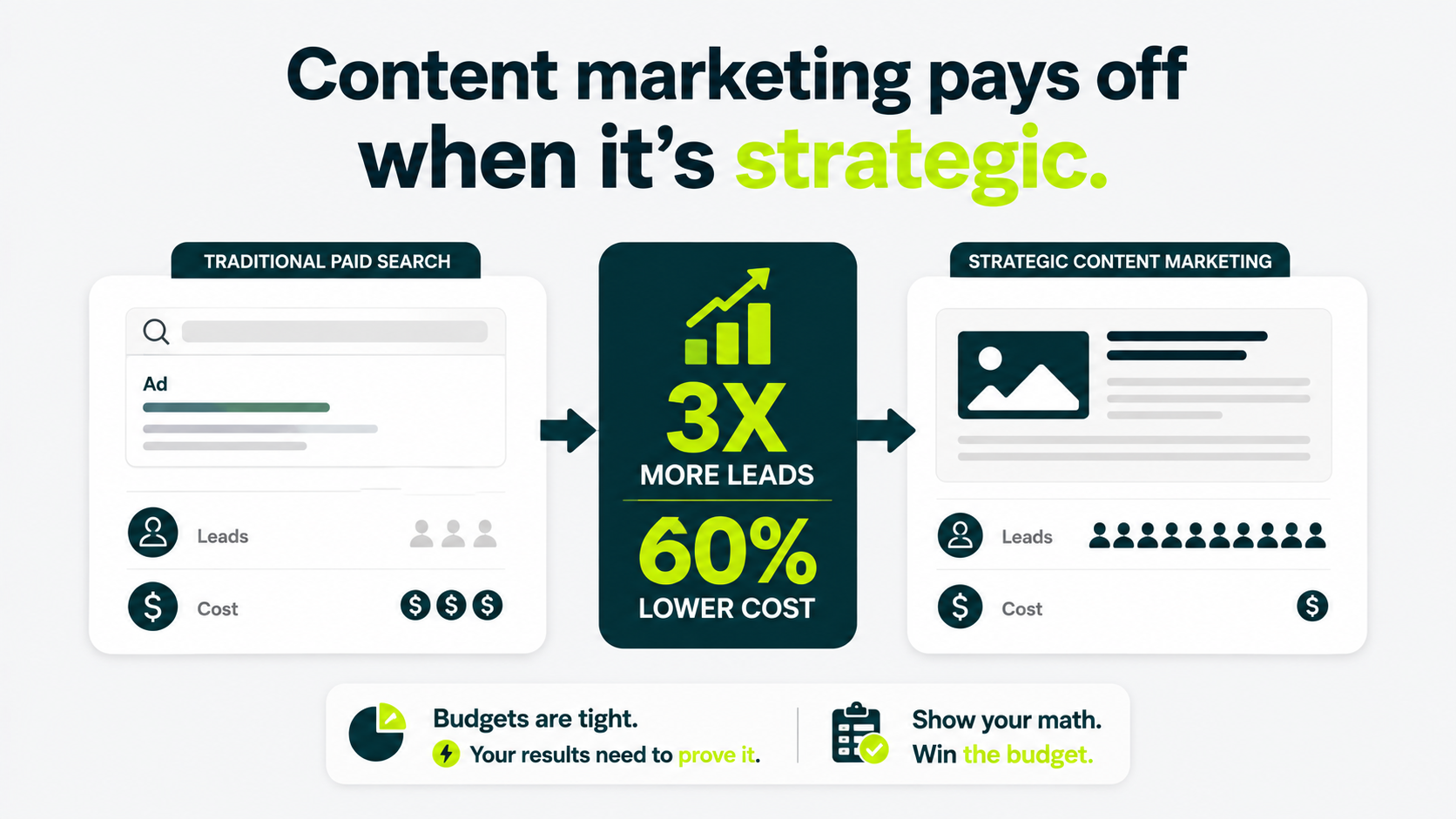
The same is true for most of the bigger, more dramatic ROI percentages you’ll find in a quick search. They sound confident, but few sources properly support them.
Does that mean content marketing fails to pay off?
Not really. It means the proof most marketers point to isn’t that strong.
Gartner’s 2026 CMO spend survey, which polls Chief Marketing Officers (CMOs) at large companies, found that marketing budgets are barely moving.
They sit at 7.8% of company revenue in 2026, up from just 7.7% in 2025. (You can see this in the graph below).
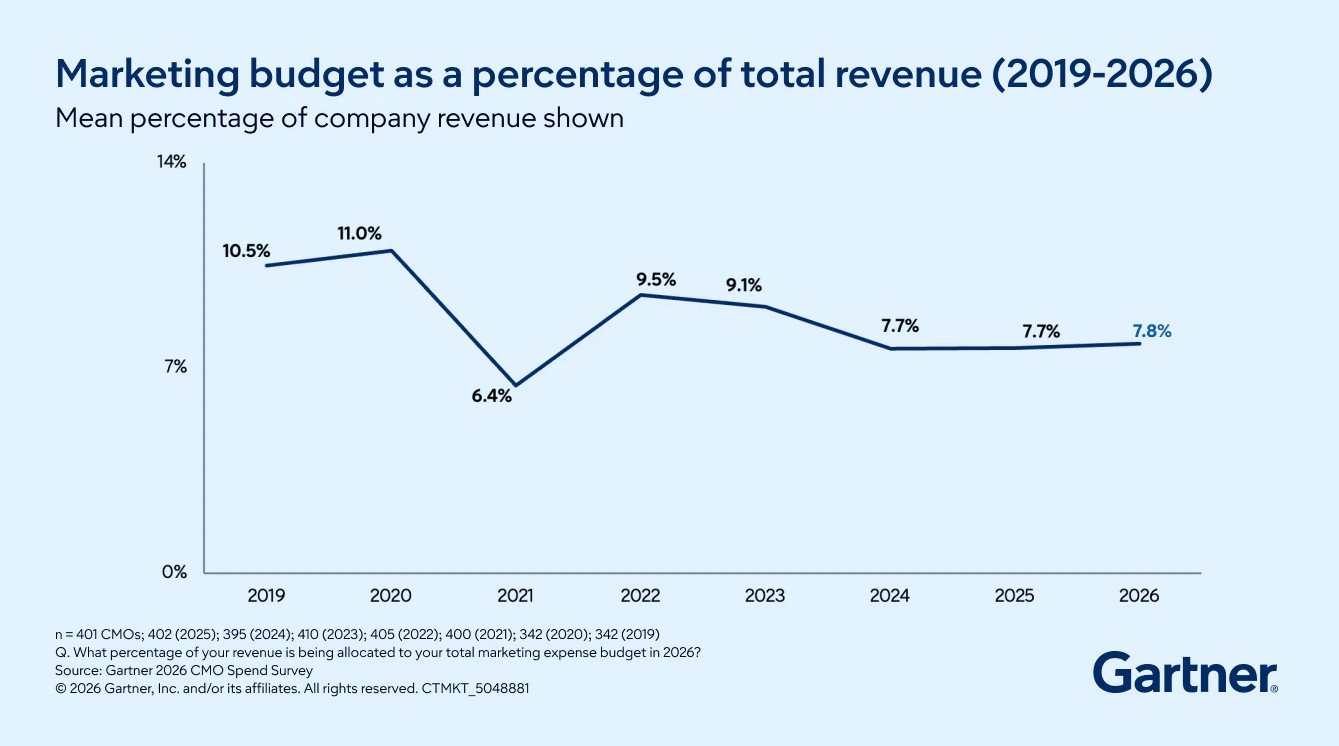
That squeeze is exactly why your own number matters more than someone else’s stat.
Companies allocate budgets to marketers who can show their own math, not to those who cite the biggest figures. And that math looks different for every channel.
ROI by Channel: Where Content Actually Returns the Most
There are mainly 4 content marketing ROI channels: email marketing, SEO, video-based content, and social media. They all have different ROI patterns and take time to compound.
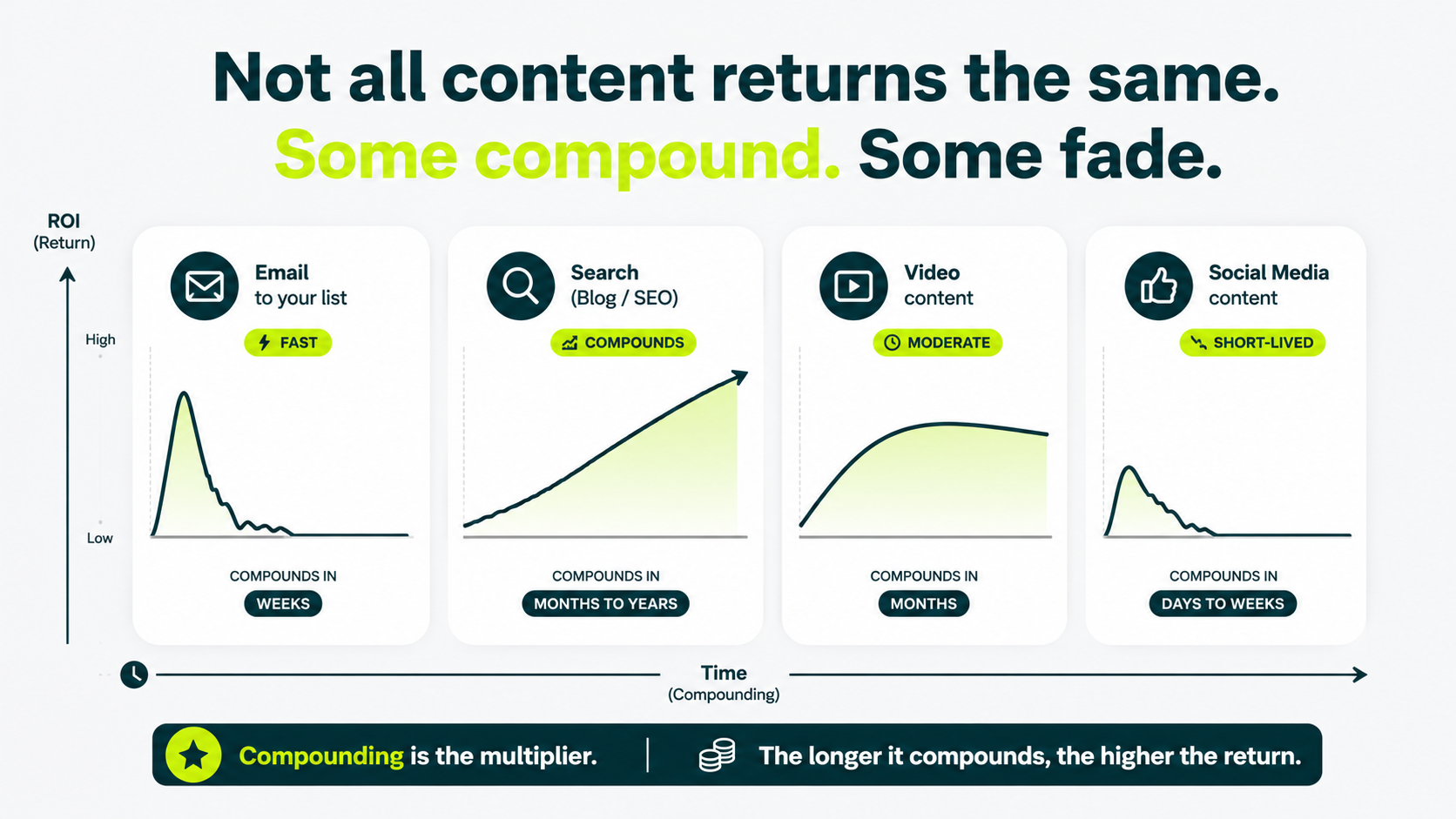
Every content channel returns differently, and grouping them into one average return hides the decision you’re actually trying to make.
| CHANNEL | SPEED & VISIBILITY PATTERN | TIME TO COMPOUND |
|---|---|---|
| Email marketing | Fast, direct, and easiest to trace back to revenue | Weeks |
| Search engine optimization | Slower to start, but keeps returning without new spend | Months to years |
| Video-based content | Builds trust quickly, harder to trace straight to revenue | Months |
| Social media content | Cheap to produce, but the return fades fast without paid boosting | Days to weeks |
HubSpot’s research reflects similar patterns across these channels.
- Email converts people who already know you.
- Search-driven content compounds, because a page that ranks well keeps returning traffic long after you hit publish.
- Video often helps businesses build trust faster because it combines visuals, voice, and demonstrations.
- Social media content moves fast and fades just as fast.
If you’re deciding where to put your first dollar, compounding property is the one to weigh most heavily.
What is compounding property?
Compounding property means content that keeps earning after you stop spending on it.
Some content keeps paying you even if you don’t push it further. Some content stops the day you stop paying for it. That’s the whole difference.
A blog post that’s still ranking in year two is returning the investment you made. And an email is finished the moment the campaign closes.
Does content marketing ROI look different for B2B?
Yes. B2B content takes longer to return, but the return per lead is higher.
B2C content marketing moves fast. A blog post or a product page can drive a purchase the same day. Volume matters more than depth, because the buying decision is small and quick.
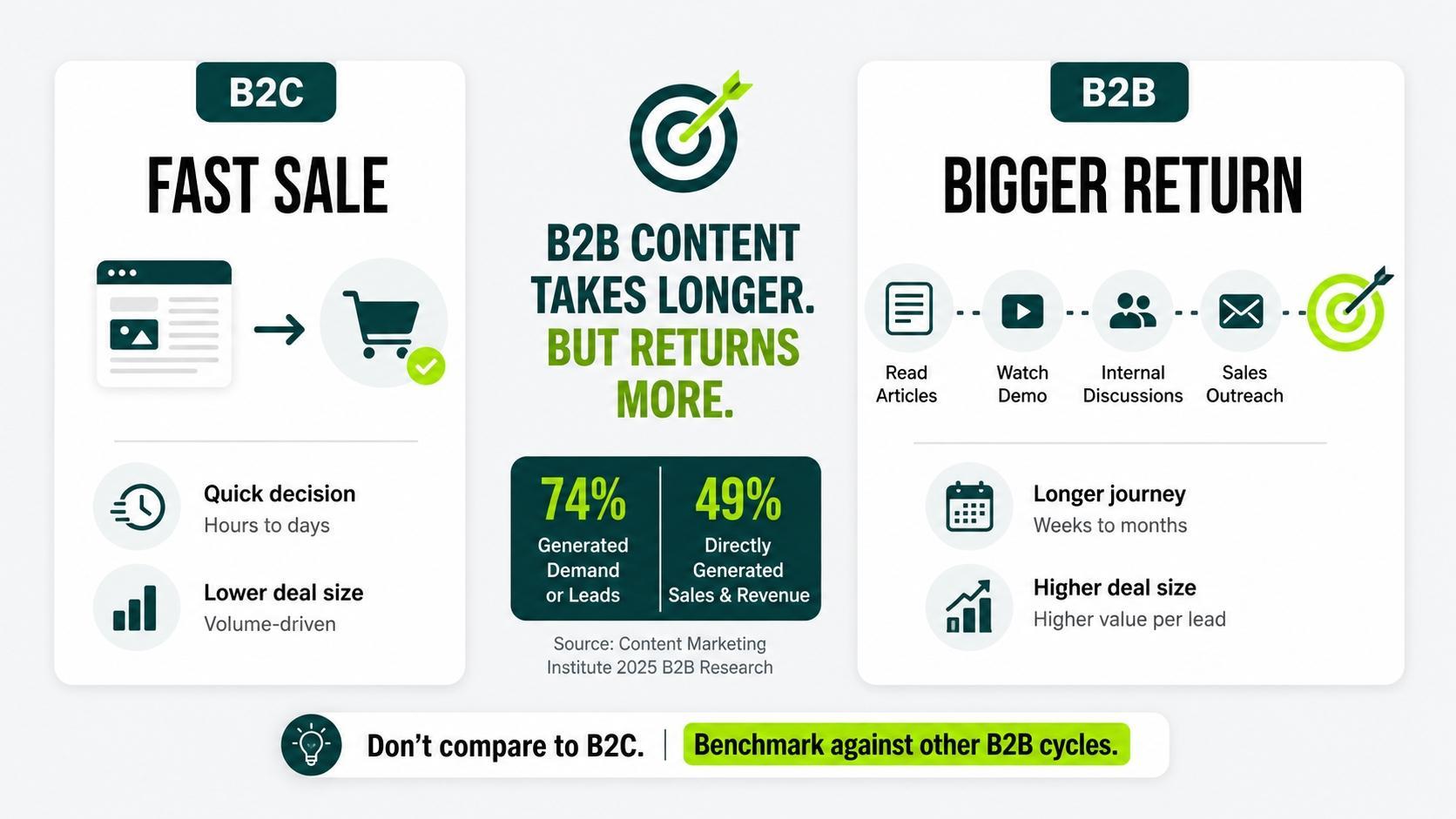
B2B content works on a longer clock. A single buyer might read six articles, watch a demo, and talk to three colleagues before anyone reaches out.
According to the Content Marketing Institute’s 2025 B2B research, 74% of B2B marketers say content marketing generated demand or leads. 49% say it directly generated sales and revenue in the past 12 months.
B2B returns arrive more slowly, and the deal size on the other end is usually much bigger.
If you’re comparing your content ROI to a B2C benchmark and wondering why your numbers look slow, that’s the reason. Compare your program to other B2B cycles, not to a retail funnel.
Content Marketing Costs Compared With Paid Ads
A lead from content costs less than a lead from paid ads, almost every time you measure it.
Once a page or a video goes live, it keeps generating leads without you paying per click again. A paid ad stops the moment you stop paying for it.
| FACTOR |
CONTENT |
PAID ADS |
|---|---|---|
| Cost per lead over time |
Drops as the page keeps ranking | Stays fixed, resets every click |
| Speed to first result |
Weeks to months | Same day |
| Life after spend stops |
Keeps producing leads | Stops immediately |
| Best use case |
Results you can wait for | Results you need this quarter |
Content that ranks well in organic search creates the biggest gap.
A well-targeted piece of content that keeps ranking can produce leads for years without major investment. Paid ads must be repurchased each time you want another lead.
That doesn’t make paid spending pointless. It’s faster when you need results this quarter, not next year.
Content is the cheaper option when you can afford to wait for it to compound. Paid is the faster option when you can’t.
The real constraint isn’t the cost per lead. It’s the time it takes to get there, which is the next thing worth being realistic about.
Why Many Marketers Struggle to Prove ROI
Most marketers can’t prove their content’s ROI because they’re tracking the wrong things at the wrong time, without a baseline to compare against.
The content tracking process often stops at traffic and clicks, while revenue happens elsewhere, often weeks or months later.
By the time a sales team closes a lead, nobody remembers which blog post or video started the relationship with that customer.
The Content Marketing Institute has surveyed marketers about this exact gap for years, and the findings barely move. Most say proving ROI is a top priority. Most also admit they can’t do it reliably.
This is a setup problem rather than a lack of skills. If nothing connects your content calendar to your revenue numbers, no amount of reporting effort fixes it after the fact.
How to tell if a stat is trustworthy before you repeat it?
Before you repeat any content marketing statistic in a budget meeting, check it against three things.
- Does the source name a sample size?
- Does it name a specific year?
- Does it provide an original study?
If a number fails any of these three tests, treat it as directional rather than provable.
A lot of the biggest content marketing ROI figures circulating right now fail this test. That doesn’t mean the underlying idea is wrong.
It means you shouldn’t stake your budget request on a number you can’t defend if someone asks where it came from.
How long before content marketing actually pays for itself?
Many SEO-driven content marketing programs show early returns between 6 and 12 months, and the return that justifies the budget usually lands after month 12.
Most content takes longer to pay off than the time companies allow, which is exactly why so many programs get cut right before they would have worked.
A realistic shape for that timeline looks like this:
Months 1 to 3
You publish content, and Google indexes it with little to no measurable return yet.
Months 3 to 6
Early traffic and a handful of leads start showing up, mostly from content that ranks quickly.
Months 6 to 12
The bulk of your published content starts to rank and compound, and lead volume becomes more predictable.
Past Month 12
Content published in year one keeps returning with no new spend, while you’re also publishing year two’s content on top of it.
The programs that quit around month 3 or 4 do so right before compounding starts. The ones that make it to month 12 are usually the ones who defend their budget with real numbers rather than promises.
Is AI changing the ROI math in 2026?
AI (artificial intelligence) tools have cut the cost of producing content, but they haven’t changed what earns authority.
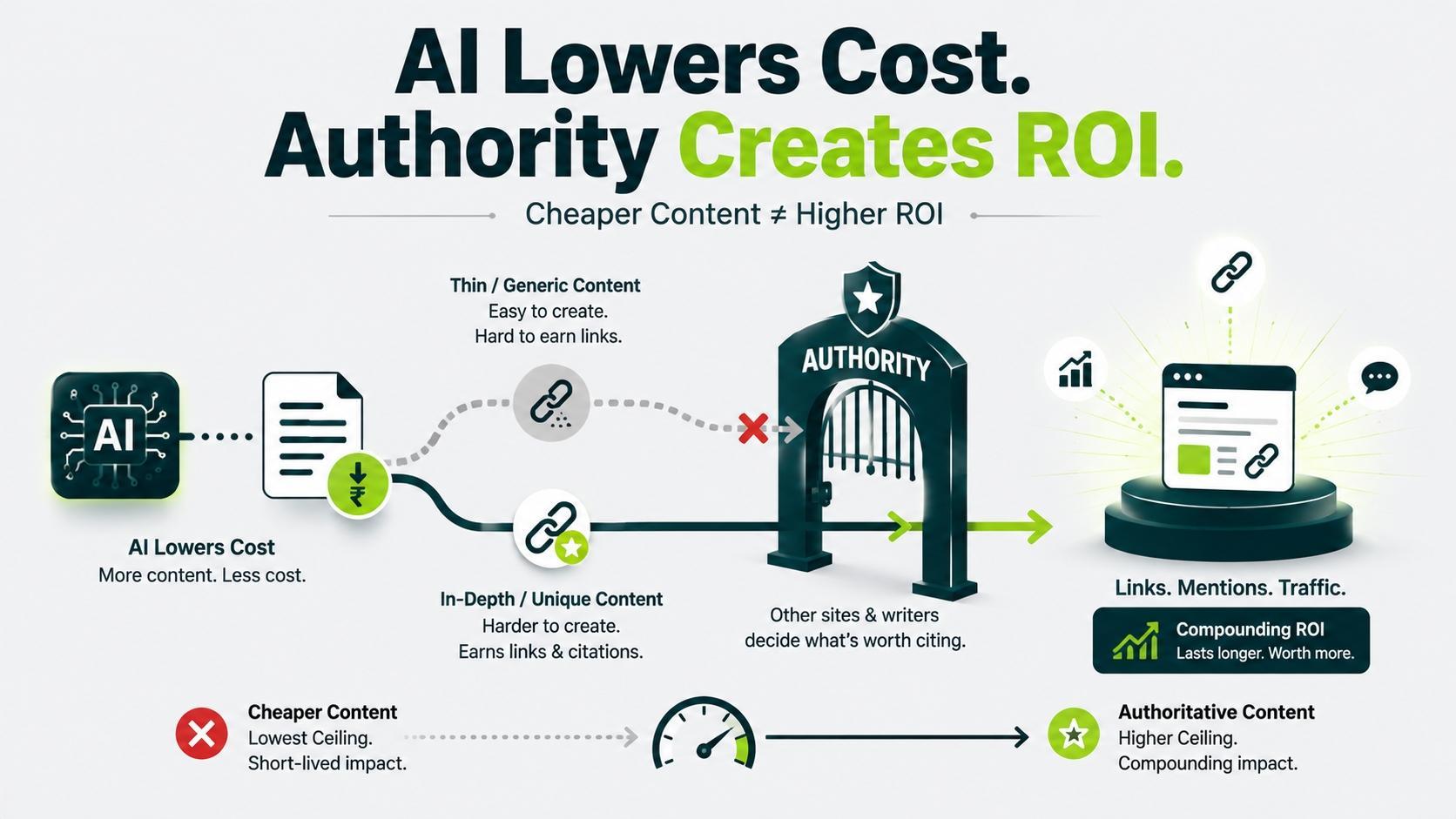
AI-generated content costs less to produce than content that a person writes and edits. If cost were the only variable in this equation, cheaper content would automatically mean higher ROI.
It doesn’t work that way. The return on content was never just about the cost to produce it. It depends on whether other sites and writers find it valuable enough to cite and link to. Thin content assembled quickly rarely clears that bar, no matter how cheap it was to produce.
AI’s actual effect on your numbers is narrower than it sounds. It lowers your cost per piece, which can look like better ROI on a spreadsheet. It does nothing to raise the ceiling on what that content can earn in authority and links, and that ceiling is where the real long-term return lives.
If nobody cites or discovers cheaper content, it won’t deliver higher ROI.
Calculate Your Own Content ROI Before You Commit Budget
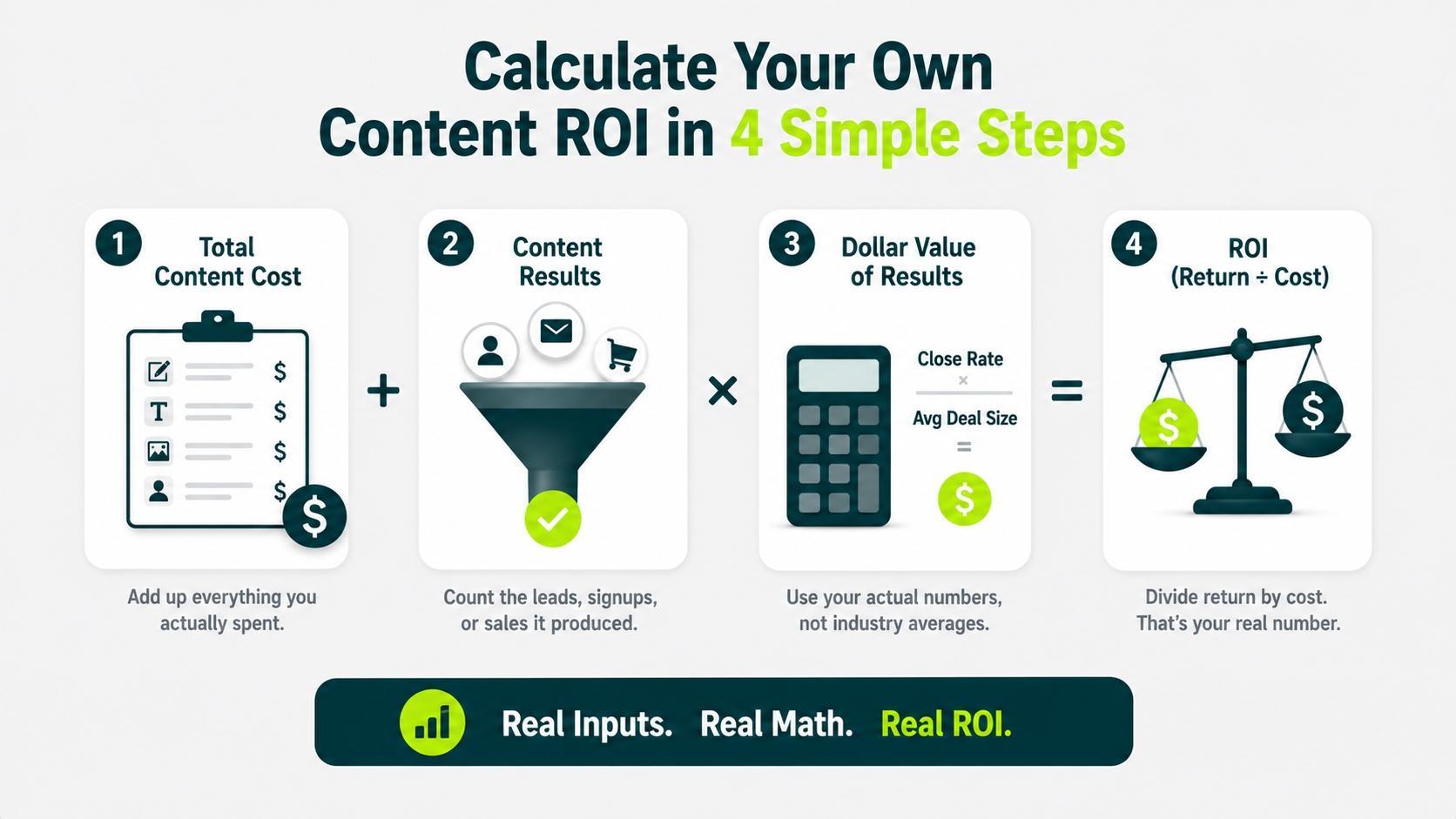
You don’t need complicated attribution software, the kind that tries to trace every sale back to the exact content that caused it. You need four inputs and about twenty minutes to get a directionally honest number.
- Add up what you actually spent: writing, editing, design, and the time of whoever manages it, priced at a real hourly rate.
- Count the leads, trial signups, or direct sales that your tracking system connects to that content.
- Turn those into a dollar figure, using your actual close rate and average deal size.
- Divide return by cost. That ratio is your real number, rather than a borrowed one.
The Content ROI Formula
ROI = (Return − Cost) ÷ Cost × 100
Spend $4,000 on a piece. It produces $12,000 in traceable revenue. Your return is 200%.
Note: Run this before the budget cycle starts.
Say you’re already tracking backlinks and want the same rough math applied specifically to link building. Outreach Desk’s ROI calculator applies the same logic to link investment rather than content spend.
Do this math before you commit next quarter’s budget, not after someone asks you to defend it. A business that can’t calculate its own content ROI isn’t ready to scale content spend yet, no matter how good the industry averages look.
The Real Reason Content ROI Compounds: Earned Links
Every number in this article so far describes a single window: a campaign, a quarter, a year. The reason some content keeps paying off long after that window closes is earned links.
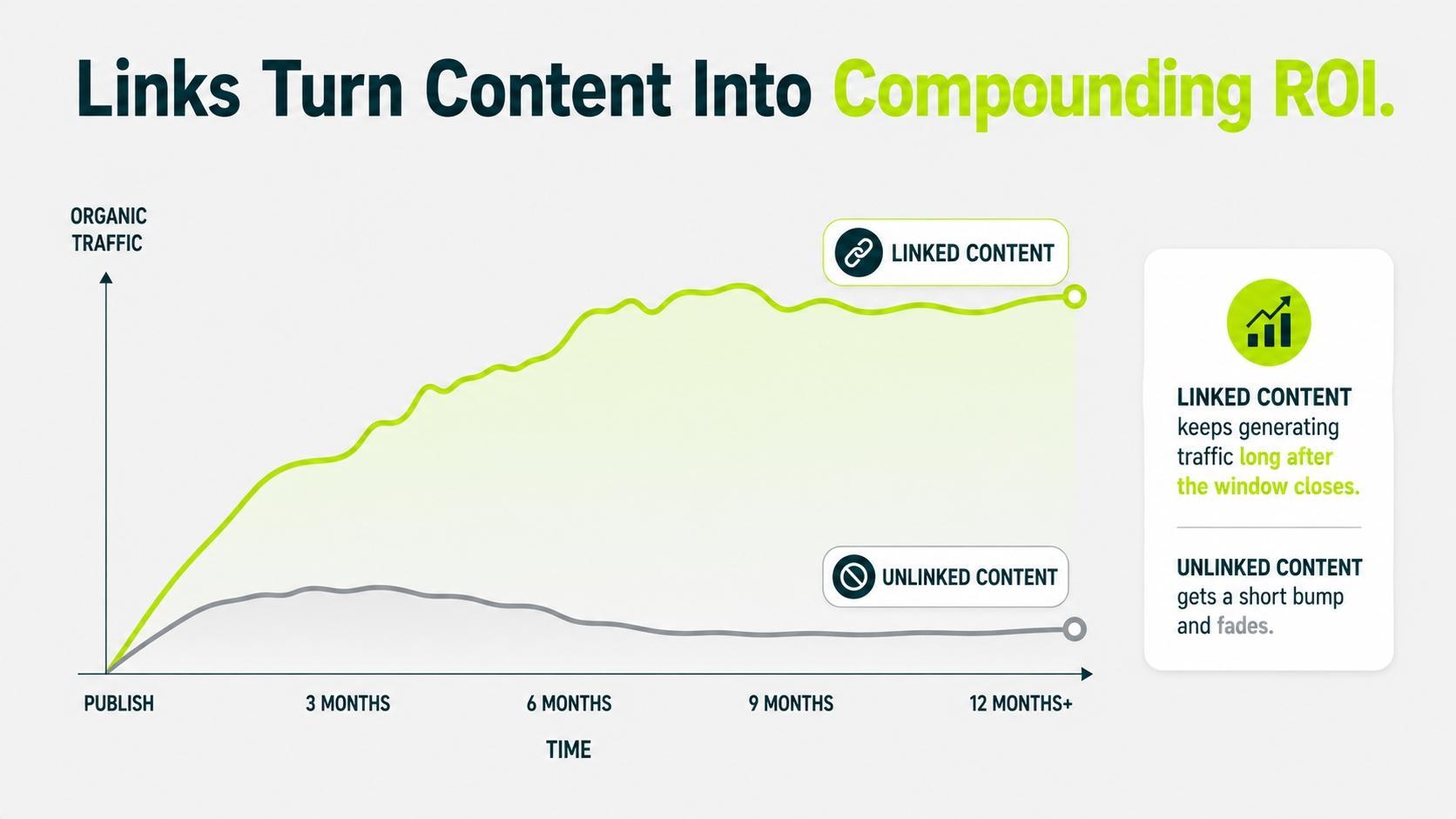
When another site links to your content because it’s genuinely useful, two things happen. Readers on that other site can click through and find you. And search engines use links as one of many signals when evaluating a page’s authority and relevance.
That second effect is the one most ROI conversations skip entirely. Traffic and leads are the return you can see in a dashboard right now. Earned links are the return that keeps compounding quietly, long after the content itself stops being new.
One pattern emerges consistently: content with earned links stays productive longer. Month eighteen, and it’s still working. Unlinked content stops working by month twelve.
Pages without links rarely rank, no matter how good the content is.
This is also why content built specifically to attract citations behaves differently from content built only to rank once.
The two can look identical sitting side by side in a content calendar, and perform completely differently eighteen months later. Backlinks are often one of the biggest reasons two similar pages perform differently over time, alongside content quality, search intent, and technical SEO.
If you want the fuller process for building that kind of content on purpose, content marketing that earns links covers it end to end. It walks through picking a topic likely to earn citations, all the way through the outreach that puts it in front of people who’ll actually link to it.
Is content marketing worth the effort?
Yes, if you’re willing to wait for it and be honest about measuring it.
The recycled multiples that show up in most searches won’t tell you that. Your own numbers will: what you’re spending, what it’s producing, and whether the content you publish is the kind that attracts links from other people.
Get those three things right, and content stops being a cost you hope pays off. It becomes the asset that keeps paying you back long after everything else you tried that quarter has stopped.
Want your content investment to keep paying off?
Build a link acquisition strategy that helps your best content earn trusted citations, increase visibility, and generate lasting returns.
Frequently Asked Questions
Which tools should I use to track content marketing ROI?
You can start with Google Analytics or HubSpot CRM tools that connect your website analytics to your revenue data. The tool matters less than whether it can trace a lead back to the specific page or video that produced it.
Most teams already own a tool capable of this and haven’t connected content publish dates to revenue reporting. Add a dedicated attribution tool only once you’ve outgrown that basic connection.
How long should I wait before judging the ROI of content marketing?
Give it 12 months before you call it a win or a failure. Most programs show early traffic by months 3 to 6. The return that justifies the spend appears after month 12, once ranked content starts compounding without extra spend. Companies that end programs at months 3 or 4 usually stop them right before they would have worked.
What are the most important content marketing metrics for executive reporting?
Three numbers matter more than the rest: what you spent, what it produced in pipeline or revenue, and how long it took to break even.
Traffic and social shares are useful for your own planning, but they rarely survive contact with a budget conversation. Lead with the money numbers and keep the rest as supporting context, and if you want help getting content to a point where it consistently produces those numbers, a quality focused link building approach is often what closes the gap between traffic and actual pipeline.
How do you calculate content marketing ROI with multi-touch attribution?
You don’t need multi-touch attribution to get a usable number, and most first-time content programs shouldn’t start there. A simpler first-touch or last-touch view, crediting whichever piece of content a buyer saw first or last before converting, gets you close enough to make a budget decision.
Multi-touch modeling is worth the investment later, once you have enough volume across enough channels for a single-touch view to start hiding real differences.
What content formats deliver the highest ROI for early-stage startups?
Search-driven blog content and case studies tend to lead for early-stage startups specifically because both continue to drive traffic long after publication without repeat spend. Video and social content build awareness faster, but usually need ongoing investment to keep performing. If budget is tight, the content that compounds without new spend is generally the safer first bet.