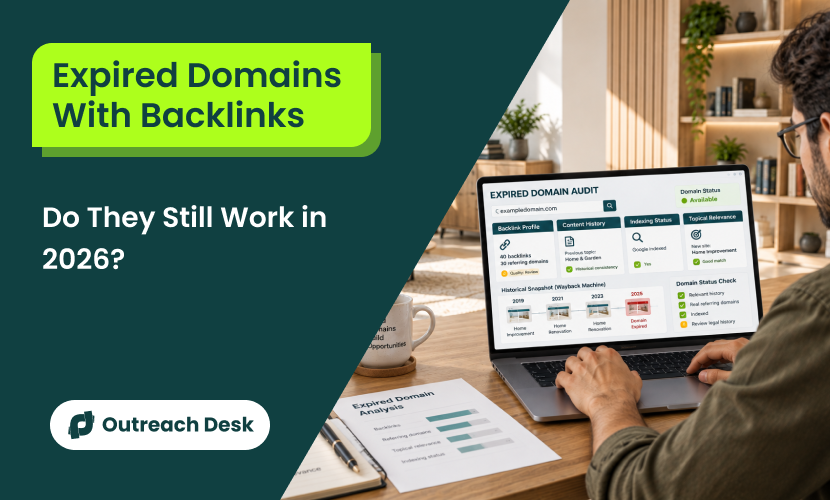
An expired domain with backlinks can give your new site’s SEO a running start, but its old content and backlinks should closely align with your new site’s topic.
Choose the wrong domain, and you may inherit a liability instead of real authority.
Choose a clean, expired domain with relevant, high-quality backlinks to give your site a stronger SEO foundation.
The difference between the two outcomes comes down to what you check before buying. The key is knowing how to check a domain’s history, backlink profile, and topical relevance before you buy it.
Key Takeaways
- Referring domains matter more than raw link count.
- Old content and backlinks must match your new topic.
- Check the Wayback Machine before trusting a domain’s history.
- Confirm indexing with a “site:domain.com” search first.
- Search “domain + trademark” to rule out legal disputes.
What “Expired Domains With Backlinks” Means
An expired domain is a domain whose registration lapsed because the previous owner didn’t renew it, making it available for someone else to buy. What makes them valuable is that other websites still link to them.
Every domain expires on a set date each year. If the owner doesn’t pay to renew it, the domain goes through a few stages before it becomes available to anyone else.
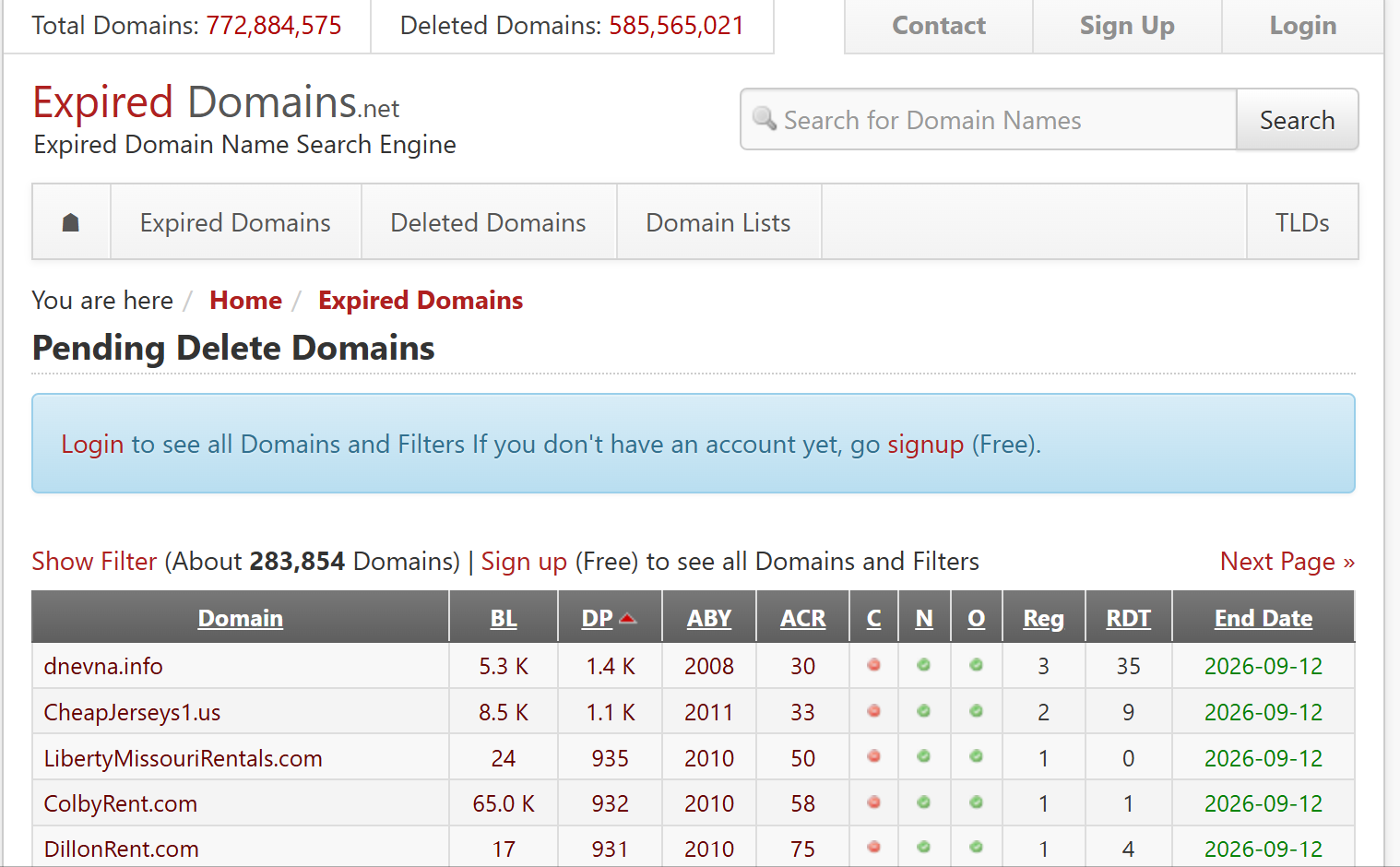
List of a few expired domains that you can check on expireddomain.net.
What Happens After a Domain with Backlinks Expires
After a domain’s registration expires, it passes through these four stages: grace period, redemption, pending delete, and drop. Each of these stages determines whether you can still renew or claim the domain.
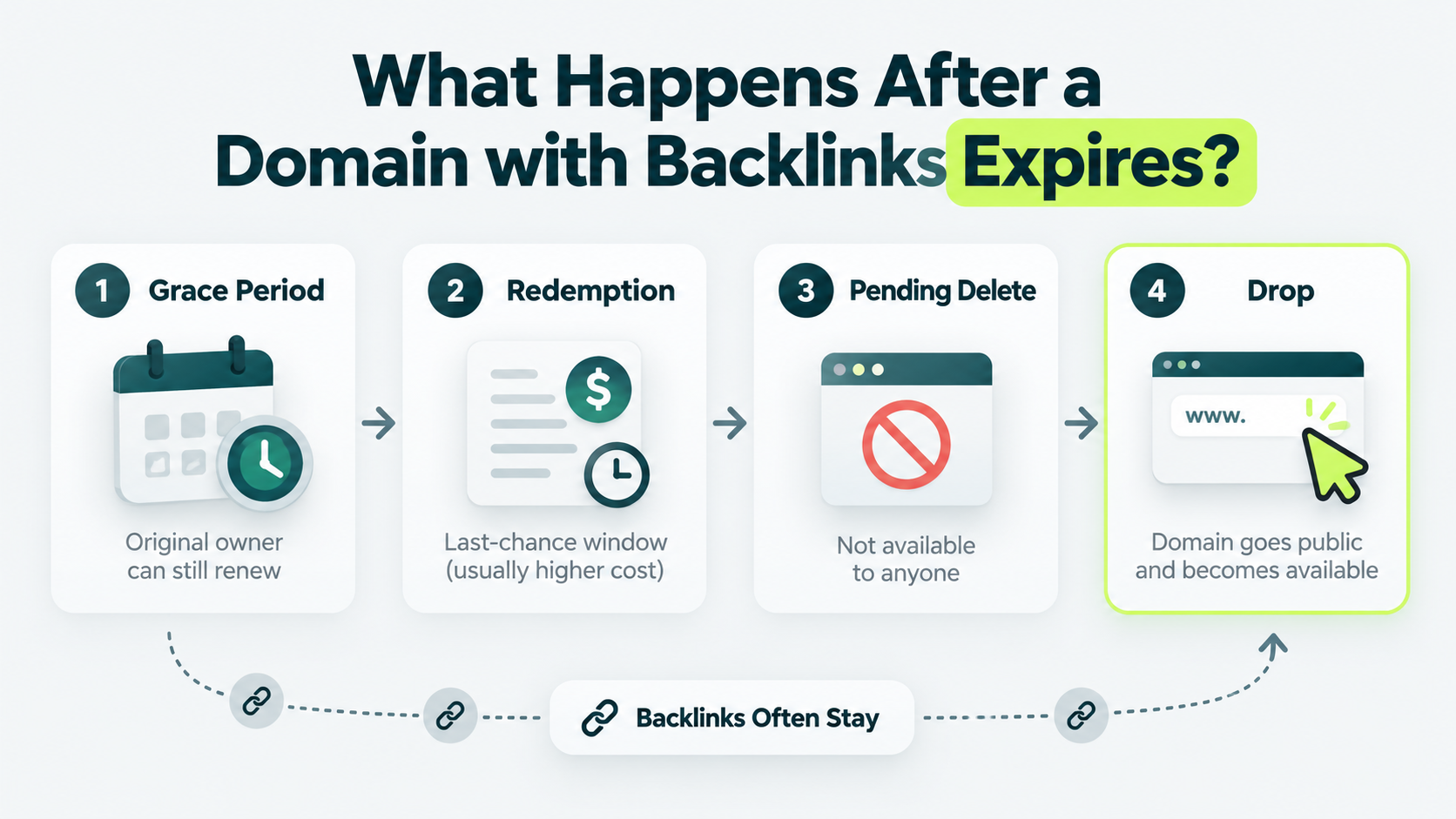
Grace Period
During this stage, even if your domain registration has expired, the original owner can still renew it before anyone else can buy it.
Redemption
Here, the original owner gets a longer, pricier last-chance window that is still reserved for them.
Pending Delete
This is the stage when there is a short window during which no one, not even the original owner, can register the domain.
Drop
The domain goes public and becomes available through auctions, backorder services, or direct registration.
Some of these domains still have backlinks pointing at them from their past, links to other sites added when the domain was active and worth linking to.
That’s the entire appeal.
Register or buy the domain after it drops, and those backlinks will still be there, pointing to whatever you put on the domain next.
Note
Not all expired domains are valuable; that’s why it’s important to analyze each domain’s backlink quality before you invest time and money.
The expired domains worth buying are the rare ones that earned real backlinks while active and were later abandoned for reasons unrelated to quality.
Businesses close and owners lose interest in good domains all the time.
How Much of a Domain’s Old Authority Actually Carries Over
Some of a domain’s old authority carries over the moment you point content at it, but the rest depends on what you do next.
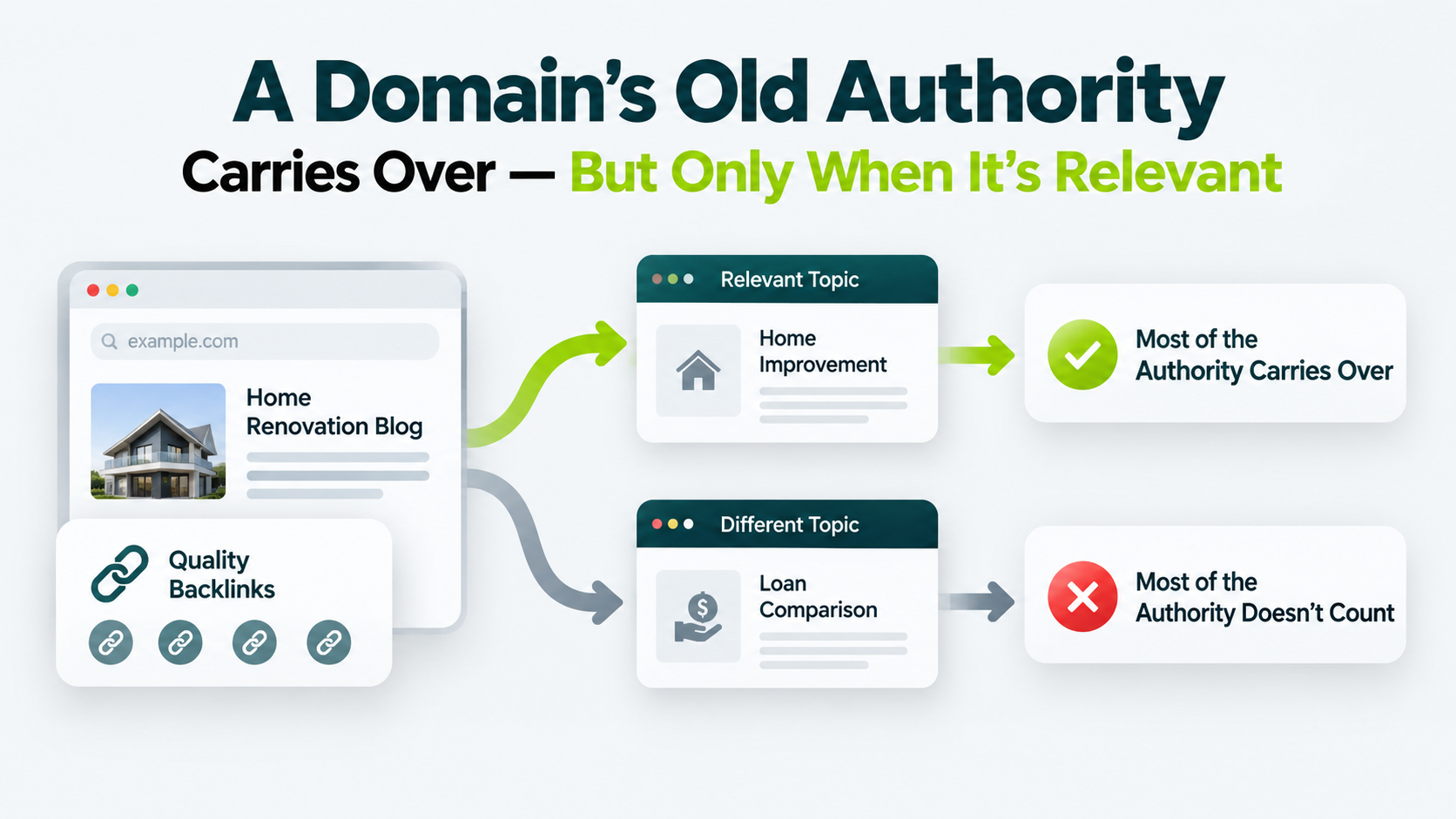
Google doesn’t store “authority” as one single number. It reads a domain through the pages that link to it, the topic those pages covered, and how closely your new content matches that history.
A domain that earned backlinks for home renovation coverage still retains those links after the domain expires.
Point a loan-comparison site at it instead, and most of that link equity stops counting toward your rankings, even though the backlinks themselves are still technically there.
Referring domains, the separate websites that link to you, matter more than raw backlink count.
A hundred inbound links from 35 different real websites carry more weight than a hundred links from a dozen link-farm sites.
Tools score a domain’s overall link strength with an authority score, often labeled Domain Rating (DR).
What is Domain Rating (DR)?
DR is a 0 to 100 number that estimates how strong a site’s backlink profile is, based on the number and quality of its referring domains.
A high DR on an expired domain tells you the domain used to matter. It doesn’t tell you whether it will matter for you.
Before you go any further, run it through a free tool to pull its domain history so you know roughly how old it is and how long it’s been dormant.
Is Buying an Expired Domain Against Google’s Rules?
Yes, if it’s for manipulating Google’s rankings. Google has a specific, named policy for exactly this failure mode.
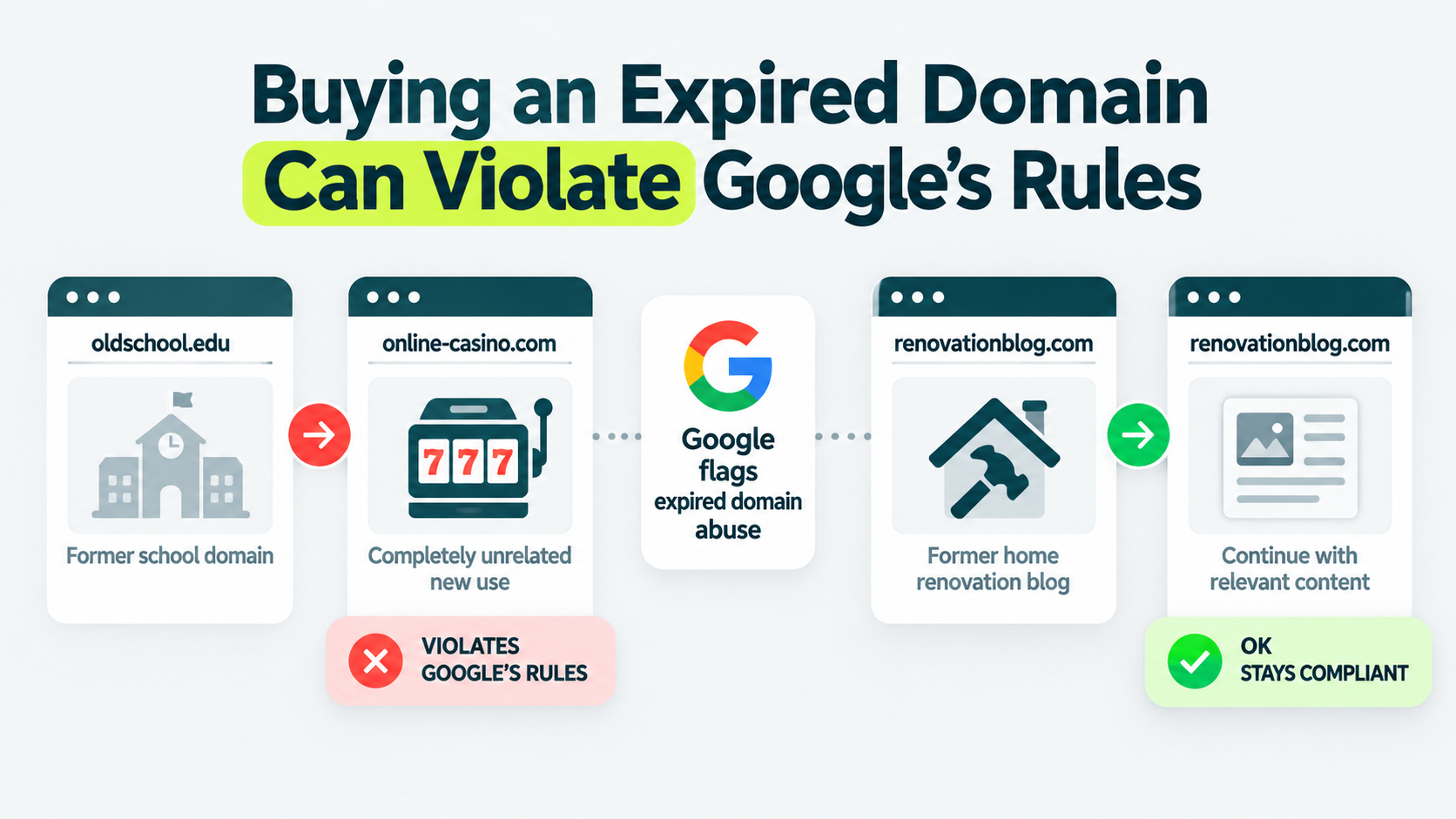
Google calls it expired domain abuse: you buy an expired domain and repurpose it to manipulate rankings with content that gives readers little to no real value.
What Counts as Expired Domain Abuse
Google’s expired domain abuse policy gives three examples:
- You drop affiliate content onto a former government agency’s domain.
- You sell commercial medical products on the domain of a former non-profit medical charity.
- You publish casino content on a former elementary school’s domain.
Every example has the same shape. The domain’s old purpose and its new purpose have nothing to do with each other. The new owner is counting on the old backlinks and trust to carry content that couldn’t earn that trust on its own.
That’s the line.
Keeping the same topic keeps you clear of expired domain abuse, but it won’t fix a toxic backlink profile or an old penalty.
If you relaunch that domain as a payday loan site, you’ve done exactly what the policy targets.
What Changed With the March 2026 Update
Google ran a spam update in March 2026 that rolled out in under 20 hours, the fastest confirmed rollout on its Search Status Dashboard.
But stay precise: Google didn’t introduce a new policy here. It codified expired domain abuse in March 2024, and 2026 just enforced that rule more precisely.
In practice, SpamBrain got better at catching violations it missed before, especially topical mismatch between an old domain and its new use.
- If you were already compliant, nothing changed.
- If you sat in a gray area, your margin shrank.
The impact still hit hard if you ignored the rule: affiliate sites relying on expired-domain redirects and private blog networks saw average traffic drops of 55% to 70% in the casino and finance sectors, per Digital Applied’s analysis.
Google catches most of this automatically: SpamBrain flags the pattern instead of waiting for a person to notice it.
SpamBrain works as a spam filter for links: it watches for a domain’s topic changing overnight, or unrelated outbound links appearing right after an ownership change.
Expired domain abuse sits alongside other named patterns that Google monitors, including link farming penalties that apply to some of the same networks. Both rely on borrowed authority rather than earned relevance, which is the actual signal Google’s systems are built to catch.
Learn the full spectrum of manipulative tactics before building on a newly acquired domain.
Buying a pet-insurance domain that’s sat unused for two years won’t help you rank a crypto exchange.
That combination gets you flagged.
How to Vet an Expired Domain’s Backlink Profile Before Buying
You can vet a domain’s backlink profile using 4 checks: its backlink quality, its content history, its indexing status, and any obvious legal red flags.
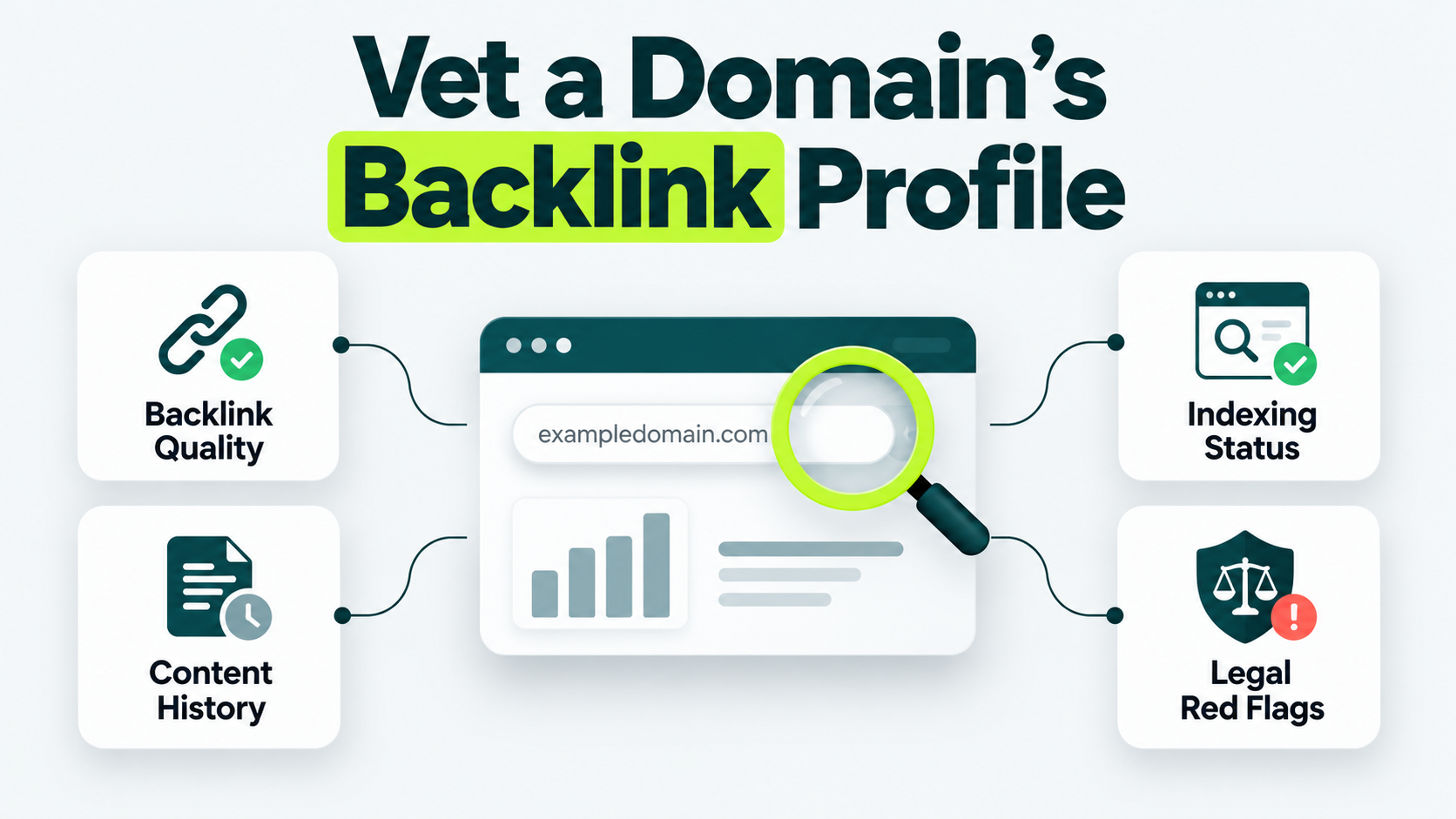
Check the Backlink Profile Itself
Pull the domain’s backlink profile using Ahrefs’ backlink checker, and focus on referring domains rather than total link count.
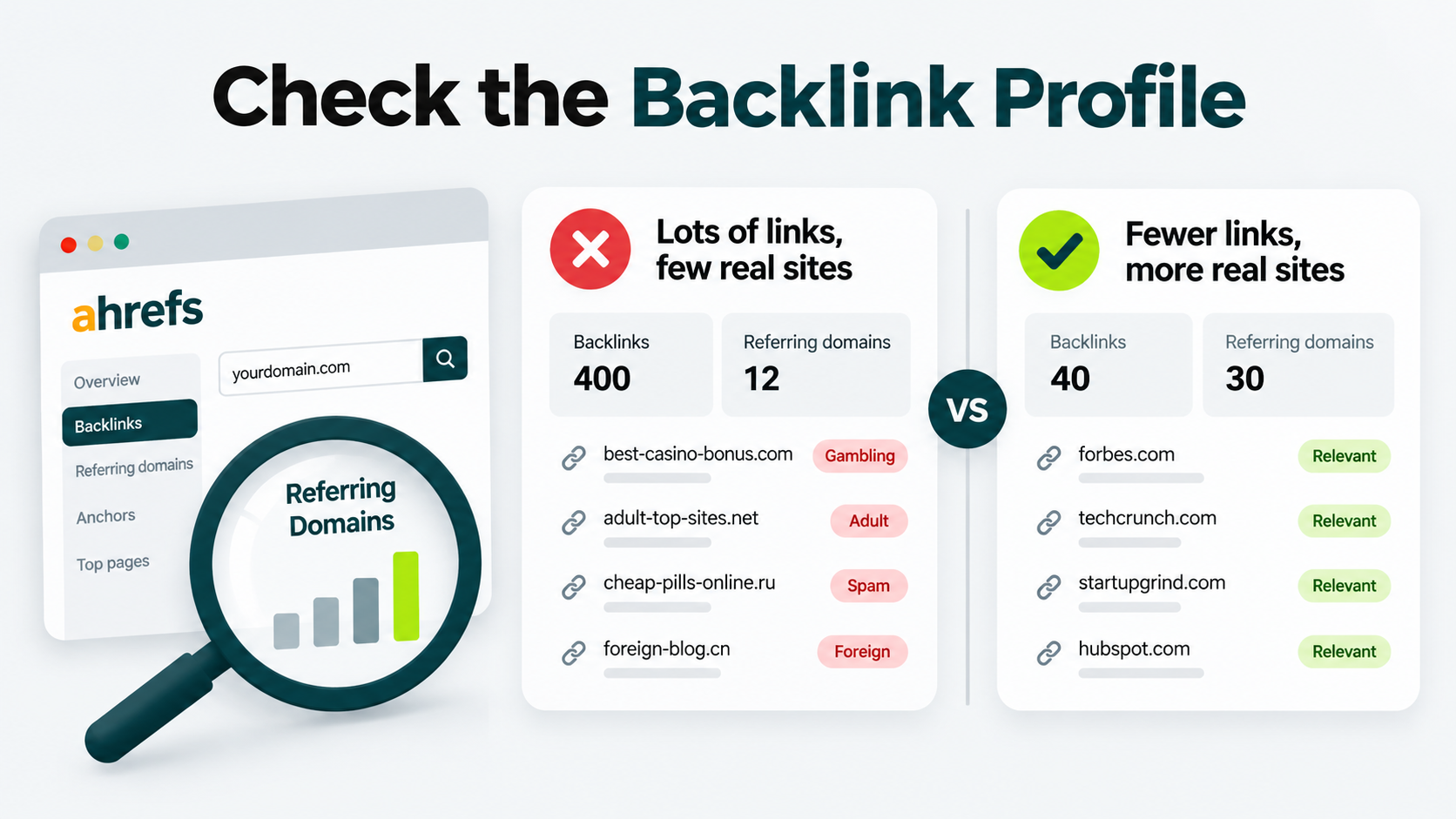
You’ll get a clearer picture this way: 40 backlinks from 30 different real websites tell you more than 400 backlinks crammed into just 12 link farm sites.
Watch for one specific pattern: a large number of backlinks from irrelevant or low-quality sites such as gambling, adult content, or foreign-language spam blogs with no connection to the domain’s topic.
One or two odd links won’t sink a domain. But when they appear repeatedly across the profile, you’re looking at the same toxic backlink pattern that Google’s systems catch.
And you’ll inherit the cleanup work along with whatever authority is left.
Want the full walkthrough?
You can check how to audit a link profile, as it takes you through the entire process step by step.
Confirm the Content History Actually Matches
Open the domain’s past in the Wayback Machine, a free archive that stores snapshots of what a site looked like at different points in time.
Compare what it published against what you’re about to put there. A gardening blog’s backlinks transfer cleanly onto a new gardening site.
They don’t transfer cleanly onto a supplement store, even if the authority score looks identical.
This is the single check most buyers skip, and it’s the one the March 2026 update made non-negotiable.
Verify It’s Actually Indexed and Penalty-Free
Search “site:domain.com” in Google. For example, if a site: search for the domain returns nothing, it isn’t indexed. You can also check if the site is indexed using our free Google Index Checker tool.
No results often mean Google removed the domain from search results before it expired, either automatically or after a manual review.
That problem does not disappear when you take ownership. You need to cross-check the domain name and search terms like “penalty” or “spam” to uncover public complaints from previous owners.
A domain can look clean in a backlink tool yet carry a Google manual action. If you buy it, you could pay for authority that Google has already stopped passing through search.
Rule Out an Obvious Legal Problem
Run a quick search for “your domain name + trademark” before you commit.
A domain built around a brand name, even an old, defunct one, can still trigger a dispute if the mark remains active or someone revives it.
This isn’t a deep legal review, just a few-minute search to rule out the obvious cases before you spend money on a domain you might have to give up.
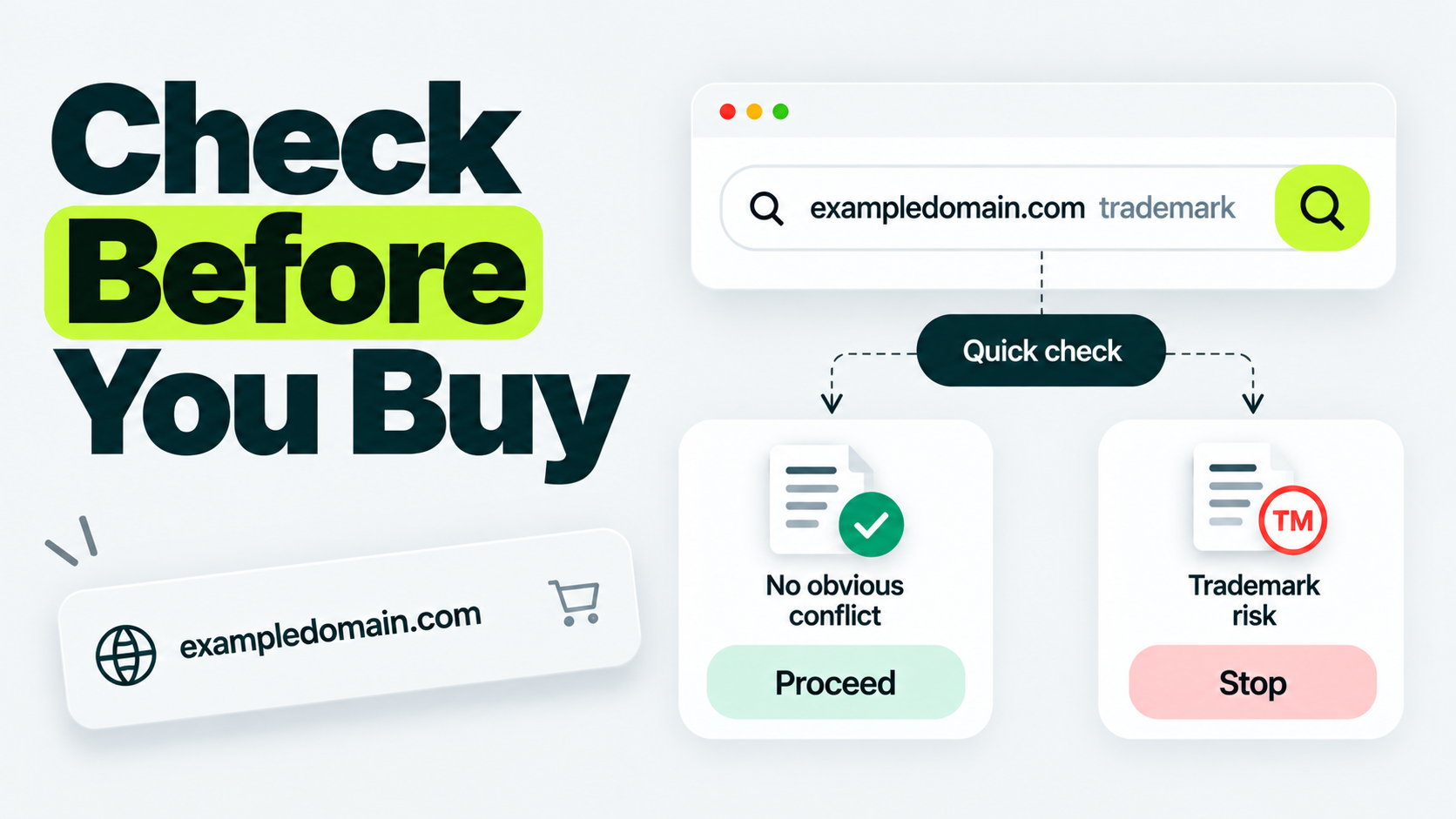
Before any of our own client redirects go live, it has to clear the same checks above.
Where to Actually Find and Buy Expired Domains
You’ll find expired domains in three places: marketplaces that list already-dropped domains, live auctions for domains about to drop, and backorder services that try to grab a domain the moment it becomes available.
Marketplaces are the simplest starting point for these aftermarket domains. You browse, filter by metrics like authority score or traffic, and buy what fits, closer to shopping than racing.
Some of the marketplaces are listed below:
- Odys.global
- Domcop
- Spamzilla
- List.Domains
- DomainRTX
- HighDA.co
- AuthorityDomains.io
- ExpiredDomains.net
Auctions move faster and can get competitive on anything with real backlink value, since other buyers are running the same vetting checks you are.
Some of the auction sites are listed below:
- NameJet
- SnapNames
- DropCatch
- Dynadot Auctions
- GoDaddy Auctions
- Sedo Auctions
- Catched.com
Backorder services sit in between. You pick a domain that’s about to drop, pay a small fee, and the service tries to register it the instant it becomes available.
There’s no guarantee you’ll win it. Prices range from a few dollars for a domain nobody else wants, up to several hundred dollars or more.
The strongest ones still have relevant backlinks and real search traffic attached.
Whichever route you take, you’re still fundamentally paying for authority instead of earning it, the same trade-off the data on buying backlinks shows in general.
Skip any marketplace that won’t show you the actual backlink report before you buy. If they won’t show the receipts, there’s often a reason you need to worry about.
Redirect It, Rebuild It, or Walk Away
The right move depends on how closely the domain’s old topic matches your new one, and how clean its history is.
| IF… |
THEN… |
|---|---|
| The old topic closely matches your new site, and the backlink profile is clean. | Point a permanent redirect straight to the matching page on your main site. |
| The old topic is close but not exact, and the old content still holds up. | Rebuild the site on the domain instead, and treat it as a new property that happens to start with existing backlinks. |
| The old topic has nothing to do with your new site. | Walk away. No redirect or rebuild makes that safe under the current rules. |
| The backlink profile looks toxic, or the domain was previously deindexed. | Walk away, regardless of how well the topic matches. |
Choosing Between a Redirect and a Rebuild
A 301 redirect tells Google and browsers that a page has permanently moved, passing most of its ranking signals to the new destination.
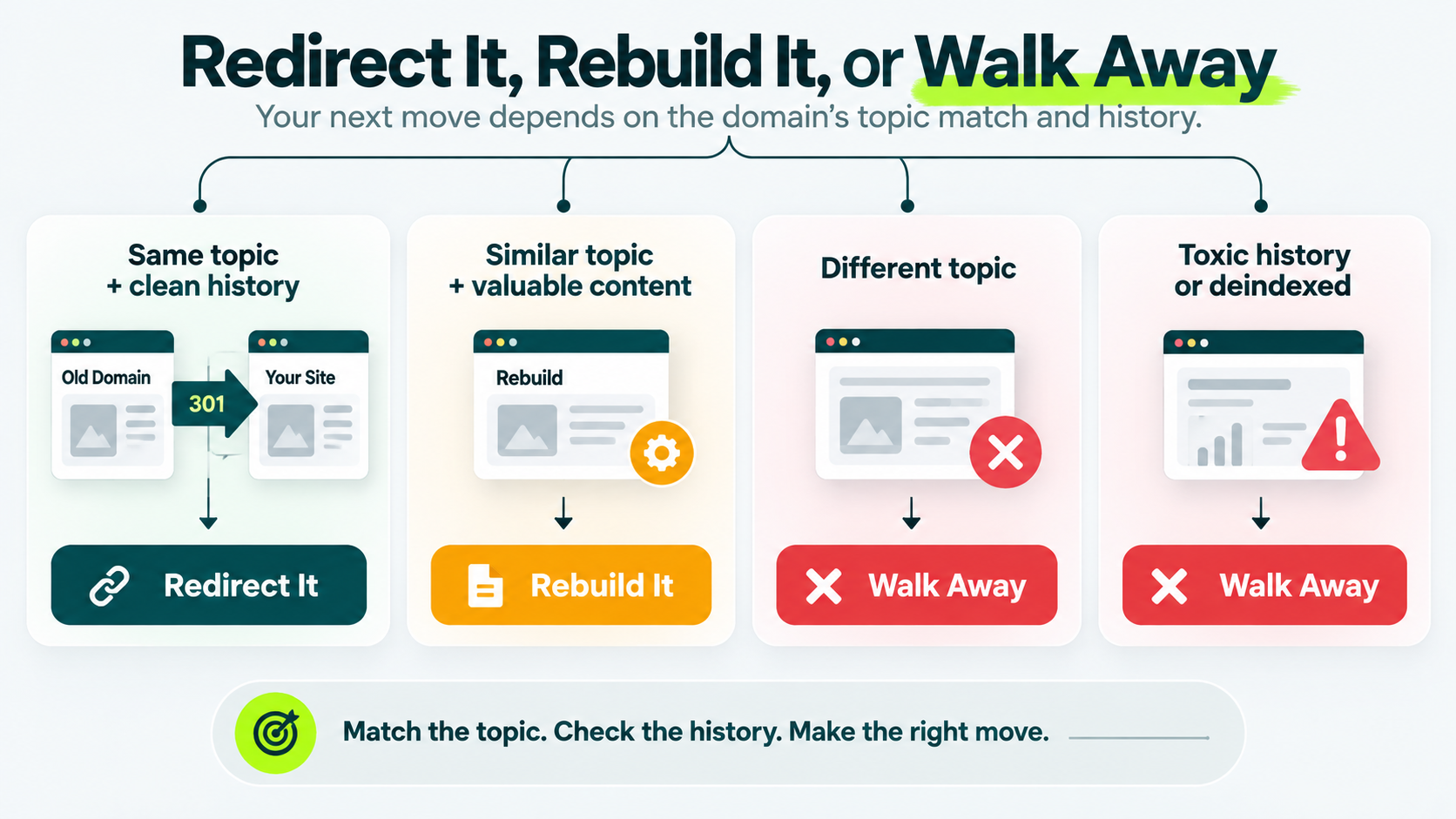
Use it only when the destination page genuinely continues the topic the domain used to cover.
Why a Private Blog Network Isn’t the Move
A private blog network (PBN) isn’t the right choice because sites that get caught don’t just lose the expired domain; they also risk the rankings of the main site they were propping up.
A private blog network is a group of sites that one person or team owns and interlinks, purely to send links to a main site.
Skip it. That’s the one use case for an expired domain that rarely survives contact with SpamBrain.
If you want the full mechanics of why people build these networks, and why they keep failing, check out how private blog networks actually work; it covers it in detail.
The Hairpin: A Case Study in Expired Domain Abuse
This is a case study related to expired domain abuse. In 2023, a buyer turned a closed-down women’s media into an AI-generated content farm.
According to Search Engine Journal’s coverage of what happened to The Hairpin, a Serbian DJ bought an expired domain of the women-focused publication. He replaced the original writers’ bylines with fictional male names and turned it into a content farm.
None of the new content had anything to do with the site’s original audience or topic. The domain kept its old backlinks and search trust for a while, exactly the outcome anyone chasing expired-domain authority wants, right up until it didn’t.
The lesson isn’t “don’t buy expired domains.” It’s that the backlinks were never the risky part; ignoring what the domain used to be about is.
Is Buying Expired Domains Still Worth It in 2026?
Yes, but for a narrower set of cases than most sellers advertise.
A domain with a clean history, real referring domains, and a topic that matches what you’re building is still a genuine head start.
A domain you’re buying purely for its authority score, planning to redirect it to something irrelevant, is a liability wearing a good metric.
The vetting work takes time, but far less than recovering from a penalty on a site you depend on.
A professional link audit exists for exactly this kind of check.
It runs a prospective domain’s backlink profile through the same scrutiny before you commit to a redirect or a rebuild.
That way, you won’t find out after you’ve already built on it.
Most people chasing this tactic are still shopping on authority score and backlink count alone.
Those who check topical history and indexing status first will still be standing after the next update.
Invest Time in Proper Vetting Before You Commit
Vetting a domain upfront takes far less effort than recovering from a penalty later on a site you depend on. Before you redirect or rebuild anything, run a professional link audit on the domain’s backlink profile; that way you catch problems before you’ve invested your time.
Not Sure an Expired Domain Is Worth the Risk?
Skip the guesswork. Get a link building strategy built on real relevance, not recycled authority that could get flagged.
What makes an expired domain’s backlink profile valuable?
You gain more value from referring domains than from raw link counts. A hundred inbound links from 35 different real websites carry more weight than a hundred links from a dozen link farm sites. You should prioritize quality over quantity when you evaluate any domain’s backlink profile.
How does Google detect expired domain misuse?
Google uses automated systems, including its SpamBrain AI, to detect patterns across content, links, and site behavior.
It flags a domain when the pattern suggests someone bought it mainly to exploit its old reputation. For example, by publishing thin or low-value content, or loading it with irrelevant links, rather than building something genuinely useful.
This matters because trying to game rankings this way rarely pays off. Once flagged, a site can face manual actions, lose its indexing, or have its old ranking signals discounted entirely.
Is Buying an Expired Domain a Shortcut Around Real Link Building?
No. A clean expired domain still needs new, relevant content and a redirect or rebuild done properly. That’s the same bar a reliable link building agency holds any placement to.
The domain’s history gives you a head start on authority. It doesn’t replace the work of making the site worth ranking.
Should I use a redirect or rebuild the domain?
Redirect your old domain to your new one if the content aligns and backlinks are clean. Rebuild if the topic is close but not exact and the old content holds up. If the topic is irrelevant or the profile is toxic, walk away.
What should I check before I buy an expired domain?
Audit backlinks in Ahrefs Backlink Checker, check the Wayback Machine history, check for any Google penalties, and make sure there are no trademark-related issues with that domain. This prevents you from buying damaged domains. Only buy from marketplaces showing backlink reports to ensure you acquire a domain that boosts your SEO.
Does Google penalize me for buying expired domains?”
You violate Google’s spam policy only when you buy a domain primarily to manipulate search rankings with low-value content. Google calls this expired domain abuse, one of several patterns covered under Google’s link spam policy.