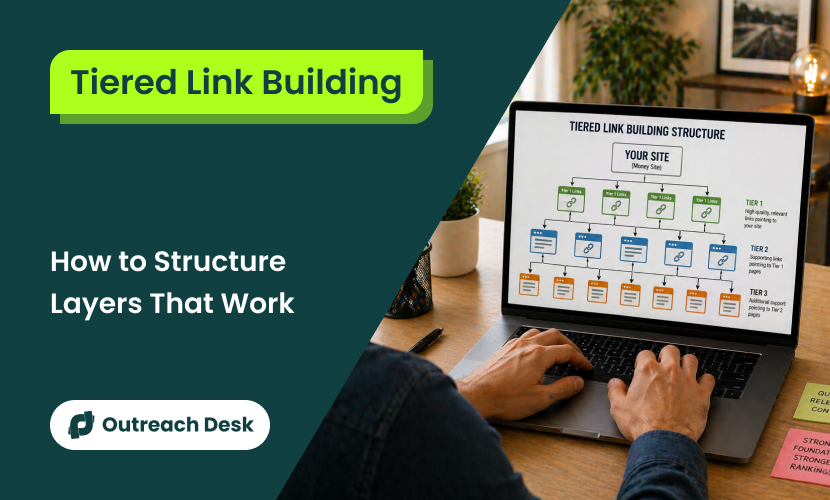
Tiered link building is a strategy where you build backlinks to your existing links. It creates layers where secondary links (tier 2 links) strengthen your primary links (tier 1 links) rather than pointing directly to your main site. Brands looking to scale this approach typically work with the Outreach Desk team.
Instead of chasing only new backlinks, tiered link building focuses on strengthening the links you already have. Tier 1 links point to your website. Tier 2 links point to the pages hosting your Tier 1 links.
This approach focuses on strengthening pages that link to you. Tier 2 links don’t pass authority directly to your website. Instead, they support the Tier 1 pages (the pages linking to you), helping maintain or slightly improve their strength.
What you’ll learn
- Why Tier 3 links rarely move rankings unless Tier 1 pages are already strong
- Which link types actually hold up at each tier (and which get ignored)
- When tiered link building helps vs when it’s a waste of budget
- How Google’s updates reduce the impact of scaled Tier 2 and Tier 3 links
- A practical framework to reinforce backlinks without increasing risk in 2026
What is Tiered Link Building?
Tiered link building is a strategy where you build backlinks in layers, with each layer supporting the one above it. Tier 1 links point directly to your site, while Tier 2 and Tier 3 links point to those backlinks rather than your site itself.
Most backlinks lose strength over time. Pages get updated, links get buried, and some simply stop passing value.
Tiered link building is a way to deal with that problem. Instead of constantly chasing new links, you build support around the ones you already have to keep them effective.
In simple words, tiered link building sorts the links pointing to your site into layers based on how directly each one connects to it. Think of a pyramid, where the top is narrow and high-quality, while the base is wider and lower-effort.
- Tier 1 links point directly to your site
- Tier 2 links point to the pages with Tier 1 links
- Tier 3 links point to Tier 2 pages

What the ‘Tiered’ Part Actually Means
The ‘tiered’ part means building links to your existing backlinks, not simply having backlinks at different quality levels.
How Tier 1, Tier 2, and Tier 3 Links Work Together
Google doesn’t just check whether a page links to you; it evaluates the strength and context of the linking page.
A backlink from a page with strong backlinks of its own passes more link authority than a backlink from a page with no inbound links.
Three tiers interact in practice:
Tier 1 → Your Site
Tier 1 links are your direct backlinks and are highly authoritative. These links must come from relevant, authoritative sites in your niche.
You should earn Tier 1 backlinks from guest posts on relevant sites, editorial mentions, resource page links, niche edits, and HARO placements. Everything below Tier 1 exists solely to strengthen these.
Tier 2 → Tier 1 Pages
Your guest post on Search Engine Journal starts to get shares, and smaller blogs begin referencing it. Tier 2 links point to the pages where your Tier 1 backlinks live.
Niche forum mentions, secondary guest posts, and social shares can support these pages. The goal is to reinforce the strength of the Tier 1 page, not artificially inflate it.
Tier 3 → Tier 2 Pages
Tier 3 links point to Tier 2 pages and are typically the highest-volume, lowest-quality layer in a tiered structure. They’re often used for scale, but in many cases, search engines ignore them or pass no measurable value.
This layer helps Tier 2 pages get indexed and pass along marginal authority.
Common sources include blog comments, social bookmarks, wiki edits, and automated submissions.
The thinking is that these links are far enough removed from your site that any penalty risk is diluted. That assumption can be risky.
In campaigns we’ve worked on, Tier 3 links rarely move rankings unless the Tier 1 page is already strong.

What Types of Links Belong at Each Tier?
Not every backlink type is worth building. Using the wrong layer wastes your time and can trigger problems.

Tier 1: High Quality, High Relevance
These are the most important backlinks. Every Tier 1 link should stand on its own merits, even without a tiered strategy.
Strong Tier 1 Sources:
- Guest posts on niche-relevant publications, sites with a real audience, and with editorial standards
- Editorial mentions earned through digital PR or original research
- Resource page placements on genuinely curated pages
- Contextual link insertions that are relevant, editorially justified, and naturally fit within the content.
- HARO and journalist-sourced links from media outlets.
These links should be on a page with higher topical relevance to your content, that gets organic traffic, and that has its own backlink profile.
If a link wouldn’t hold up under a manual quality review or feel forced, irrelevant, or transactional, it doesn’t belong at Tier 1.
Tier 2: Legitimate but Less Exclusive
Tier 2 links don’t point to your site; they point to the pages that host your Tier 1 links. That separation gives you more flexibility, but it doesn’t remove quality requirements.
Tier 2 Sources:
- Social media shares and profile linking to the Tier 1 page
- Niche forum discussions that naturally reference the content
- Secondary guest posts on mid-authority blogs
- Web 2.0 content (Medium, LinkedIn articles) linking to the Tier 1 page
- Directory listings for the site hosting your Tier 1 link.
Here, the bar is lower than Tier 1, but the links should be contextually relevant.
If you’re building low-quality or irrelevant Tier 2 links, Google can easily detect them.
In fact, in most campaigns we’ve handled, Tier 2 links only made a difference when the Tier 1 page was already indexed, relevant, and getting some traction. A closer look at how to sequence and build out this layer effectively is covered in tier 2 link building.
Tier 3: Volume With Caution
Some SEO professionals say Tier 3 adds value, while others say it strips authority and damages the site’s reputation.
Commonly Cited Tier 3 Sources Include:
- Blog comments
- Social bookmarks
- Wiki edits, profile links
- Automated submissions
Tier 3 links are built to help Tier 2 pages get indexed and pass a small amount of authority, nothing more.
Here’s the honest take:
For most businesses, Tier 3 isn’t worth the effort or the risk.
The authority gain is minimal compared to the detectable footprint it creates. If you use Tier 3 at all, keep sources varied and never automate at scale because Google’s spam policy has only gotten sharper since the 2024 spam update cycle, especially with systems like SpamBrain.
Does Tiered Link Building Still Work in 2026?
Yes, tiered link building can still have an effect, but its impact is limited and far less reliable than it once was.
The core principle is the same. The strength and context of a linking page influence how much value it can pass. Modern ranking systems are far more complex than PageRank alone.
What changed is Google’s ability to detect manipulation. The algorithm in 2026 is much better at identifying artificial link structure than it was even three years ago.
Broad Core Updates, the spam update cycle starting March 2024, and improvements to SpamBrain have made low-quality tiered link building a losing bet.

The nuance most guides miss:
Tiered link building works only when each tier is defensible on its own. If your genuine editorial Tier 1 links are supported by legitimate Tier 2 social shares and secondary content, you’re strengthening an already-natural structure.
If your Tier 1 links are genuine editorial placements on low-quality sites and your Tier 2 links are hundreds of automated blog comments, the tier structure actually increases your risk.
This creates detectable footprints connecting low-quality activity back to your domain.
A better way to evaluate tiered link building is to look at link quality at every level. If the links at each tier don’t hold up on their own, the structure doesn’t add much value.
Pro Insight:
The sites that see any benefit from tiered link building in 2026 aren’t using it as their primary strategy. In fact, they’re using strong modern link building tactics to earn Tier 1 links first, then selectively amplify the highest-potential ones with Tier 2 support. This is a targeted approach, not a pyramid scheme.
The Real Risks of Tiered Link Building
Most sites just mention Google penalties as a risk in tiered link building practices and move on. Here are the real risks that you should know before moving ahead.
Pattern Detection Across Tiers
Google identifies relationships between sites, pages, and link patterns. If your Tier 2 and Tier 3 links share common footprints, such as network similarity, link velocity, and behavioral patterns, then the search system doesn’t need to trace every link back to your site to respond to these patterns.
In many cases, they simply ignore or devalue low-quality links. The bigger risk isn’t always a penalty, but the effort produces no meaningful impact.
Wasted Effort, Not Just Penalties
Google can choose to simply ignore manipulative and low-quality links rather than penalize the entire site. You could build hundreds of Tier 3 links and end up with little to no measurable impact. Your time and money are wasted.
Maintenance Overhead
Tiered structures need ongoing monitoring. Tier 1 pages lose links. Tier 2 pages go offline. If you’re not tracking each layer’s health, your carefully built structure erodes without you noticing.
Opportunity Cost
Every hour spent on Tier 2 and Tier 3 links is time not spent earning stronger Tier 1 links. For most sites, a single high-quality, relevant Tier 1 link will have a more consistent impact than investing the same effort into supporting layers.
How to Build a Tiered Backlink Structure Safely
Getting this right starts with knowing exactly what you’re working with before you add anything new.
Step 1: Audit Your Existing Tier 1 Links
Before building support layers, know what you’re supporting. Pull your full backlink profile using outreach productivity tools such as Ahrefs or Semrush. Identify your strongest live, indexed Tier 1 backlinks. Focus on pages that have:
- Topical relevance to your site
- Receive organic traffic
- Have low-existing backlink counts
- Sit on domains with clean, editorial link profiles.
In most cases, selecting a small, high-potential subset of links is enough to test whether a tiered approach adds any value.
Step 2: Build Tier 2 Links to Your Best Tier 1 Pages
For each target Tier 1 page, you can build 3-7 Tier 2 links from varied, legitimate sources. Variety, relevance, and matters more than volume here.
A practical Tier 2 mix might include:
- Sharing the Tier 1 content through social platforms where it can reach a relevant audience.
- Write a Medium or LinkedIn article that naturally references and links to the Tier 1 page’s content.
- Find a relevant forum discussion where mentioning the Tier 1 content adds more value.
- Secure a secondary guest post on a mid-authority blog that links to the Tier 1 page.
Each Tier 2 link should look like something a real person created because they found the Tier 1 content valuable. If it doesn’t pass that test, skip it.
Step 3: Decide Whether Tier 3 Is Worth It
Before moving on to the Tier 3 links, you should wait. Two well-executed tiers deliver the benefit, with some risk. For most sites, this is where you should stop.
If you still want to proceed with the third-tier link building, keep it as user-friendly or contextually justified.
Many commonly used Tier 3 tactics, such as social bookmarking, profile links, or large-scale submissions, are frequently ignored by search systems like Google, which can introduce unnecessary risk if scaled.
Also, don’t use tools that create hundreds of links simultaneously because the Google spam system can catch these signals easily.
Do this instead:
If you’re at the point of building Tier 3 links, you’d likely get better returns spending that same effort acquiring one more strong Tier 1 backlink.
Step 4: Monitor and Maintain
Use a link-change tracker to track link health across tiers monthly and focus on:
- Tier 1 links that have been removed or switched to nofollow.
- Tier 2 pages that have been deindexed
- Sudden changes in referring domain counts for key Tier 1 pages.
If a Tier 1 link goes offline, the entire support structure beneath it loses its purpose.
Tiered Link Building vs. Flat Link Building
If you’re planning to build a tiered link-building strategy, then wait. Not every site needs layers of backlinks. For many businesses, a ‘flat’ strategy can work.
Flat link building means putting all your efforts into earning the best possible backlinks from authoritative, relevant sites. These help produce better results with less complexity.
| Factor | Tiered Approach | Flat Approach (Tier 1 Only) |
|---|---|---|
| Site maturity | Established sites with 50+ existing Tier 1 links | Newer sites are still building an initial backlink foundation |
| Niche competitiveness | Highly competitive verticals where small edges matter | Moderate competition where strong Tier 1 links alone can rank |
| Budget | Enough to sustain quality across multiple layers | A limited budget is better concentrated on fewer, stronger links |
| Risk tolerance | Comfortable with gray-area tactics and ongoing monitoring | Prefers staying clearly within Google’s guidelines |
| Existing Tier 1 quality | High-quality Tier 1 links worth amplifying | Weak Tier 1 links that need replacing, not supporting |
| Team/time availability | Resources to monitor and maintain multiple tiers | Limited capacity is better spent on acquisition |
Sites with DR 40 or less almost always benefit more from flat strategies. This approach focuses on manual link building and direct placements.
You can move to a tiered approach once you have a solid Tier 1 foundation with specific links worth amplifying.
Common Mistakes That Undermine Tiered Strategies
Understanding tiered link building is one thing, but executing it without making costly mistakes is another.
Here are the most common mistakes people make when building tiered backlinks for their sites.
Using the Same Anchor Text Across Tiers
Anchor text is the clickable words in a hyperlink. For example: “best project management software.”
If every single link pointing to your site used that exact phrase or very close variations of it, Google interprets it as someone deliberately engineered those links rather than earning them naturally.
Real links from high-authority sites use a variety of anchor texts, including your brand name, your URL, and sometimes keywords. A closer look at how to choose and vary it effectively is covered in anchor text strategy.
Building All Tiers Simultaneously
You publish one well-written article today, and over the next few months, other websites discover it, find it valuable, and link to your blog as a reference. Natural link accumulation looks like this.
Now, imagine if the same article gets 15 backlinks in the same week from irrelevant sources, after it was published. This is a sign of artificial behavior because discovery doesn’t happen that fast from an irrelevant source.
The same logic applies to tier link building. If your Tier 1 link suddenly receives hundreds of Tier 2 links the moment it goes live, search engines notice the unnatural velocity. Maintain a time gap between Tier 2 and Tier 3 links for safety.
Neglecting Tier 1 Quality to “make up for it” With More Tiers
A Tier 1 link from an irrelevant, low-quality website with no real authority does not meaningfully become valuable just because you point 50 Tier 2 links at it. Tier amplifies strength, but it cannot create strength where none exists.
Important rule:
Start with strong Tier 1 links or don’t start at all. No amount of support structure below compensates for a weak top layer.
Over-Investing in Tier 3
Some older SEO guides recommend building 300 or 1,000 Tier 3 links per Tier 2 page. That advice is now outdated in 2026.
Even if Google doesn’t penalize you directly, the time and money spent on that volume of low-quality links generates little to no authority for your site.
Ignoring Link Equity Fundamentals
This is the most foundational mistake of all, and the one most people skip over: ranking signal pass-through, the SEO value that passes from one page to another through a link. But not all links pass equity equally.
If you don’t understand the difference between dofollow and nofollow, how redirects affect link value, or how internal linking distributes authority within your site, adding tiers on top of a weak foundation won’t help.
Conclusion
Tiered link building is a precision tool. It can strengthen your backlink profile when the foundation is solid, and each layer meets a basic quality threshold.
This link building works only when your Tier 1 links are already strong and worth amplifying, you understand your competitive landscape clearly, and you have the patience to build each layer gradually and carefully.
For most businesses in 2026, the highest-impact move remains the same as it’s always been.
Earn better Tier 1 links through genuine editorial relationships and content worth linking to. Once those are in place, selective Tier 2 support can quietly compound its value over time.
Not sure if a tiered approach fits your link strategy?
Start with a clear audit of your current backlinks.
1) Will tiered link building get my site penalized?
Not automatically. It depends entirely on how you build each tier. Tier 2 links are built through guest posts and genuine social sharing, which is perfect for SEO practice. But, using automated tools or blasting thousands of Tier 3 links through blog comment spam and low-quality directories is considered manipulation.
2) How many Tier 2 links should you build per Tier 1 link?
There’s no fixed number. Still, 3-7 Tier 2 links per Tier 1 link are realistic. The number of links matters far less than their quality and variety. Five diverse Tier 2 links will consistently outperform fifteen links from the same source type.
3) Can tiered link building hurt your rankings?
Yes, it can hurt your rankings if you’re careless while building layers or backlinks. Google can simply ignore your links entirely, which means all that effort you put in is wasted, or apply a manual penalty in the worst case.
The risk increases when you automate any tier or repeatedly use the same low-quality link sources. Patterns will catch you, and Google is very good at recognizing them.
4) Should beginners use tiered link building?
Probably not. If you’re still building an initial backlink profile, tiered strategies add complexity that only pays off once you have a solid foundation. Your time is better spent first understanding what backlinks are and earning strong Tier 1 placements. Get the fundamentals right before adding layers on top.
5) How long does it take for tiered link building to show results?
Expect 8-16 weeks for Tier 2 support to visibly impact the authority of your Tier 1 link. Search engines need time to discover, crawl, and evaluate every link at every layer. If you need quick ranking movement, this is not the right strategy for that goal.