Your client trusts you to build links for their business. But you don’t have the bandwidth to run campaigns at scale, and admitting that feels risky.
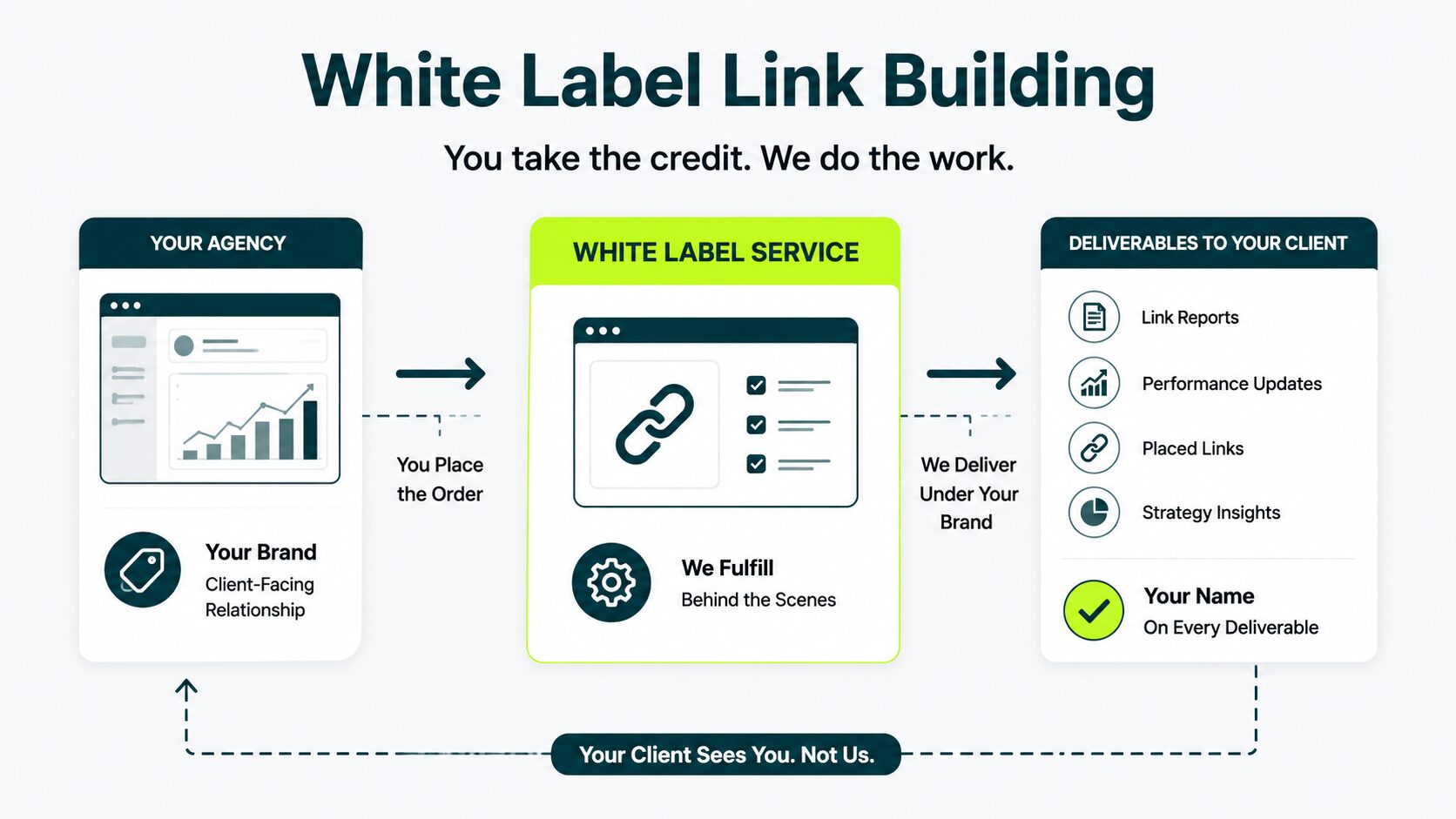
White label link building solves this: your agency sells link building to clients and a specialist provider builds the links on your behalf, with all deliverables branded to your agency. The provider stays invisible. The client never learns who fulfilled the work.
The model works when you set it up correctly. Most agencies that run into trouble skipped one step: the briefing process.
What You’ll Learn
- How the 5-step white-label fulfillment process works, from order to client delivery.
- The 5 criteria that separate reliable providers from ones that’ll damage your clients’ backlink profiles.
- The Agency Briefing Checklist, the pre-order document that prevents anchor over-optimization and velocity spikes.
- What every white label report must include and what missing data tells you about a provider’s standards.
What is White Label Link Building?
White label link building is when you outsource your link building operations to a specialist provider who works behind the scenes. The provider builds the links and delivers everything under your brand.
Understand this with an example: you own a bakery.
A customer walks in and orders a custom birthday cake, but you don’t have a cake designer. Then what do you do?
Instead of saying no to your customer, you ask a professional cake designer to make the cake. The designer doesn’t put their logo or name on it. You package it with your bakery’s branding and give it to the customer.
The customer is happy because they received a delicious cake.
The cake designer gets paid for making it. Your bakery earns a profit and strengthens its customer relationships.
White label link building works in exactly the same way.
Here you handle the client’s contract, reporting, and communication while the service provider handles prospecting, outreach, and placement behind the scenes.
Now, one question is probably on your mind: Is white label link building right to do?
The answer is yes. Agencies have outsourced design, development, and paid media execution for years without treating it as a weakness.
How the White Label Link Building Model Works
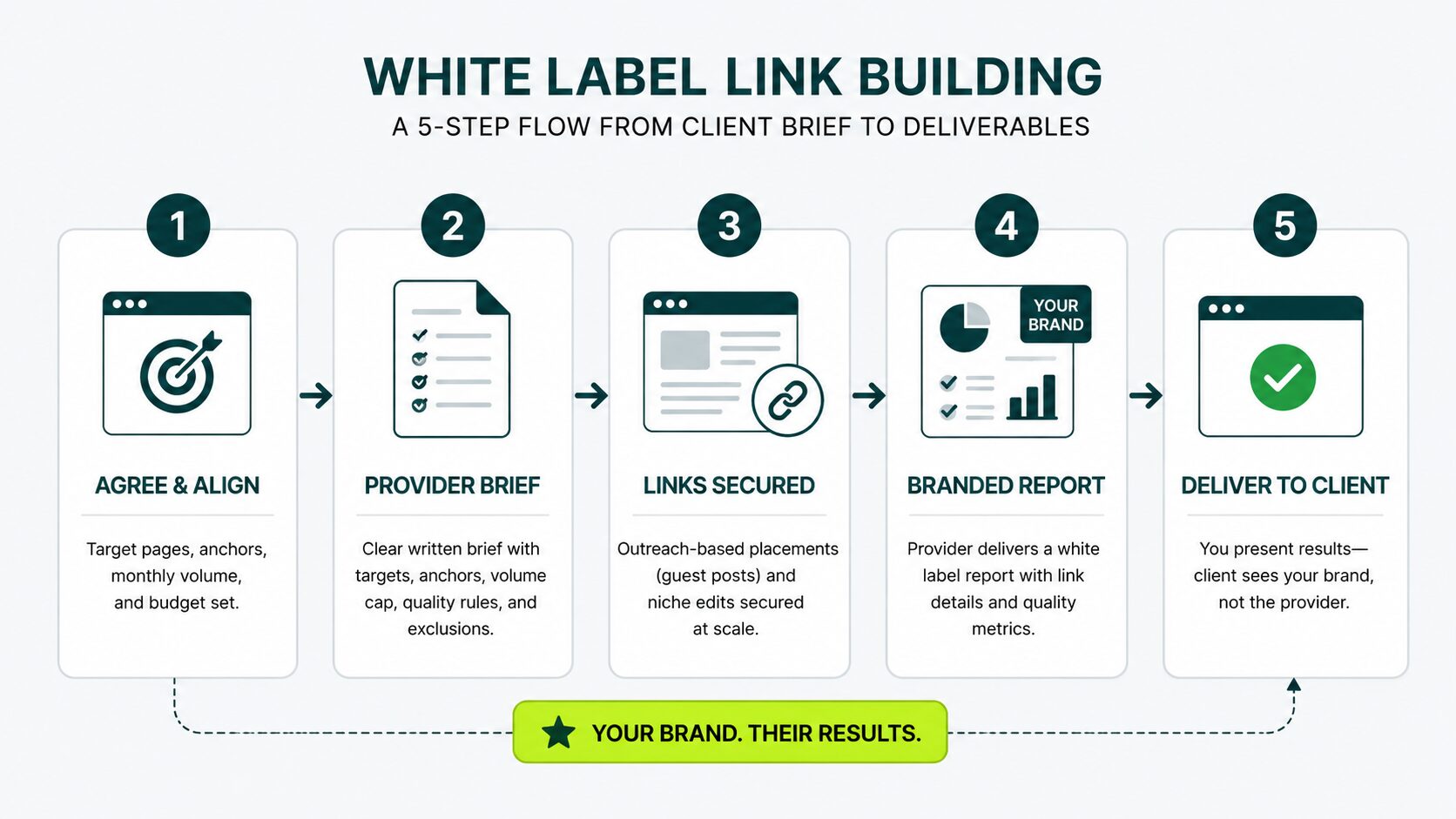
The white label link building model runs through 5 stages: agree and align, provider brief, links secured, branded report, deliver to client.
Stage 1: Sell the Campaign to Your Client
Your agency sells link building services to a client. You and your client agree on target pages, anchor text targets, monthly link volume, and budget. The client pays your agency at your rate.
Stage 2: Brief the Provider in Writing
Next, you share the brief with the link building provider in writing. Also, you send a document specifying the target URL, the anchor text distribution that you want, a monthly link ceiling, quality checks, and any publisher categories to avoid.
Most agencies often share vague briefs, which eventually produce results that are hard to explain to clients.
Stage 3: Provider Executes Outreach and Secures Placements
The provider conducts link building outreach and secures placements in the target niche. The two main link types in white label arrangements are outreach-based link placements like:
Guest Posts
A writer creates an article on a third-party website and places a contextual link inside the body of the article.
Niche Edits
Niche edits involve adding a link to an already-published article on a relevant website. This approach allows agencies to secure contextual backlinks from existing content through niche edit link building rather than creating a new article from scratch.
Stage 4: Provider Delivers a Branded Report
After that, the provider delivers a branded report. The report carries your agency’s name, lists each placed link, and includes quality data for the referring domain (a separate website that links to your client’s site).
Stage 5: Present the Deliverables to Your Client
You present the deliverables to your client. From their perspective, your team handled the entire campaign.
This is the operational core of link building outsourcing under a white label link building agency: fulfillment happens invisibly, and the client relationship stays fully with your agency.
When Does White Label Link Building Make Sense?
White label link building makes sense in three specific situations.
When Your Team Is at Capacity
If strategists are spending hours on outreach instead of strategy, you’re using expensive expertise for tasks that can be outsourced.
This is a clear sign that outsourcing white label services makes sense. It’s about improving efficiency rather than fixing a skill gap.
When Your Client Is In a Niche You Don’t Have Publisher Relationships In
A client in fintech or healthcare needs placements your generalist prospect list doesn’t cover. Building those relationships from zero costs months that a campaign timeline usually doesn’t have.
A white label provider that already has established relationships in that niche can place links your team couldn’t reach for some time.
When You Want to Add Link Building as a Service Without Hiring First
Some agencies want to expand their service offerings before they’ve built the internal capacity to do so.
Rather than hiring a dedicated link building specialist (which involves time, salary, and a lag before the hire is productive), you should use a white label provider as your fulfillment infrastructure.
The client pays the agency at the agency’s rate. The agency pays the provider at the provider’s rate. The middle margin is the business model for scaling agency based link building services.
In Simple Words
Client pays agency $1000.
Agency pays provider $600.
Agency keeps $400.
That $400 gap is profit. Agency doesn’t do link work itself, just manages client and keeps the difference.
What to Look for in a White Label Service Provider
BuzzStream’s 2025 findings show that only 30% of teams working with external link builders are fully confident in the results. The gap usually comes down to choosing a provider based on price and a single metric rather than the criteria that actually predict quality.
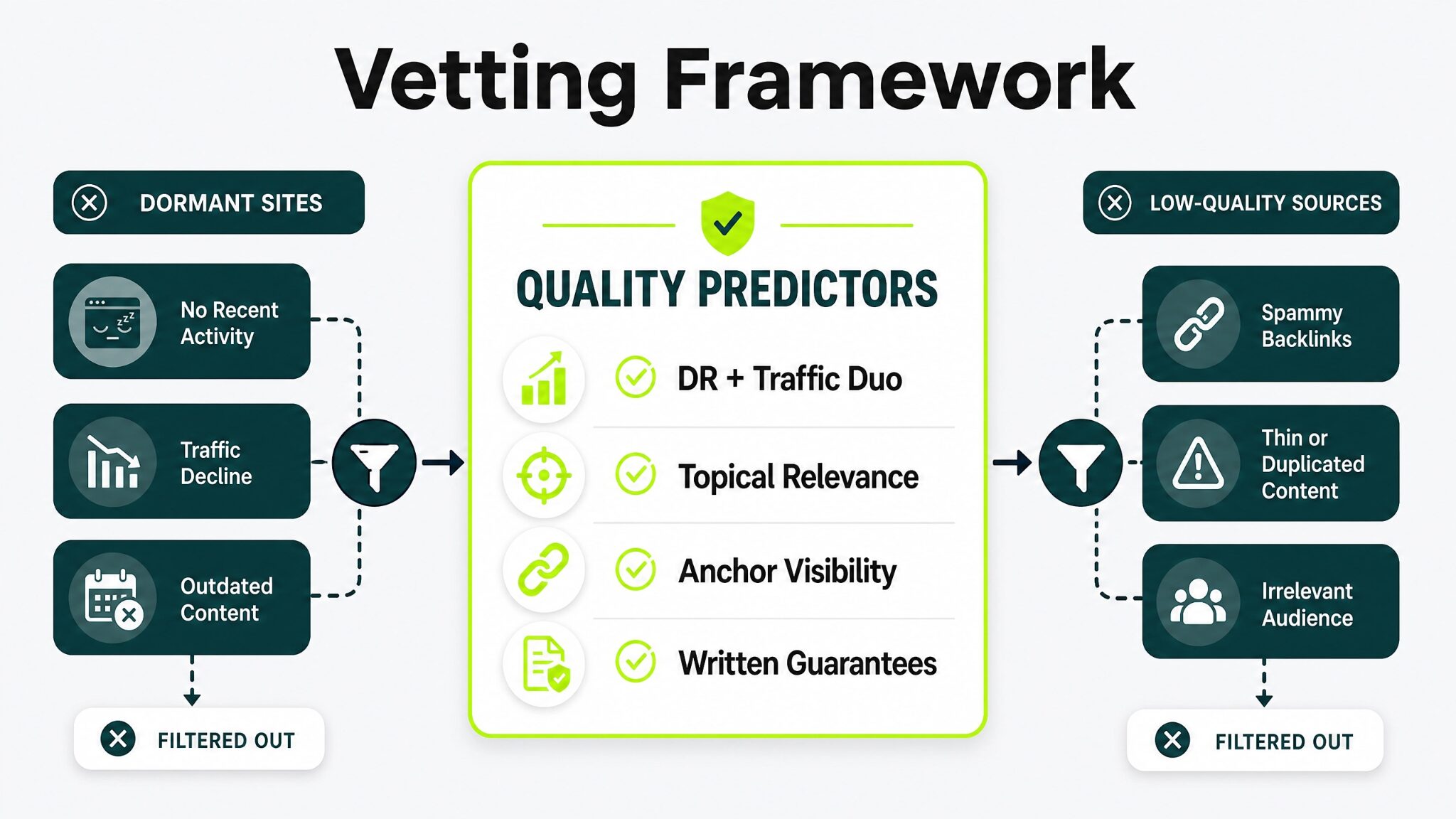
DR and Traffic Metric
The first metric most agencies check is Domain Rating (DR), a 0 to 100 score from the SEO tool Ahrefs that estimates the strength of a website’s backlink profile. It’s a necessary filter, but DR alone isn’t enough.
A domain can maintain a high DR for years, built on accumulated links, even while the site itself has stopped publishing new content and has no active readership.
A link from a site like that looks clean in a report and does little for the client in practice.
Instead, you can ask providers to include current monthly organic traffic data for each referring domain alongside the DR number. If they can’t or won’t, that’s a meaningful signal about what their reporting will look like.
Topical Relevance
The publishers’ topical relevance matters more for E-E-A-T than raw domain authority.
What is E-E-A-T
Google’s framework for assessing the expertise, experience, authoritativeness, and trustworthiness of content.
A link from a site that covers topics closely related to your client’s industry is a more credible endorsement than a link from a high-DR site in an unrelated category.It’s one of the core reasons niche relevance matters more than raw metrics.
Ask prospective providers to show you examples of publishers they’ve placed links on in your client’s niche. “High-authority sites” is not specific enough of an answer.
Anchor Visibility
Anchor text visibility is something providers often shortchange in their reporting.
Every placement should include the exact anchor text used. Whether that’s exact match, partial match, branded, generic, a naked URL, or image alt text, not just the link URL and a site rating.
Without the anchor text, you can’t manage the client’s anchor distribution, leaving you blind to one of the most common causes of an unnatural-looking backlink profile.
Written Guarantees
Two things need to be in writing before you commit to a provider:
- Delivery timeline (expected links per month and when the report arrives)
- Replacement or refund policy for links that disappear after placement.
Placed links sometimes vanish when publishers update or restructure pages. A provider with no written policy on this leaves you holding a deliverable that no longer exists, with nothing to show the client and no recourse.
The Risks Agencies Overlook
The biggest risk in white label link building is placing an order without telling the provider exactly what you need.
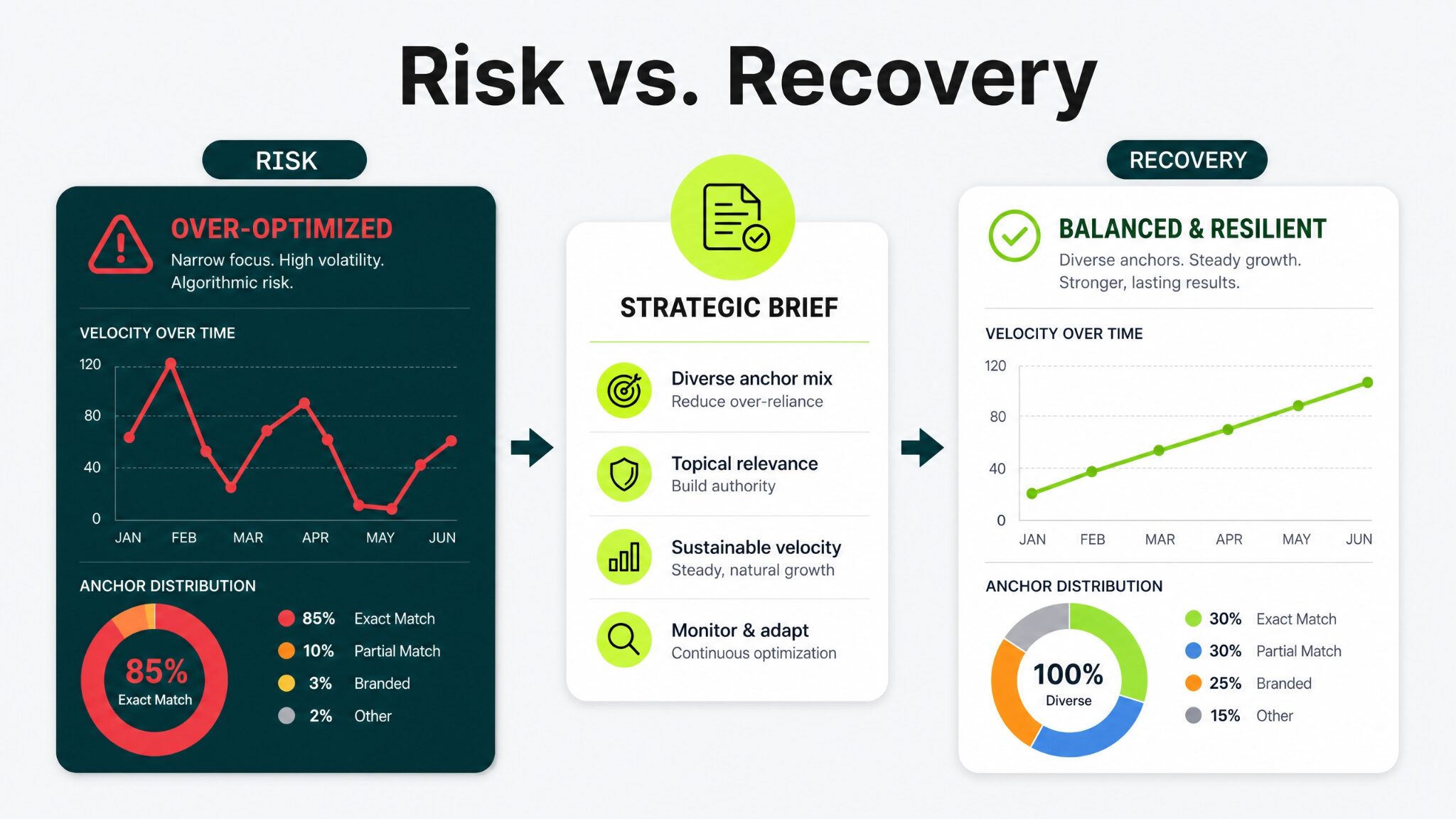
One SaaS client came to Outreach Desk after a previous white label provider built their backlink profile with 68% exact-match anchors, all pointing at a single target keyword.
Google’s algorithm flagged the pattern within weeks, and organic rankings for that keyword dropped out of the top 20.
Outreach Desk restructured the anchor mix down to 12% exact-match, filling the rest with branded, partial-match, and natural anchors. Rankings recovered to prior positions within four months, and the keyword has held steady since.
Anchor Over-Optimization
Anchor over-optimization happens when too many of a client’s inbound links use the same anchor text, especially the exact target keyword. When the distribution is too uniform, it signals to Google that the links weren’t earned naturally.
Providers default to what you tell them.
If you don’t specify anchor distribution in your brief, many will use exact-match anchors because they’re clear and easy to generate. The client’s backlink profile takes the hit.
Specifying anchor text targets in the brief before the provider places a single link is the fix.
Link Velocity Spikes
Link velocity (the rate at which new links point to a site, measured month-by-month) is a signal that Google tracks. A site that has been acquiring 2 links per month and then suddenly receives 20 in a month stands out and attracts scrutiny.
That spike isn’t automatically a penalty, but it draws attention. When a sudden influx coincides with other signals of artificial link acquisition, the risk compounds.
A white label order placed without a monthly velocity ceiling leaves the provider with the decision about how fast to move. Match the ceiling in your brief to the client’s historical link acquisition rate.
Publisher Site Decay
A link placed today on a clean, active publisher site doesn’t stay that way permanently. If the referring domain is later penalized, stops publishing, or acquires a poor link profile of its own, the value of your placed link changes. In worse cases, Google may treat that link as a negative signal.
Agencies running white label arrangements often lack an audit trail for these changes. You didn’t build the publisher relationship, so you don’t get notified when the site’s status shifts.
Protection comes from knowing how to use a disavow file and having a provider that offers a written replacement policy for links that deteriorate within an agreed window.
How to Brief a White Label Link Provider
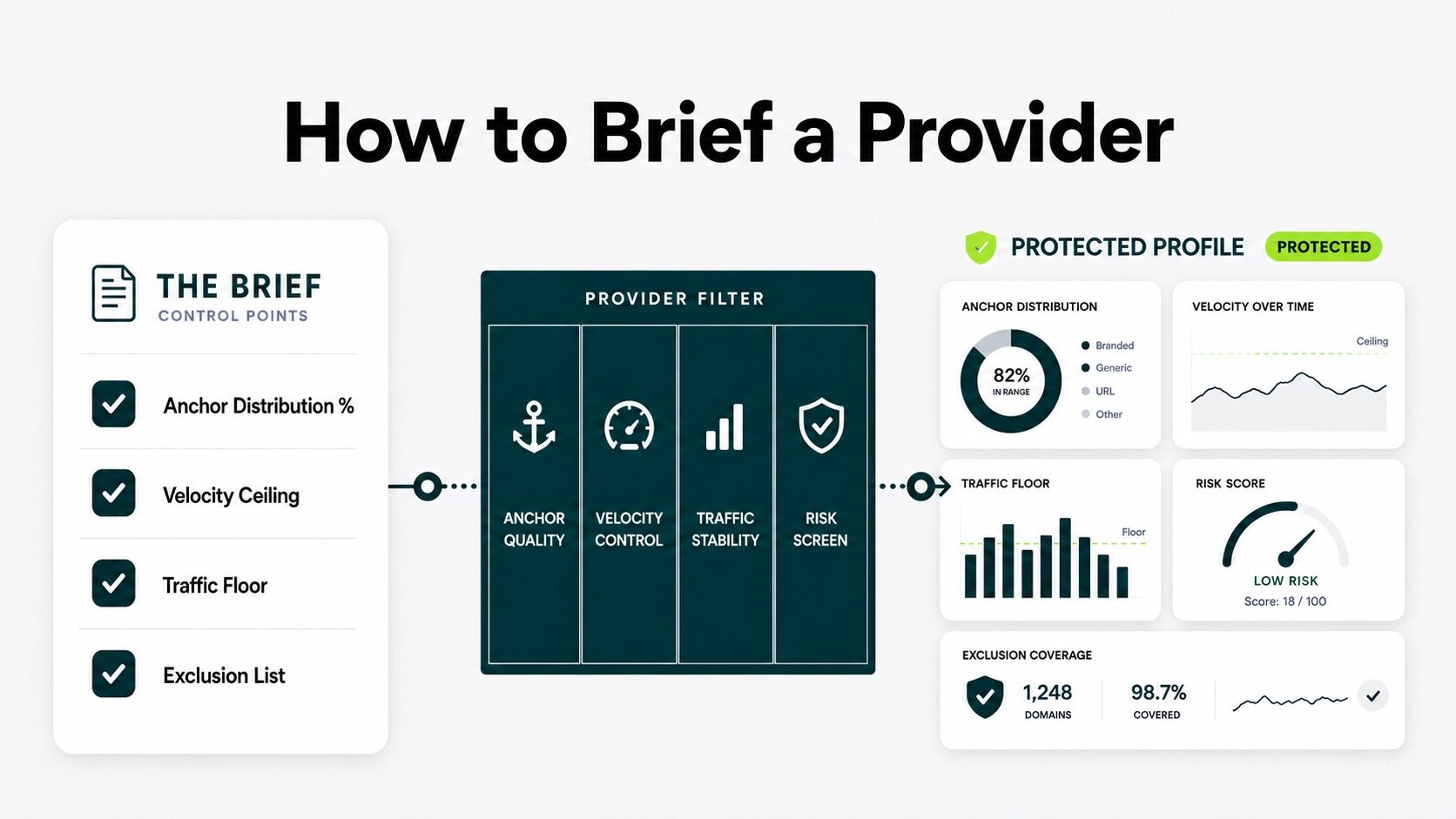
The brief is the document that protects your client’s backlink profile. At Outreach Desk, we scope every white label order using the same checklist for link building campaigns.
Anchor Text Targets and Distribution
Specify the exact anchor text targets and distribution, and how many of each type.
- Brand anchors (your client’s business name)
- Partial-match anchors (a phrase that includes part of the target keyword without being the full keyword)
- Topical anchors (phrases that describe the subject matter without directly targeting the keyword)
Give the provider a target percentage for each type, not just a list of keywords.
If you want 40% brand, 35% partial-match, and 25% topical, write that down. Without it, the provider makes that decision, and it won’t be based on what your client’s profile actually needs.
Monthly Velocity Ceiling
Set the maximum number of outreach-based link placements the provider should complete in a single calendar month. Base this number on the client’s current link acquisition rate.
If the client has been building 3 to 5 links per month organically, starting with 20 white label links in month one creates a spike that looks unnatural. Start at a rate that matches the site’s history and scale from there as the profile grows.
Excluded Publisher Categories
List the publisher categories your client should not appear on. Common exclusions include adult content, gambling, low-quality content farms, sites in industries unrelated to the client, and sites that openly sell links in bulk.
Some of these seem obvious. They’re not always obvious to a provider who doesn’t know your client’s brand or your client’s audience.
Minimum Traffic Floor for Each Referring Domain
Set a minimum monthly organic traffic threshold for every site the provider proposes to use. This is separate from the DR minimum, and it filters out the kind of high-DR dormant sites described above.
A reasonable starting floor depends on the client’s niche and target market, but the provider should be able to show you current traffic data for every domain they propose before placement. If they can’t, the domain fails the check.
Disavow Protocol
Define what happens when a placed link doesn’t meet quality standards after delivery. Who identifies the problem? How quickly does the provider respond? What is the process for getting a replacement?
The disavow file is a list of links you submit to Google through Search Console, telling it to ignore those links when assessing your client’s site.
Knowing when and how to use it is the difference between proactively managing a bad link and discovering a problem only when a client reports a traffic drop. A written protocol means both parties know what happens when something goes wrong.
What a White Label Report Should Include
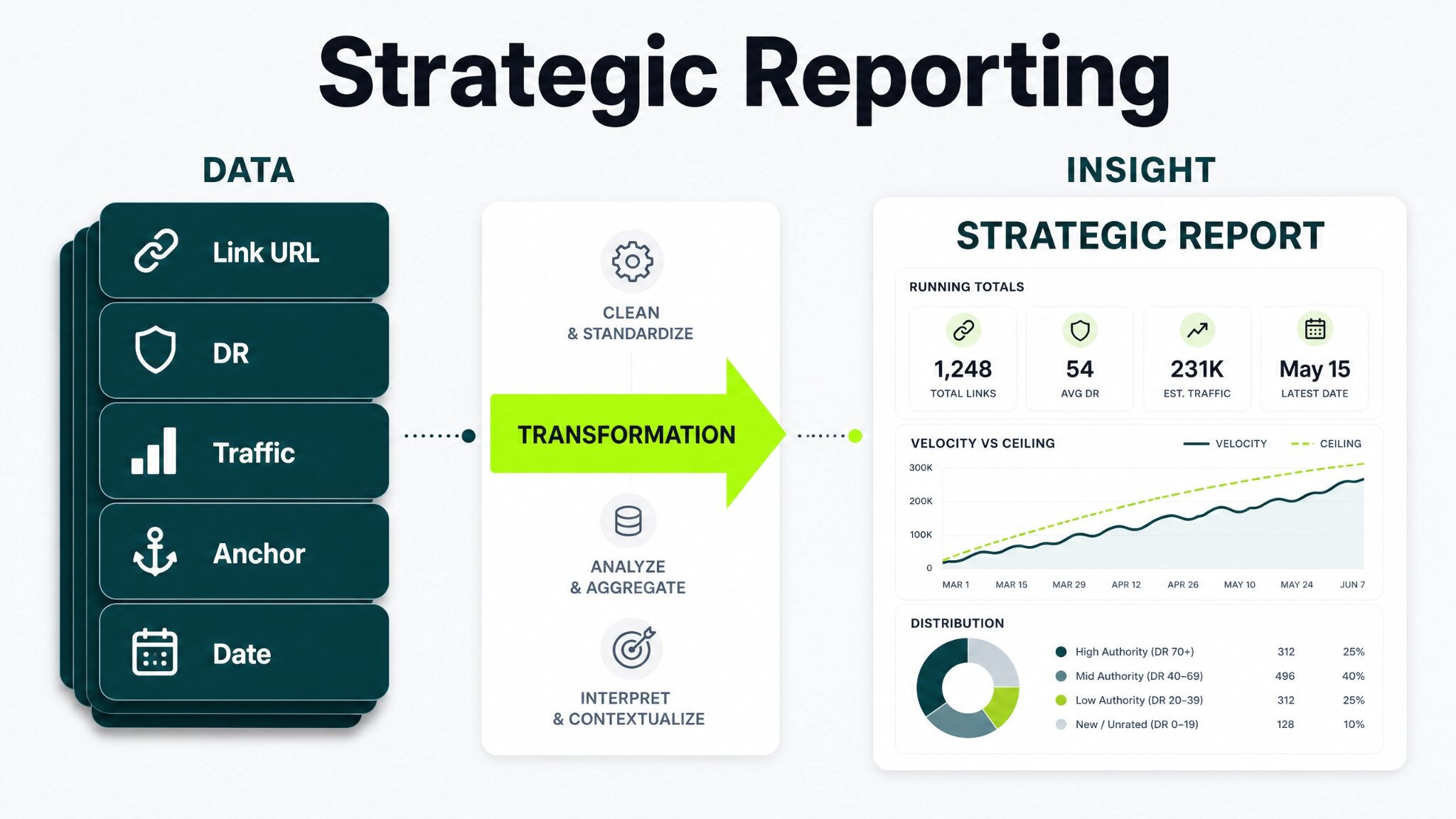
A complete white label report gives you the data you need to brief the next month intelligently.
The Placed Link URL
The full URL of the page where the link lives, including the specific article path, not just the domain. A domain name alone isn’t enough to verify the placement or check whether it’s still live.
Domain Rating and Monthly Organic Traffic Together
Every report should list both DR and current monthly organic traffic for each referring domain. DR without traffic tells you nothing about whether the site is still actively read.
A domain with DR 65 and 200 monthly visitors is a different asset from a domain with DR 65 and 12,000 monthly visitors. One of those links is worth defending to a client.
The other is harder to justify when rankings don’t move, and you can’t point to credible publishers.
The Anchor Text Used
Record the exact anchor text linking to your client’s page, not a generic label like “brand anchor.”
You need this to track whether placed links are building the distribution you specified in the brief, and to catch any drift before it compounds.
The Date of Placement
The date each link went live. This lets you match placements against ranking changes over time, and it starts the clock on your provider’s replacement policy window.
Running Campaign Totals
A summary at the bottom: total unique referring domains to date, current anchor distribution across all placements, and links placed this month vs. the velocity ceiling.
This section is what separates a deliverable report from an operational one. Without it, each monthly order starts from scratch.
Before You Place Your First Order
Before you place your first white label order, pull the anchor text report for your most important client.
If you can’t see the current split between brand anchors, partial-match anchors, and topical anchors, you don’t have what you need to brief a provider.
That report is where your brief starts.
Not sure whether to build in-house or partner with a white label provider?
Talk to our experts about the most cost-effective way to scale link building without compromising quality and client trust.
Is the white label link building process safe?
Yes, the white label link building process is safe when you work with a trusted link building partner and set clear campaign guidelines from the start.
Problems usually happen when campaigns lack clear instructions, leading to unnatural anchor text patterns or link growth over time.
Choose a provider that shares referring domain traffic data, not just DR, and clearly define your anchor text and monthly link targets before every campaign.
How much does white label link building cost?
Cost varies by link type and the quality of the target domains. Guest post placements on higher-traffic, topically relevant sites cost more than niche edits on lower-traffic domains, and pricing increases with the target site’s traffic and relevance.
As a starting point, ask prospective providers for a sample report showing the traffic and DR of domains they’ve placed links on at different price points. That tells you more than a price list alone.
What’s the difference between white label and outsourced link building?
In standard outsourcing for link building, the external team may be visible to the client. The client knows (or could find out) that a third party is doing the work.
White label adds the private-label layer: the provider’s identity stays hidden, all deliverables carry your agency’s branding, and the client relationship stays entirely with you. The process of building links is similar. The way it’s presented to the client is different.
How long does it take to see results?
Links influence rankings over months, not weeks. From what we’ve seen across campaigns, meaningful ranking movement from link building typically becomes visible between 3 and 6 months after consistent placements go live.
The variables that affect that window are how competitive the target keywords are, how strong the client’s existing backlink profile is, and whether placements happen at a consistent pace month over month.
White label link building doesn’t shorten that timeline; it determines who builds the links within it.