Edu backlinks are links from university and college websites that point to your website.
Many professionals pursue them because educational institutions are often seen as trustworthy sources, but the value of these links depends on where they appear and how relevant they are to your site.
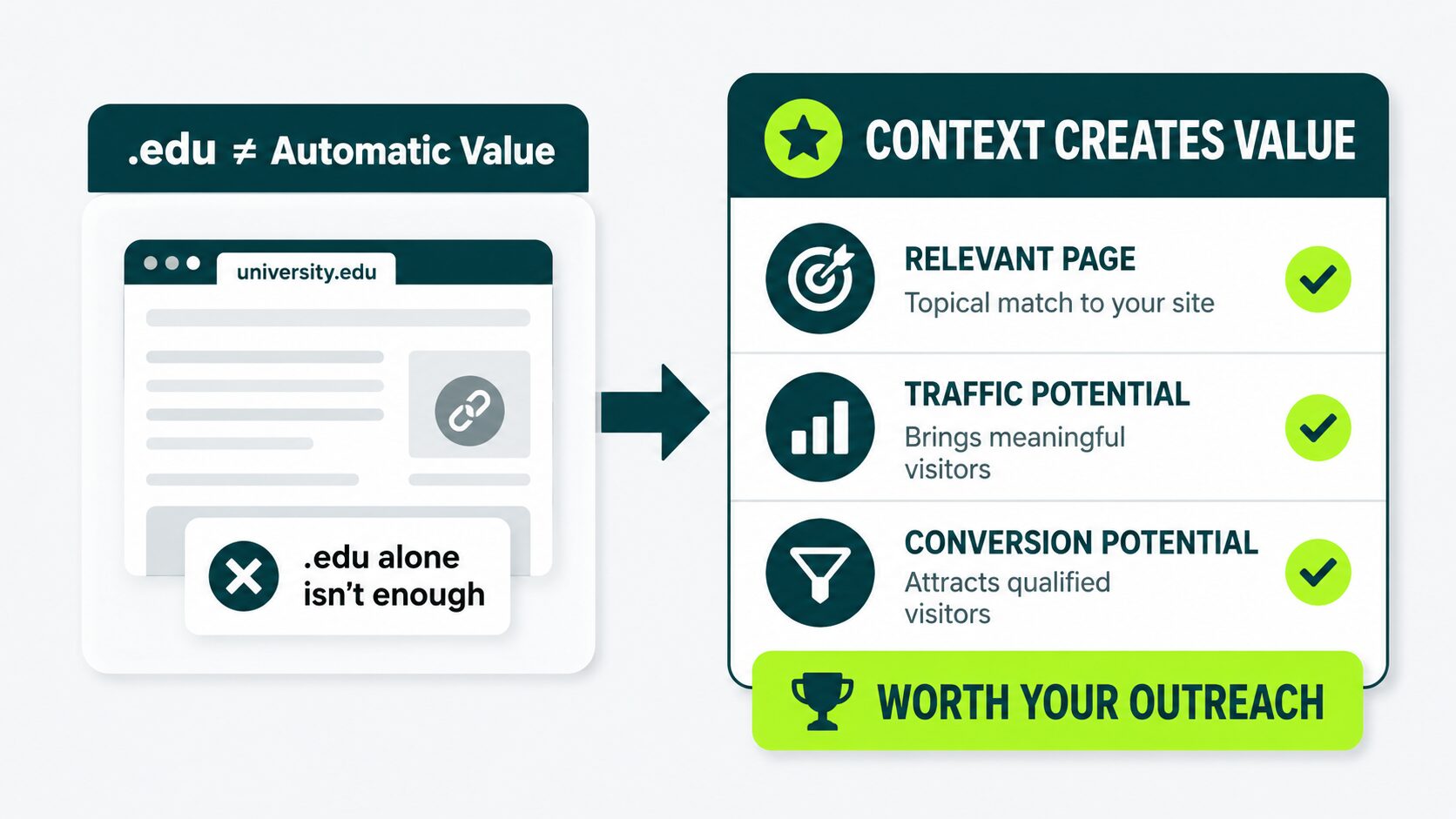
Not every .edu backlink deserves your outreach efforts. Edu backlinks can help when they come from relevant, trusted university pages, but their value depends more on context than the .edu domain itself.
Before you invest time chasing them, look at the page’s relevance, traffic potential, and likelihood of converting qualified visitors to your site.
Understanding those factors helps you separate worthwhile opportunities from backlinks that add little real SEO value.
What You’ll Learn
- The .edu extension itself doesn’t move rankings; the page that links to you does.
- A 4-question test tells you whether edu backlinks are a good fit for your specific situation.
- Four free tactics that work for solo founders are resource page pitches, broken link replacement, faculty interviews, and free tools.
- Scholarship campaigns work for some businesses, but are a poor first edu link tactic for almost everyone.
- Vet every candidate with a relevance, placement, and traffic test before sending a pitch.
- The mistakes that kill most of the campaigns happen at the prospecting stage, not the pitching stage.
What Edu Backlinks Actually Are
An edu backlink comes from a website using the .edu domain extension. Only accredited American post-secondary institutions can register one.
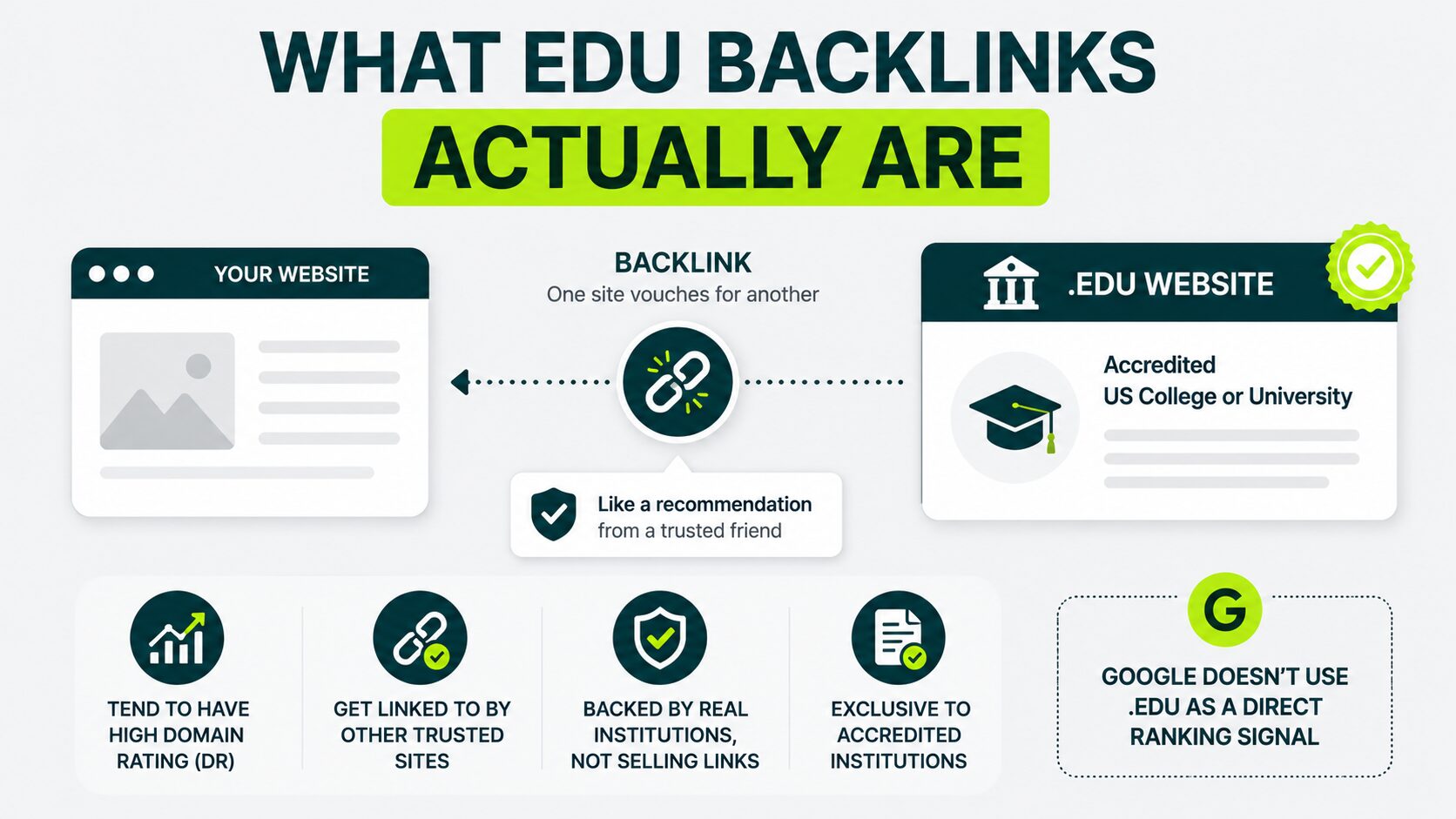
A backlink is one website vouching for another. Think of it like a friend recommending you for a job.
Similarly, .edu backlinks are recommendations from accredited colleges or universities.
Edu backlinks get so much attention because this extension isn’t open to anyone with a credit card or a domain registrar. Only a real, accredited educational institute can use it.
That exclusivity often makes the .edu sites appear more authoritative and trustworthy, which is one reason they attract so much attention in SEO.
You’ll often hear people point to a few common characteristics of .edu websites. Many have a high Domain Rating (DR is a 0 to 100 score from the SEO tool Ahrefs that estimates the strength of a website’s backlink profile).
They also tend to attract links from trusted websites, and because they’re operated by established educational institutions, they’re far less likely to be selling links or pages.
Each of those is true; what’s also true is that Google doesn’t treat the .edu extension itself as a ranking signal.
Do Edu Backlinks Actually Move Rankings?
The .edu domain itself doesn’t give you a bonus.
Edu backlinks help when they come from a relevant, trafficked university page, and do nothing when they come from a profile or directory page nobody reads.
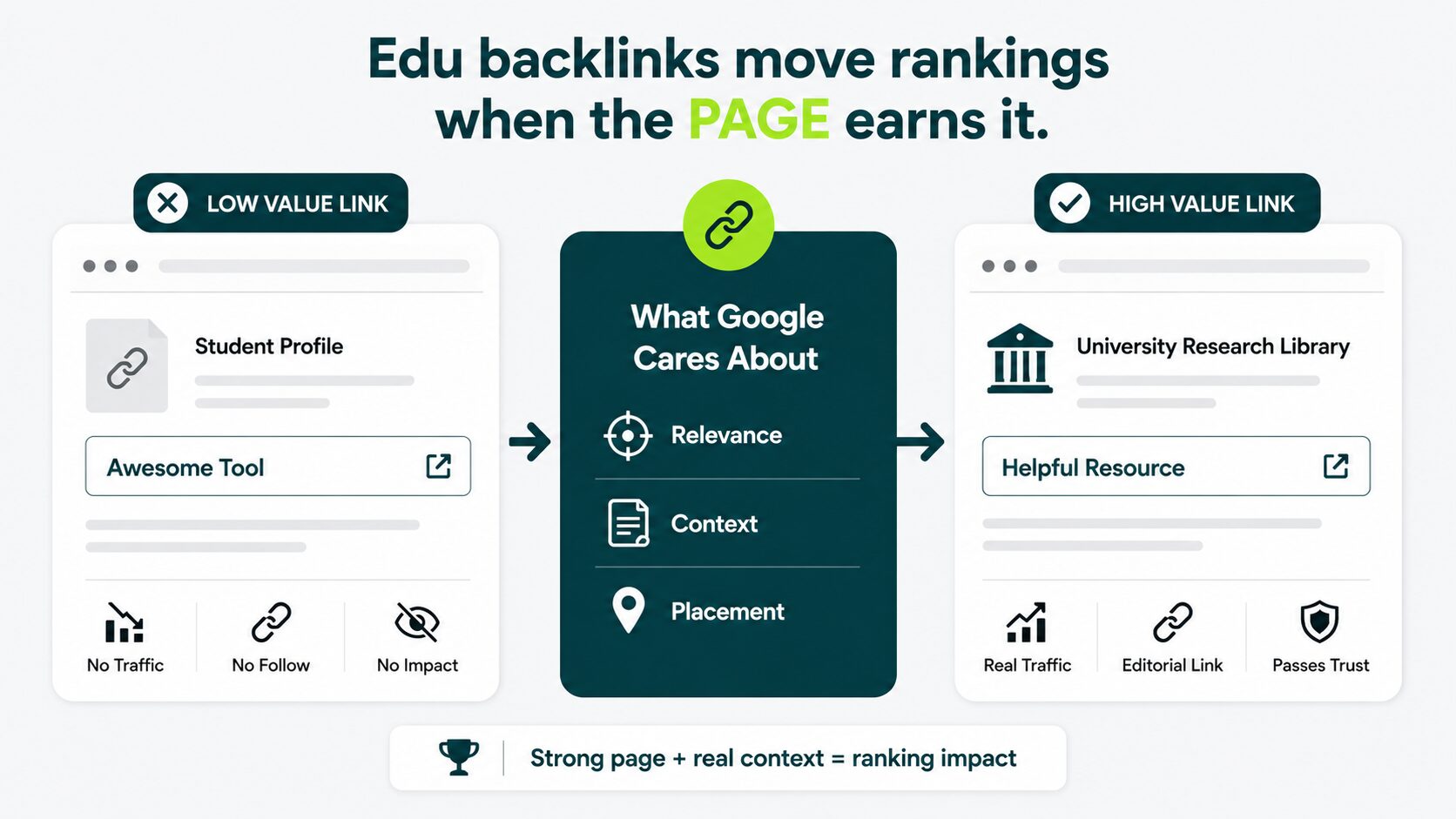
Google’s link best practice states that “Google uses links as a signal when determining the relevancy of pages.” Good anchor text (the clickable words readers see) should be descriptive, reasonably concise, and relevant to both pages.
There’s no clause about .edu domains in that documentation. Just relevance, context, and placement.
There are Two Reasons Edu Links Feel Powerful
1. Earned Authority
Plenty of .edu pages have built up real authority over the years as other strong sites have cited them. When a research library or a journalism department links to a useful tool, the link inherits that page’s earned trust.
The trust comes from the page’s track record, not the .edu in the domain name.
2. Editorial Discipline
Edu sites tend to be careful about who they link to. Internal review processes, faculty oversight, and content guidelines mean most outbound links are intentional.
That alone makes them more useful to Google than a sponsored placement on a content farm.
Where the Myth Breaks
A nofollow link from a dusty student profile page that gets 4 visits a year is worth almost nothing. The DR 88 domain doesn’t save it.
The page is the unit Google cares about, not the domain extension.
Before You Chase Any Edu Link: The 4-Question Decision Test
Most first-year founders shouldn’t chase edu backlinks. The four questions below will tell you whether you’re the exception.
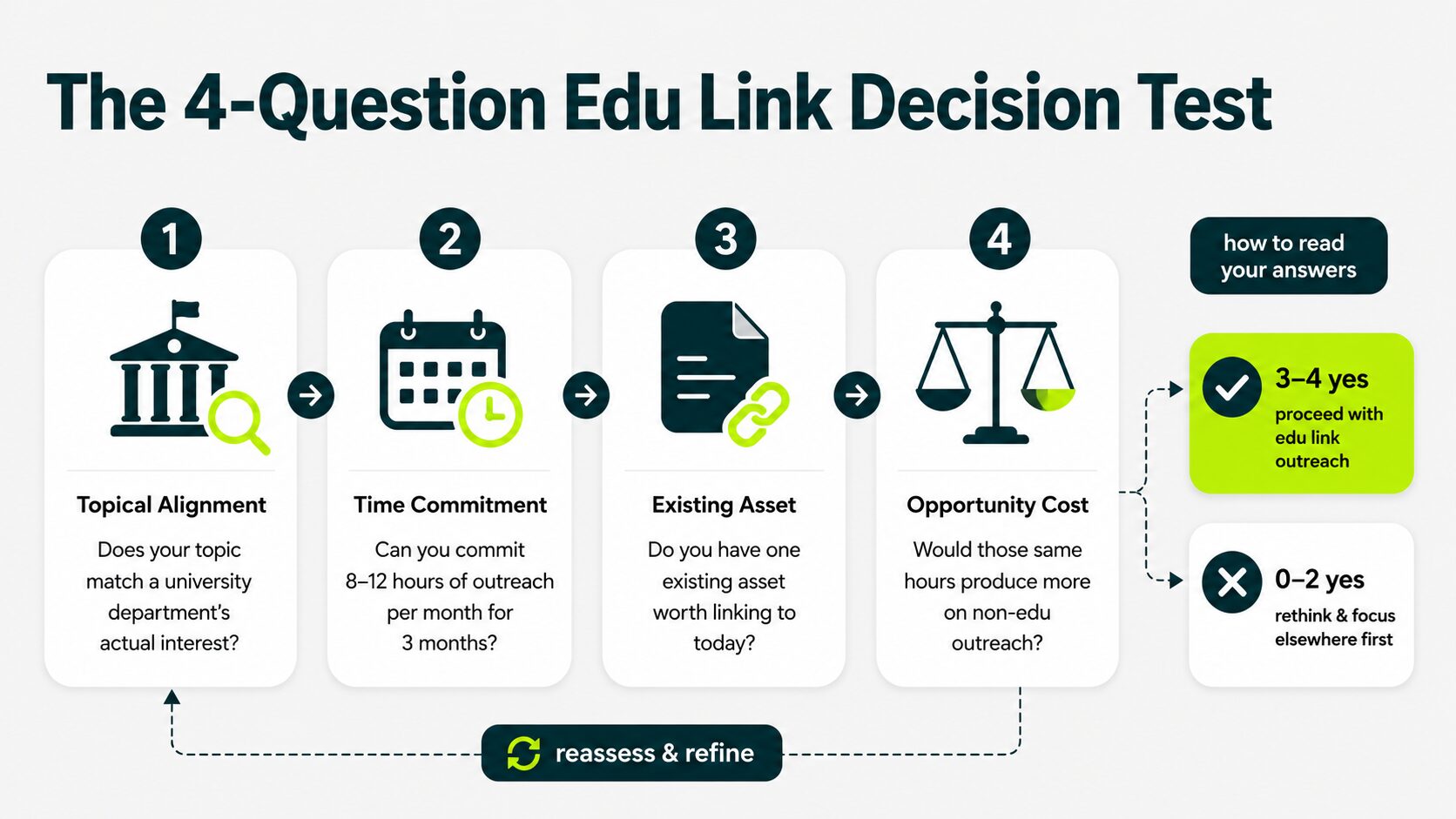
Question 1: Does Your Topic Match a University Department’s Actual Interest?
If your business doesn’t touch a topic some real university department teaches, researches, or supports, edu links are almost always the wrong target.
Here are some relevant examples:
- A coding bootcamp can find a logical home on a computer science department’s resource page.
- A budgeting app can land on a financial aid officer’s list of external links.
- A career assessment tool can land on a career center’s reading list.
- A veterinary practice building local authority can land on a vet school’s externship partner page.
- A specialty pet treat ecommerce store can’t, no matter how good the product is. There’s no department whose mission includes that product.
The test isn’t whether a university student might use your service. Most universities have students who might use almost anything.
The test is whether a faculty or staff member would write your page name onto a list they maintain. If the answer is no, you can stop here. The same principle holds true for backlinks in general, not just .edu sites. Before pursuing any placement, it helps to know what makes a link relevant in the first place.
Question 2: Can You Commit 8 to 12 Hours of Outreach Per Month for 3 Months?
Edu campaigns don’t pay back fast. Plan for 24 to 36 hours of focused work spread across three months before any link lands.
Split that time into three outreach blocks (personalized emails asking site owners to link to your page).
Block 1: Prospecting
You’ll search for relevant pages, vet each one, and build a list of 30 to 50 real candidates.
Block 2: Pitch Writing
Every email must be specific to the page, which means reading what the department already links to.
Block 3: Follow-Ups
Most first emails get no reply, and a second or third reminder is what moves things.
If the math on those hours feels heavy against your other priorities, this isn’t the moment to start. Build the asset first, or move to a tactic with a shorter feedback loop.
Question 3: Do You Have an Existing Asset You Can Link to Today?
Universities link to specific pages, not just your homepage.
Without a page that genuinely deserves a spot on the resource list, close the gap before outreach starts.
Linkable assets share a pattern:
- They solve a real problem clearly.
- They’re free to use.
- They hold up if a librarian skims them.
Examples that work:
- A free calculator
- An original data report
- A step-by-step guide that no one else has written
- A glossary
- A reading-level checker
Examples that don’t work
- A sales page with three paragraphs of feature copy
- A generic blog post that paraphrases what’s already on the web
- A product comparison page
If you don’t have a link-worthy asset like that, you need to fix that gap first.
Question 4: Would Those Same Hours Produce More on Non-edu Outreach?
If you can name three blogs, podcasts, or industry sites in your niche where a pitch has higher odds, those should win the hours instead.
Edu links sound distinguished, which is why they pull beginners in first. The math sometimes favors them and sometimes doesn’t.
A DR 50 link in your direct niche, with audience overlap, often does more for rankings than a DR 75 edu link from an off-topic department.
Treat edu links as one option to evaluate, not a default tactic.
How to Read Your Answers
Answer all four questions honestly, then apply the rule.
If you answer “no” to question 1 or question 4, skip the edu links and put the time elsewhere.
The math doesn’t work for your situation, and no amount of clear outreach changes that.
If you answer “no” to question 2 or question 3. Fix the gap first.
Build the asset before you pitch, and open the calendar block before link prospecting. Both gaps are recoverable on their own.
If you answer “yes” to all four, then you’re the exception.
In Outreach Desk campaigns, the edu links that actually landed almost always came from businesses that could answer “yes” to all four questions before outreach began.
Free Ways to Earn Edu Backlinks That Actually Work
Four tactics consistently work for solo operators in 2026: resource page pitches, broken link replacement, faculty quotes or interviews, and offering a free tool that a department can list.
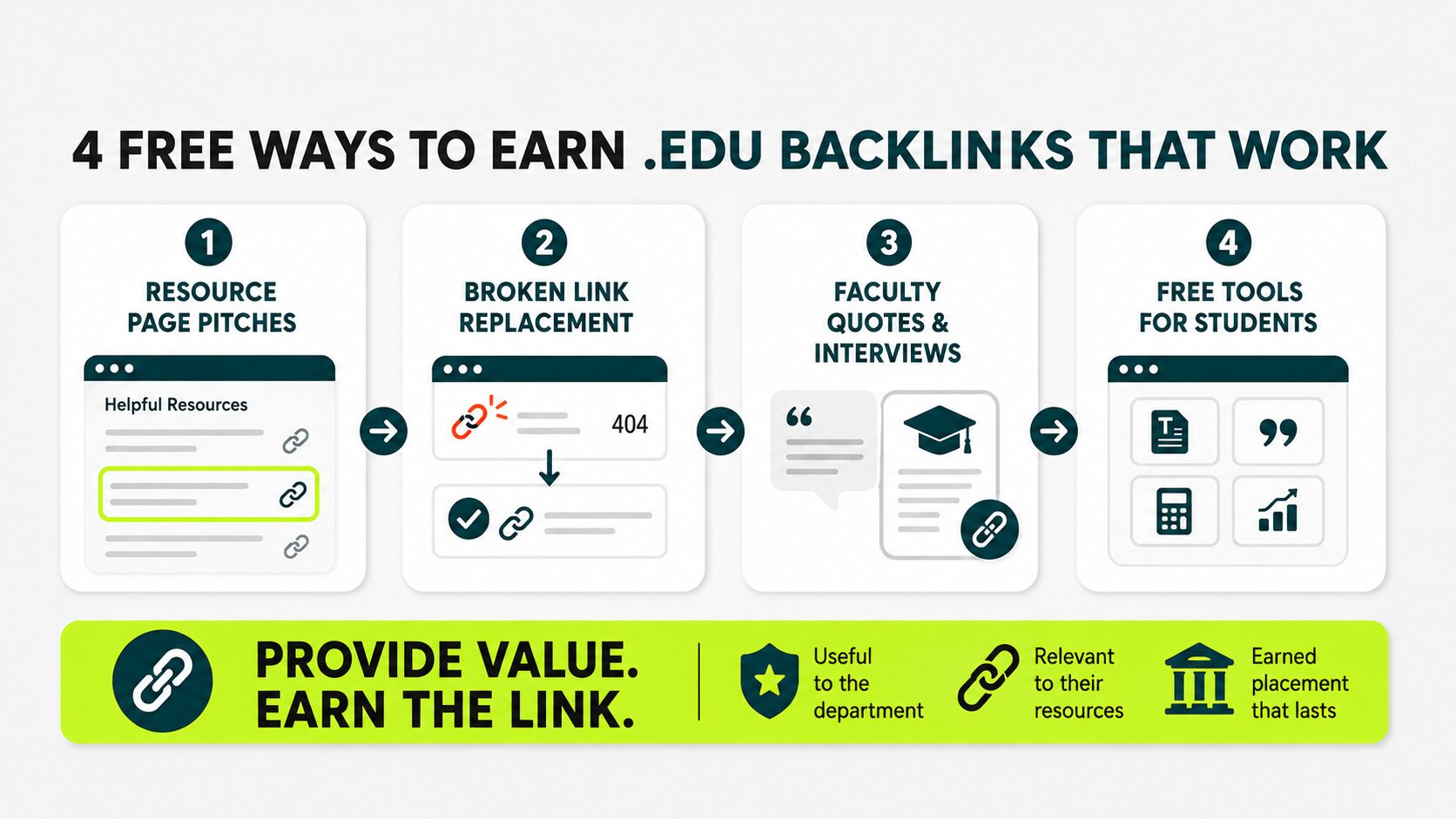
Resource Page Pitches
Resource page pitches work when a department maintains an outbound link page and your asset genuinely fits one of the topics the page covers.
A career center’s “helpful job search resources” page is a typical example. A finance department’s external link section is another. The page already exists.
The staff member who maintains it adds a link whenever they find something useful.
What the pitch should include
The pitch is short:
- Name the resource page you would like to consider.
- Explain how it fits the page’s stated theme in one sentence.
- Leave a clear contact at the end.
Common rejection pattern
- The page hasn’t been updated in the past two years.
- The page is locked to internal tools.
- Your resource reads as a product or sales page rather than a genuinely useful reference.
The fix for the third pattern is to anchor the pitch to a free guide or tool rather than a product page.
The complete prospecting workflow lives in our guide on how to earn a resource page link, it applies to any domain extension, including .edu.
Broken Link Replacement
Broken link replacement works when you find a dead link on a university page and offer a working alternative that genuinely matches the topic.
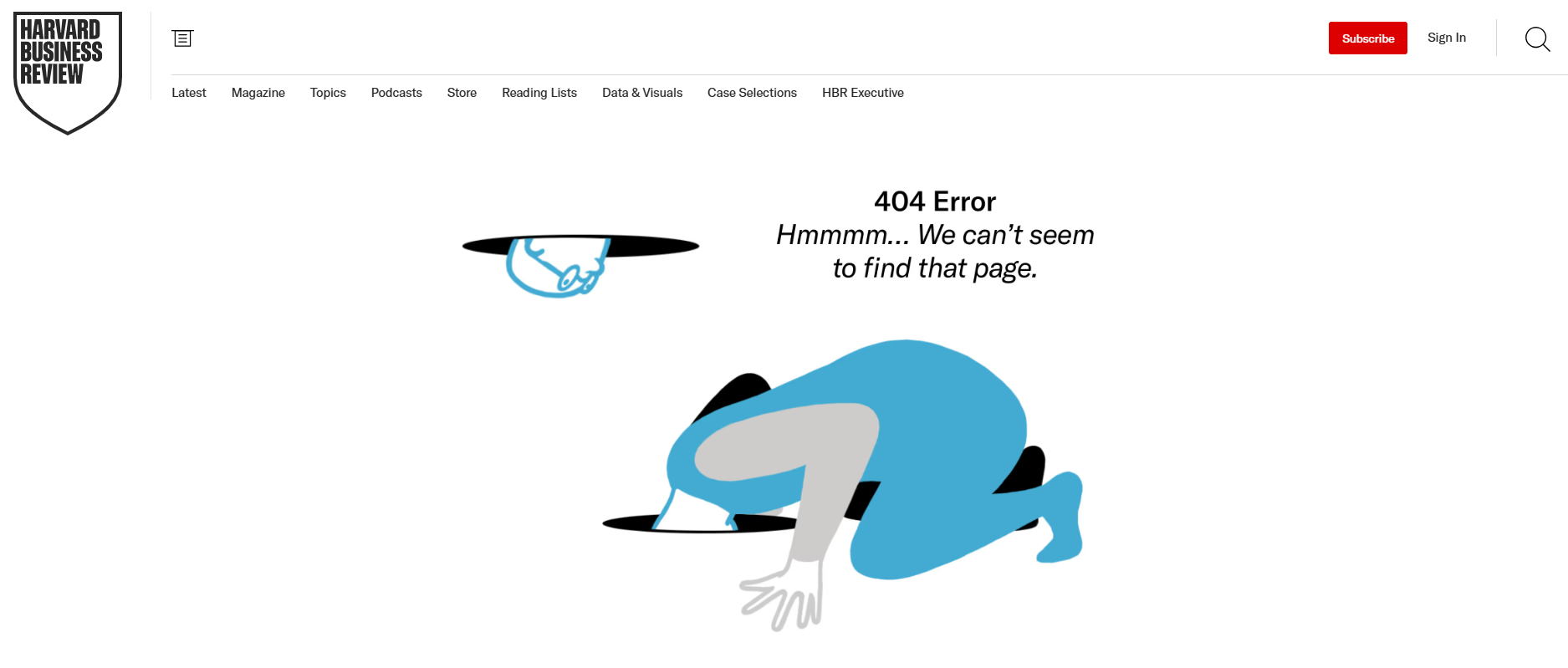
The workflow is straightforward and usually follows three specific steps:
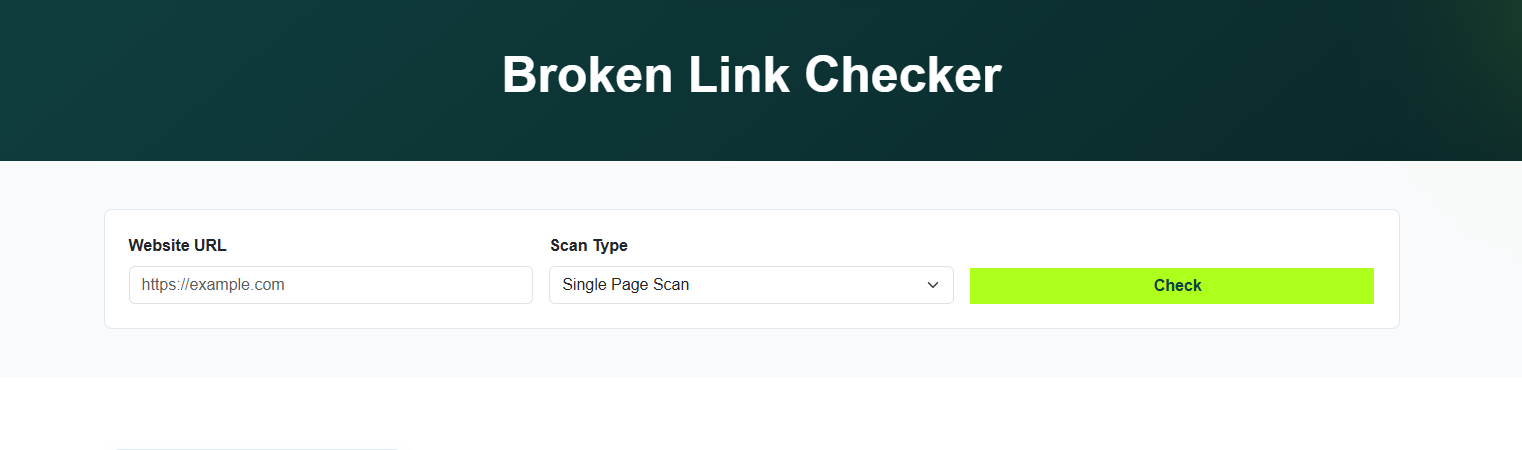
Start by running a crawler (a tool that automatically scans and checks web pages for links), or use a free broken link checker on a department page that already links to external resources.
Then identify any 404 links (dead links that return an error) where the original topic matches a page on your site.
Email the page maintainer with a short note like, “I noticed this link is dead, here’s a similar resource that’s live.”
The most common mistake that kills this tactic is forcing the match.
If the dead link points to a free Python tutorial and your replacement is a paid Python course landing page, the maintainer won’t swap it in. The replacement should look like a like-to-like alternative at first glance.
For the complete broken link prospecting workflow, see our guide on the broken link approach.
Faculty Quotes and Interviews
Reach out to faculty researching topics adjacent to your business. Offer to either quote them in an article on your site or interview them on your podcast.
Faculty often share the content in which they are featured.
A professor whose research appears in your article will frequently link to the article from their faculty page or department bio.
The link is the clear editorial placement, the kind that Google actually values.
What the pitch should include
The pitch needs a real story angle. The simpler opener is “I write about X, and I’d love to feature your work on Y.”
Then you can also offer specifics such as:
- The question you’d ask
- The article you’re working on
- How much time you’ll need from them
Five minutes via email is doable for many faculty members. A 30-minute video call is harder to secure unless you can point to an established audience or publication.
Common rejection mistakes
Most rejections come in the form of silence. Professors get a lot of cold outreach. The ones who reply are usually the ones whose topic you engage with substantively, not the ones with the biggest names.
If you’d rather contribute directly to a department blog, the process is similar to the approach outlined in guest contributing as outreach.
Free Tools for Students
Build a small free tool that solves a real problem for students or staff, and pitch it to departments whose work overlaps with the tool’s topic.
For example, the most relevant tool depends on the department:
A writing center may prefer resources that support academic writing. A financial aid office is more likely to share tools that help students plan and manage expenses. Common examples include:
- A grammar checker for non-native English writers
- A citation generator
- A budget planner for first-year living costs
- A free reading-level analyzer
None of these requires much polish.
They work, they’re free, they require no sign-up, and they solve a problem that maps to the department’s mission.
How the pitch works
The tool does the convincing; the pitch just needs to introduce it.
Here’s a simple pitch:
Subject: Potential Addition to Your Student Resources Page
“Hi [Name],
We recently built a free tool called [Tool Name] to help students with [specific task or challenge].
Since your department supports students in [relevant area], I thought it might be a useful addition to your resources page. You can view it here: [URL].
If you think it would be helpful for students, we’d appreciate your consideration.
Thanks for your time.
Best,
[Your Name]
[Organization]”
Simple, short, specific, and with no asks beyond consideration.
The biggest constraint
The slowest part is building, not the outreach.
If engineering resources are tight, lighter-weight asset formats earn the same kind of placement. Examples include downloadable templates, checklists, calculators, research summaries, and other practical resources that provide clear value to students or staff.
Paid Approaches: Scholarships, Sponsorships, and Realistic Cost
Scholarships, event sponsorships, and student discount programs are the three paid routes that earn .edu placements. None of them is a fast or guaranteed return.
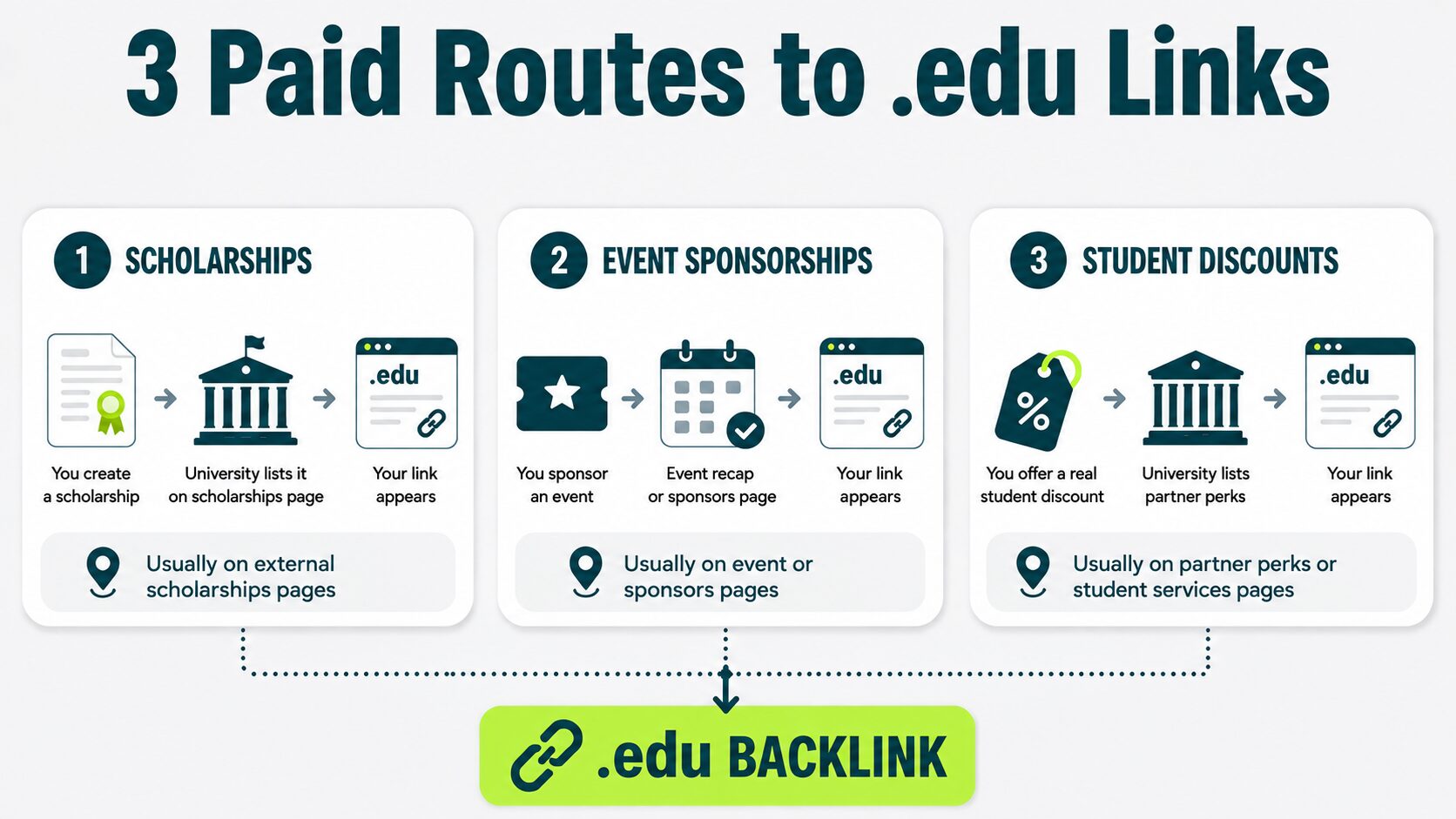
Scholarships
A scholarship program can earn .edu links when a real student wins an award. Universities then list the scholarship on their financial aid or external scholarships page.
The mechanics are simple in theory. Here’s how it works.
- Create a scholarship with clear eligibility rules and an application process.
- Build a page on your site explaining the scholarship and how to apply.
- Reach out to scholarship officers and financial aid pages at relevant universities, asking to be listed.
If they list you, the page is usually an .edu external scholarships directory.
The reality is harder. Google has explicitly called out scholarship link schemes as a manipulative tactic in its spam guidance, and many universities have responded by tightening which scholarships they list or adding nofollow to outbound links.
The pages that don’t apply nofollow tend to require a meaningful award amount, typically $1,000 or more, and a transparent application and selection process that the university can verify. This distinction between a legitimate scholarship campaign and a spammy one is covered in more detail in this scholarship link building strategy.
Why it’s usually a poor first campaign
You pay the fixed costs (the award itself and the administrative time) before you know whether a single university will list you.
If you’re going this route, treat it as a long-term brand play that produces some links. Don’t treat it as a link building tactic that happens to involve a scholarship.
Event Sponsorships
Sponsoring a campus event, club, or student organization can earn a sponsor mention on the event page, often with a backlink.
When this tactic works best
The tactic works best when the sponsorship is genuinely relevant.
- A code-review tool sponsoring a hackathon makes sense.
- A pet treat brand sponsoring a debate club doesn’t, and the sponsorship office knows the difference.
The costs vary widely:
- A small student-run hackathon might take a $250 contribution.
- A larger event might run $2,500 or even more.
Where the link usually appears
If the link appears, it lands on an event recap or sponsors page, which has lower DR than a department homepage.
The value depends on whether the page gets actual traffic and stays live after the event.
This breakdown of sponsoring and hosting events for backlinks covers how to vet an event before you commit and negotiate the placement once you’re in.
Student Discount Programs
Offer a meaningful student discount and submit it to the university’s perk pages and student services offices.
The discount must be real
The discount must be meaningful.
- A 10% off coupon code doesn’t qualify.
- A discount in the 30% to 50% range is generally substantial enough to qualify, though the right number depends on your product’s regular price point.
How this tactic works
Universities maintain perk pages for partner businesses, and these pages occasionally link out.
They’re not the most powerful edu links, but the efforts required are low relative to the link earned, provided you already have a verified student pricing tier in place.
Where this works best
This route works best for:
- Software
- Online education
- Productivity tools
- Customer subscriptions that students would actually use
Where it doesn’t work
It doesn’t work well for:
- One-time purchase products
- Services with thin student demand
The closer the offer aligns with a genuine student need, the more likely it is to gain traction with university perks and student service pages.
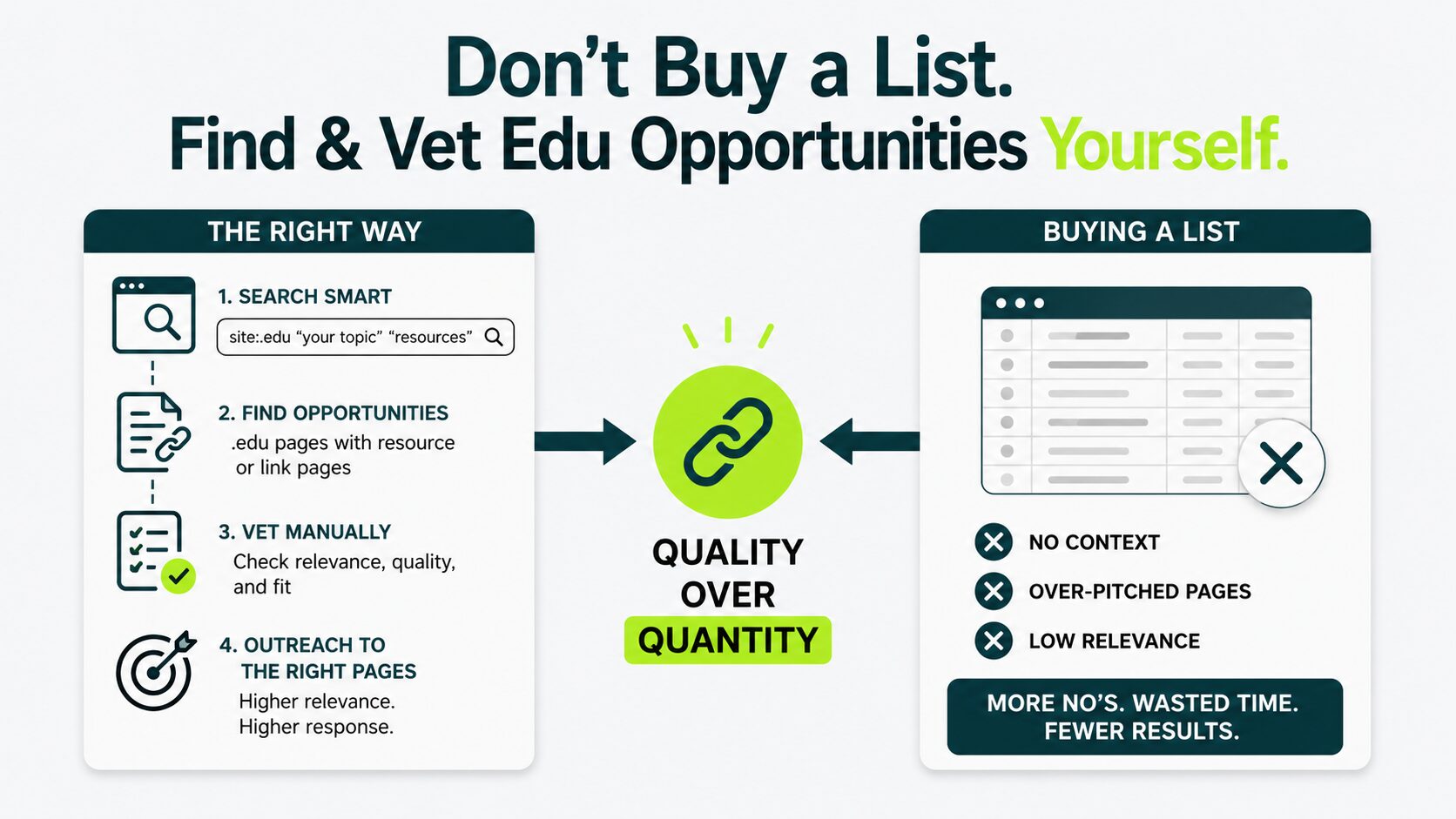
How to Find Edu Opportunities Without Buying a List
Use Google search operators to identify .edu pages that match your topic, then vet each candidate.
Start With Search Operators
The starting operator looks like this: site:.edu “your topic” “resources”
You then swap “your topic” for the specific topic your asset addresses. And swap “resources” for whatever container word the page would use, such as:
- “links”
- “tools”
- “reading list”
- “external resources”
- “recommended
Each container word returns a slightly different page.
Finding Broken-Link Opportunities
A second operator that identifies broken link opportunities is site:.edu intitle:”resources” intext:”404”. This works because many broken link pages display “404” or “Page Not Found” directly in the page text.
Though some sites handle errors differently, this operator won’t catch every dead link, only the ones that surface the error as visible text.
Vet Every Candidate Manually
Once you have a candidate list of 30 to 50 pages, the next step is the slow part. Open each page, confirm if it’s still maintained, review the existing links, and decide whether your asset belongs alongside what’s already there. Most pages won’t make the cut.
Why Buying a List Doesn’t Solve the Problem
A purchased list skips these vetting steps entirely.
Shared “edu domain databases” circulating in SEO forums tend to be widely recycled. The same set of pages gets pitched repeatedly by anyone who buys the list, which means maintainers have often already rejected or ignored most of these requests.
How to Vet a Specific Edu Opportunity Before You Invest Time
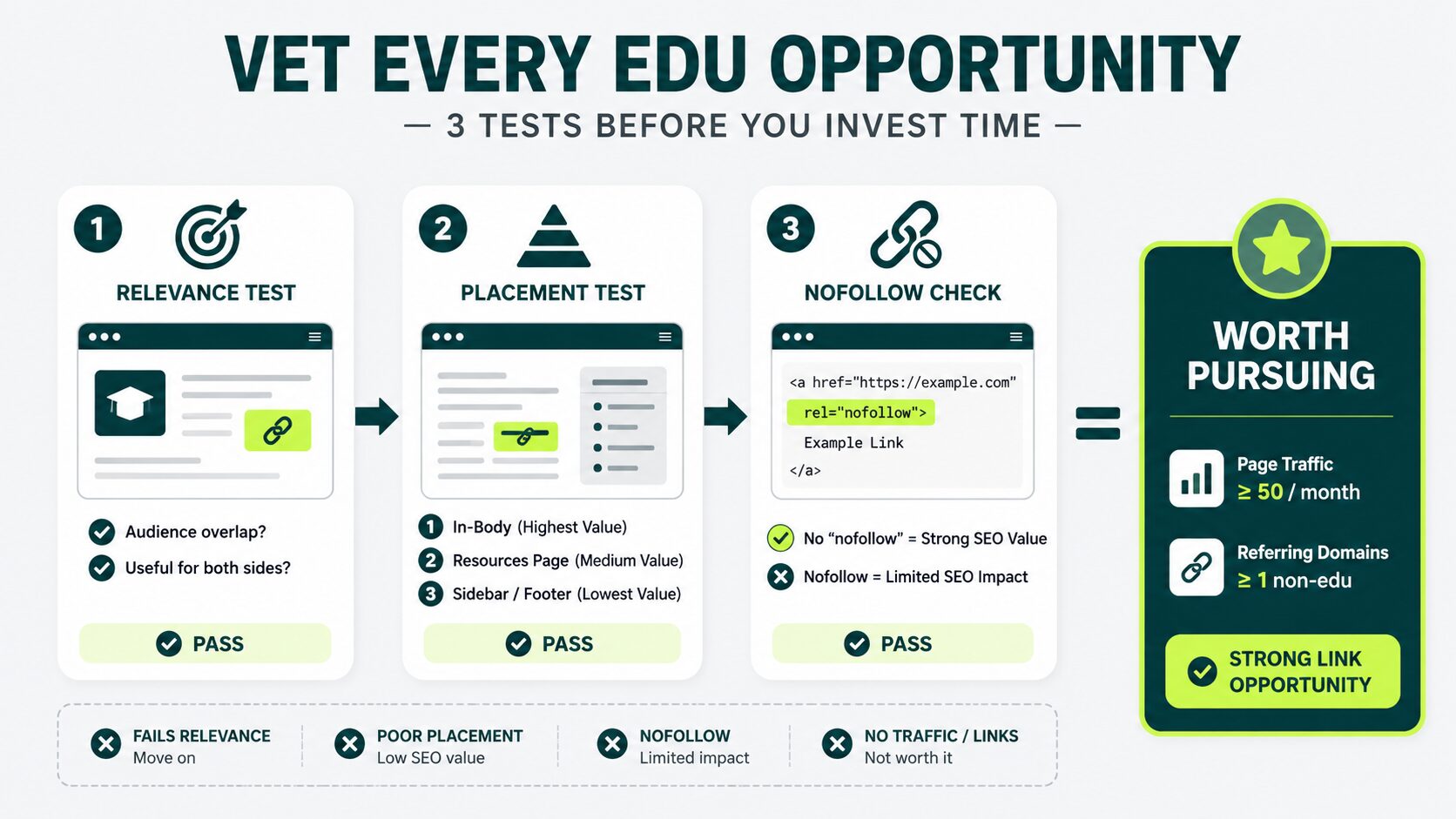
Run three tests on every candidate page before sending a pitch. Most candidates fail at least one.
The Relevance Test
Ask whether the page’s audience overlaps with your customer in a way that makes the link useful to both sides.
Consider the difference between these pages:
- A computer science department’s resources page linking to free coding tools is relevant to a developer learning platform.
- A general university homepage isn’t, even though it has a higher DR.
- A career center’s external links page is relevant for an interview prep app. A campus event calendar isn’t.
Two questions to ask
- If a student found this page and clicked your link, would they actually be in the market for what you offer?
- Would the link improve the page for the maintainer’s audience, or is it only useful for you?
If the answer to either question is no, the page failed the test. You should probably move on.
The Placement Test
Where on the .edu page the link appears matters more than the domain’s DR. There are three tiers ranked by SEO value.
1. In-Body Links Inside an Article or Guide
The value is highest. The contextual link placement that appears inside the content that a reader engages with.
2. Resources Page Links Inside a Topic-Organized List
It has a medium value. The link is intentional, and the page is maintained, but the surrounding content is thinner than an in-article placement.
3. Sidebar, Footer, or General Directory Links
It has low value. Even on DR 80+ domains, sidebar, footer, and directory links pass minimal authority; placement matters more than domain strength here.
One Quick Nofollow Check
Check whether the link carries a rel=”nofollow” attribute.
Some universities apply nofollow to most outbound links, especially on scholarship pages and lists of perks.
A nofollow link still has brand value, but its direct SEO impact is small. Inspecting the element on the candidate page takes 3 seconds.
The Authority and Traffic Test
A DR 70 .edu page that gets 4 monthly visits is worth less, as a link source, than a DR 50 .edu page that gets 4,000. Look at the page-level metrics, not just the root domain.
Most SEO tools show:
- Traffic to the specific page
- Referring domain (other sites pointing to that specific page)
These metrics are more useful than looking only at the overall domain. If the page has no traffic and no referring domains, it has failed the test. The page itself is likely orphaned or ignored, and a link from it offers limited link value regardless of the domain’s overall authority.
A Reasonable Minimum Standard
A reasonable floor for a candidate is:
- At least 50 monthly visits to the page.
- At least one referring domain that isn’t another university page.
Below that, the page is effectively invisible. Too few people see it as a link there to send meaningful value or traffic your way.
Our guide to how to earn high-quality backlinks breaks down what makes any link worth pursuing.
Where Most Edu Campaigns Fail
Most edu campaigns fail before the first reply lands. Here are the five most common failure patterns and what the fix looks like.
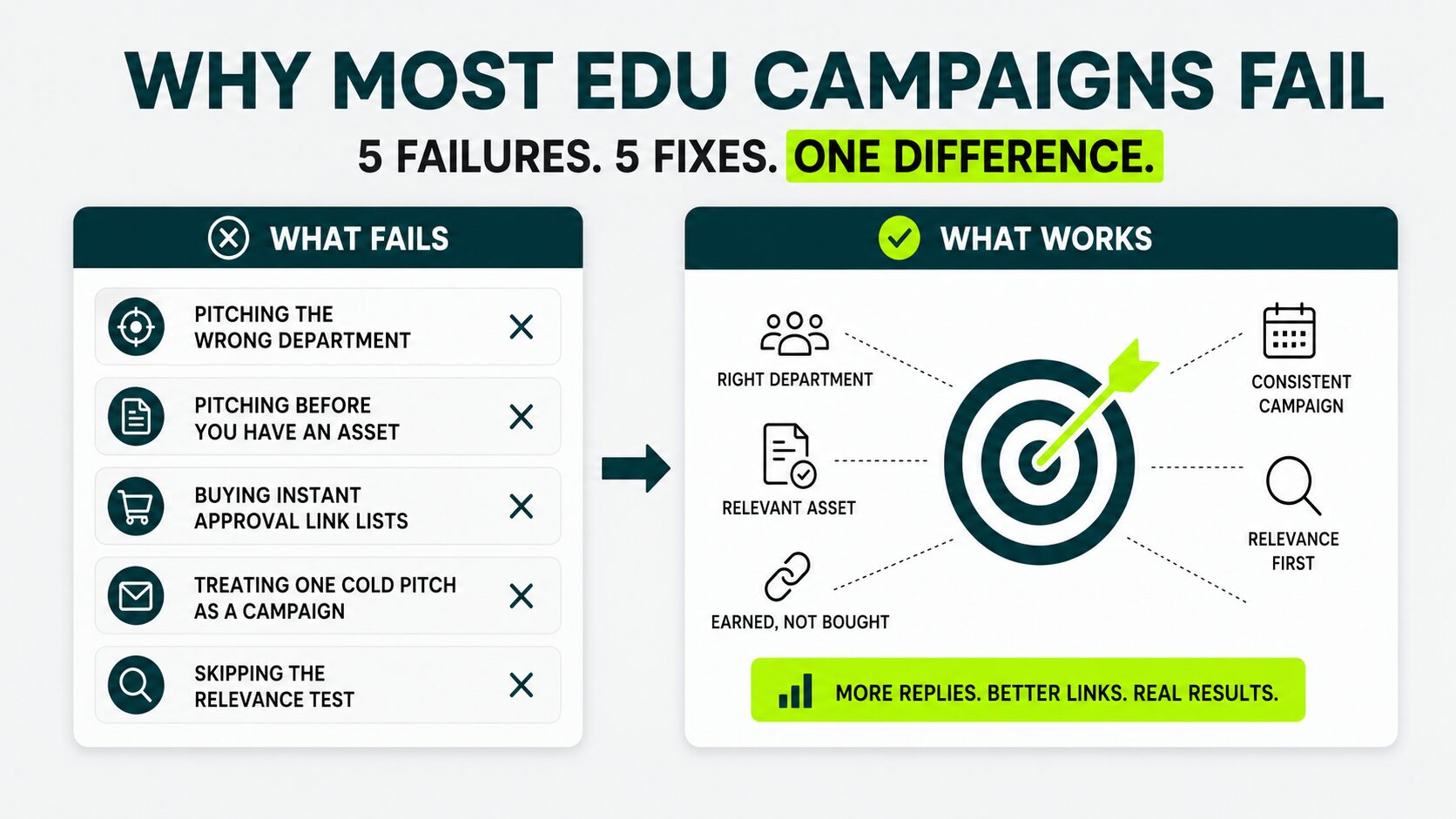
Pitching the Wrong Department
You sent a great pitch about your career-prep tool to the math department. The math department doesn’t maintain a career page, and your pitch dies in someone’s inbox without a reply.
The fix is to do the prospecting work in the previous section before composing any email. A pitch to the right page is short and lands. A pitch to the wrong page is long, defensive, and ignored.
Pitching Before You Have an Asset
You email a librarian asking them to link to your homepage or your product page. The librarian’s job is to maintain a useful page for students, not to drive traffic to your business.
The fix is to point every pitch at a specific free asset that genuinely belongs on the page you’re pitching. Build that asset first if you don’t have one. The asset is what you pitch.
Buying Instant Approval Edu Link Lists
You bought a $30 service that promised “instant approval edu backlinks.”
What landed in your dashboard was a list of profile-page links, comment dumps, and forum posts on domains that happen to use .edu.
The two problems
- These links are usually nofollow, have little to no traffic, and the pattern of mass-placed profile and comment links is the kind that Google’s spam systems are specifically built to detect.
- Google’s link spam policies cover this exact pattern, and the cleanup work is harder than the time it would have taken to earn one real link.
The fix isskip these services entirely.
Stick to white hat link building principles instead: valuable content, relevant outreach, and genuine relationships. Shortcut tactics like this one tend to cost more in cleanup than they ever saved in time.
Treating One Cold Pitch as a Campaign
You sent one beautifully crafted pitch to a scholarship office, didn’t hear back for a week, and called the tactic broken.
Here’s the fix for volume myth: A real edu campaign sends pitches to 30 to 50 candidate pages over four to six weeks. It follows up two or three times on each, tracking which subject lines pull replies.
One pitch isn’t a campaign. It’s a guess.
Skipping the Relevance Test
You pitched a well-written email to ten different department resource pages, but none of them shared your topic.
The replies were polite but final, “This doesn’t fit what we link to.”
The fix is to run the relevance test from the previous section on every candidate before drafting the pitch. The test takes 30 seconds per page and saves you the hour you’d spend writing a pitch that can’t land.
A relevant prospect with an average pitch will usually outperform an irrelevant prospect with a great pitch.
Three Action Plans Based on Your Four Answers
Your action this week depends on which of the four decision-test answers you landed on. Each branch has a different step to take forward.
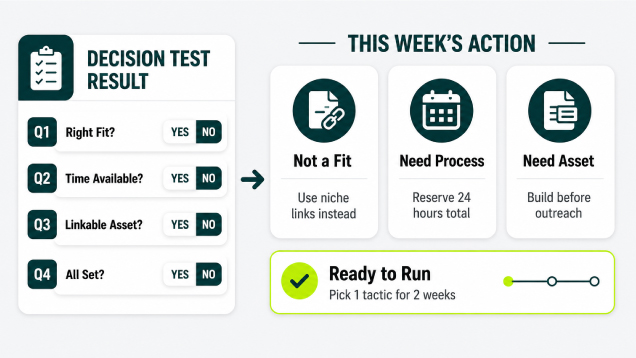
If Your Answer to Question 1 or Question 4 Was No, Edu Links Aren’t Your Tactic
If you answer no to either of those questions, pursuing edu backlinks is unlikely to deliver the impact you’re looking for.
Rather than investing time and resources into this strategy, focus on earning links from authoritative websites within your industry.
Relevant, high-quality backlinks from niche-specific sources typically provide stronger SEO value and are more likely to support your long-term growth objectives.
Our overview of core link building strategies is where to start.
If Your Answer to Question 2 Was No, Your Gap is Time and Process
Block 8 hours this week on the calendar, then 8 more each of the next two weeks. If you can’t commit those hours, the link campaign won’t work, no matter how good the prospect list is.
If Your Answer to Question 3 Was No, Your Gap is an Asset
Link-worthy asset formats and build the smallest version of each this week. The pitches start once the asset exists.
Pick one tactic from the free tactic section and run it for two weeks before adding another.
- Resource page pitches are the lowest-friction starting point if you have a clear asset.
- Broken link replacement is the better starting point if you’re earlier in the asset lifecycle and don’t have one yet.
If running the outreach yourself isn’t appealing, talk to the professional link building agency about a custom edu-friendly campaign that fits your stage.
Run the Test, Then Decide
Most first-time edu link campaigns fail to meet one of the four conditions above before they even start because of the wrong assets, timing, or capacity. The test exists to catch that before you spend the weekend, not after.
Run the test honestly. If your test results clear all four conditions, pick one tactic and give it 90 days. Edu links from outreach-based tactics usually take 4 to 8 weeks just to land, and longer still to show in rankings.
Not sure if edu backlinks are worth pursuing for your website?
Get a strategy for identifying and prioritizing the most valuable .edu link opportunities.
Are .edu backlinks dofollow?
Some are, but most aren’t. University scholarship pages and student profile pages frequently use the nofollow attribute on outbound links.
Resource pages maintained by individual departments often use the dofollow link attribute, but you can’t assume. Right-click the link, select “inspect,” and check the HTML for a rel=”nofollow” attribute before counting on the SEO value, or use a browser extension that flags nofollow links automatically.
How much do .edu backlinks cost?
If you’re earning them through scholarships, sponsorship, or discount programs, direct costs range widely. A small student event sponsorship might cost a few hundred dollars; an awarded scholarship runs into the thousands.
If you’re earning them through outreach to resource pages or faculty interviews, the cost is your time. As a rough benchmark, plan on 24 to 36 hours spread across three months to land your first one. Prospecting and vetting take longer than outreach itself.
There’s no reliable rate card for these links because they aren’t supposed to be for sale.
Can I buy .edu backlinks safely?
No, services that promise instant or bulk .edu backlinks deliver low-quality placements (profile pages, comment dumps, forum posts) that Google’s link spam policies were written to identify and discount.
Beyond the SEO risk, the placements rarely have any traffic, so they don’t even help with brand exposure. Earn the link or skip the tactic.
How long does it take to see results from .edu backlinks?
With a relevant, well-trafficked placement inside the real content, ranking movement typically becomes visible 4 to 8 weeks after Google’s crawler discovers the link. Though this varies by competition level and how authoritative the linking page is.
If the page has low traffic, no referring domains, or carries a nofollow attribute, the SEO impact is small. The high root domain’s authority doesn’t change that.