Most brands treating event sponsorships as a branding play are leaving some of the easiest backlinks in their niche on the table.
Conferences, webinars, community meetups, and industry awards create some of the easiest opportunities that competitors can’t copy with a cold email, because the link is tied to a real-world relationship. Event link building works when the event clears six checks.
Event link building helps you earn links by participating in, sponsoring, and hosting on event-related websites.
What You’ll Learn:
- How Google treats sponsor links, and why event backlinks still matter.
- The two paths into event link building (sponsor vs host), and when each fits.
- Where to find events worth your time in 2026.
- Six checks to run before you sign a sponsorship.
- How to negotiate placement, anchor, and link attributes with organizers.
- The 30-day post-event link velocity playbook most beginners skip.
What Event Link Building Actually Is
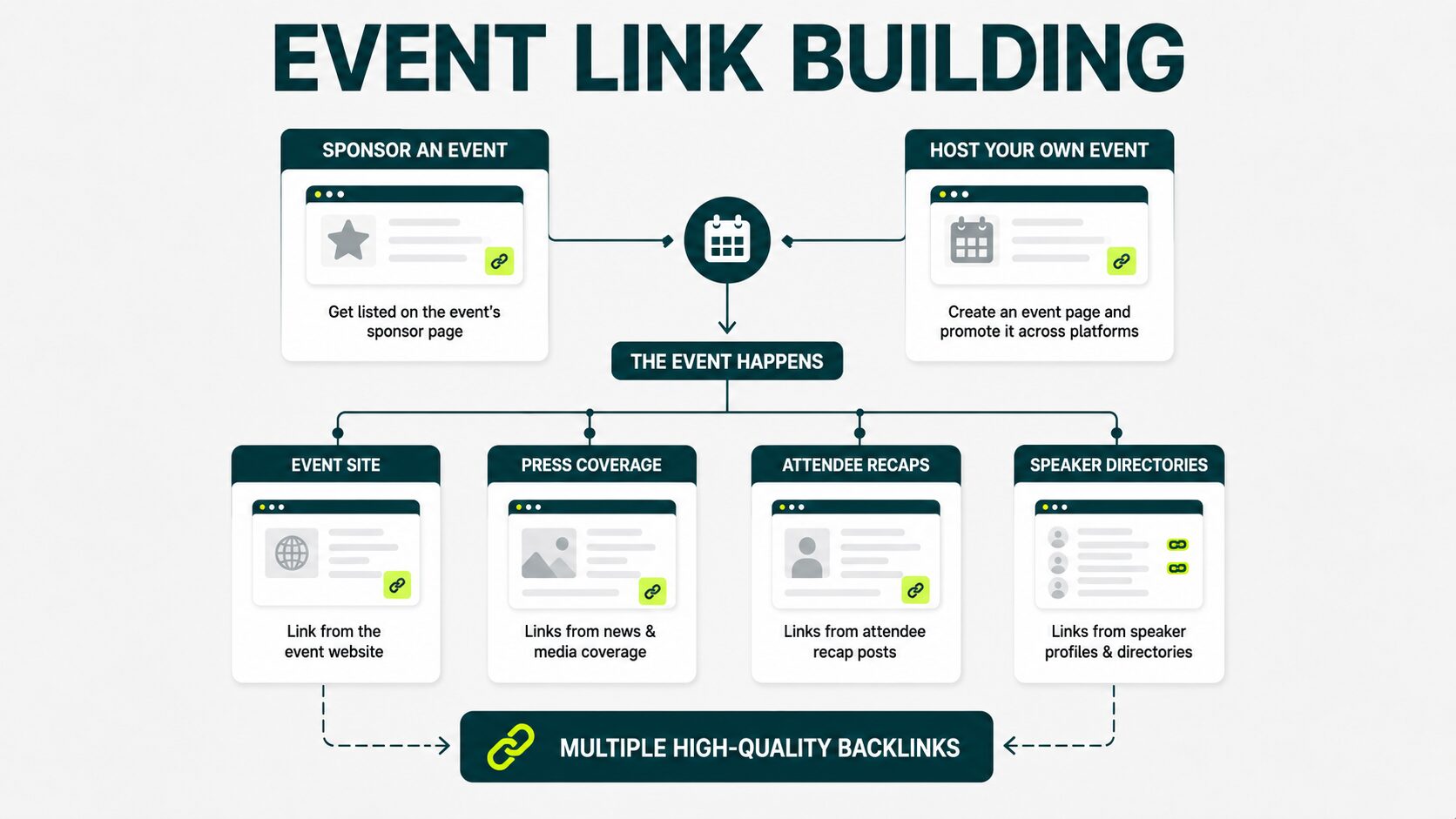
Event link building means earning backlinks by sponsoring or hosting events. The links come from the event’s own site, press coverage, attendee recap posts, and speaker directories.
A backlink in SEO is a link from one website to another. Google treats it like a vote of confidence; the more votes you have from the trusted sites, the more Google trusts you.
There are two paths into it, and most beginners start with sponsoring because the cost is bounded and the work is less.
The First Is Sponsoring
You pay to book a spot on an event’s sponsor page. That page links back to your site, usually along with branding around the event itself.
The Second Is Hosting Your Own Event
You create an event page on your site, then list it on every platform that accepts event listings. Links come from the press, the speakers, and the attendees who write about it afterward.
Both paths align with the broader link building strategies a growing business uses. They’re worth treating as one tactic because the work overlaps.
Why Event Backlinks Count (Including the Sponsored Ones)
Event backlinks count because Google judges a link by its context, not by whether it’s labeled as paid.
The first question worth answering: aren’t sponsored links automatically nofollow, and don’t those get discarded?
The real answer is more subtle. Google’s outbound link guidance tells publishers to mark paid placements with the attribute rel=”sponsored” or rel=”nofollow”.
- rel=”sponsored” is the tag for paid links.
- rel=”nofollow” ‘is the older please ignore tag.’
Google now treats both as hints rather than hard rules. That means the search engine may still factor the link into its understanding of who you are and what your site covers.
If you want the longer version our dofollow vs. nofollow guide covers it. The short version: the attribute matters less than the context in which the link appears.
That’s the technical layer. The practical layer matters more for first-time sponsors.
The sponsor link appears on a page that Google indexes. It points to your site, not a tracker URL. It carries some surrounding text or context. It comes from a site that already ranks for topics the event covers. Those four signals do the real work for you, whether the attribute is dofollow, nofollow, or sponsored.
The bad sponsor link fails most of those tests. It appears in a footer strip with thirty other logos. The page itself is barely indexed and never updates. It’s an image link with no alt text. It points through a redirect that adds noindex headers along the way.
The Two Paths: Sponsoring Versus Hosting
Sponsoring and hosting both generate backlinks, but they require very different inputs. The right path depends on your budget, your bandwidth, and how soon you need links.
| Question |
Sponsoring |
Hosting |
|---|---|---|
| Cost | Bounded by sponsorship fees. | Open-ended, scales with event size. |
| Effort | Low. A few emails, a logo, a deck. | High. Planning, marketing, logistics, and follow-up. |
| Time to first link | Quick. Sponsor page goes live in weeks. | It takes a long time. Months from concept to event date. |
| Link Yield | A handful per event, sometimes one. | Many, if you promote the event well. |
| Link control | Low. You take the placement on offer. | High. You design the page yourself. |
| Risk | The placement may be weak. | The event itself may flop. |
Here’s how most beginners should read that table.
If you’ve never run an event and you have a small first-time budget for this tactic, start with sponsoring. The work is bounded, and the link arrives quickly. You’ll learn what a good sponsor placement looks like.
If you have months of runway and can put a small team on planning full-time, hosting produces more links per event than sponsoring. A well-marketed hosted event sees links from registration platforms, attendee blogs, press recaps, and speaker bios. People also reference your event in their own posts for months after it ends.
Outreach Desk’s campaign observes that it is sponsoring wins on efficiency until you’re spending enough to rent a venue anyway; at that point, you might host your own event.
The teams that get the most out of this tactic run both in sequence. Sponsor one or two events first to build relationships and figure out what’s worth paying for. Then host your own, and use the relationships you made as a sponsor to fill the speaker slots and seat the audience.
How to Find Events Worth Your Time
You find events worth your time in three places: platforms built for listing events, the industry organizations behind your space, and the search results where competitors already show up.
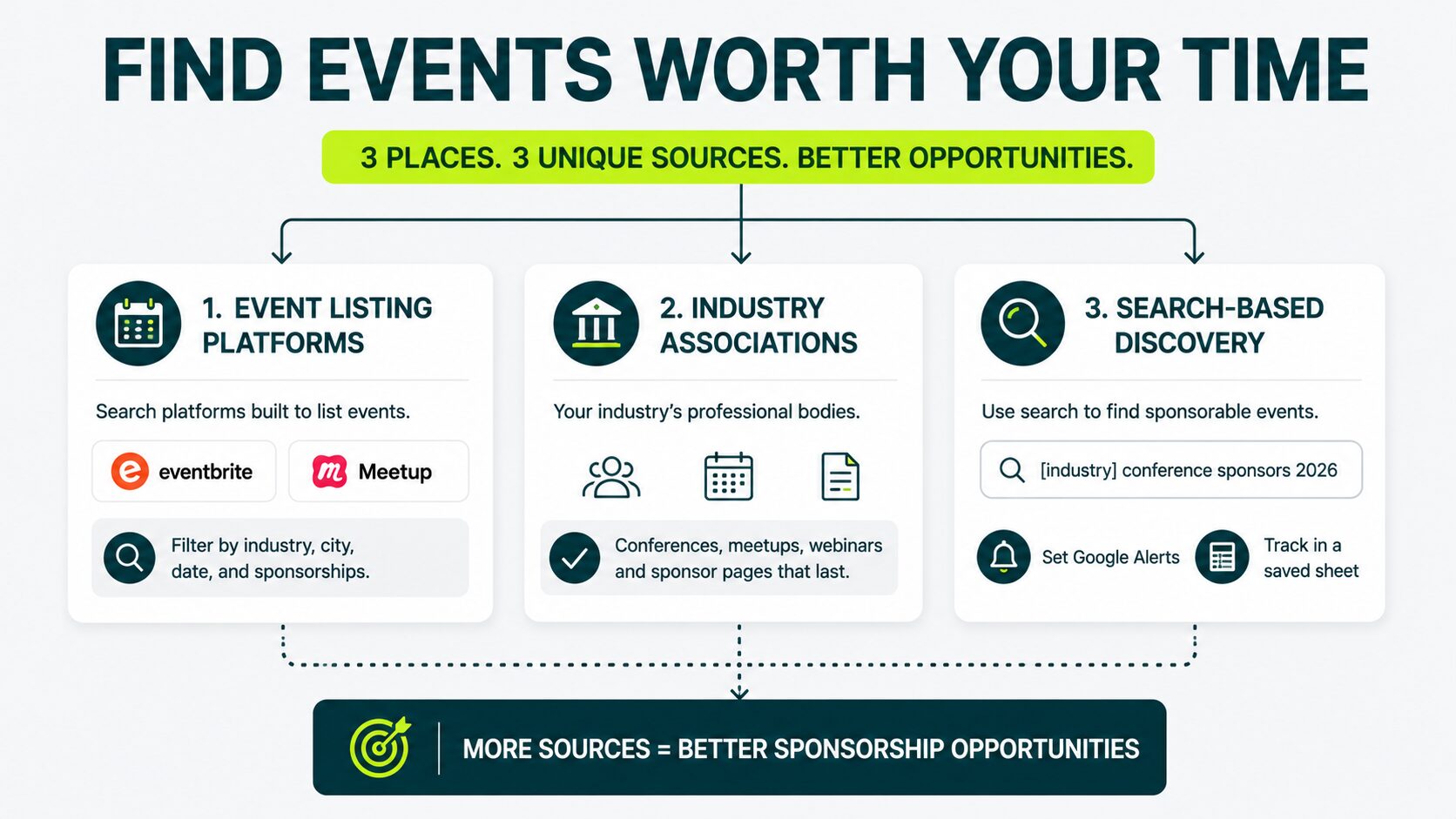
Each surfaces a different kind of event, so work through all three rather than picking one and hoping for success.
Event Listing Platforms
Start with the platforms designed to list events. Eventbrite and Meetup are two that still matter in 2026. You can search them by industry, city, and date range to find events that accept sponsorships or partnerships.
A note on platform freshness: Every roundup written more than a year ago lists at least one platform that has been shut down. Confirm any platform you’ve heard about still exists and still accepts sponsor inquiries before you spend an hour on it.
Industry Associations
The professional body for your industry is one of the most reliable sources of sponsorship opportunities, and it’s what most beginners skip.
Every industry has an association of some kind. For search marketers, it’s events like BrightonSEO and regional meetups. For dentists, it’s the state and national dental associations. For climate-tech founders, it’s groups like Climatebase or the local cleantech council.
These groups host annual conferences, regional meetups, and webinar series. They publish sponsor pages that get pulled into directories and press releases, and those pages tend to stay live year after year.
Search-Based Discovery
Use Google to find sponsorable events. The query pattern that works is [your industry] conference sponsors 2026, and the platform-specific version is site:eventbrite.com [your city] [your industry] sponsors.
Set a Google Alert for the same phrases so you can catch new sponsorship announcements in your inbox without having to search weekly. Pair the alerts with a saved spreadsheet of every event you’ve evaluated, so you don’t keep re-evaluating the same bad option.
When Your Business Is Local
If you run a local business, the highest-value event links usually come from local sponsorships rather than national conferences. That’s true for dentists’ offices, roofing companies, and any city-based service.
The complete playbook is in our guide on local link building tactics. The short version: sponsor school events, charity events, and chamber of commerce conferences in your city.
The Vetting Checklist Before You Say Yes
This is the part most first-time sponsors skip and then regret. Before you agree to any sponsorship, walk through six checks. Skip any one of them, and the link you pay for might not be worth the cost.
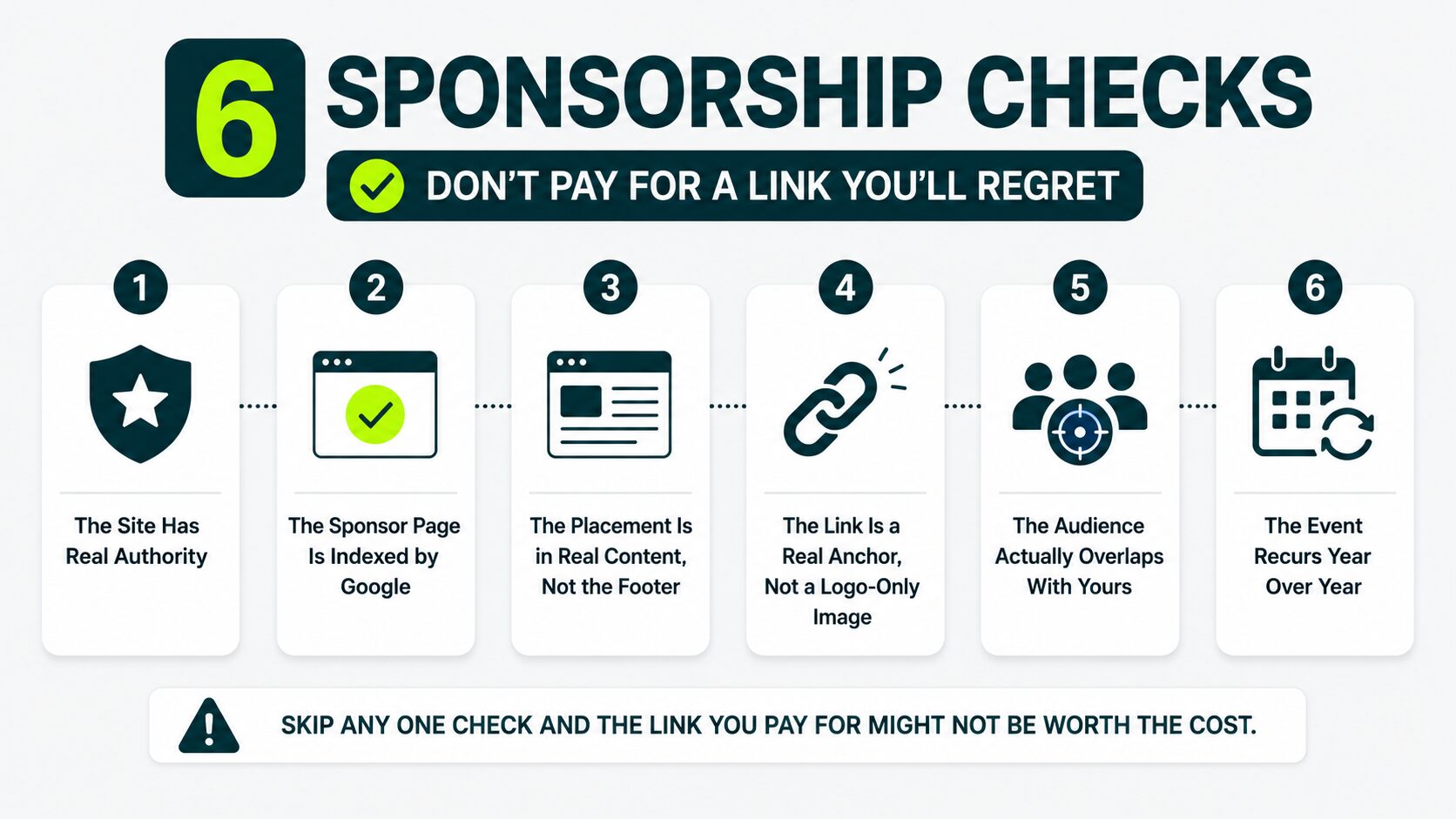
This is the filter that Outreach Desk uses before agreeing to include an event sponsorship in a client’s link building plan.
1. The Site Has Real Authority
The event’s website should have a domain rating in the range you’d be comfortable receiving a link from. Domain Rating (DR) is a score from 0 to 100 in Ahrefs that estimates the strength of a site’s overall backlink profile.
You can check it using the methods in our guide on checking a domain’s link strength, or with Ahrefs’ free DR checker.
As a general rule, we won’t recommend sponsoring an event whose website appears below DR 25. For the events in highly competitive niches such as SaaS, fintech, legal, and marketing, we raise the bar to DR 35.
If the event is newly launched or runs mostly offline with a lightweight web presence, audience quality, and attendee list size can outweigh a low DR, but we still require a minimum DR of 15 to make sure the site isn’t penalized.
2. The Sponsor Page Is Indexed by Google
Open Google in an incognito tab and search site:eventdomain.com sponsors. If the sponsor page doesn’t show up, it’s not indexed (Google isn’t including it in its searchable database). A link from a page Google doesn’t index is nearly invisible.
Bonus Check
Look at the page’s source for a noindex tag. Right-click, view page source, and search for noindex. If it’s there, the link won’t be counted.
3. The Placement Is in Real Content, Not the Footer
The sponsor logo wall in the site footer is the lowest-value placement. Logos there share weight with thirty other sponsors, and Google often ignores footer content when it reads a page to decide what the page is about.
The placements you want are inline (your sponsor card appears within the main content area of the page) or top-of-fold (top sponsor tier, listed before the others). If the only placement on offer is footer-only, the sponsorship is not worth the cost.
4. The Link Is a Real Anchor, Not a Logo-Only Image
Ask the organizer directly: when your company is listed as a sponsor, is the link wrapped around the logo image or around the text?
A logo-only link with no alt text is functionally an image link, and image links pass less context to Google than a text anchor that names your brand. The fix is asking for a text mention along with the logo, even if it’s just your company name as a text caption underneath.
5. The Audience Overlaps With Yours
A backlink from a high-DR site is less valuable if your target audience never visits it. It may boost authority, but it brings little traffic and weaker relevance than the DR score alone suggests.
Before you commit, check the event’s speakers, past attendees, and agenda. If your ideal customers would realistically attend the event, the backlink is likely more valuable than its DR score alone indicates.
6. The Event Recurs Year Over Year
A one-off event creates a page that often gets neglected or removed within a year of the event ending. A recurring event has a page that is refreshed annually, with internal links from past-edition recap posts and press coverage over time.
Recurring events tend to produce compounding links. One-off events produce links with a short half-life. If the event is a first edition, factor that into the price you’re willing to pay.
Walk through these six checks for every event before you sign anything. A no on three or more usually means walk away. A no on one is sometimes acceptable, but only if the audience overlap on check 5 is strong.
How to Negotiate the Link Placement
You negotiate the link with the teams that are asking for five specific things, in writing, before you sign the sponsorship deal. The five things below cost the organizer almost nothing, and they multiply the value of the link you’re paying for.
Pitching to organizers and writing the follow-up are their own skills.
Link building outreach mechanics determine how these conversations unfold. The list below focuses on what to ask for once they’re underway.
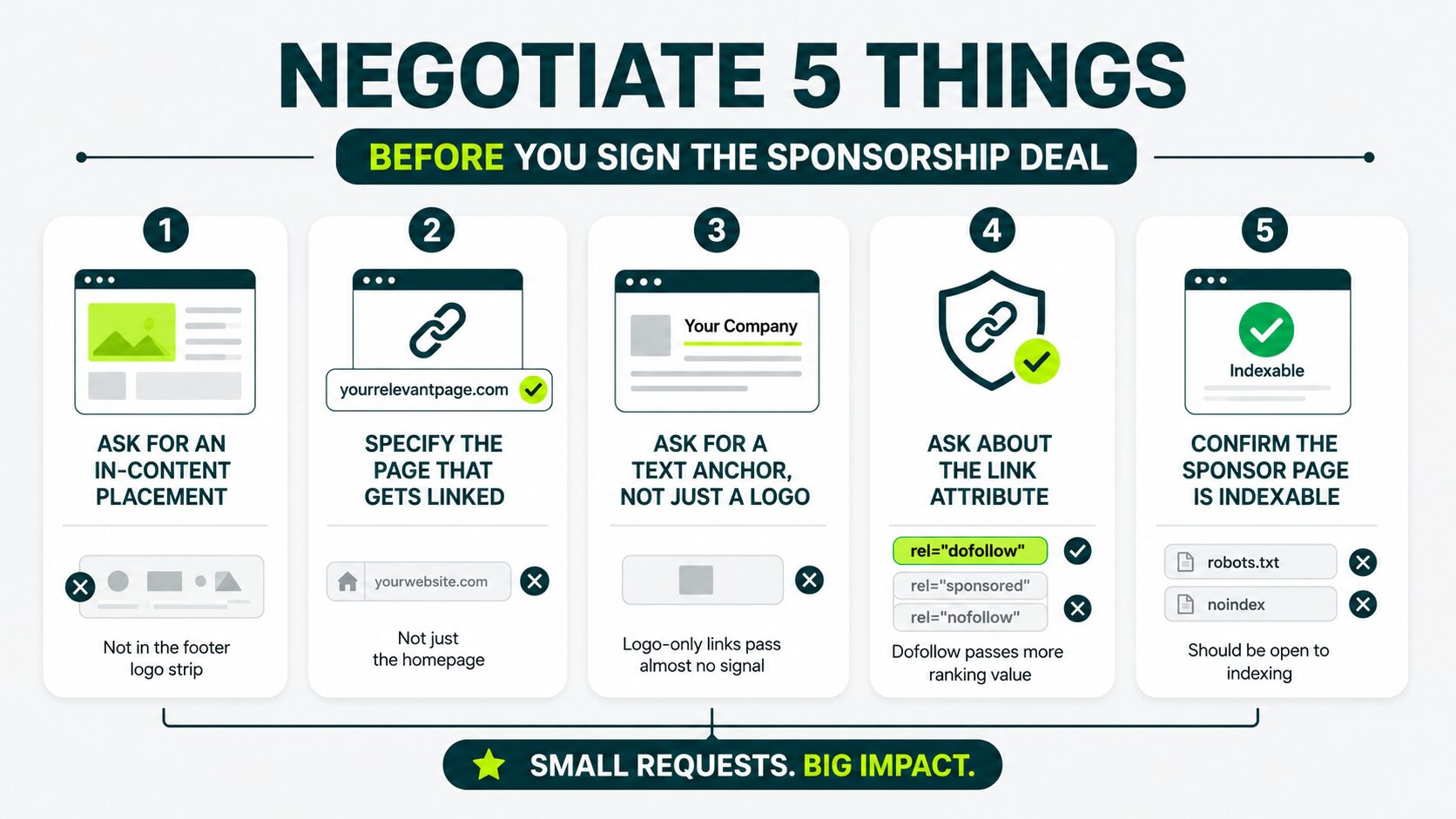
Ask for an In-Content Placement
The placement matters more than the link, which is one of the core principles behind contextual link building. Ask whether your sponsor card can appear in the main content area of the sponsor page, rather than in a footer logo strip.
Example: “Would it be possible to have our sponsor block placed in the main ‘Our Sponsors’ section, along with a short description? We’re happy to provide the copy.”
Specify the Page That Gets Linked
Most organizers will link to your homepage by default. Sometimes the homepage is the right destination. Often, a relevant inner page is a better match for the event’s audience. That could be a city landing page, a product page, or a related blog post.
Example: “We’d Like the Link to Point to [Specific Url] Rather Than Our Homepage, Since That Page is the Best Match for Your Audience.”
Ask for a Text Anchor, Not Just a Logo
A logo-only link with no surrounding text passes almost no topical signals to Google. Ask for a text mention of your company name (and ideally a one-sentence description) underneath or beside the logo.
Example: “Could we include our company name as a text mention beside the logo, with a one-line description of what we do?”
Ask About the Link Attribute
If the organizer is willing, a dofollow link passes more ranking weight than a rel=”sponsored” or rel=”nofollow” link. Many organizers will agree to dofollow without thinking twice. The ones who refuse usually have a blanket no dofollow policy, and it’s not worth fighting over.
Example: “One last detail: Is the sponsor linkdofollow by default, or tagged rel=sponsored? We’ve been asked to confirm with sponsorships.”
Confirm the Sponsor Page is Indexable
Ask the organizer or their developer whether the sponsor page has any restrictions on how Google crawls it. The page should be open to indexing, not blocked by robots.txt (a file that tells Google which pages not to crawl) or tagged as “do not index.”
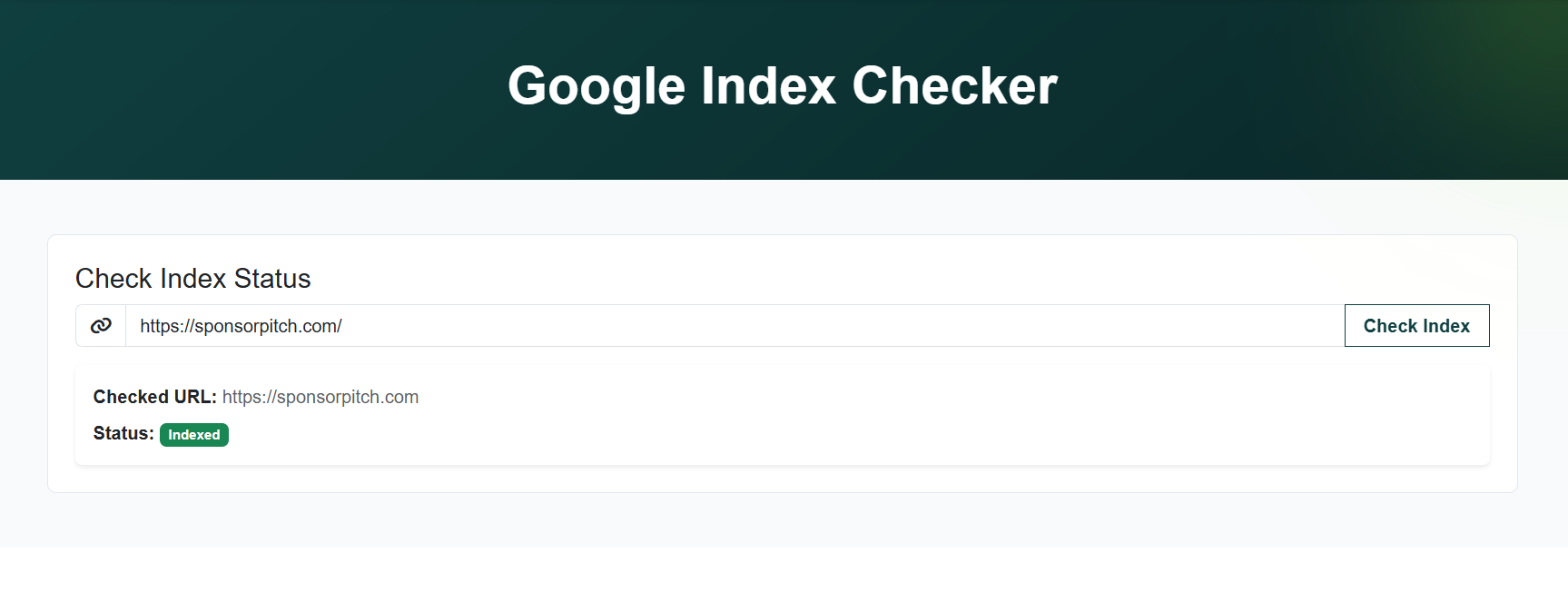
If you’re unsure whether the sponsor page is already appearing in search results, a Google index checker can provide a quick verification.
Example: “One last detail: is the sponsor page open to indexing? We’ve been asked to confirm with sponsorships.”
In our experience, the single most common mistake first-time sponsors make is accepting a logo-only placement in a footer. The placement is invisible to Google when it reads the page, and the link itself rarely passes meaningful weight. If that’s the only placement on offer, the right move is to move on.
A real Outreach Desk observation, not all sponsorships are equal. Across our last batch of event sponsorships, the one we recommended had in-content placements, and the one we declined was footer-only at similar prices.
Hosting Your Own Event for Link Gravity
Hosting an event gets you more links than sponsoring, but it requires a well-built event page and proper launch planning.
Three pieces matter most:
- The page itself.
- The platform it gets listed on.
- The pre-launch outreach.
Build the Event Page as a Linkable Asset
The event’s permanent home on the internet is the page you build on your own site. Treat it like a linkable asset on your site, not a placeholder.
What the page needs:
- The event name as the main heading.
- A complete description of what attendees will get.
- Date, time, and time zone.
- Address of the venue (or “online” with the platform name).
- Speaker bios with photos.
- A clear button to register.
Add event structured data (a small piece of code Google reads to understand that the page describes an event). Google’s event structured data guide lists the three required properties: name, location, and start date.
With the markup at the correct place, your event becomes eligible for rich results. These are enhanced search results that show extra detail like the date and a registration link, right in the search results.
Remember
Google doesn’t guarantee that rich results will appear, but the markup itself is a small investment that pays off when they do.
List the Event on Every Relevant Platform
Once the page is live, list the event on every platform that accepts event listings. Eventbrite and Meetup are the obvious ones. Industry-specific directories usually generate stronger links because their content is topically relevant.
That includes search marketing conference roundups, local Chamber of Commerce events calendars, and industry association event pages.
Practical Rule
When you list the event on a third-party platform, link the listing back to your event page. The third-party platform serves as a referrer, and your page remains the primary source.
Run Outreach Before the Event Date
The window between announcing the event and the event itself is when most of the press, podcast, and partner links get earned. Outreach here means sending personalized emails to the journalists, podcasts, and partners, asking to cover or share the event.
Three moves worth running in that window:
- Email industry publications with a pitch for a preview or interview about the event.
- Reach out to relevant podcasts offering one of your speakers as a guest, tied to the event date.
- Coordinate with the partner companies (sponsors, co-hosts, speakers’ employers) so they publish posts about the event linking back to your event page.
Bonus
Host one to pick up links from the bigger event’s audience without running a full conference. A satellite event is a smaller, local gathering tied to a larger conference (such as a happy hour at SaaStr or a workshop at BrightonSEO).
What to Do After the Event Ends
The 30 days after an event produce more links than the sponsor page itself does, but only if you go and chase them.
In our experience, the sponsor page is only the starting point. Most event-related backlinks are earned within 30 days of the event.
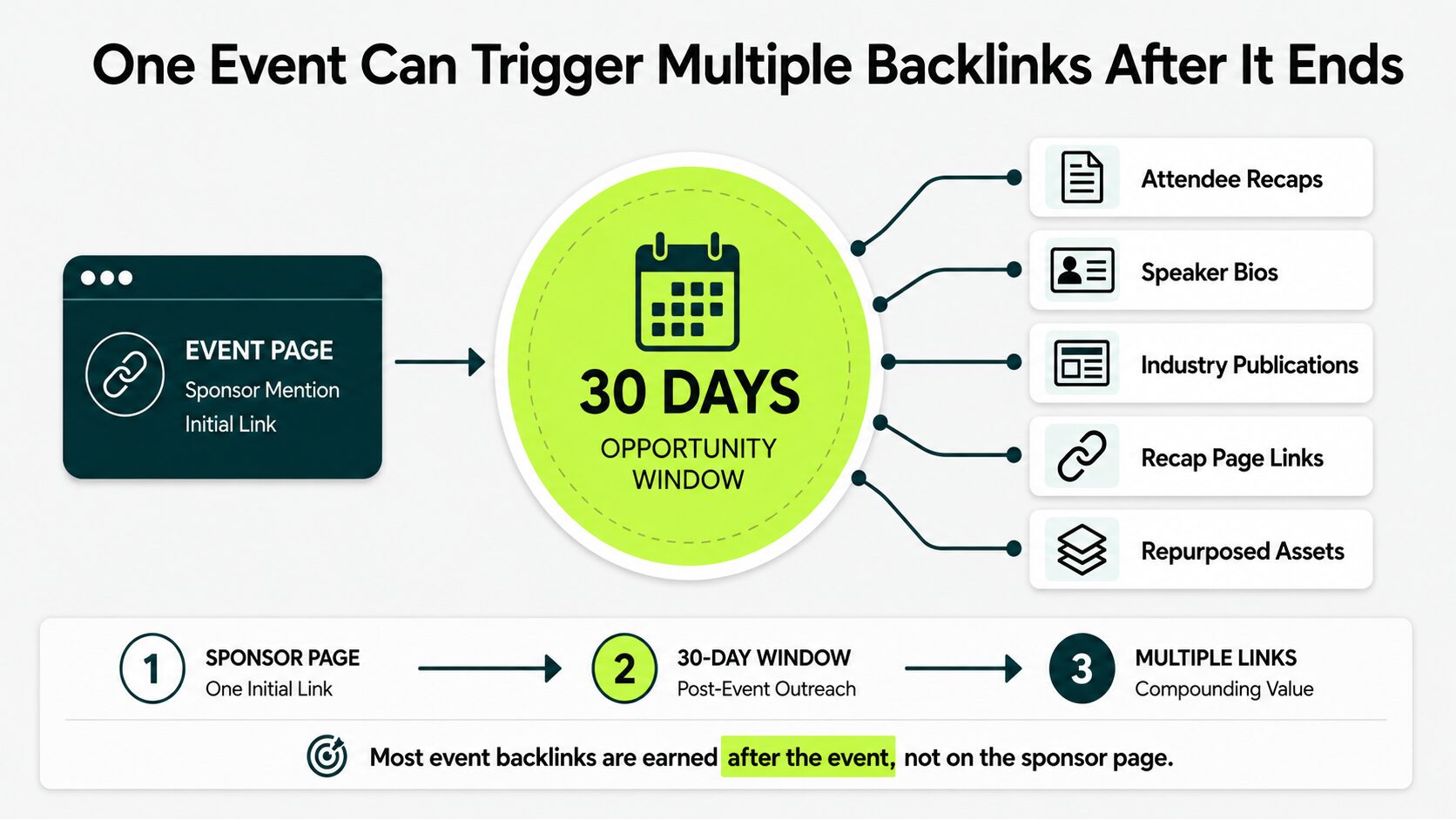
Here’s the post-event playbook for sponsors and hosts.
Email Every Attendee Who Wrote About the Event
Attendees publish recap posts on their company blogs, on Medium, and on LinkedIn. Most don’t automatically link to sponsors.
Email the ones whose posts mention the event and ask for a one-line mention of your company with a link. This works best when your product is directly relevant to what they wrote about.
Update Your Own Speaker and Team Bios
If anyone in your firm spoke at the event, update their LinkedIn, your About page, and any external speaker bios as well.
Each bio should mention the event and link back to a recap page. The bio links keep working for years.
Pitch a Recap or Lessons-Learned Post to Industry Publications
The week after an event is the best window to pitch industry publications. The pitch is a “5 takeaways from [event]” or “what the panel got right” post.
The post itself goes on the publication, and naturally links back to your site as the source of the analysis.
Look for Recap Pages That Could Use a Link to You
Many event organizers publish recap pages listing speakers, sponsors, and key moments. If your sponsor mention or speaker placement is missing or under-linked on those recap pages, email the organizer with a polite ask.
This is also a window where broken-link recovery on recap pages sometimes works. The play: old recap pages that link to a competitor whose page has died are open to replacement.
Submit Your Event Recap to Resource Pages
Industry resource pages sometimes accept your event recap as a worthwhile addition. Think lists like “best SaaS conferences of 2026” or “top SEO events to attend.” Search for industry-specific resource pages and pitch the recap as an additional resource.
The mechanics of pitching resource page editors are the same as for any resource-page outreach.
Repurpose the Event Content Into Linkable Assets
Slides, talk transcripts, panel recordings, and any data shared at the event can become standalone pieces of content.
A slide deck published as a Slideshare and embedded on a blog post earns links of its own. A transcript or summary post becomes a citable source for anyone writing about the same topic afterward.
Pitch Your Speakers to Podcasts in the Following Quarter
A talk at a recognized event makes a speaker more likely to appear on podcasts. The two to three months after an event is the right window for podcast outreach.
Send a quick “we just spoke at [event]” pitch to podcasts in the adjacent space. Podcast show notes nearly always link to the guest’s site.
Most of these moves don’t get done because the team running the event is exhausted by the end. Build a post-event link checklist into your event plan from day one.
Assign it to a specific person who isn’t running the event itself. That’s how the 30-day window stops being a missed opportunity.
Mistakes That Waste Sponsorship Money
Four mistakes most consistently waste sponsorship money: title-tier overspend, footer-only placement, skipping indexability checks, and ignoring the post-event window.
Buying the Title Sponsorship When the Mid-Tier Would Do
Title sponsorships sound great on paper. They’re also five to ten times more expensive than the mid-tier sponsorship. The link you get is often the same as the one you’d get from the next tier down.
Buy a mid-tier sponsorship at three events instead of a title sponsorship at one. The link yield will be higher, and the audience exposure will spread.
Accepting a Footer Placement Because “It’s Still a Link”
Footer placement on a high-DR site looks like a high-quality link. When Google reads the page for what it’s really about, it usually isn’t, because footer content is widely deprioritized.
Push for in-content placement, or move on. If the sponsorship includes a footer link, the math rarely works at the price tier that most events charge.
Forgetting to Confirm Indexability After the Page Goes Live
You negotiate everything correctly. The page goes live. Then, the sponsor page is set to noindex by the developer because it was copied from a staging template.
The link doesn’t count, and nobody notices for weeks.
After the sponsor page is live, search for site:[eventdomain.com] [your company name] to confirm that Google indexes the page with your link. If nothing comes back, email the organizer. Most fix it within a day once they realize.
Skipping the Post-Event Work
The single most expensive mistake is treating the event itself as the deliverable. The sponsor page link is one of several links the event makes possible. The rest only show up if you actively chase them for the 30 days after the event.
Build the post-event checklist into your event plan from the start, and assign someone to it before the event date.
A note from our experience: the single most common mistake first-time sponsors make is accepting only logo placement in a footer. The placement is invisible to Google when it reads the page, and the link itself rarely passes meaningful value. If that’s the only placement on offer, the right move is usually to move on.
Conclusion
Most people treat event link building like a numbers game, pitching every conference and meetup they can find and hoping something sticks.
The real edge comes from positioning yourself as a resource before you ever ask for anything. When organizers, sponsors, and attendees already see you as someone worth referencing, the backlinks follow naturally rather than being chased down.
Start by identifying two or three events in your niche that publish resource pages, speaker bios, or recap content, and reach out with something genuinely useful to offer. That one shift, from asking to contributing, is what separates a handful of earned links from a repeatable strategy you can build on all year.
Looking for backlinks that come from real industry involvement?
Get a plan focused on turning events, partnerships, and sponsorships into valuable link opportunities.
Do event sponsor links count as backlinks for SEO?
SEO search engine optimization) cares about more than just the link attribute.
Google treats sponsor links marked with rel=”sponsored” (or rel=”nofollow) as hints, not hard directives. That means it may still factor them into its understanding of your site. The placement quality, the page’s indexability, and the surrounding content all matter more than the attribute by itself.
Is Hosting an Event Worth it for the Links Alone?
Rarely. Hosting produces more links than sponsoring, but the planning cost is high. Host only when the event also serves your brand, lead generation, or community goals.
If earning high quality links is the only outcome you care about, sponsoring two or three mid-tier events is usually a better use of the budget or working with a specialist link building agency that builds editorial authority without the event planning overhead.
How much does an event sponsorship cost?
Costs range widely. Small local meetups and webinars sometimes accept sponsorships for a few hundred dollars. National industry conferences run from a few thousand to tens of thousands of dollars for top sponsorship tiers. The mid-tier sponsorship at a mid-sized event is usually the highest-value entry point for a first sponsor. See how link building pricing compares across tactics before committing budget”
How long after the event do the links show up?
The sponsor page link goes live within a few weeks of signing the deal, often before the event itself. The post-event recap links (attendee blog posts, press recaps, speaker bio updates) trickle in over the following 30 to 60 days. Links from people referencing the event in their own content can keep trickling in for months after that.