You only see the mentions where someone tags you on social platforms. The rest, often the majority, go unnoticed, which is exactly what mention tracking is built to fix.
Social media mentions tracking means capturing every public reference to your brand across social platforms, including untagged mentions that don’t notify you.
When done well, mention tracking doubles as a customer service queue, a sales radar, and a backlink prospect list.
The Short Version
- A social media mention is any public reference to your brand on social, tagged or untagged.
- Manual tracking via platform search and Google Alerts catches untagged mentions across most major channels at no cost.
- A paid tool makes sense once your weekly mention volume passes 50 to 80 entries.
- Four metrics matter: volume, sentiment, reach, and share of voice.
- The Mention Triage Framework sorts every mention into one of four actions: respond, engage, convert, or claim.
- Some social mentions can be converted into backlinks once the system surfaces them.
What Counts as a Social Media Mention (and What Doesn’t)
A social media mention is any public reference to your brand, product, or key person on a social platform. The post can tag you or not. It can be a post, a comment, a story, a caption, or a thread reply.
Tagged mentions trigger notifications. Untagged ones don’t, and they usually outnumber tagged ones by a wide margin.
That second half is where most brands lose visibility. Notifications fire only on tagged references. Everything else lives in the open feed, and if nobody on your team looks for it, it’s invisible to you.
Social media mentions are part of broader brand mentions, which can include press coverage, podcasts, blogs, and other online references. Unlike broader brand monitoring, social mentions move faster and reflect real-time conversations on social platforms.
Tagged Mentions
A tagged mention is a post, comment, story, or video that explicitly @-tags your brand account.
You’ll see these for free. Instagram, X, LinkedIn, TikTok, Facebook, and Threads all notify you when someone tags the brand handle. If your only tracking system is the notifications tab on each app, that’s what you catch.
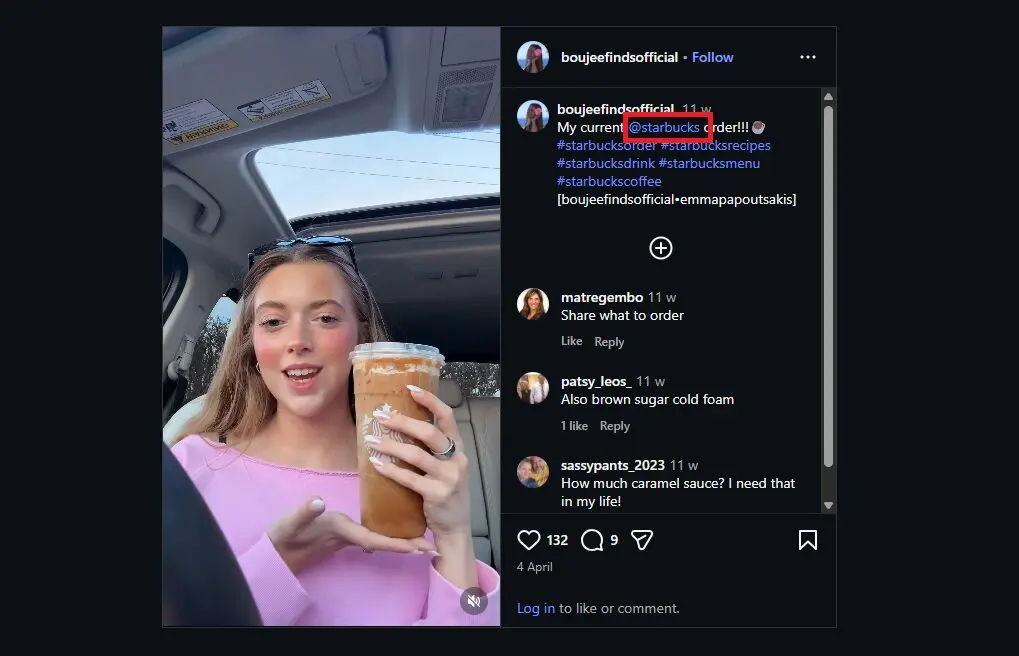
Source: Instagram
Untagged Mentions
An untagged mention names your brand in the body or caption but doesn’t link the account.
These are the ones that disappear unless you actively look for them. Think of a photo with a caption that says “loving my new [brand]”, no @ symbol, no notification.
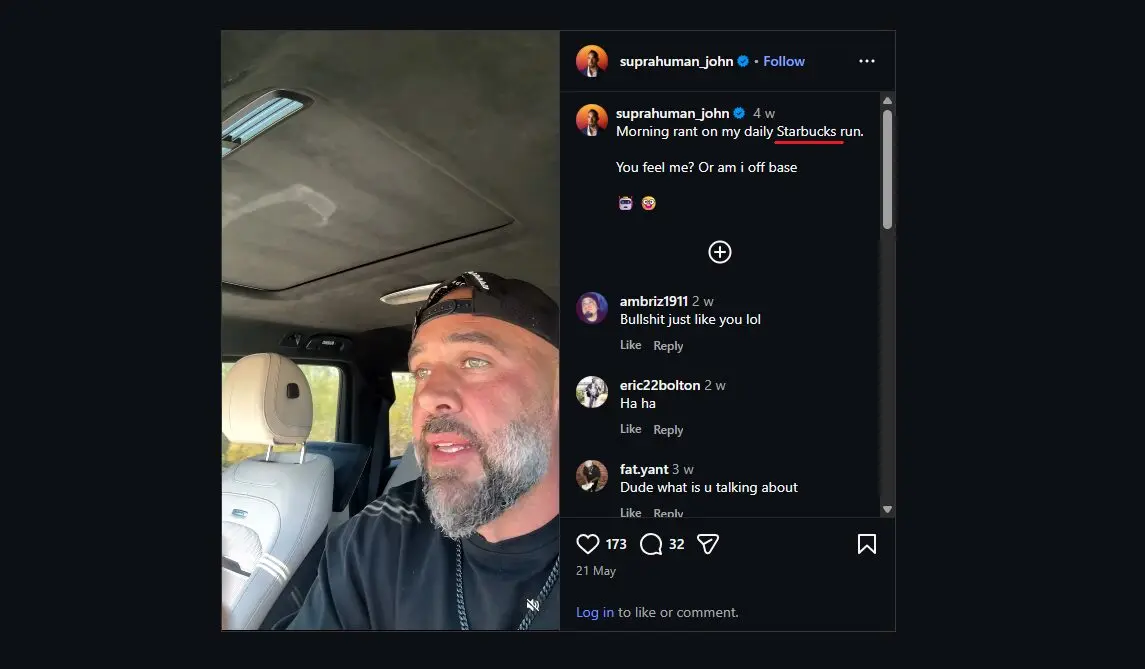
Source: Instagram
A Reddit thread complaining about a feature. A LinkedIn post by a customer that mentions the brand in passing.
None of these reach you unless someone tags you, the post goes viral, or you’re searching for it on purpose.
The people who think to tag you are a small subset. The people who say your name make up a much larger group.
That’s the gap that tracking exists to close.
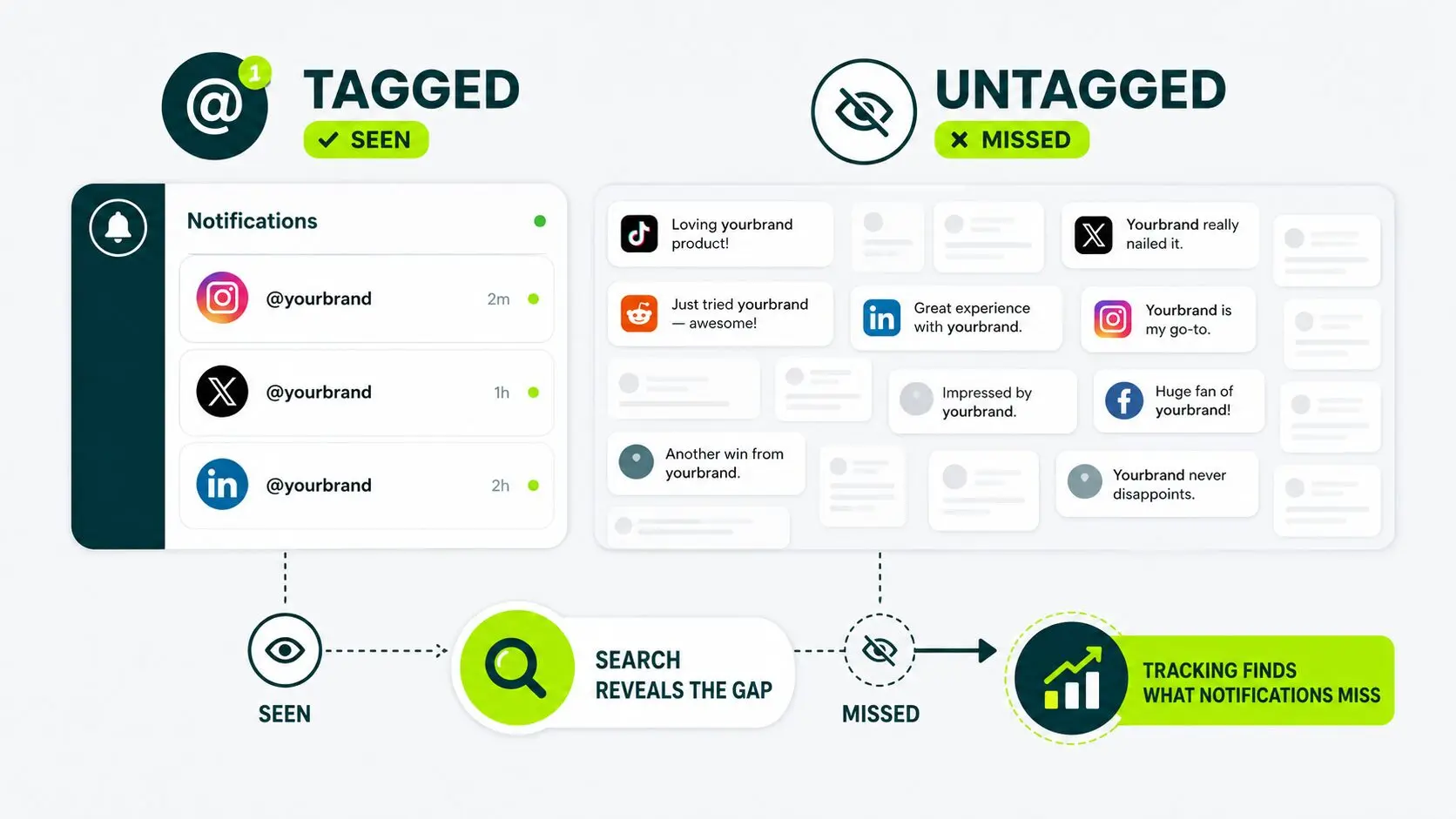
In our experience tracking mentions across client accounts, untagged volume spikes sharply after PR hits or product launches. This is the exact moment most teams aren’t actively monitoring.
Why Mention Tracking Has Become a Business Requirement
Mention tracking now affects your reputation, your sales pipeline, and your visibility in AI Search results.
AI search now decides which brands to surface based on where they’re talked about.
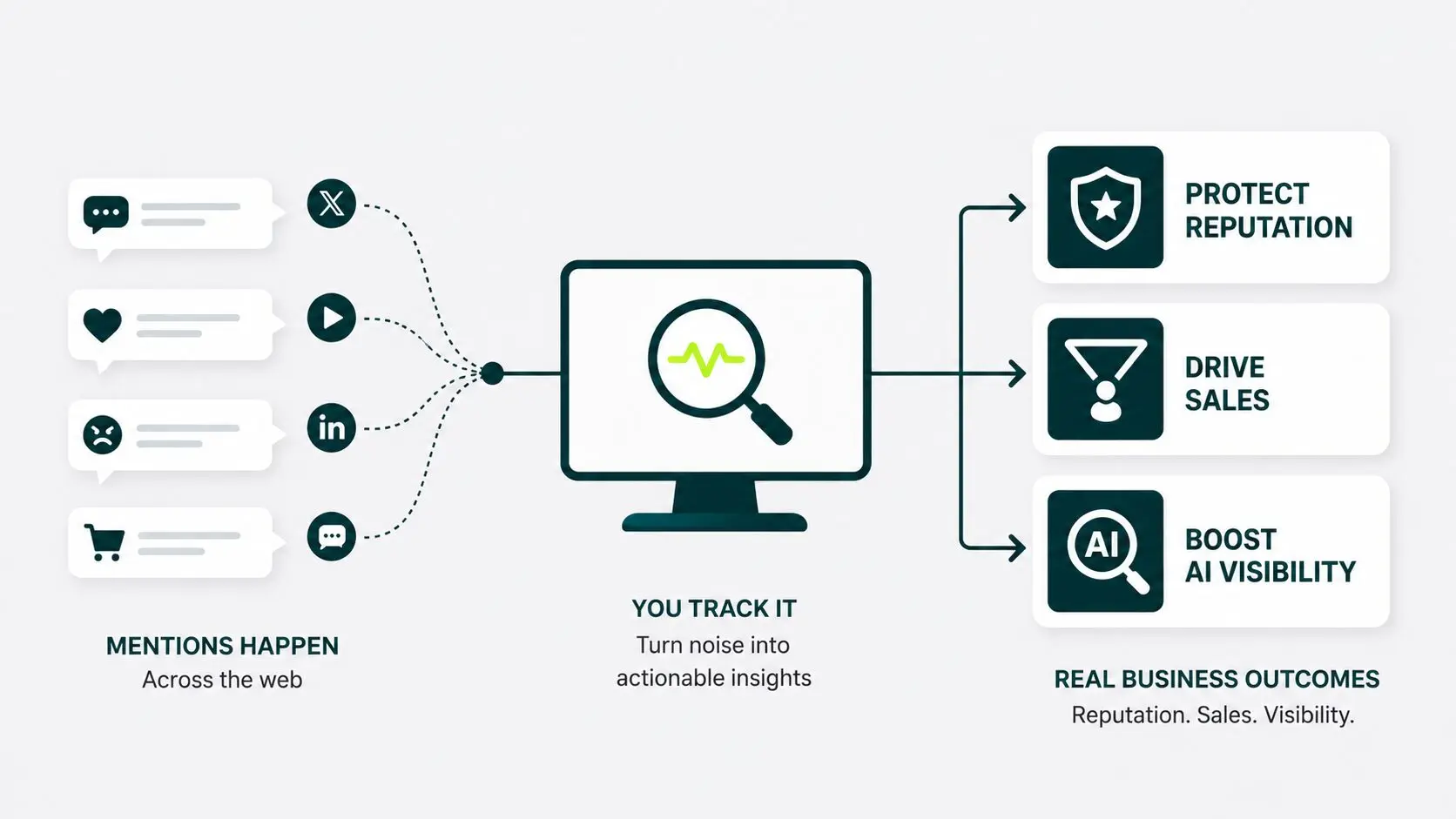
Reputation: Customers Treat Silence as a Decision
If you don’t respond on social media, customers leave. According to SproutSocial’s customer service data, 73% of social users say that if a brand doesn’t respond on social platforms, they’ll buy from a competitor next time.
That’s the cost of an untagged complaint you never saw. That is a lost customer, not a missed reply.
The same logic applies to praise. An unanswered shout-out is a small thing on its own. A stack of them tells the next person that your brand doesn’t show up for its fans.
Sales: Mentions Are a Lead Source
In our experience, a meaningful share of brand mentions, often 15 to 30% depending on the category, are buying signals you can act on.
“Anyone use a [your category]?” “Looking for recommendations on a [thing your product does].” “Tried [competitor] and hated it.” Each one is a person you can talk to today.
If your tracking is set up well, those mentions reach a human within hours. If not, your competitor’s tracking finds them first.
AI Visibility: Mentions Feed the New Search
ChatGPT, Perplexity, and Google’s AI Overviews now decide which brands to mention based on signals about how often your brand is talked about online. That’s wider than just backlinks. Social mentions are part of what surfaces your brand.
This matters for ranking in AI answer engines because the assistants surface brands that the rest of the web has already validated. A brand with a steady stream of public references gets surfaced. A brand with none does not exist as far as the model is concerned.
Tracking those mentions is how you know whether the signal is showing up at all.
The Free Manual Tracking Baseline Every Brand Can Run Today
You can catch most of what matters without a paid tool. The setup takes about an hour and uses things you already have: platform search, native notifications, and Google Alerts.
This setup catches most tagged and untagged mentions across your brand’s platforms.
1. Turn On Native Notifications
Open each social account where the brand has a profile. Make sure tagged mentions, comments, direct messages, and replies trigger a push notification.
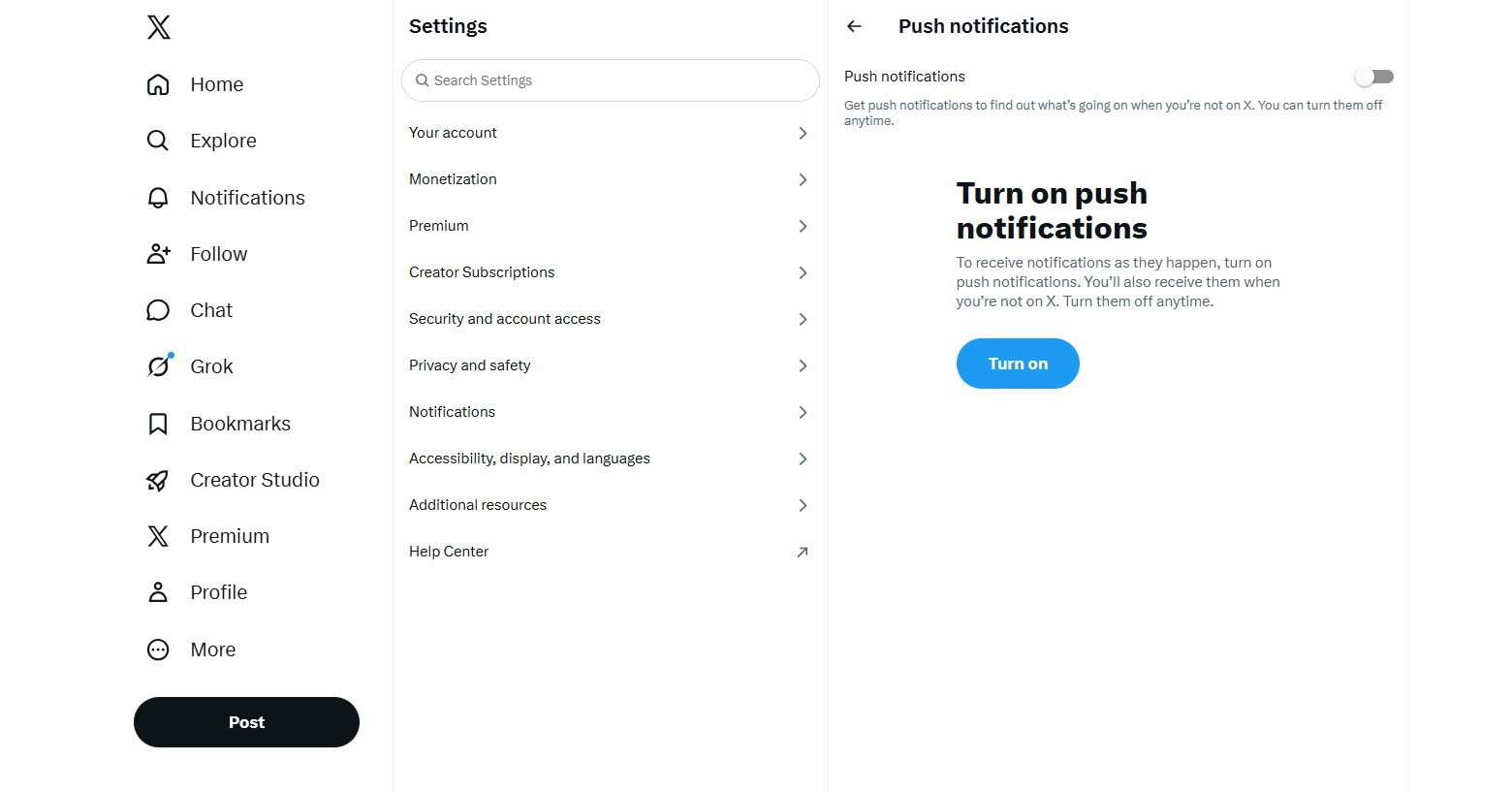
This is the floor. It catches the easy stuff (the tagged mentions) and gets you set up to handle them fast.
2. Save a Search for the Brand Name on Each Platform
On X, type your brand name into the search bar without the @ symbol, then save the search.
- On Instagram, search the brand name in the explore tab and check the “tags” and “places” results.
- On LinkedIn, search the brand name and filter by “Posts” with a “Past week” filter.
- On TikTok, search the brand name and check the “Top” and “Videos” tabs.
Each of these takes seconds and surfaces the untagged content your notifications never see.
3. Add Common Misspellings and Product Names
If your brand name is easy to misspell or has multiple acceptable forms, search for each version. A brand called “Lumen” should also search “Lumin” and “Lumens.” A two-word brand should search the no-space version.
Add product names to the list, too. People often mention the product without naming the company.
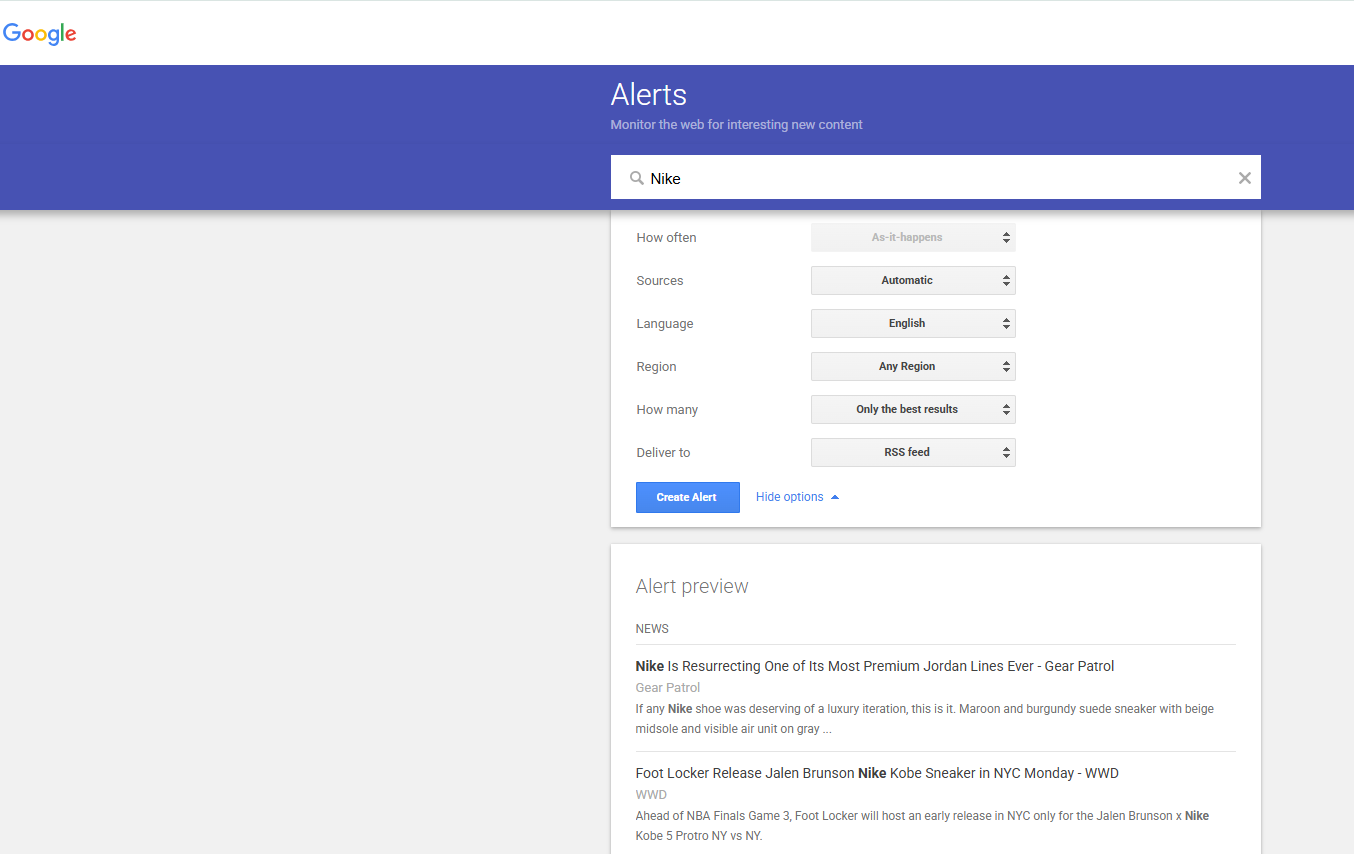
4. Set Up Google Alerts for the Brand and the Product Names
Open Google Alerts, create an alert for the brand name, and set delivery to once a day. Repeat for each product name. Set the source to “web” and the language to your customer base’s language.
Google Alerts catches web mentions, which is wider than just social. Anything that ends up on a blog, news site, or public forum will show up here too.
5. Block Time to Run the Searches
Put a recurring 10-minute slot on your calendar each morning. Open the saved searches, scan the new results, and route anything worth acting on into the triage system covered later in this guide.
Without the calendar slot, the searches go unused within a week.
This baseline catches most of what a paid tool catches. In our experience, manual tracking captures, on average, 85% of mentions compared with a paid tool.
The mentions you’ll miss tend to live on private accounts, in non-English communities, or in small Discord and Slack groups. Public search doesn’t index any of them.
None of them is worth paying for in year one.
When Manual Tracking Stops Working (and What to Pay For)
Manual tracking stops working at a predictable point. You hit the wall when mentioning volume, platform count, or response speed that exceeds what a human can sort by hand.
Most early-stage brands do not hit that wall in their first year. Some never hit it. Buying a tool before you need one wastes money you’d rather spend on customer acquisition.
Four signals say it’s time to graduate.
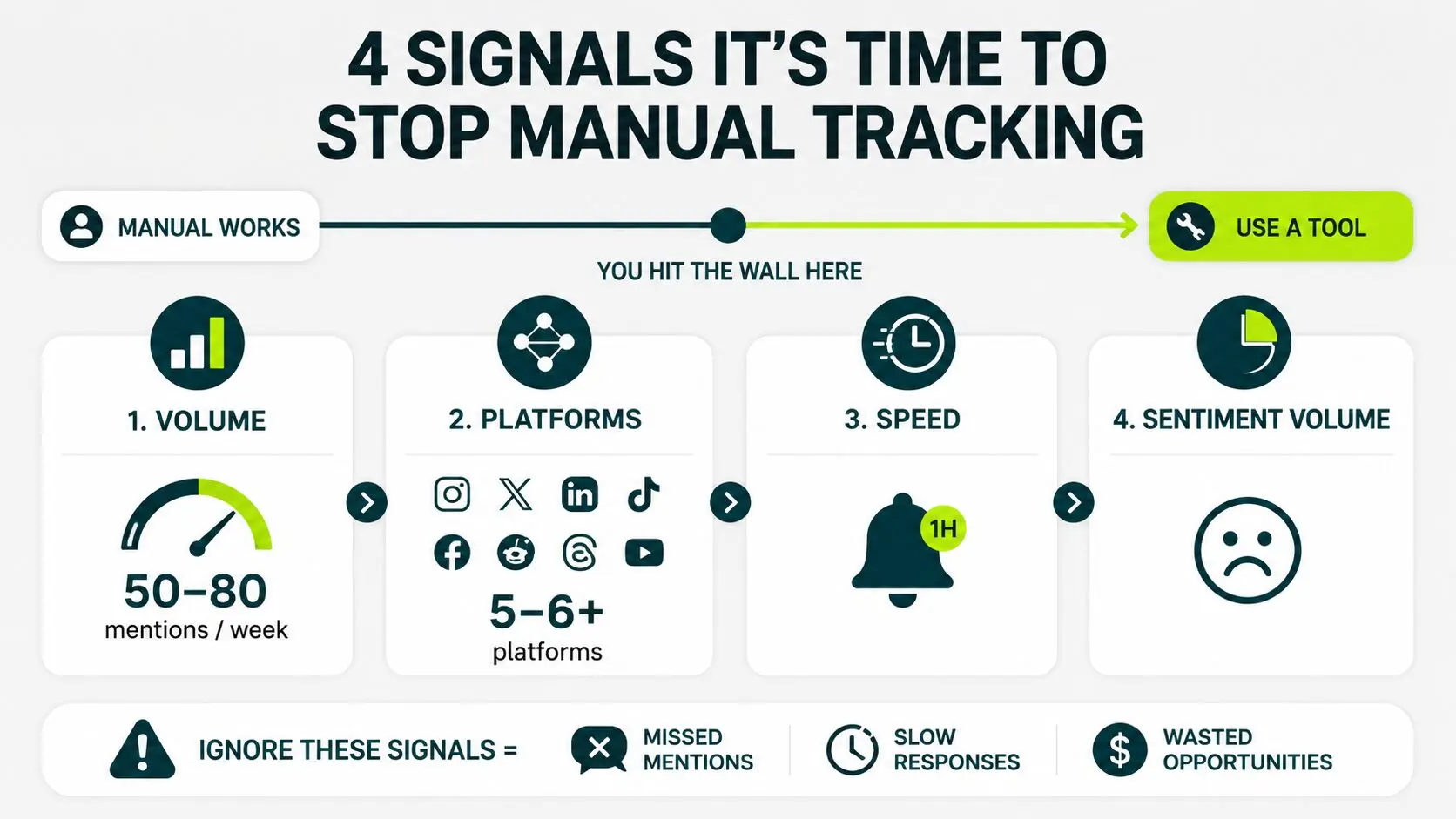
Volume
Volume refers to the number of mentions your brand receives each week. When this number grows beyond what a human can reasonably monitor, manual tracking becomes inefficient.
Based on our experience, the typical threshold is around 50 to 80 mentions per week. Below that, a careful morning sweep catches everything. Above that, you’ll miss things.
Platforms
If you’re tracking one or two platforms, manual works fine. Once you’re across six or more (Instagram, X, LinkedIn, TikTok, Facebook, Reddit, Threads, YouTube comments), the calendar slot gets too long. A tool that aggregates feeds saves enough time to be worth $50 to $200 a month.
Speed
If your business needs to respond within an hour during business hours, manual tracking won’t keep up. You get notifications on tagged mentions. Untagged ones live in the search you do every morning.
That’s fine for “respond within a day,” but not for “respond before the screenshot gets reposted.”
Sentiment Volume
When the share of negative mentions starts to require daily triage, a tool with built-in sentiment scoring saves real time. Below that threshold, you can review each one manually.
What to Look For in a Paid Tool
A paid tool earns its place when it covers every platform you’re active on, scores sentiment, and fires real-time alerts for negative spikes.
| Feature | Why it matters |
|---|---|
| Coverage across all platforms you care about | A tool that only covers X and Instagram leaves you back to manual on the rest |
| Sentiment scoring, you can override | Auto-sentiment misses sarcasm, regional slang, and emoji-driven tone |
| Custom keyword lists with Boolean logic | Lets you track product names, common misspellings, and competitor mentions together |
| Real-time alerts for negative spikes | The point of automation is to hit a crisis before it gets bad |
| Export and integration with your inbox or CRM (the customer record tool your sales team uses) | A dashboard nobody opens daily is useless |
Free tools to start with: Google Alerts, X advanced search, and Reddit’s keyword tracking. Mid-tier (around $50 to $200 monthly): tools positioned for solo founders and small marketing teams. Enterprise (around $500 monthly and up): the big aggregators with deep historical data.
Skip the enterprise tier unless you’re past the volume threshold. Your team also needs someone whose job is to use it daily.
Many “we need an enterprise tool” decisions turn out to be “we need someone to triage mentions” decisions. Know which one you’re actually solving for.
The Metrics That Actually Matter
Mention tracking tools report dozens of numbers. Most don’t tell you anything you can act on. Four do.
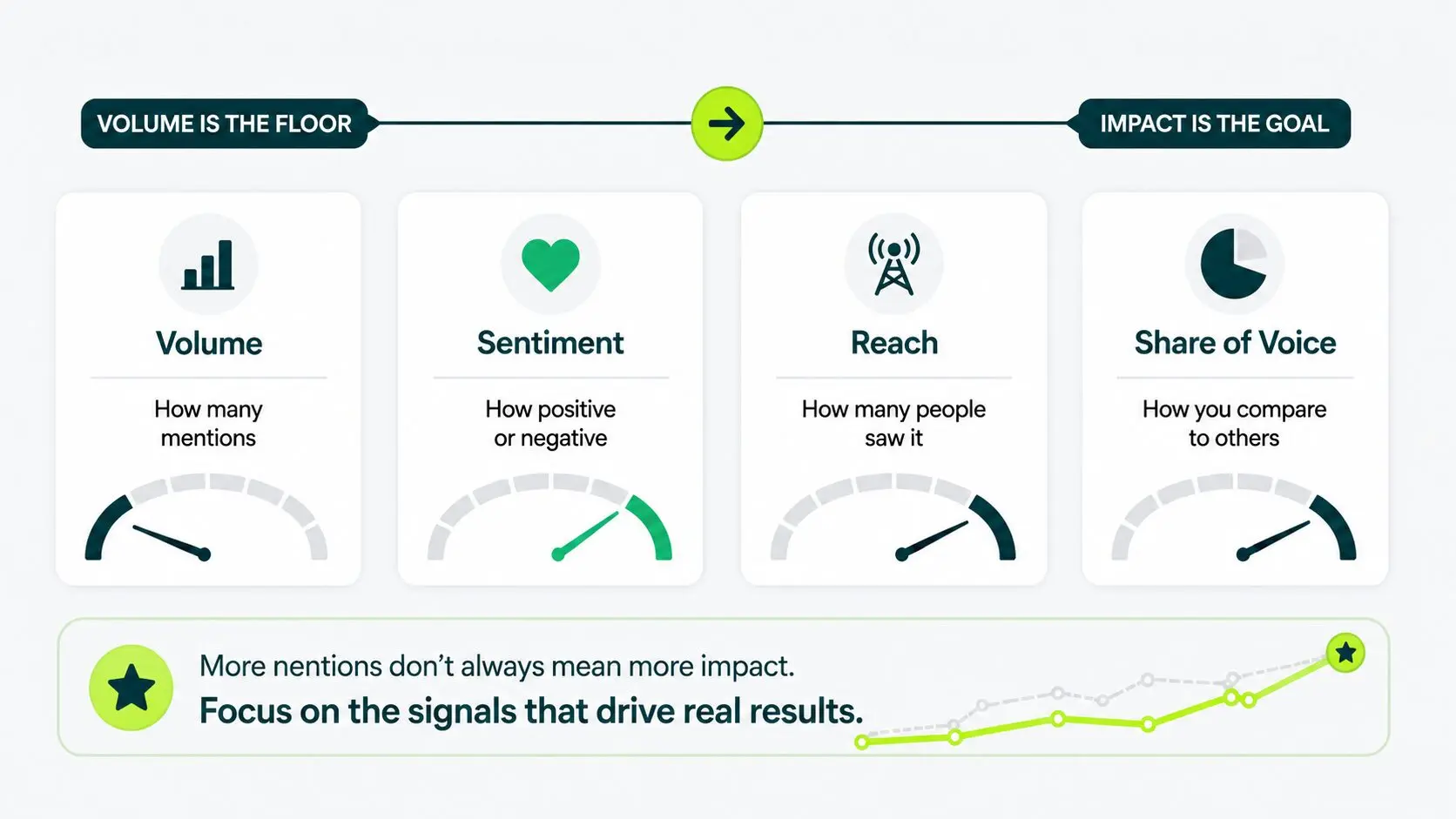
Volume Is the Floor, Not the Ceiling
Volume measures how often your brand is mentioned, but it won’t tell you whether those mentions are helping or hurting you.
Use volume as a sanity check: is the trendline going up, flat, or down over rolling 30-day windows? Beyond that, treat the absolute number as background noise.
Sentiment Is the One to Watch Most
Sentiment is the metric that moves fastest and predicts customer behavior better than any other number in your mention tracker.
A sudden spike in negative sentiment is the closest thing mention tracking gives you to a fire alarm. When that line moves, something happened in the last 24 hours that you need to find and address.
Auto-sentiment misses sarcasm, slang, and emoji tone. Treat the tool’s classification as a draft, not a verdict. Anything flagged negative needs a human review before you decide what to do.
Reach Tells You Which Mentions Count
Reach is the number of people exposed to each mention. A mention from a 12-follower account and a mention from a 120,000-follower account both count as one in your volume number. They are not the same event.
Sort your mentions by reach descending at least once a week. The top of that list is where your time actually compounds.
Share of Voice Tells You Where You Sit
Share of voice is your brand’s percentage of total mentions across a defined competitive set.
If five brands in your category get 10,000 mentions a week combined and your brand accounts for 800 of them, your share of voice is 8%. The number is most useful as a trend: is your share climbing, holding, or eroding over time?
A flat share of voice alongside rising category volume means you’re losing ground while appearing to grow. That’s the kind of pattern volume alone hides.
What to Skip
Hashtag virality, post engagement, click-through rates, and influencer scores are social media analytics, not mention-tracking metrics. Track them in your social media management tool.
The Mention Triage Framework: Respond, Engage, Convert, Claim
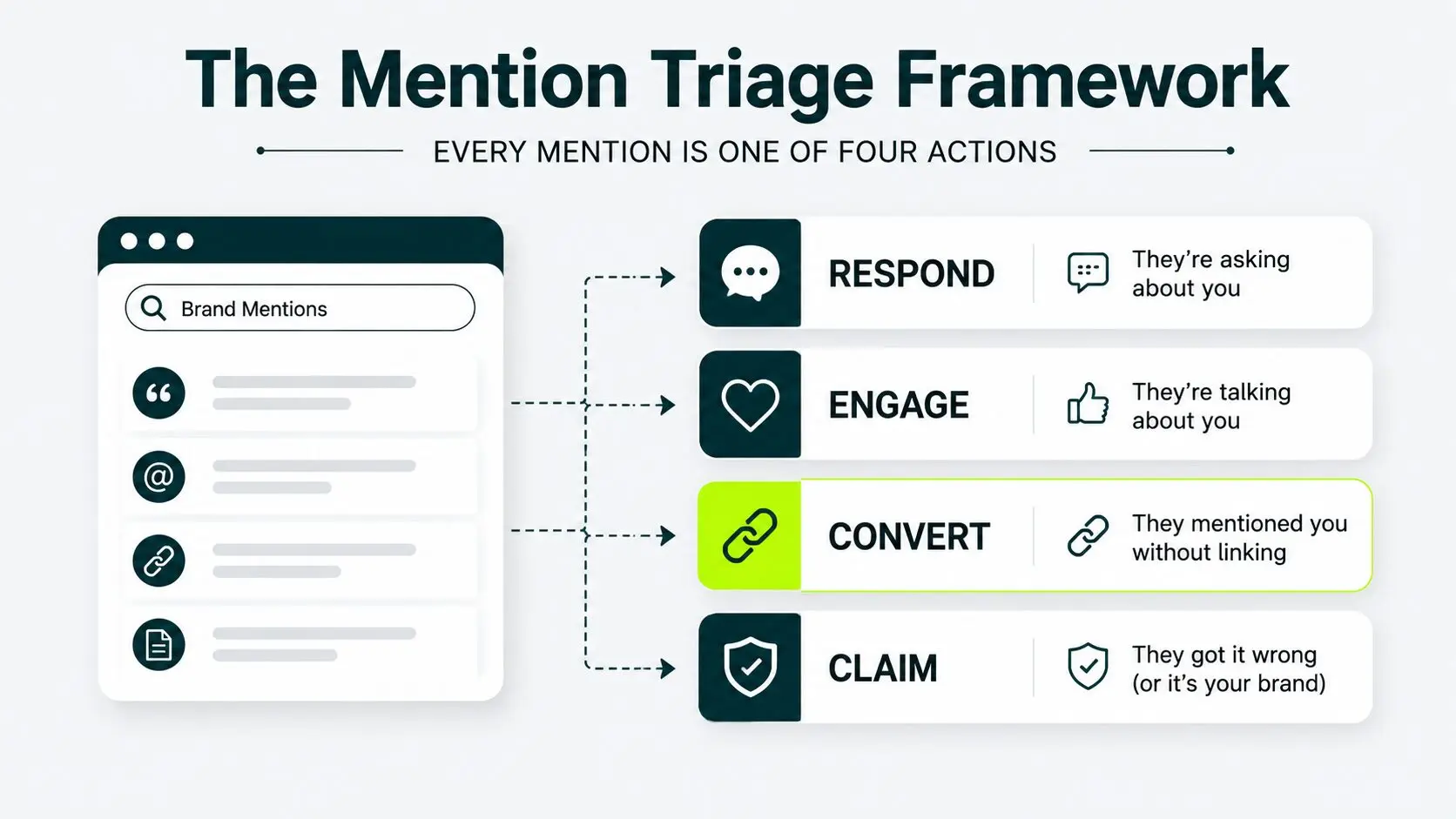
Sort every mention you catch into one of four buckets within minutes of capture. Without a sorting rule, mentions pile up, and you start ignoring them out of decision fatigue.
The Mention Triage Framework gives you that rule. Each captured mention is one of four things: a Respond, an Engage, a Convert, or a Claim.
Respond
A Respond mention is one where someone needs an answer from your brand soon.
Customer complaints, product questions, refund requests, and clearly negative experiences all fall under this category.
The clock is short. A response within an hour is good; four hours is acceptable. Anything the next day reads as neglect.
Route these to whoever runs customer service, not whoever runs social. The fastest brands have a shared channel in which mentions tagged “Respond” automatically become tickets.
Engage
Engage mentions are positive references that don’t need a same-hour response, but they reward warmth when you acknowledge them.
Praise posts, customer photos, casual shout-outs, and conversational references go here. A short comment, a like, or a thoughtful repost turns a one-time mention into a relationship.
The trap with Engage mentions is overdoing it. A brand that replies to every casual mention reads as needy. A brand that acknowledges the meaningful ones reads as paying attention.
Sort by reach when in doubt and engage with the top 10% to 20% by audience size.
Convert
A Convert mention is a buying signal. Treat it as a sales lead, not a social post.
Someone is asking for recommendations in your category, complaining about a competitor, or describing a problem your product solves.
These are sales leads disguised as casual posts. “Anyone use a [your category] that doesn’t [common complaint]?” is a lead. “Tried [competitor]. Hated it.” is a lead.
“Looking for [thing your product does]” is a lead.
Route Convert mentions to whoever owns sales conversations. The reply isn’t a marketing reply. It’s a person reaching out to a person who just said they have a problem worth solving.
Don’t write a sales pitch. Ask a question, offer to help, and let the conversation tell you whether this is a real lead or a stranger venting.
Claim
A Claim mention is one with potential for backlinks. These are the mentions most brands miss entirely. A blog post or news article that names your brand without linking.
A LinkedIn post by a journalist who quotes you without a citation. A Substack post that recommends your product but doesn’t link your homepage. Each one is a chance to turn unlinked mentions into links.
The catch is that Claim mentions don’t all live on social. Many of the highest-value ones surface in search-indexed publications. Your social mention tool scans those, too, since it tracks the open web.
When one shows up in your dashboard, it goes in the Claim bucket and waits for a short, polite ask.
How the Buckets Map to Action
Every mention you capture should land in exactly one bucket within a few minutes of capture. The bucket dictates who acts and how fast.
| Bucket | Owner | Speed | Output |
|---|---|---|---|
| Respond | Customer service | 1 to 4 hours | Resolution, ticket |
| Engage | Community or social | Same day | Reply, like, repost |
| Convert | Sales | Within a day | Direct message or comment with a question |
| Claim | SEO (the work that gets your pages ranking in Google) or outreach | Within a week | Polite email asking for a link |
The framework’s value lies in turning a wall of incoming signals into four queues, each with a different owner.
Most brands without a framework treat all mentions as one undifferentiated stream. That’s why the dashboard fills up, and the action stops.
Turning Unlinked Social Mentions Into Backlinks
Not every social mention belongs in the Claim bucket. Most don’t.
A Claim mention names your site, shows a screenshot of your product, or quotes someone at your company, but doesn’t link back to the page it references.
These mentions are worth chasing because the person already chose to talk about you publicly. They’re not cold prospects. They just didn’t link.
1. Filter Mentions by Surface Type
Blog posts, news articles, Substack posts, and long-form pieces on LinkedIn or Medium are the only surface types worth filtering. Run a weekly filter on those captured mentions with a published page link.
Most of your Claim opportunities live in the “blog and article” slice of your tracker. If you’re using Google Alerts, those mentions already arrive in your daily digest.
2. Qualify the Mention
Three things make a Claim mention worth chasing.
| Signal | What It Tells You |
|---|---|
| The post names your brand specifically, not just the category | The author thought of you, not a generic alternative |
| The publication has a real audience (any traffic, any authority score) | A link from there would carry actual weight |
| The mention is about a page on your site that already exists | You have something concrete to link to |
If two or three are present, send the ask. If only one, skip.
3. Send a Short, Polite Ask
A good backlink ask is three sentences. Thanks for the mention. Here’s the page the mention refers to, and a soft request to add the link if it makes sense for the reader.
Avoid templated reclamation emails that read as if they were automated. They get ignored. A real human reading a real article wrote what they wrote. Treat them like that.
Outreach here means writing a short, personalized email to the publisher asking for the link, not a templated blast. For broader campaigns that go beyond reclamation, the outreach campaigns for links guide covers the structured email workflow.
4. Track the Conversion
Keep a simple sheet with three columns: the original mention link, the date you sent the ask, and the outcome (link added, ignored, declined).
Two reasons. First, you’ll learn which publications and which kinds of mentions convert. Second, you can spot the right contacts at publications that mention you most, which makes the next claim from the same outlet much easier.
Conversion rates depend on publication quality and mention specificity. According to Outreach Desk’s internal data, on average, 25% of qualified asks result in links.
Even a low conversion rate compounds. Every quarter of qualified asks adds links you wouldn’t have had with a tracking system that stopped at “respond to praise.”
The Claim bucket is the connection between social mentions and SEO. Most brands skip it entirely. If you don’t, you end each quarter with links you didn’t have to pitch cold.
Building a Tracking Rhythm You Will Actually Keep
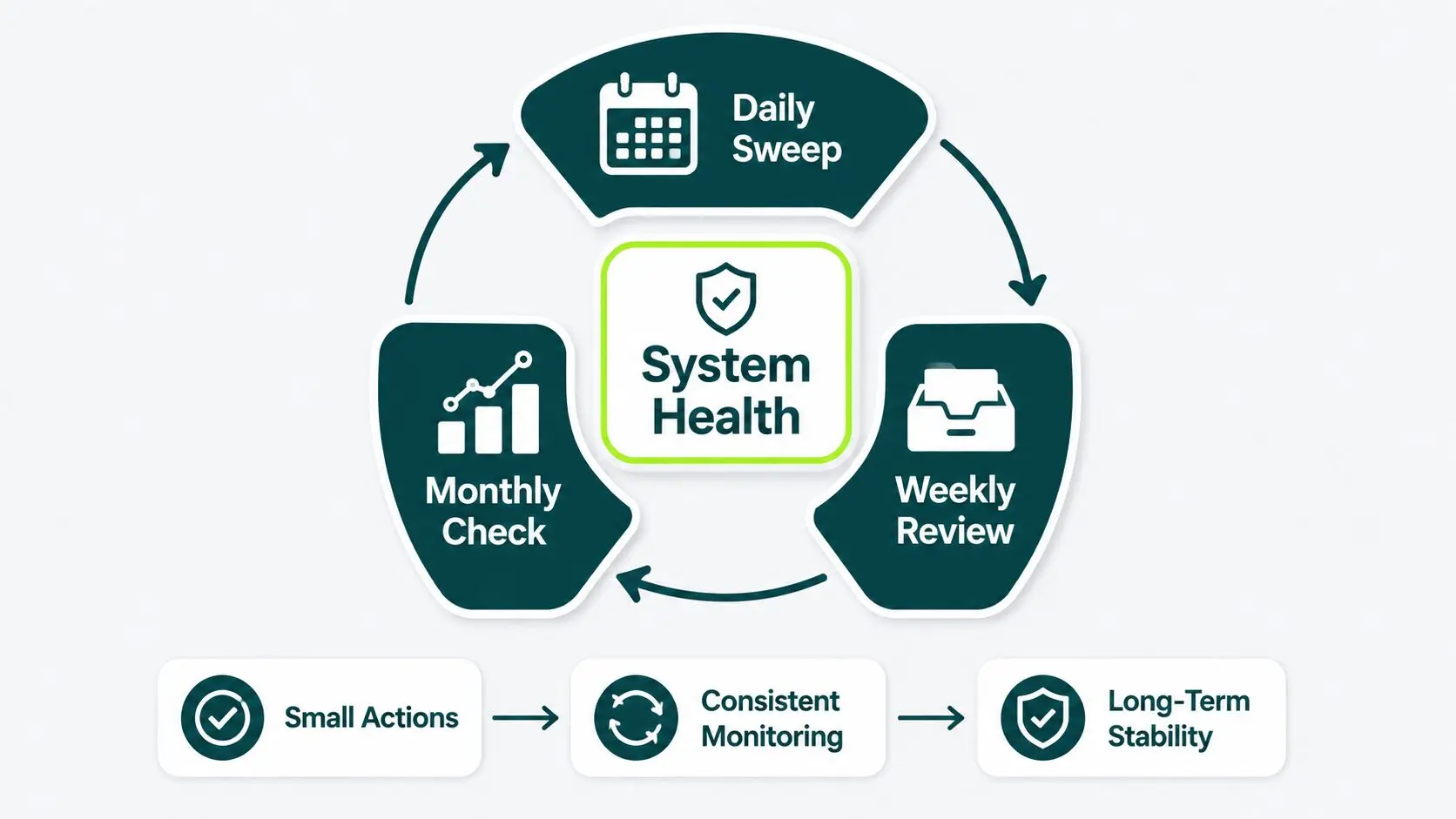
The system you set up is only as good as the rhythm you maintain. Mention tracking dies the same way most marketing habits die: by becoming optional.
Three habits keep it alive.
The Daily 10-Minute Sweep
The daily sweep is a 10-minute routine that keeps your mention queue from backing up. Sort new mentions into the four triage buckets. Route anything urgent.
Ten minutes is the budget. If the sweep regularly takes 20 or 30 minutes, you’ve crossed the volume threshold. That’s the cue to look at a paid tool.
The Weekly Triage Review
The weekly triage review tells you which buckets are falling behind before the gap becomes a process problem. How many Respond mentions hit the under-four-hour mark? How many Convert mentions started a conversation? How many Claim mentions received an ask?
The point isn’t to grade yourself. It’s to spot when a bucket starts to fall behind so you can fix the process before the gap becomes structural.
The Monthly Metrics Check
Once a month, pull volume, sentiment, reach, and share of voice for the last 30 days against the previous 30. Look at trends, not absolute numbers.
This is where you spot the slow shifts. A quiet rise in negative sentiment. A creeping decline in share of voice. A publication that keeps mentioning you without linking.
Daily and weekly checks catch incidents. Monthly checks catch patterns.
Extend the Rhythm to AI Search
AI assistants like ChatGPT, Claude, and Perplexity surface brand mentions social tools miss. Tracking them works differently but follows a similar discipline.
The setup for monitoring brand mentions in ChatGPT is a logical next layer once the social side is steady, and the broader approach to AI assistant mention tracking covers other tools.
The brands that win at this are not the ones with the best tool. They’re the ones who set up something small, kept it running for a year, and let the compounding do the work.
Open your social mention tracker right now. Sort the last 100 captured mentions into the four buckets: Respond, Engage, Convert, Claim. If anything sits on the Claim list, start your week with unlinked mention reclamation and work down from there.
A week of this work compounds across a year. If you track mentions consistently in 2026, you turn quite a few praises into customers, links, and visibility.
Pick One of the Four Buckets and Start There
If your mention queue is empty, run a 10-minute sweep today. If you already have mentions coming in, open your tracker, filter the last 30 days, and pull every unlinked brand reference into the Claim bucket.
Send three outreach asks before Friday. That single habit will help you run consistently for a quarter, build links you didn’t have to pitch cold, and close the gap between brands that only see tagged mentions and brands that see everything.
Missing untagged brand mentions costing you customers, leads, and backlinks?
Track every mention, prioritize the most valuable ones, and turn social signals into real SEO and sales opportunities with expert guidance.
What is the difference between social media monitoring and social media mentions tracking?
Social media mentions tracking captures every public reference to your brand across platforms. Social media monitoring is broader. It includes tracking competitor activity, industry keywords, and category conversations, not just your own brand name.
Mentions tracking is a subset of monitoring. Start with mentions tracking to cover your brand first, then expand to monitoring once that system runs without daily attention.
How do I respond to a negative brand mention on social media?
Route it to customer service within one to four hours, not to whoever manages social content. Write a direct reply that acknowledges the issue without being defensive.
Don’t ask the person to move the conversation to DMs unless the resolution genuinely requires private information. A public, calm response does more for your reputation than a private fix that nobody else sees.
Does social media mention tracking work for B2B brands?
Yes. B2B brands get fewer mentions than consumer brands, but the ones they do get carry more weight. A single mention from a founder, analyst, or industry publication can reach a highly targeted audience.
The triage system still applies: route complaints fast, engage with the meaningful ones, and treat category questions as sales leads. The Claim bucket matters even more in B2B because unlinked mentions from niche publications are easier to convert into backlinks.
Should I track and convert mentions myself or work with an agency?
Tracking mentions is manageable in house with the right tool. Converting unlinked mentions into backlinks at scale is where most teams stall; it requires consistent outreach to publishers who already wrote about you. A dedicated link building agency runs that outreach systematically instead of letting claimable mentions go unconverted.”
How do I know if a social mention is worth responding to?
Check two things: reach and intent. A mention from an account with a real audience and a clear signal (question, complaint, or recommendation) is worth acting on.
A mention from a low-follower account with no engagement usually isn’t. Sort by reach weekly and focus your responses on the top 20% by audience size. Below that, a like or no response at all is the right call.
What’s the difference between a social mention and a backlink?
A social mention is a public reference to your brand on a social platform or open web page, with or without a link. A backlink is a hyperlink from another website pointing to a page on yours.
Social mentions don’t directly pass SEO authority. But unlinked mentions on blogs, news articles, or Substack posts can be converted into backlinks through outreach strategy, which is what the Claim bucket exists for. The mention is the signal. The backlink is the outcome you aim for.