You paid for ten guest posts last quarter. The rankings barely moved, and now someone’s telling you tier 2 link building is the fix.
Instead of buying more backlinks, you build small links pointing at the ones you already have. And they pull harder for you.
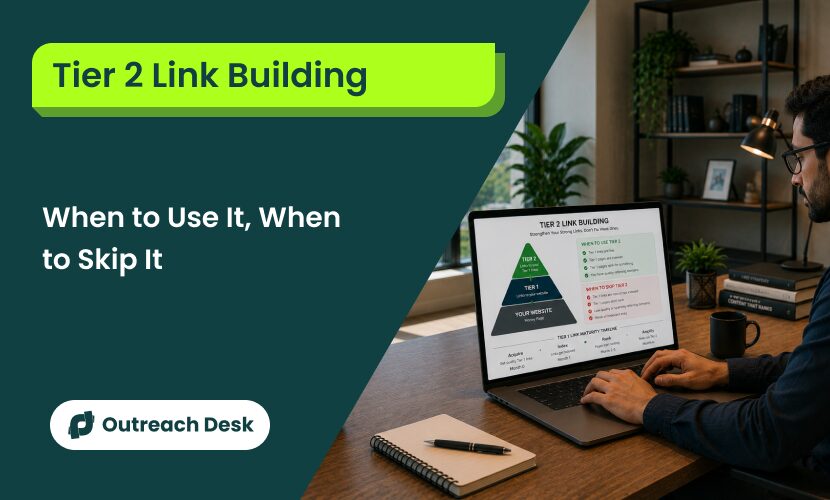
Tier 2 link building means building new backlinks to the pages that already link to your site. When these existing links gain strength, they pass more ranking power, but this only works if your tier 1 inventory is already solid.
Key Takeaways
- Tier 2 link building points new links at your existing backlinks, not your site, to increase the ranking power those links pass.
- It works only when tier 1 links are live, indexed, and on pages already ranking for something.
- Weak tier 1 inventory doesn’t respond to tier 2 amplification. The fix is better tier 1 first.
- Anchor text and link velocity both carry risk at tier 2, and each has specific limits.
- 3 free checks tell you if it worked: referring domain growth, movement in tier 1 page rankings, and indexation status.
The Simplest Way to Think About Tier 2 Link Building
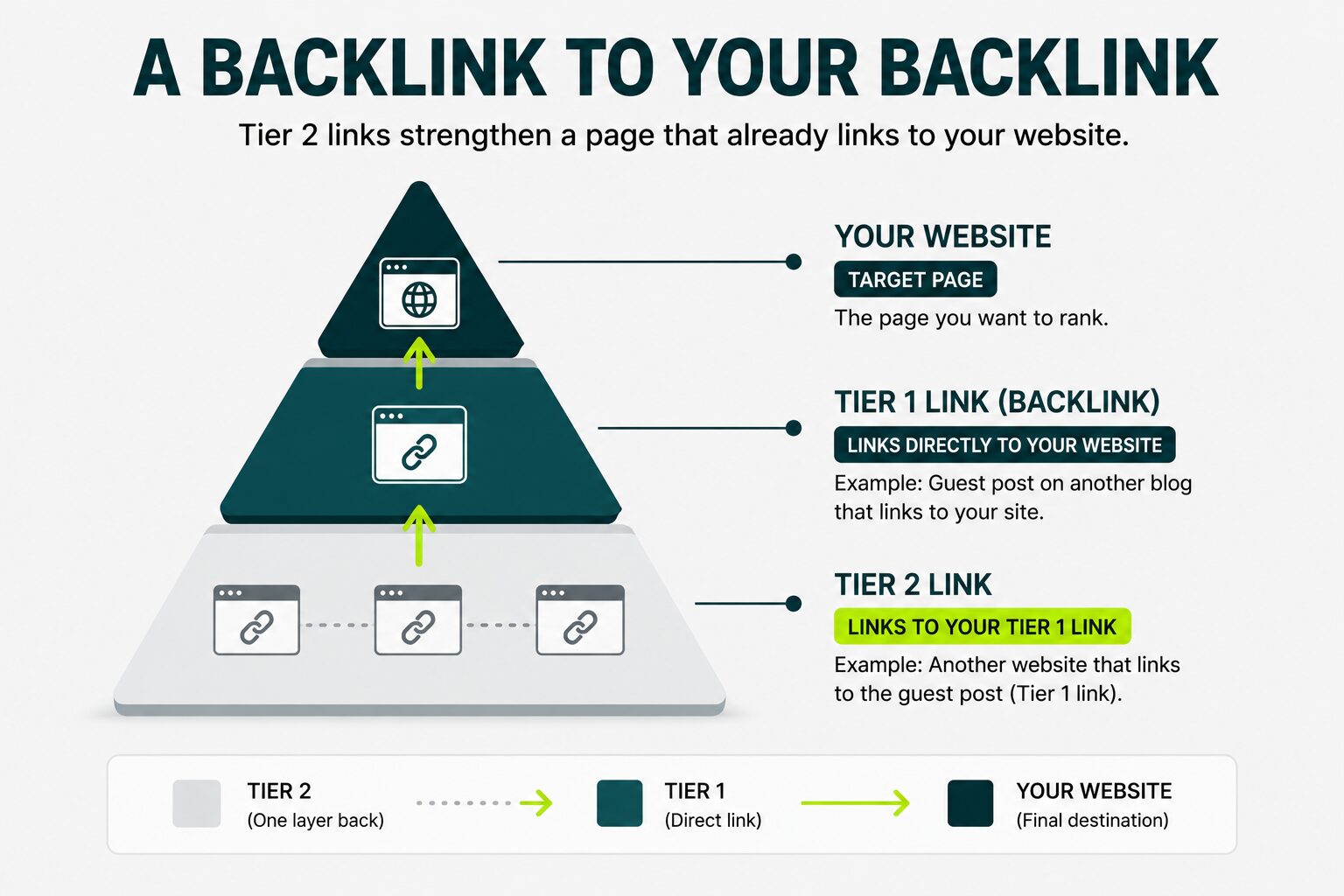
A tier 2 link is a backlink that points to one of your other backlinks, not directly to your website.
Picture three layers. Your website sits at the end.
A guest post on someone else’s blog links to your website. That guest post is a tier 1 link, the kind most people mean when they say “backlink.”
Now, think of a third site linking to that guest post. The link from the third site to the guest post is a tier 2 link.
Tier 2 sits one layer back from the page you actually want to rank. Tier 1 sits directly against it.
There’s also tier 3, which links to tier 2. That belongs to the full tiered link approach and isn’t something a beginner needs to act on this month.
The reason any of this matters is that ranking power flows through links, just as water flows through pipes.
A backlink helps your site more if the page linking to it is stronger.
Put differently, tier 2 is about strengthening the links you already paid for, rather than paying for new ones.
Why a Link to Your Link Can Move Rankings
A link to your link moves rankings because Google still treats backlinks as a ranking signal.
An Ahrefs 2025 links study examined 1 million Google search results.
It measured how often pages that ranked well also had many referring domains.
A referring domain is a separate website that links to a target page.
The correlation came out at 0.255. The researchers called that a weak correlation that still carries real weight.
Translation for a beginner: links still matter, but a weak link won’t move your rankings. The links that move the needle are the ones that come from pages with their own backlinks pointing at them.
That’s the mechanism tier 2 leans on.
When a third site links to the guest post that links to you, the guest post’s backlink profile gains referring-domain weight. Google reads a slightly better signal from that guest post.
The link in the guest post you received carries more weight than before.
Practitioners call the thing that flows through these links “link equity.” A simpler picture: it’s the ranking power passed along when one page vouches for another.
The deep version sits inside our guide to link equity basics. But the simple version is enough to make the rest of this article useful.
Two things have to be true for tier 2 to actually move anything:
- The tier 1 link has to be a real link that Google can see and count.
- The page that provides the tier 1 link needs strengthening.
Most wasted spend on tier 2 traces back to one of those two conditions being broken.
The Five Places Tier 2 Links Actually Come From
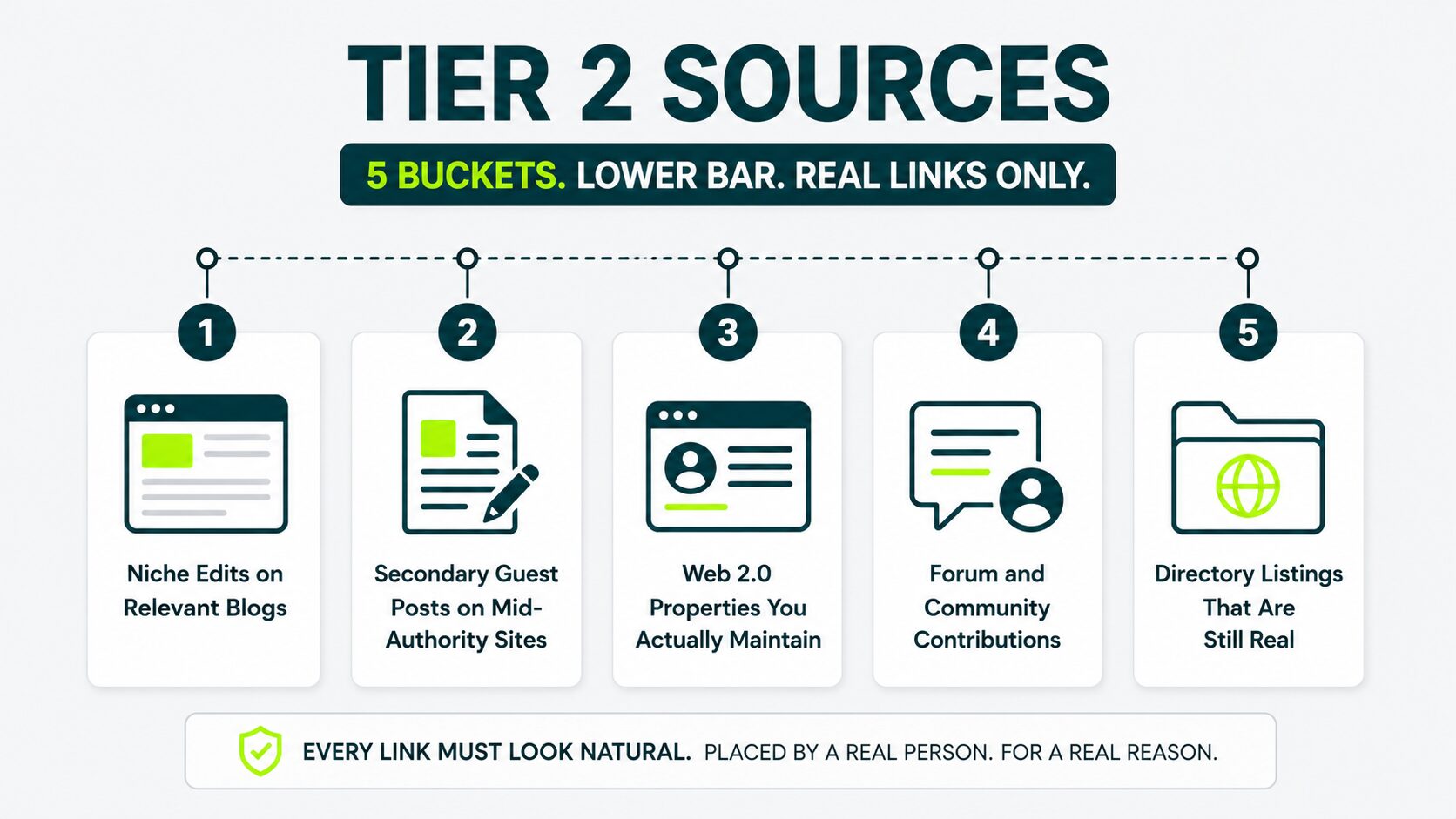
Tier 2 sources fall into five buckets:
The bar is lower than tier 1. But each source still has to look like a real link that a real person decided to place, not an obvious pattern.
Niche Edits on Relevant Blogs
A niche edit is a link added to an article that’s already published, usually on a smaller blog that takes them.
For tier 2, you’d place that link inside a post on a third site that points to your existing guest post.
The advantage is speed and topical relevance.
The risk is that some niche edit sources sell to anyone with a credit card. Google has gotten better at spotting paid edit networks.
Pick blogs in your topic that look like they care about their own content.
Our guide to niche edit placements walks through the basics if you’ve never done one before.
Secondary Guest Posts on Mid-Authority Sites
A guest post written specifically to link to your tier 1 page.
The host blog is usually smaller than the one carrying your tier 1 link. But the post is still genuine writing on a real site.
This is the cleanest tier 2 source and also the slowest.
Think of it as a second guest post placement whose sole job is to reinforce the first.
Web 2.0 Properties You Actually Maintain
A Web 2.0 property is an account you create on a platform like Medium, LinkedIn articles, or Substack, and then publish on.
Tier 2 links from these can work when the account appears to be a real publisher. That means multiple posts, varied topics, and a real bio.
They stop working the moment they look like a link farm scheme. Empty profiles, one post each, nothing on them except links.
Forum and Community Contributions
A long, useful post on Reddit, Quora, a niche forum, or a Stack Exchange-style site. The link to your tier 1 page sits inside the post, in context.
The link itself is usually nofollow. That means Google treats it as a hint, not a direct ranking signal. But the traffic and indexing signal still help.
The trap here is posting throwaway answers just to drop a link. Mods catch that, and so does Google.
This method helps you safely build links in forums while keeping your posts real and trustworthy.
Directory Listings That Are Still Real
A directory listing means submitting your tier 1 page to an industry list, a curated resource page, or a topical directory.
Most general directories have been useless for years.
A small number of niche directories still pass real value: local business lists, industry resource pages, and association directories.
Skip anything that asks for nothing more than a URL and an email.
When Tier 2 Is Worth Your Time
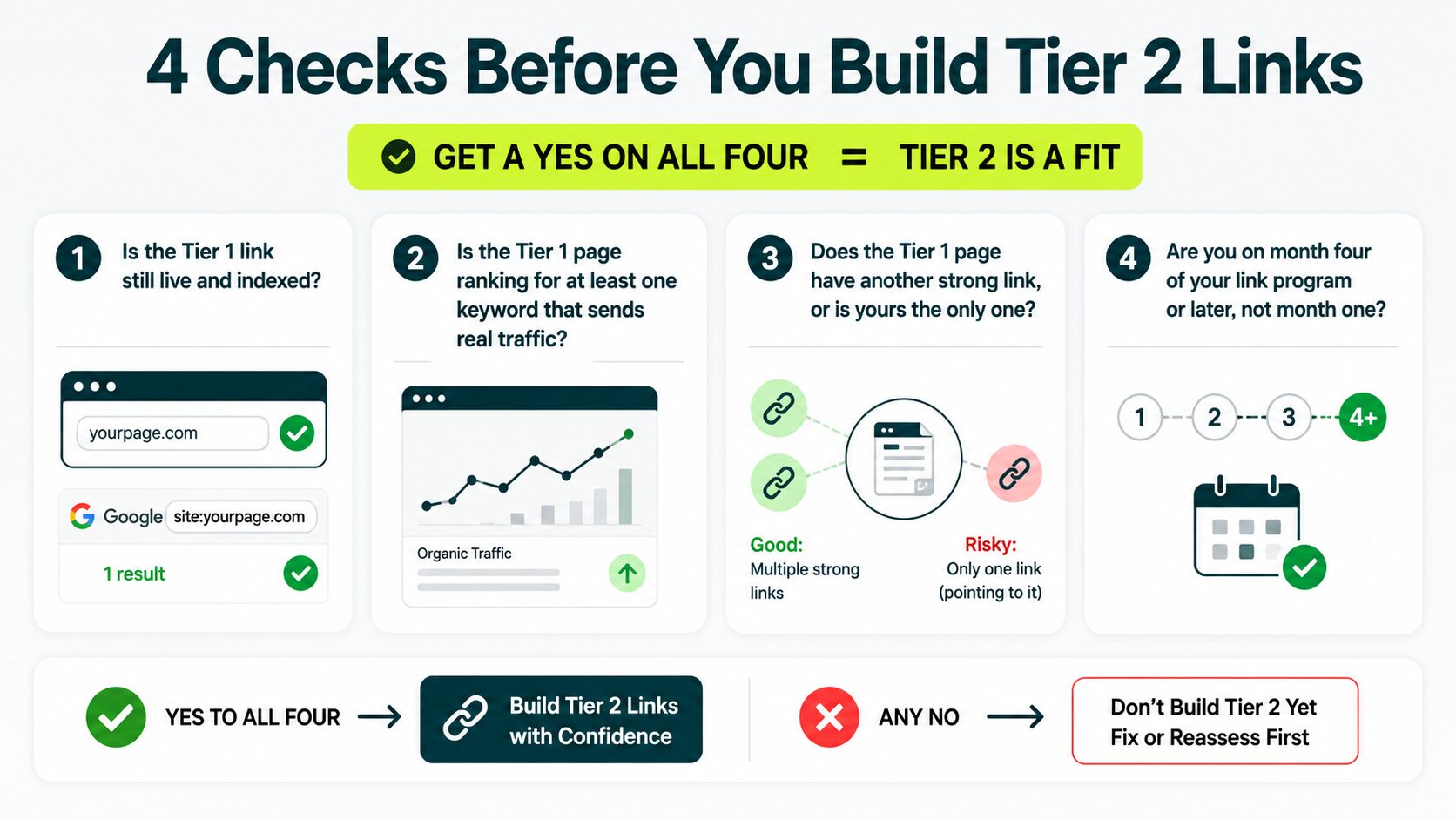
Run these four checks before spending time and money on tier 2. Get a clear yes on all four, and you have a fit. Hit a no on anyone, and tier 2 isn’t the move yet.
1. Is Tier 1 Link Still Live and Indexed?
Tier 2 has nothing to amplify if the page no longer exists or Google never indexed it.
Open the tier 1 URL.
If it loads, copy the URL into Google with “site:” in front, or run it through a free index checker to confirm the page is indexed.
Can’t see it in the index? Fix that first, or move on to a fresh tier 1 link.
Our guide to auditing the links you already have covers how to spot dead and unindexed tier 1 links in your inventory.
2. Is The Tier 1 Page Ranking for At Least One Keyword That Sends Real Traffic?
Open Ahrefs and check the page that’s giving you the tier 1 link. If it ranks for nothing, strengthening it strengthens zero.
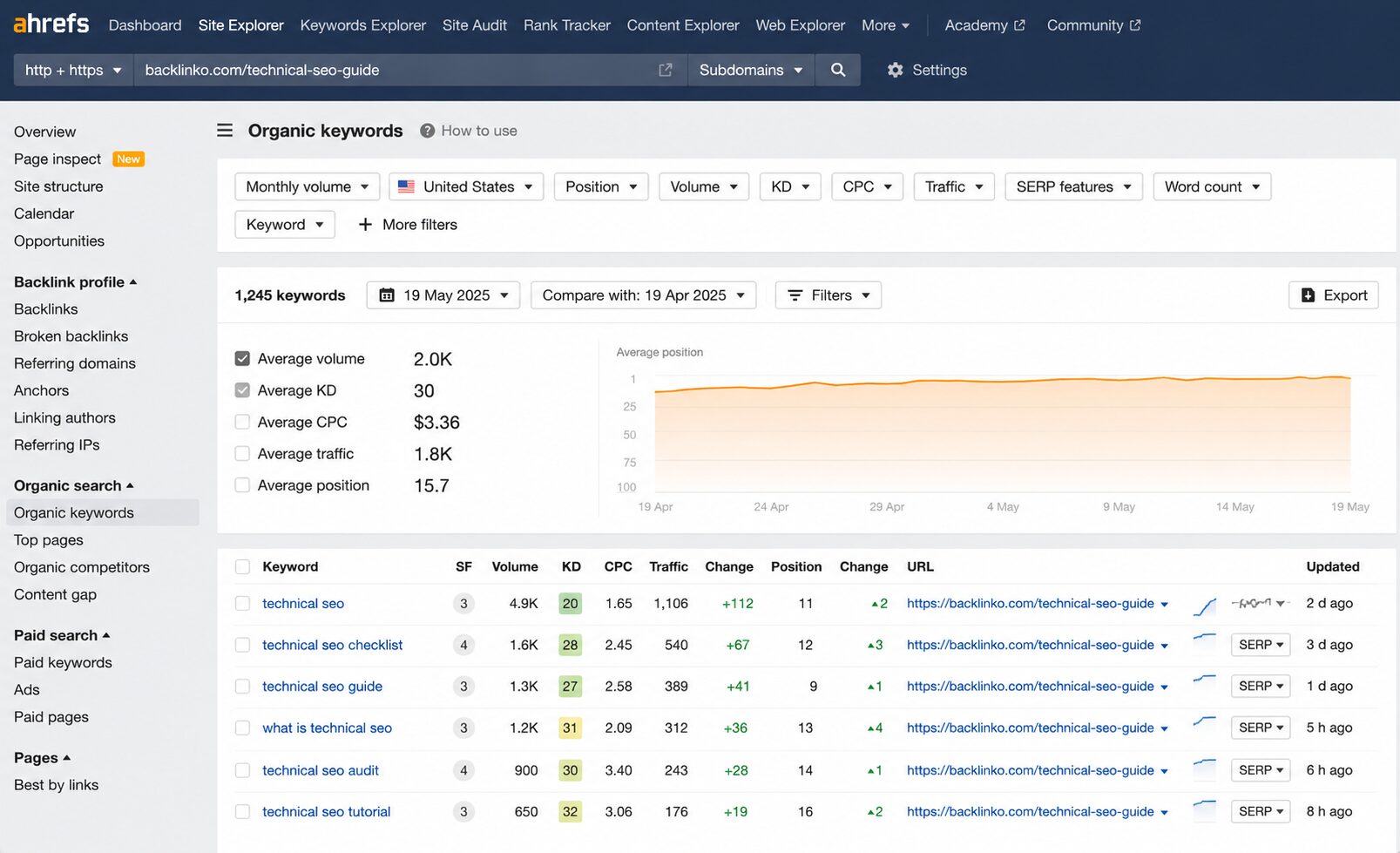
Tier 2 doesn’t make a page that ranks nowhere to start ranking. It only lifts pages that already rank for something by helping them rank a little higher.
3. Does the Tier 1 Page Have Another Strong Link, or is Yours the Only One?
A page with one inbound link (yours) and nothing else is hard to lift with tier 2 alone.
Pages that already have a couple of decent inbound links respond much faster to a tier 2 push.
Did your tier 1 placement land on a page that nobody else has ever linked to?
Tier 2 isn’t the answer. Earning a stronger tier 1 placement is.
4. Are You on Month Four of Your Link Program or Later, Not Month One?
Tier 2 stacked on top of brand-new tier 1 looks like manipulation.
Give the tier 1 link a few months to settle and get indexed first.
If you’re brand new to link building, spend the next 90 days on building guest post links instead
Outreach Desk campaigns show that tier 2 links most often amplify tier 1 links that are already moving in the rankings. Only a small fraction of tier 2 links independently drives new positional gains.
When Tier 2 Is Wasted Effort
Tier 2 wastes money when:
- Site is under six months old
- Tier 1 links are weak
- Trying to rescue a post that won’t rank
- Picked tier 2 because tier 1 felt hard
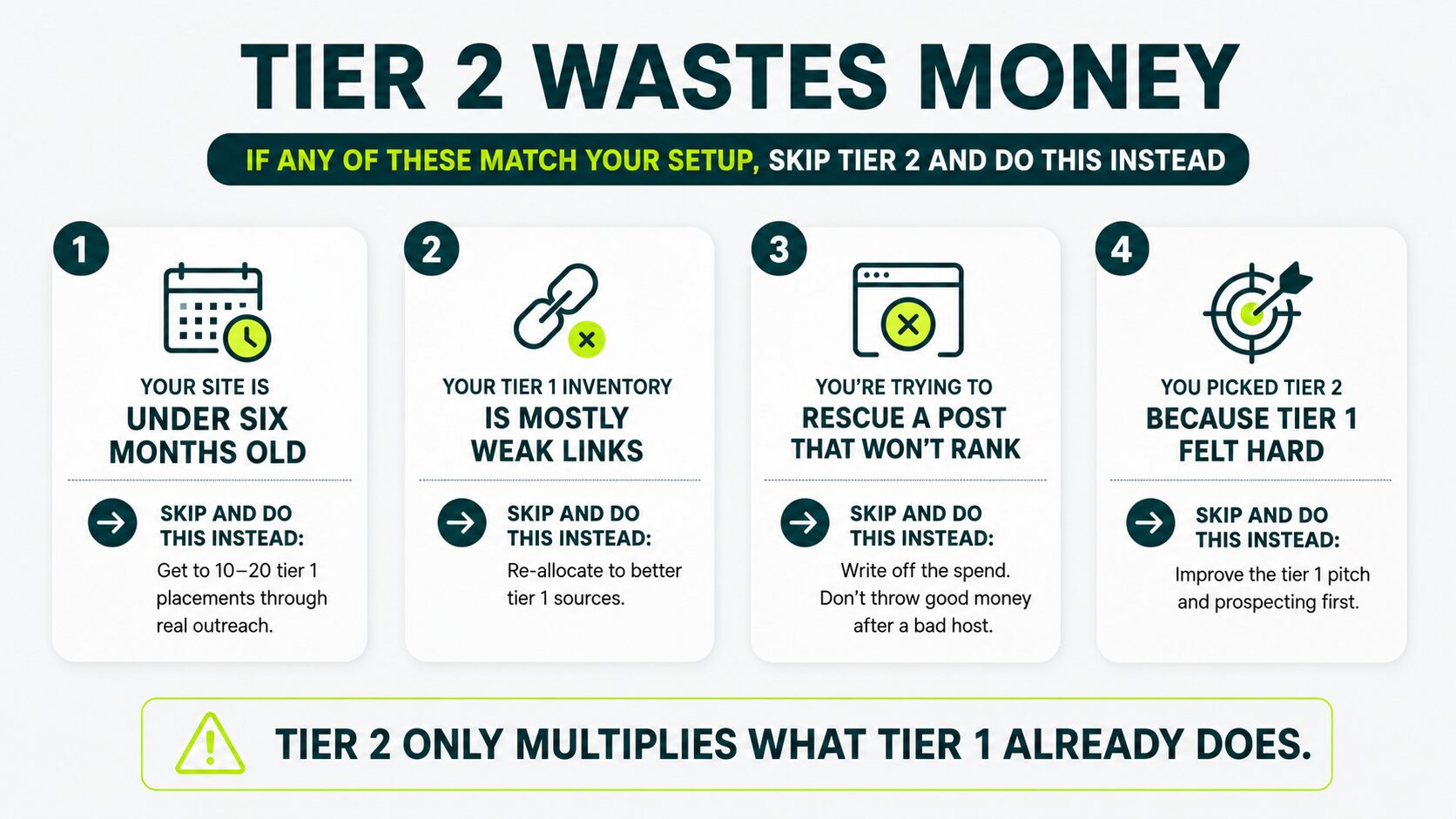
If any of these match your setup, follow the “skip and do this instead” line. Stop reading the rest of the section.
Your Site Is Under Six Months Old
A site that just launched has more pressing problems than amplifying its tier 1 links.
The first job is enough tier 1 to look like a real, recommended business. That means 10 to 20 placements from genuine editors, built over a few months.
Skip and do this instead: get to that 10-to-20 number through real outreach. The fastest path is still earning a contributor article one at a time.
Your Tier 1 Inventory Is Mostly Weak Links
You bought 20 guest posts on a marketplace. They all sit on sites with no traffic, no editorial standards, and no outbound links.
Tier 2 won’t save them. You’re stacking weak amplifiers on top of weak signals.
Skip and do this instead: re-allocate to better tier 1 sources. Or use niche edits strategy on stronger pages that already have their own traffic.
You’re Trying to Rescue a Guest Post on a Site That Was Never Going to Rank
Some guest posts get bought on hosts with no audience and no inbound links.
Tier 2 cannot make those pages relevant.
The host site doesn’t get found by Google in the first place. A link from it carries almost nothing, no matter how much you point at it.
Skip and do this instead: write off the spend. Read the Outreach Desk’s guide to buying backlinks before the next purchase.
You Picked Tier 2 Because Tier 1 Felt Hard
Tier 1 outreach is slower and more frustrating than buying tier 2 on a marketplace.
That’s not a reason to switch.
Tier 2 only multiplies what tier 1 already does.
Has your tier 1 work stalled because outreach takes too long or hardly anyone replies? The fix is a better outreach strategy, not amplification.
Skip and do this instead: improve the tier 1 pitch and prospecting before adding a tier underneath.
Tier 2 rarely fixes weak tier 1 inventories. In most cases, weak tier 1 links need to be rebuilt or replaced before amplification can have any effect.
How Google Reads Tier 2 Patterns
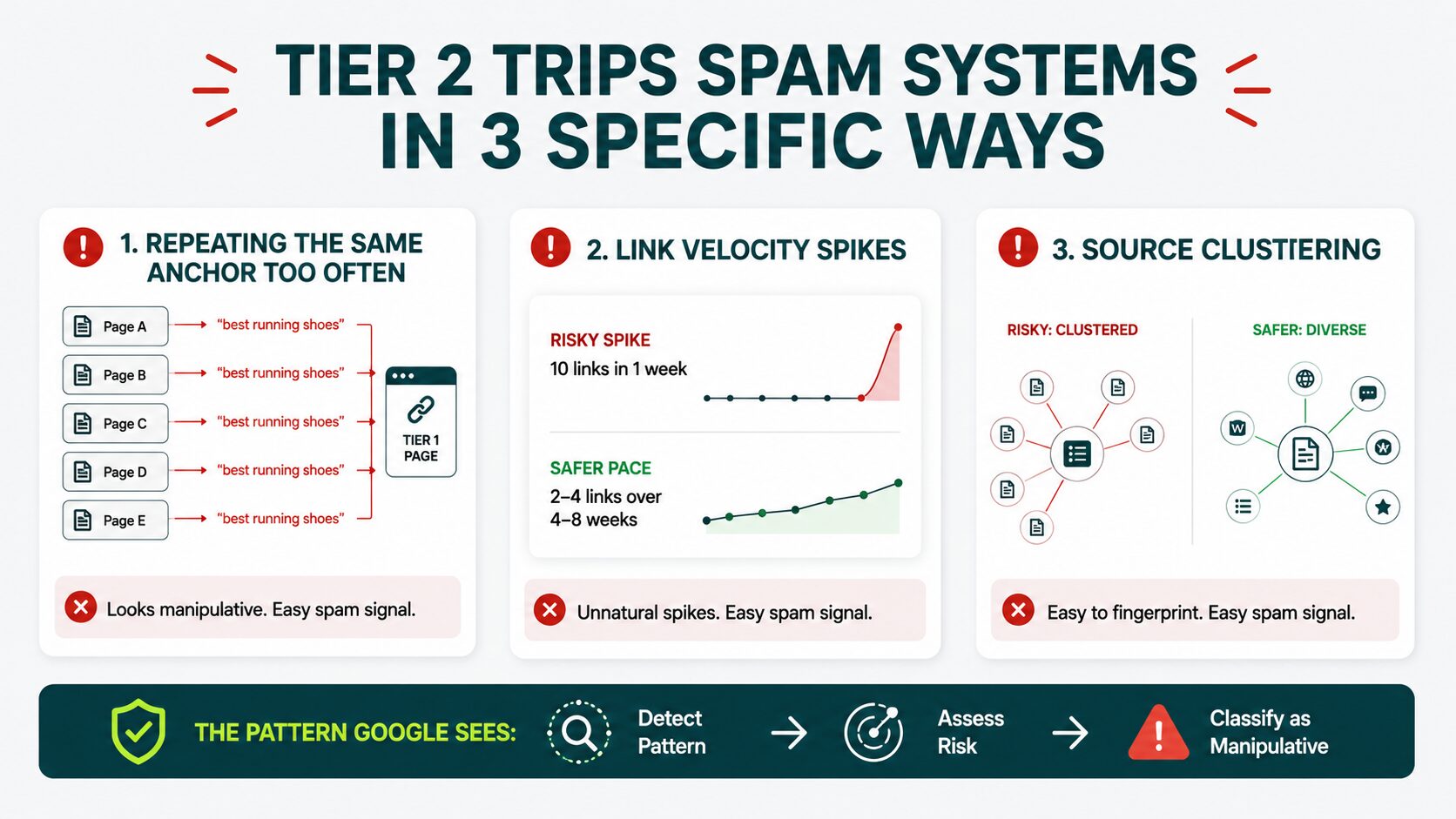
Google’s spam systems read patterns, not single links. Tier 2 trips them in three specific ways.
Repeating the Same Anchor Too Often
Use the same anchor for every tier 2 link. Google reads it as someone trying to push a phrase. An anchor (or anchor text) is the clickable words of a link, like a sign telling readers what’s behind the click.
An exact-match anchor uses your target keyword verbatim, with nothing else in the phrase. Tier 1 already has its own anchor distribution rules. Tier 2 has different ones.
The safest tier 2 pattern is much more relaxed than the tier 1 pattern. The next section gets specific about percentages.
Link Velocity Spikes
Building ten tier 2 links to one tier 1 page in a week looks nothing like organic growth. Real pages don’t acquire links that way.
A safer pace is two to four tier 2 links per tier 1 page over four to eight weeks.
The exact number depends on the host page’s existing organic link velocity.
Source Clustering
Every tier 2 link from the same network of sites tells Google something. The same goes for the same Web 2.0 platforms or the same handful of niche directories. Google can connect the dots.
Real healthy link profiles look varied. They were built by different people at different times.
A tier 2 push from one source, one platform, or one anchor pattern looks like one person on a Tuesday.
Anchor Text and Link Diversity for Tier 2
Tier 2 anchor text rules look almost nothing like tier 1 anchor text rules.
A tier 1 anchor tells Google what the page receiving the link is about, used in moderation.
The job of a tier 2 anchor is different. It makes the page that links to you look like a normally-linked page, not a target.
A safe starting distribution looks like this:
| Anchor type | Share of tier 2 anchors | Example |
|---|---|---|
| Branded | 35 to 45% | “according to Acme Tools” |
| Generic | 15 to 25% | “Read more on this”, “the full article” |
| Naked URL | 15 to 20% | “https://example.com/article-title” |
| Partial-match | 15 to 25% | “A guide on tier 2 link building” |
| Exact-match | 5 to 10% | “tier 2 link building” |
Notice two things about this distribution.
The share of generic and naked URL anchors is much higher at tier 2 than at tier 1.
Second, the exact-match share is intentionally small.
Pointing at it with “read more on this” is what a real person does. Pointing at it with “tier 2 link building” over and over is what software does.
You’re not trying to rank the tier 1 host page for your keyword.
You’re trying to add weight to a link, not to ship a phrase up the search results.
See If Your Tier 2 Links Are Really Helping You Pages
Tier 2 either moves a needle or it doesn’t. Three free checks tell you which.
Referring Domain Growth on the Tier 1 Page
Open your tier 1 host page in Ahrefs (the free backlink checker works). Or any free tool that shows referring domains. Note the number before you start tier 2. Re-check it monthly.
The referring domain count on the host page should climb, slowly and unevenly, if your tier 2 work is real.
Didn’t move? The tier 2 links you built didn’t index, weren’t picked up, or aren’t passing signals.
Ranking Position of the Tier 1 Page for Its Primary Keyword
The tier 1 page already ranks for something. That was check 2 in the pre-flight.
Track that ranking weekly. Tier 2 moves a needle by lifting the tier 1 page’s ranking by a position or two over six to twelve weeks.
Was the page at position 18 when you started, and position 12 two months later? Tier 2 worked. If it’s still at 18, it didn’t.
Indexation Status of the Tier 1 Page
Drop the tier 1 URL into Google with site: in front (for example, site:example.com/article-title).
Is the page still in the index? You’re good.
If the page vanished from the index, something went wrong.
Sometimes the host site decides to noindex old content. Sometimes Google has dropped the page.
No amount of tier 2 will fix an unindexed host page.
So, should you build Tier 2?
Tier 2 link building works when the tier 1 inventory you’ve already paid for is real, indexed, and ranking for something.
Most people who think they need tier 2 actually need either more tier 1 or better tier 1. The four-question check is the fastest way to tell which group you’re in.
Have tier 1 links that haven’t moved your rankings as much as you hoped? Talk to the Outreach Desk team before adding tier 2 on top.
We’ll audit the underlying tier 1 inventory first. Then we’ll tell you honestly whether amplification is the right next move.
Looking to amplify your existing backlinks?
Get a tailored tier 2 link-building plan that strengthens your current SEO efforts without risking penalties.
What are tier 3 backlinks?
Tier 3 backlinks are links that point to your tier 2 links, sitting one more layer back from your website. The same logic applies. A tier 3 link strengthens a tier 2 link, which strengthens a tier 1 link, which strengthens your page.
In practice, beginners almost never need tier 3. The deeper you go, the smaller the lift and the higher the risk of looking spammy.
Can I buy tier 2 backlinks?
Yes, and most agencies sell them. Marketplaces also sell them by the package.
The cheaper the package, the more likely the links come from a single Web 2.0 farm or a cluster of low-quality network sites. That’s the same source-clustering pattern Google’s spam systems are built to detect.
How many tier 2 backlinks do I need per tier 1 page?
For most beginners, two to four tier 2 links per tier 1 page are plenty.
The cheapest packages sell 10 or 20 per tier 1 page. The math doesn’t get better past the first few.
Each additional tier 2 link adds less than the previous one, and the velocity risk grows quickly. Less is usually safer.
Are tier 2 backlinks safe?
Tier 2 backlinks are safe when three things line up. The sources look like real sites. The anchors are mostly branded or generic. And the velocity is slow.
They become unsafe when the sources are obviously thin (e.g., empty Web 2.0 accounts or link farms). Or when the anchors are all exact matches. Or you build ten of them in a week.
The risk is roughly proportional to how automated the pattern looks.
Does tiered link building still work in 2026?
Yes, but the gap between the right way and the wrong way has widened.
Google’s spam systems are better at detecting thin-layered links than they were three years ago. And the marginal value of any link is smaller now, so a poorly placed tier 2 link adds even less.
Done with restraint on tier 1 inventory that’s already earning, it still moves rankings. Most brands that get this right work with a specialist link building agency rather than managing the tier structure in house
Should I build tier 2 links or just more tier 1 links?
Build more tier 1 if you have fewer than 15 to 20 of them. Build tier 2 if you have more than that, and the tier 1 inventory is already pulling weight.
Tier 1 outreach is harder per link. But each tier 1 link does more for you than each tier 2 link, in most situations. Tier 2 is a multiplier on tier 1, not a substitute for it.