Backlink Removal Service Built on Direct Webmaster Outreach
Your strategist finds harmful backlinks and removes them at the source. Disavow is reserved for links you can’t remove.

Manual link-by-link review
Direct webmaster outreach
Disavow only as a fallback

4.8/5
Trusted by agencies
and brands worldwide.
Disavow Queue
46 links
Campaign Dashboard
LINKS REVIEWED
68 confirmed harmful
LINKS REMOVED
32% removed at source
CONTACTS REACHED
9 replies
REPLY RATE
Of contacts reached

Removals Confirmed
22





Service Overview
Why a Real Backlink Removal Service Takes More Than a Disavow File
In a backlink removal service, the team finds the links hurting your site and removes them at the source. That sounds like something a disavow file already does, but it does a different job.
A disavow file only asks Google to stop counting a link when it calculates your rankings. The link stays exactly where it was, on the site that published it, no longer counted in your favor but otherwise untouched. Nothing about the web itself changes.
Link removal changes the web. A real person contacts the site owner, explains why the link needs to come down, and the link disappears. Google recommends removing unnatural links first. If you cannot remove them, you can consider disavowal.
Most services skip straight to disavow because it’s faster and doesn’t require anyone to reply to an email. That approach leaves the links live on the web while asking Google to ignore them when evaluating your site.
Three things define a real backlink removal service:

Outreach First, Always
Your strategist sends a removal request for every reachable link before considering disavowal.

Full Documentation
We log every attempt, reply, and outcome, so you know exactly what happened to every link.

Disavow as the Honest Fallback
What can’t be removed gets disavowed carefully, with only the links that genuinely need it added to the file.
How We Work
How Your Backlink Removal Campaign Works
Your campaign moves from confirmation to outreach to documented resolution. Disavow covers only what’s left.
Your strategist checks flagged links manually against your Search Console data and traffic history. You never ask a webmaster to remove a link that wasn’t the problem.
Links from old vendor campaigns, forgotten guest posts, and private blog networks a past agency built without telling you all get the same check.
A generic contact form rarely reaches someone who can act.
Your team researches the actual owner, editor, or webmaster behind each linking page because a request that lands in a real inbox is far more likely to be seen than one lost in a support queue.
Cold email replies average 3.43% overall in 2026, per Instantly’s benchmark data, and a generic bulk request performs at or below that.
Each request names the exact page, the exact link, and the specific reason it needs to come down. That is what separates a request that gets read from one that gets deleted as spam.
If a site owner doesn’t reply within a set window, your team sends one polite follow-up. Links still unresolved after that move to the fallback stage.
Your team also records each follow-up and response to avoid duplicate outreach. If a site owner requests additional information or proof of ownership, your team addresses the request before deciding on the next step.
Some webmasters never respond. Some sites are dead, abandoned, or hostile. Your team can consider disavowal for eligible links you couldn’t remove.
Before proceeding, your team reviews the remaining links to confirm that disavowal is appropriate. This step requires caution because disavowing links that contribute value could affect your site’s search performance.
Your team documents the reasons for each disavowal decision.
You get a complete report covering every link reviewed, every outreach attempt, and the outcome of each.
The report also highlights links successfully removed, links still pending, and links considered for disavowal.
Your team tracks unresolved cases and periodically checks previously removed links to identify any that reappear, helping you decide when further action is necessary.

Expected Results
Outcomes a Backlink Removal Service Delivers
When harmful links are removed from the web rather than just ignored, you get a cleaner profile and a clear record of how it got that way.
Links Removed at the Source
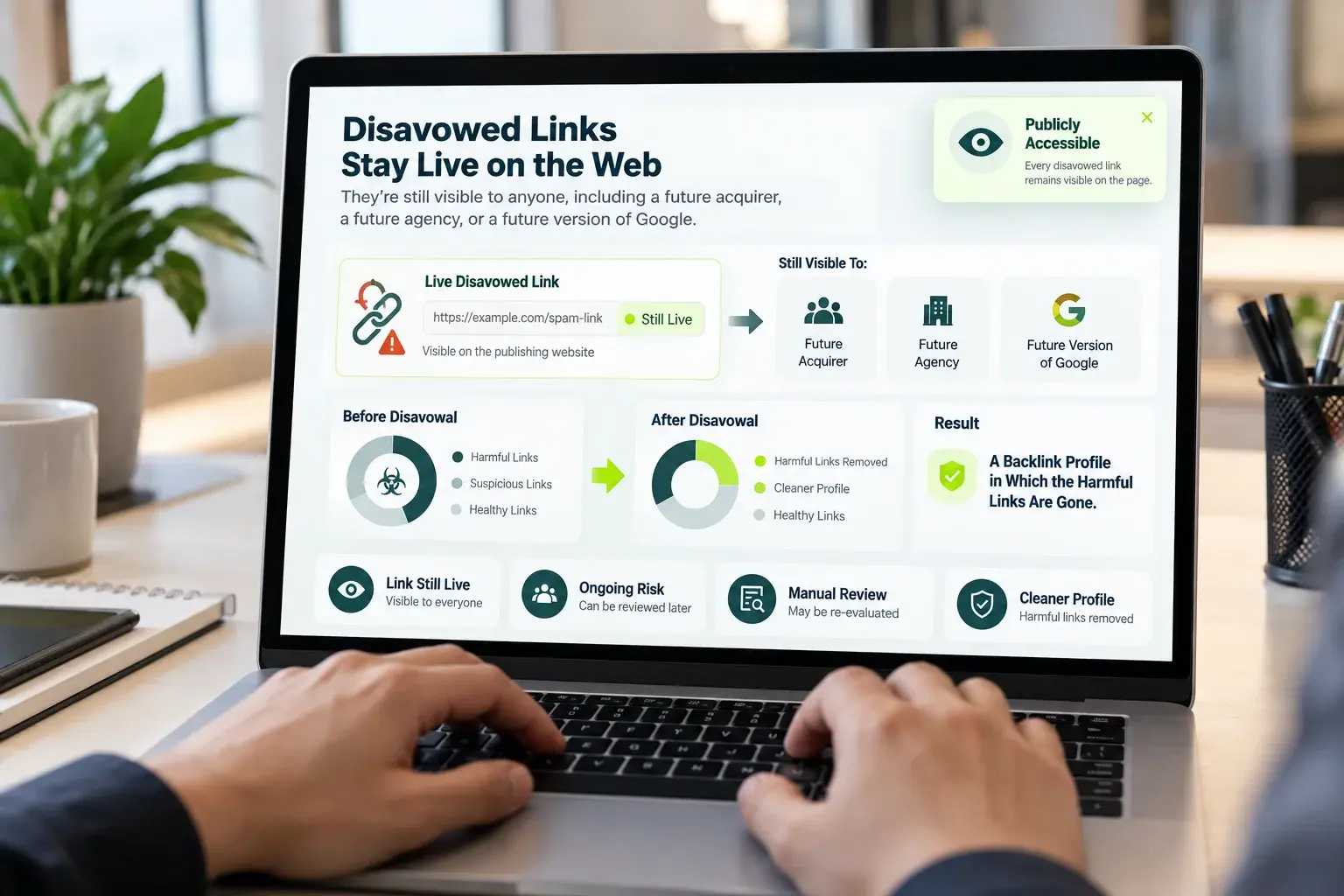
A disavowed link is still live on the page that published it.
It’s still visible to anyone who looks, including a future acquirer, a future agency, or a future version of Google that weighs signals differently than it does today.
The result: a backlink profile in which the harmful links are gone.
A Documented Path Back From a Manual Action
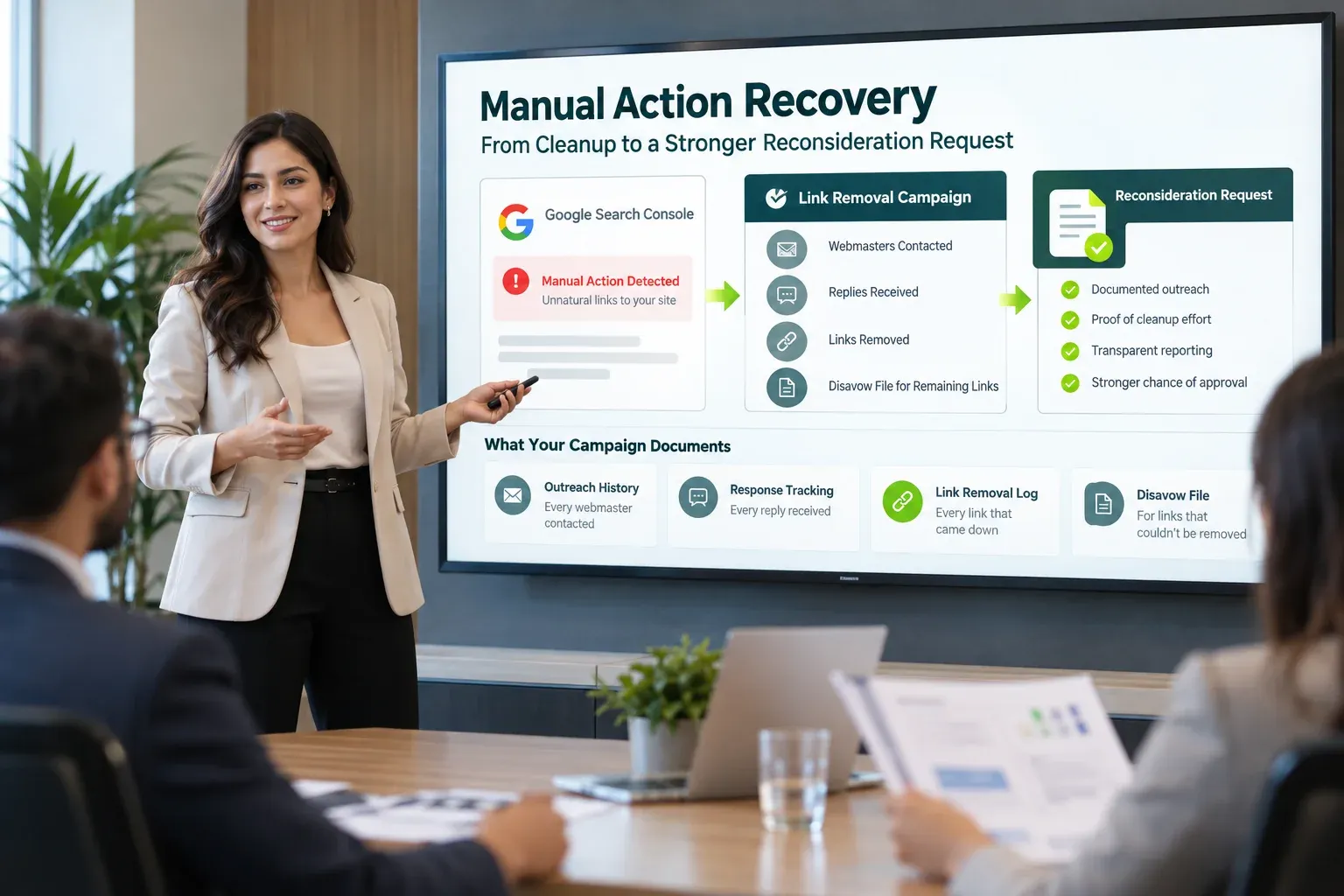
A manual action in Search Console means a Google reviewer flagged specific links as unnatural, and a reconsideration request needs real proof of cleanup effort to succeed.
Your removal campaign produces exactly that proof: every webmaster contacted, every reply, every link that came down, and a disavow file for what’s left.
The result: a reconsideration request backed by documented outreach.
Real Outreach Instead of a Templated Email Blast
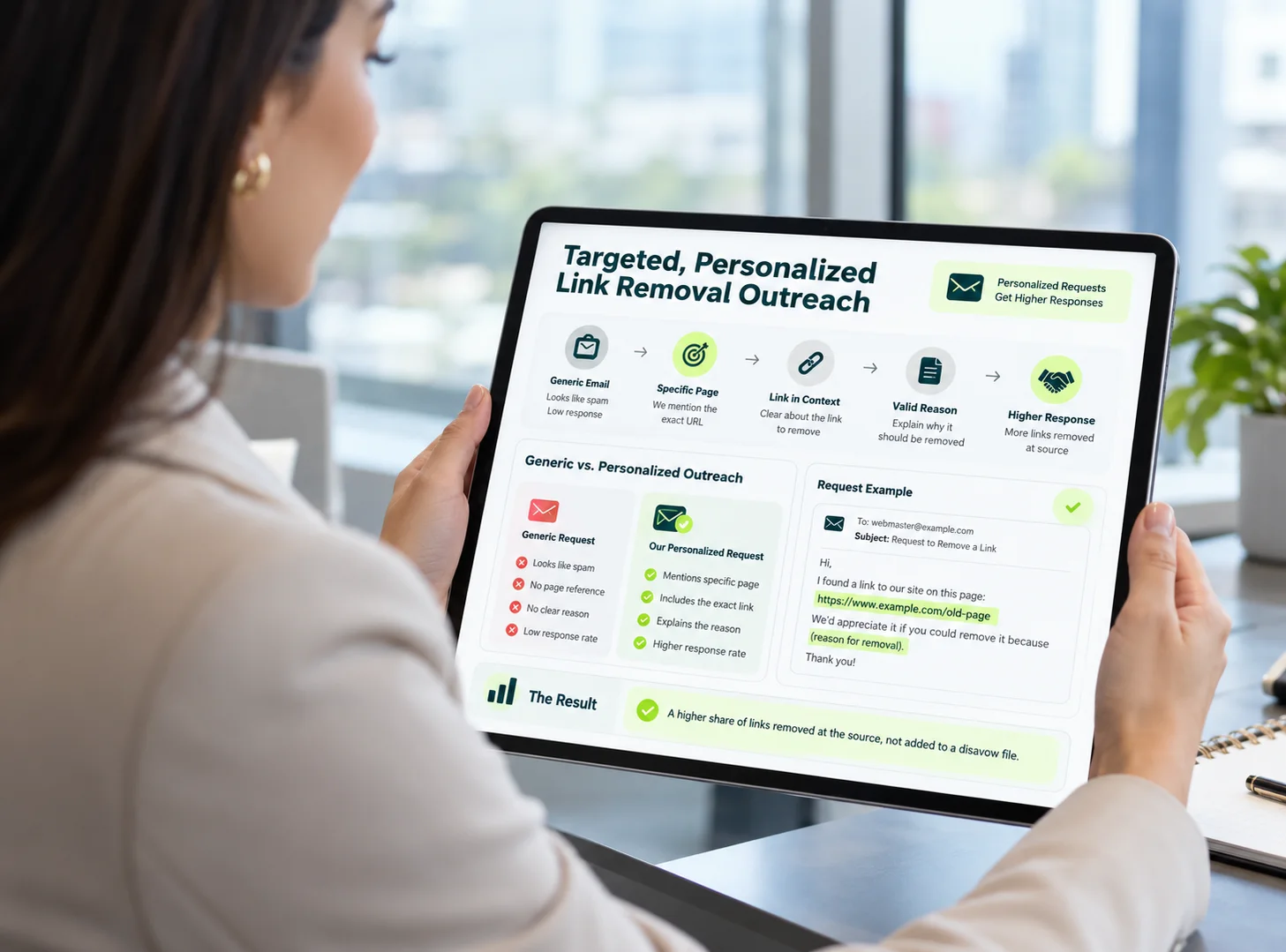
A single generic email may not be enough when a webmaster does not respond. A generic request reads like spam and gets treated like spam.
Your request names the specific page, link, and reason, which is the difference between a reply and a deletion.
The result: a measurably higher share of links removed at the source instead of quietly added to a disavow file because nobody followed up.
A Clean Profile Before You Build, Launch, or Sell
Cleaning up documented link-policy issues gives you a clearer baseline before you start new SEO work.
The result: a documented baseline you can build from, whether that’s with our team or your own.

Client Success Stories
What Clients Say About Our Backlink Removal Service
Verified reviews from businesses that got harmful links removed at the source rather than just disavowing them.

4.8/5 

5/5 
Rating on Google



We had a messy backlink profile from past SEO work and didn’t know where to start. The team reviewed our links, contacted site owners directly, and kept us updated throughout. We finally had a clear picture of what was removed and what still needed attention.

Marketing Director,
SaaS Company

After receiving a manual action notice, we needed a clear plan to address harmful backlinks. The team handled outreach, followed up with webmasters, and documented every step. Their approach gave us a structured cleanup process and clear records for our reconsideration request.
Head of SEO,
Ecommerce Company

We wanted to clean up old backlinks before starting a new SEO campaign. The team checked which links needed removal, reached out to website owners, and used disavow only when removal wasn’t possible. Communication was clear, and we knew exactly where things stood.
Founder,
Digital Marketing Agency
Service Framework
Investment, Timeline, and Deliverables
Every backlink removal campaign is scoped to the size of your problem. Here’s what shapes your investment:

Number of Links Needing Removal
More links mean more individual research and outreach emails to write, send, and track.

How Hard the Sites Are to Reach
Sites with no visible contact information take real research to find a real owner behind them.

How Willing the Webmasters Are
A cooperative site owner costs far less time than one who needs three follow-ups and still says no.

Whether Disavow Is Needed Too
Directional pricing
Removal cost depends on the size and reachability of the problem, rather than a flat per-link rate. Every backlink profile is different, so we don’t use one-size-fits-all pricing. You’ll get a detailed proposal after your strategic call.
What You Get
Every Attempt, Every Reply, Every Removal Reported
Complete transparency on what was found, what was tried, and what actually came down:

Full Outreach Log
A record of every webmaster contacted, the exact request sent, and whether they replied.

Removal Confirmation Tracking
Verified confirmation that a link is actually gone, rather than just a note that a removal request was sent.

Disavow File and Documentation
The exact disavow file you submitted for links you couldn’t remove.

Before-and-After Profile Summary
A clear before-and-after view of your backlink profile once the campaign wraps.
Our Approach
A Removal-First Approach Built to Protect What You’ve Earned
You get real outreach behind every request, rather than a disavow file built from a spreadsheet nobody double-checked.
| Factor | IN HOUSE/DIY |
 |
|---|---|---|
| Contact Discovery | Stops at a generic contact form, or gives up if one isn’t visible |
Researches the real site owner or editor behind each linking page |
| Outreach Quality | One generic email, sent once, to everyone on the list |
A personalized request naming the exact page, link, and reason |
| Follow-Up Discipline | Rarely happens. Most DIY attempts stop after the first email |
A second, polite follow-up on a set schedule before anything escalates |
| Disavow Timing | Often the first move, before removal is ever attempted | The honest fallback, used only for what outreach genuinely can’t reach |
| Documentation | A spreadsheet with no record of what was actually tried |
A full log of every attempt, every reply, and every outcome |
Who We Help
Situations a Backlink Removal Service Handles
Backlink removal covers more ground than a single negative SEO attack.

A Negative SEO Attack

A Manual Action Notice

A Past Agency’s Leftover Links

Pre-Campaign or Pre-Launch Cleanup

Buying or Selling a Business

Algorithm Update Fallout
Common Questions
Frequently Asked Questions
Clear answers on how removal works, how long it takes, and what it can and can’t fix
Disavowing a link tells Google to ignore it, but the link stays live, and a disavow file only works if you remember to update it as new toxic links appear. We find the harmful backlinks first, then contact the site owner directly to get the link taken down.
If it won’t come down, disavow is the fallback, not the first move. A professional link building service handles both steps as part of one process instead of leaving the outreach to you.
Disavowing tells Google to stop counting a link. It doesn’t remove anything. The link stays live on the site that published it, visible to anyone who looks, including a link building agency, acquirer, or algorithm update.
Removal contacts the site owner directly and gets the link taken down, which is the outcome Google itself prefers whenever it’s possible. Disavow is what’s left for links removal genuinely can’t reach.
See what to know about disavowing backlinks before deciding whether disavowal is necessary.
Most campaigns wrap up within a few weeks to a couple of months. The timeline depends on how many links need attention and how responsive the webmasters are.
A handful of cooperative site owners can clear in under two weeks. Unreachable or unresponsive sites can extend the timeline, and a backlink checker tool can help verify whether removed links stay offline.
No single fix guarantees a ranking recovery, and anyone who promises one is overselling it. Removal solves the backlink piece of the puzzle specifically.
A backlink profile audit can help identify other issues that may affect the site alongside harmful links.
It doesn’t automatically trigger Google’s re-review after a manual action. That takes a reconsideration request too.
Yes, nothing here is technically impossible to do yourself. The real cost is time, rather than skill: researching contacts, writing personalized emails, and following up without a team splitting the work.
Most business owners don’t make it past the first dozen unanswered emails, right around when a professional would send the follow-up.
A documented follow-up goes out once, then the link moves to the disavow list if there’s still no response.
This is normal; do not consider it a failure. Plenty of harmful links sit on abandoned sites with no real owner checking the inbox, and disavowing is exactly what that situation calls for.
Usually only a small remainder. Most links get resolved through removal directly.
Whatever’s left, the sites that never respond or refuse outright, move to a disavow file as the fallback, rather than the starting point.
Once harmful links are removed or disavowed, the next step is usually rebuilding on a clean foundation.
You can also review our pricing plans to understand the available options.
Ready to Get Harmful Links Removed the Right Way?
Get a senior strategist to review your situation, confirm which links actually need to go, and scope a removal campaign built on real outreach instead of a templated disavow file.
4.8/5
Trusted by agencies
and brands worldwide.