Logistics Link Building That Turns Market Updates into Links
Your team already tracks rates, lane conditions, and capacity changes every week. We turn that into content trade publications can cite, earning links that strengthen authority and improve search visibility.

Market updates editors can cite
Trade and regional press outreach
Partner and customer pages

4.8/5
Trusted by agencies
and brands worldwide.
DOMAIN RATING
14 → 29
Campaign Dashboard
TRADE PRESS CITATIONS
+17 citations
MARKET UPDATES PUBLISHED
+16 published
SHIPPER SEARCH RANKINGS
+18 positions
ORGANIC TRAFFIC
+214%

QUOTE REQUESTS (RFQ)
7 → 19





Service Overview
Why Freight Market Commentary Earns Links Other Content Can’t
In logistics, market commentary is news. Rates, capacity, and lane conditions change every week, and the trade press writes about those changes as they happen.
In January 2026, Supply Chain Dive built a story on Freightos’s weekly rate update. The story quoted Freightos’s head of research and linked to its updates twice.
Many agencies sell industry directory packages for link building. A directory listing is a site in a list. A market update gives an editor something to write about, and a reason to link back to its source.
A backlink is one website vouching for another, like a shipper’s reference vouching for a carrier. When a trade story links to your update, that’s the vouch.
The best-known examples come from large firms. C.H. Robinson and Arrive Logistics each publish a monthly market update. Your version starts smaller: what your team already sees on the lanes you run, written up on a schedule.
Three things define logistics link building done right:

Your Market View Is the Asset
Your team’s regular view of its own lanes is something an editor can use.

Published on a Schedule
A regular update gives editors a source they can return to, instead of a one-off study they cite once.

Pitched Where Shippers Read
Updates go to the trade and regional business press your customers read, rather than directory lists.
How We Work
How Your Logistics Link Building Campaign Works
A logistics campaign runs six steps, from what your team already knows to updates editors can cite.
You start with the lanes, modes, and markets your team runs every week.
Your team already knows things shippers want to hear: where capacity is tightening, which lanes are running late, and what customers keep asking about.
Your strategist interviews the people closest to the freight and maps what to publish. You decide what stays private, because some of it belongs to your customers.
Next come the pages that need the authority.
For most logistics companies, that’s the set of service pages for each mode and customer type. A warehousing page and a drayage page answer different searches from different buyers.
If you recruit carriers or drivers, you plan those pages separately because a different audience reads them.
This is the asset that anchors the campaign. It’s a short, scheduled update that covers what your team sees on the lanes you run. Monthly suits most firms; weekly suits a firm with enough to say every week.
Your strategist drafts it from your team’s observations, and your team signs off before anything goes out. The point is your market perspective.
Each update links to the service pages it covers, passing authority to the pages that bring in freight.
Updates go where shippers and logistics managers read.
Your strategist pitches each one to freight and logistics trade publications and to regional business press. Each pitch leads with the one observation an editor can use that week. Editors decide what runs, and plenty of pitches go nowhere.
When a story cites an update and links to it, that link is the one this work is for.
Some links come from relationships you already have.
Customers, technology partners, and carriers you work with sometimes keep a page naming the firms they rely on. A real working relationship is a reason to be on it, and you say which are close enough to ask.
We check industry associations and directories too, but only count them when the listing is public and links to your site.
Your strategist opens and checks every link that lands before it reaches your report. You see where it landed, which update or source produced it, and the page it points to.
Your strategist reports every pitch, too, including those no editor picked up, so you can see which kinds of observations editors cite.

Expected Results
Outcomes Logistics Link Building Service Delivers
When trade stories cite your market view, shippers meet your expertise before they ever send a quote request.
Ranking for the Searches Shippers Actually Run
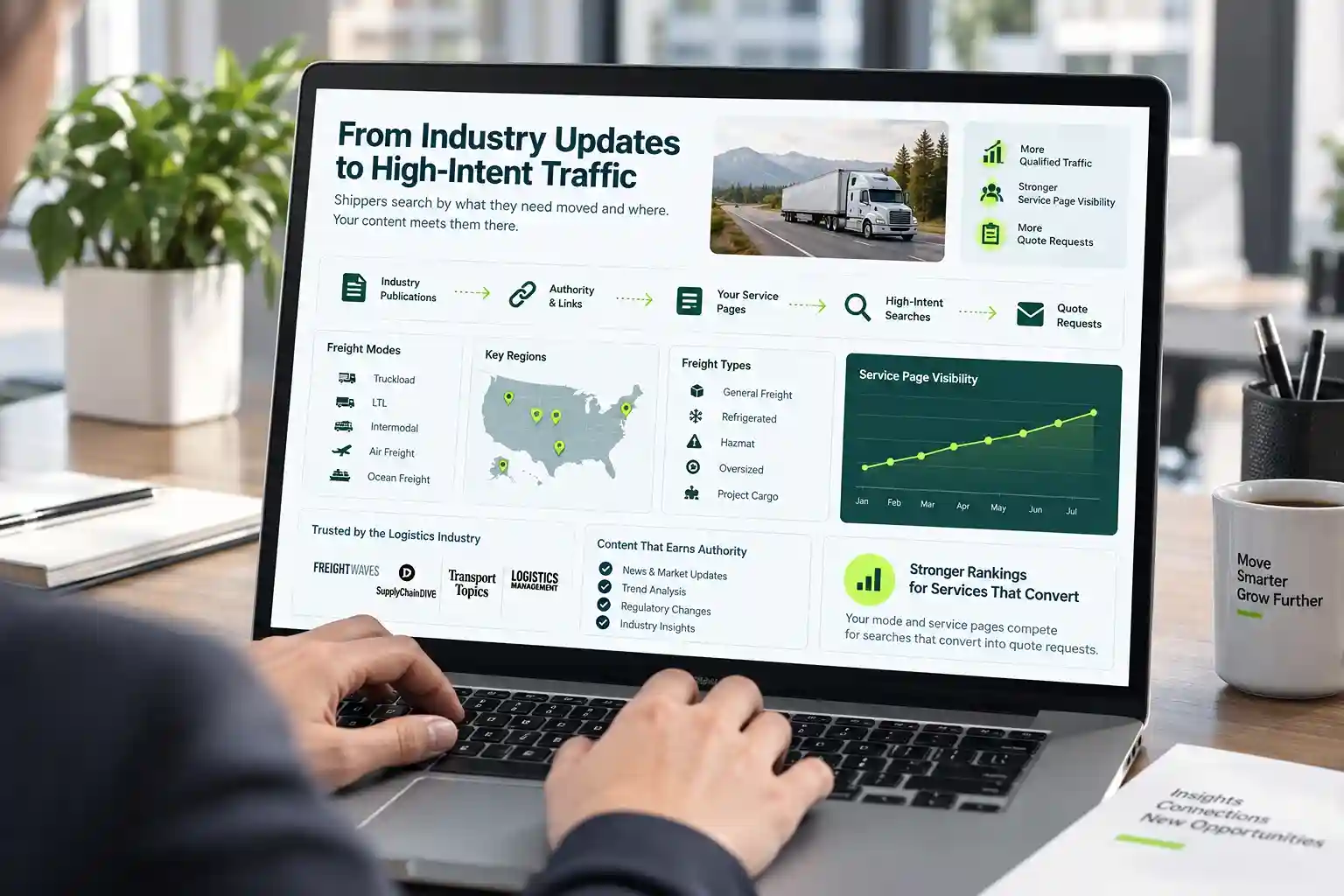
Shippers search by what they need moved and where: a mode, a region, and a type of freight.
Authority that your updates earn from the publications shippers read flows through to the service pages that answer those searches.
The result: Your mode and service pages compete for searches that convert into quote requests.
A Name Editors Come Back To
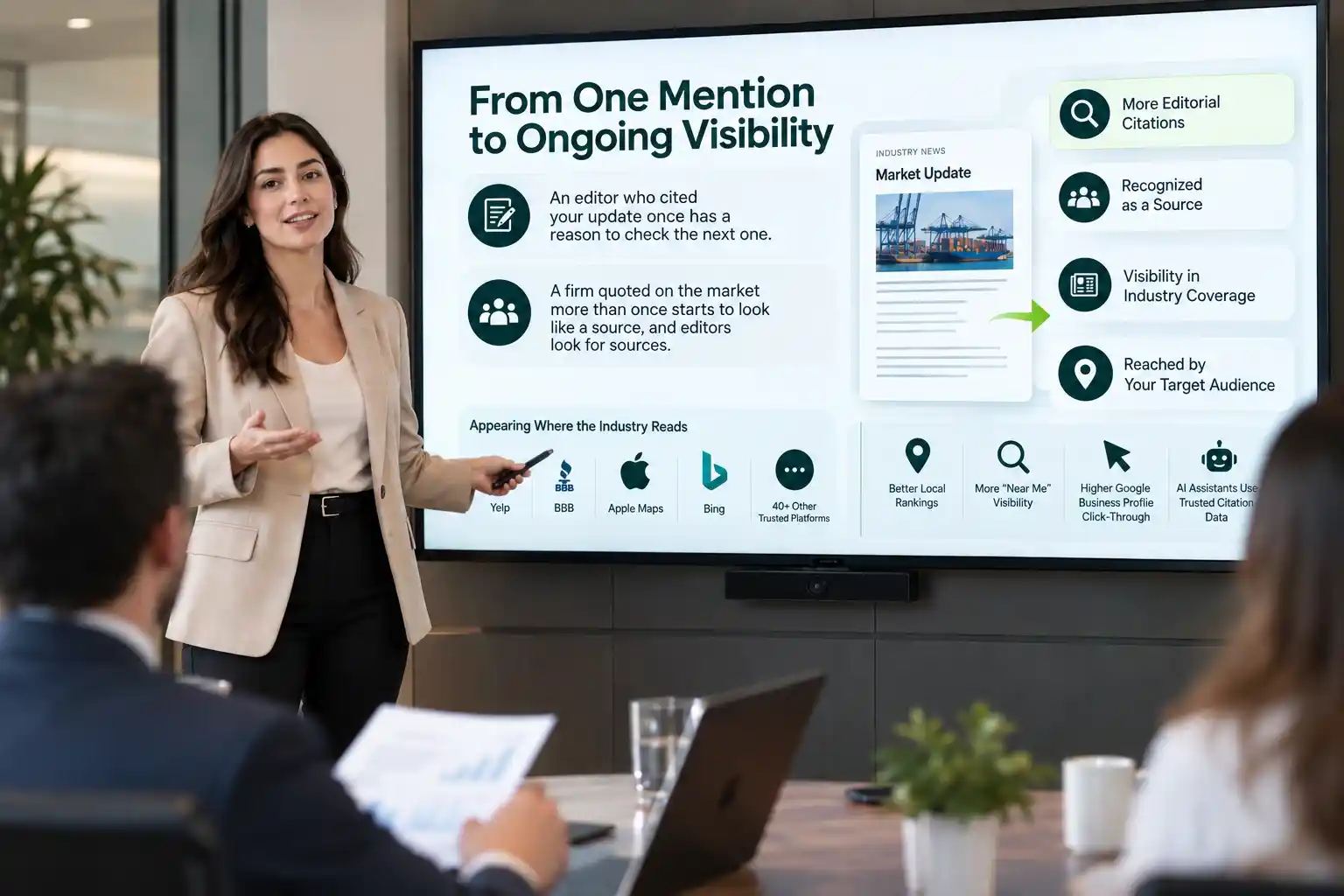
An editor who has cited your update once has a reason to check the next one.
When editors quote a firm on the market more than once, it starts to look like a source, and editors look for sources.
The result: Your firm’s name shows up where shippers read about the market, rather than where they search.
Updates That Keep Working After You Publish Them
Every update you publish stays on your site as a dated record of the market.
When an editor needs to show how a lane changed over a year, an archive of monthly updates is the kind of source editors cite.
The result: Older updates can keep earning links long after they go up.

Authority Built Mode by Mode
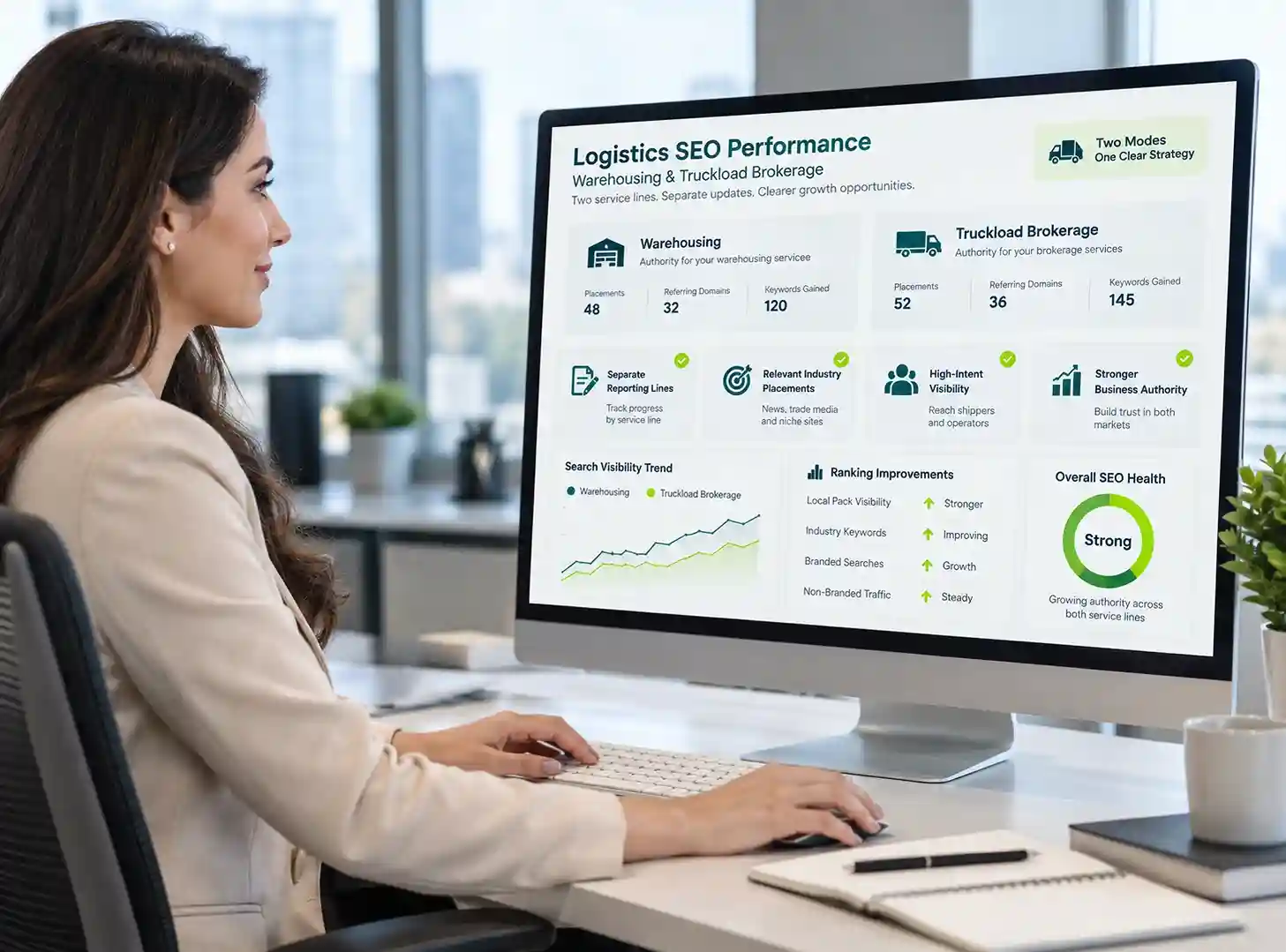
Running warehousing and truckload brokerage means two sets of buyers and two sets of searches.
Per-mode work gives each service line its own updates, placements, and reporting line.
The result: You see which part of the business the authority is building for, and you can put budget where you want to grow.
Client Success Stories
What Clients Say About Our Logistics Link Building Service
Reviews from logistics companies that turned their market view into search visibility.

4.8/5 

5/5 
Rating on Google


We regularly publish updates about freight rates, supply chain trends, and changes in the logistics market, but they weren’t generating much organic visibility. The link building campaign helped turn that expertise into relevant editorial placements, strengthening our authority and bringing more targeted traffic to our website.

Marketing Director
Logistics Company

We didn’t want generic backlinks that had nothing to do with our industry. The campaign focused on relevant transportation, supply chain, and business publications where our market insights mattered most. Our content gained more visibility, and we started seeing more referral traffic from industry-relevant sources.
Head of Marketing
Freight & Logistics Company

Our team already had valuable insights into shipping trends, freight costs, and supply chain changes. The strategy helped package those insights into content that publishers could reference and link to. That gave us stronger industry visibility while supporting the pages and resources we wanted to promote.
Content & Communications Manager
Logistics Provider
Service Framework
Investment, Timeline, and Deliverables
You’re buying individual placements, each one a link a real editor or site chose to publish. Your market view is what makes them worth publishing.

Modes
Warehousing, truckload, drayage, and last-mile each reach different buyers and different publications.

Markets
A regional carrier needs a different scope from a brokerage working lanes across the country.

Existing Voice
Firms that already publish a market view, or that editors already quote, start from a further-ahead position.

Campaign Duration
Placements begin to land within the first two months, and ranking movement usually becomes apparent over three to four months.
Directional pricing
Once we understand your niche in freight forwarding, warehousing, cold chain, ecommerce fulfillment, or supply chain consulting, we’ll outline exactly what we include, what placements to expect, and how your authority will grow over time.
What You Get
Every Update, Every Pitch, Every Placement Reported
You see which updates earned links, which pitches went nowhere, and which service lines the authority is building for. Results split by mode when you run more than one.

Live Placement Reporting
We send you every placement as a link you can open yourself, and we name the publishing site.

Citation Tracking
When a story cites one of your updates, you see where it ran, what it quoted, and whether it linked.

Pitch Reporting
We list every pitch, including the ones no editor picked up, so the next update can be sharper.

Per-Mode Reporting
We split results by service line, because authority for a warehousing page does little for a drayage page.
Our Approach
A Relevance-First Approach Built for Your Growth
You get links your market view earns, a report on every pitch, and clear terms before the campaign begins.
| Factor | GENERIC LINK BUILDING AGENCIES |
 |
|---|---|---|
| Content Source | Templates where they swap in the word "logistics" |
Market updates built on what your team sees on its lanes |
| Trade Press | They promise “Industry publications” without naming one |
We pitch trade and regional press and report every placement |
| Directories | They sell volume as the main deliverable | We check and count directories only when they are public and linked |
| Proof | They show link examples from other industries | We report on your own updates and placements |
| Pricing | They quote pricing privately after a discovery call | We provide clear pricing before the campaign begins |
Who WeHelp
Types of Logistics Link Building We Support
Whatever you move and however you move it, we build the authority that matches how shippers actually choose a partner.

Third-Party Logistics Providers (3PLs)

Freight
Brokerages

Asset-Based Carriers

Less-Than-Truckload Carriers

Drayage and Intermodal Providers

Last-Mile and Courier Companies
Common Questions
Frequently Asked Questions
Get clear answers on logistics link building, covering market-relevant placements, industry authority, reporting, and content-led outreach strategies.
No, a market update earns its place through analysis, and the lanes your team already runs give you something specific to analyze.
Arrive Logistics describes its own monthly reports as “expert analysis and insights on freight market trends,” and that’s the right model.
You build your update on your team’s own observations rather than someone else’s numbers. Content that earns links explains why useful analysis attracts them.
Monthly suits most firms. Weekly only works if you genuinely have something new to say each week; a thin weekly update does more harm than a strong monthly one.
C.H. Robinson publishes its market update monthly, in writing and on video. Whatever the schedule, consistency matters more than frequency, because an editor who knows when your next update lands has a reason to wait.
We start with the pages and search terms that matter most to the business, then identify relevant opportunities that support those priorities. An experienced link building team can adapt the campaign around the pages, audiences, and markets you want to grow.
No, editors decide what runs, and no one who pitches the press can promise a story. What the work controls is whether each update is worth citing and whether it reaches the right editors.
Every pitch is reported, including the ones that went nowhere, so you can see what’s landing. The best-known firms that editors cite this way are large companies, and a mid-size firm should expect a slower start.
Then say so in the next update. Freight markets turn quickly, and an update that explains what changed and why earns more trust than one that pretends it saw everything coming.
Your team signs off on every update before it goes out, so nothing is published in your name that your people don’t stand behind. A clear read that’s occasionally wrong beats a vague one nobody can check.
Yes, link building for moving companies is for household and commercial movers.
This page is for logistics companies themselves: third-party logistics providers, brokerages, and carriers that sell freight capacity to shippers.
If you do more than one of these, your strategist will say on the first call which page fits which part of the business.
Only when they’re public and actually link to your site, so we check each one before it counts. Some associations are worth joining for the relationships alone, whether or not the listing links. If your business also sells, rents, or services equipment, forklift dealer link building follows a different approach.
This campaign doesn’t make directory volume the main deliverable, because a list of listings gives an editor nothing to write about. Digital PR that earns links generally covers the press side of the work.
Pricing for logistics link building depends on factors such as your industry’s competitiveness, the authority of the sites you’re targeting, and the number of links you need each month.
Because every logistics brand’s goals and starting point are different, we tailor packages instead of using a flat rate.
For general guidance on what’s included at each tier, visit our pricing page and reach out to our team for a quote suited to your specific needs.
Ready to Turn Your Market View Into Links?
Get a senior strategist to map the market view your team can publish, the press it fits, and the price of the work.
4.8/5
Trusted by agencies
and brands worldwide.