A guest post marketplace is a platform that connects buyers with publishers for paid guest post placements.
The top 10 guest post marketplaces ranked below for link building are Collaborator.pro, WhitePress, Adsy, PRNEWS.IO, Linkhouse, Getfluence, GuestPostLinks, Serpzilla, Icopify, and Bazoom.
The 4-test buyer audit further down tells you how to vet any platform in ten minutes before placing an order.
The disqualifier list shows you the three situations where direct outreach beats a marketplace.
The rankings are based on publicly available information at the time of review.
The Short Version
- The top 10 guest post marketplaces are differentiated by network size, pricing, and editorial transparency.
- A 4-test buyer audit (random listing, editorial control, all-in price, removal policy) go.
- Why a “from $40” placement often lands between $90 and $160 once you add content, commission, and revisions.
- The Google policy rule that determines whether a paid link helps or hurts your SEO rankings.
- Three situations where direct outreach beats any marketplace: sensitive niches, new domains, and hyper-local campaigns.
What Is a Guest Post Marketplace
A guest post marketplace is a website where publishers list their blogs for sale. Buyers pay to place an article, with a backlink, on one of those blogs.
The marketplace handles payment, placement, and basic quality checks, while the editorial standard is set by the publisher who runs each blog.
Three models dominate guest post marketplaces:
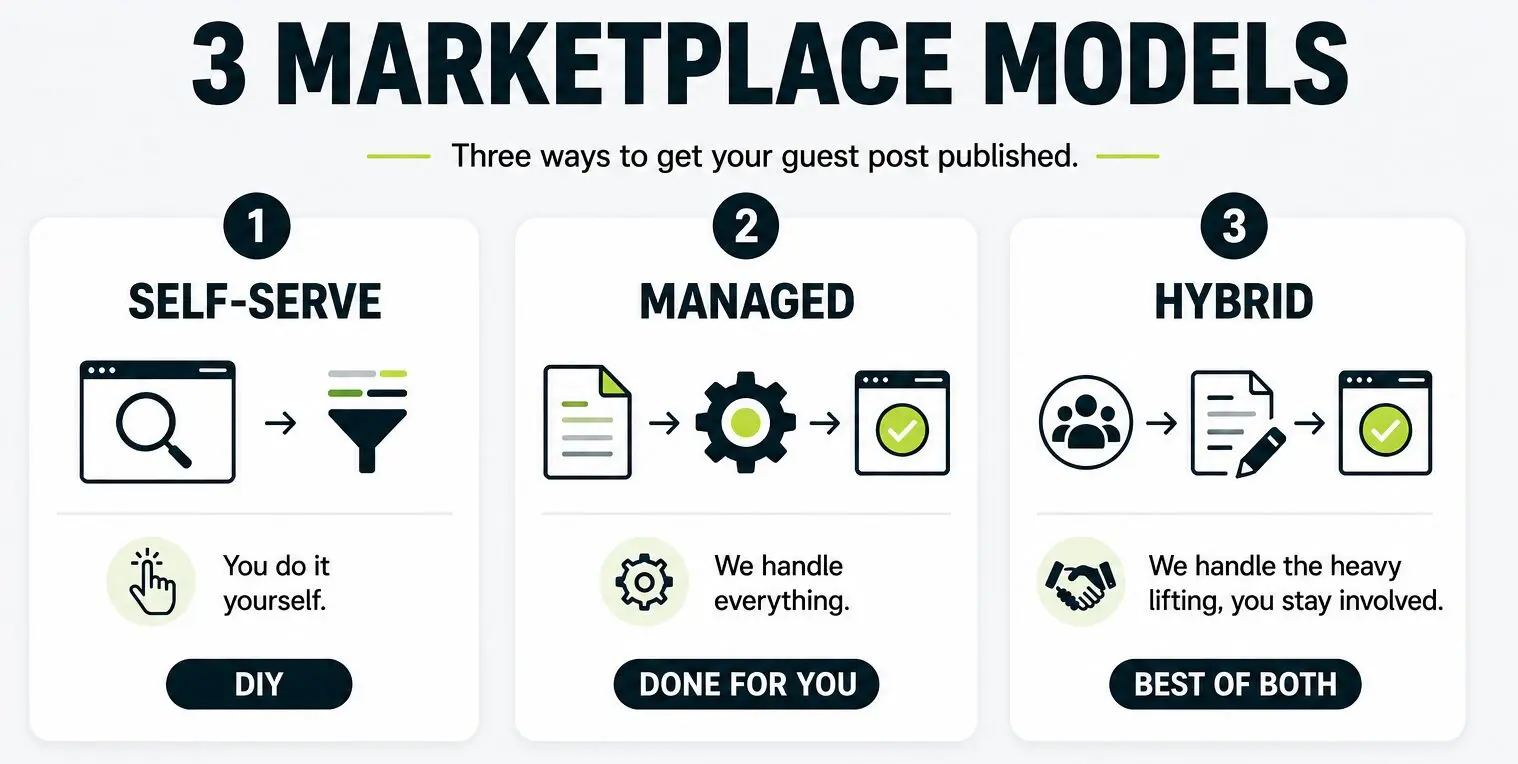
Self-Serve Marketplace
The self-serve marketplace platform lets you browse the database, filter by niche, traffic, authority, and place an order yourself. Collaborator and WhitePress work this way.
Managed Marketplace
The managed service takes a brief, sources the publisher for you, writes the post (or has you write it), and handles placement end-to-end. The HOTH, Loganix, and FatJoe fit this pattern, though they overlap with full-service link building agencies.
Hybrid Marketplace
This is the model that combines self-serve browsing with managed execution.
You browse and select publishers from a curated catalog, while the provider handles outreach, placement coordination, and content creation on your behalf.
Each guest post marketplace model compresses months of outreach into a few clicks. That’s the value, and that’s where most of the risk lives.
Are Guest Post Marketplaces Safe Under Google’s Policy?
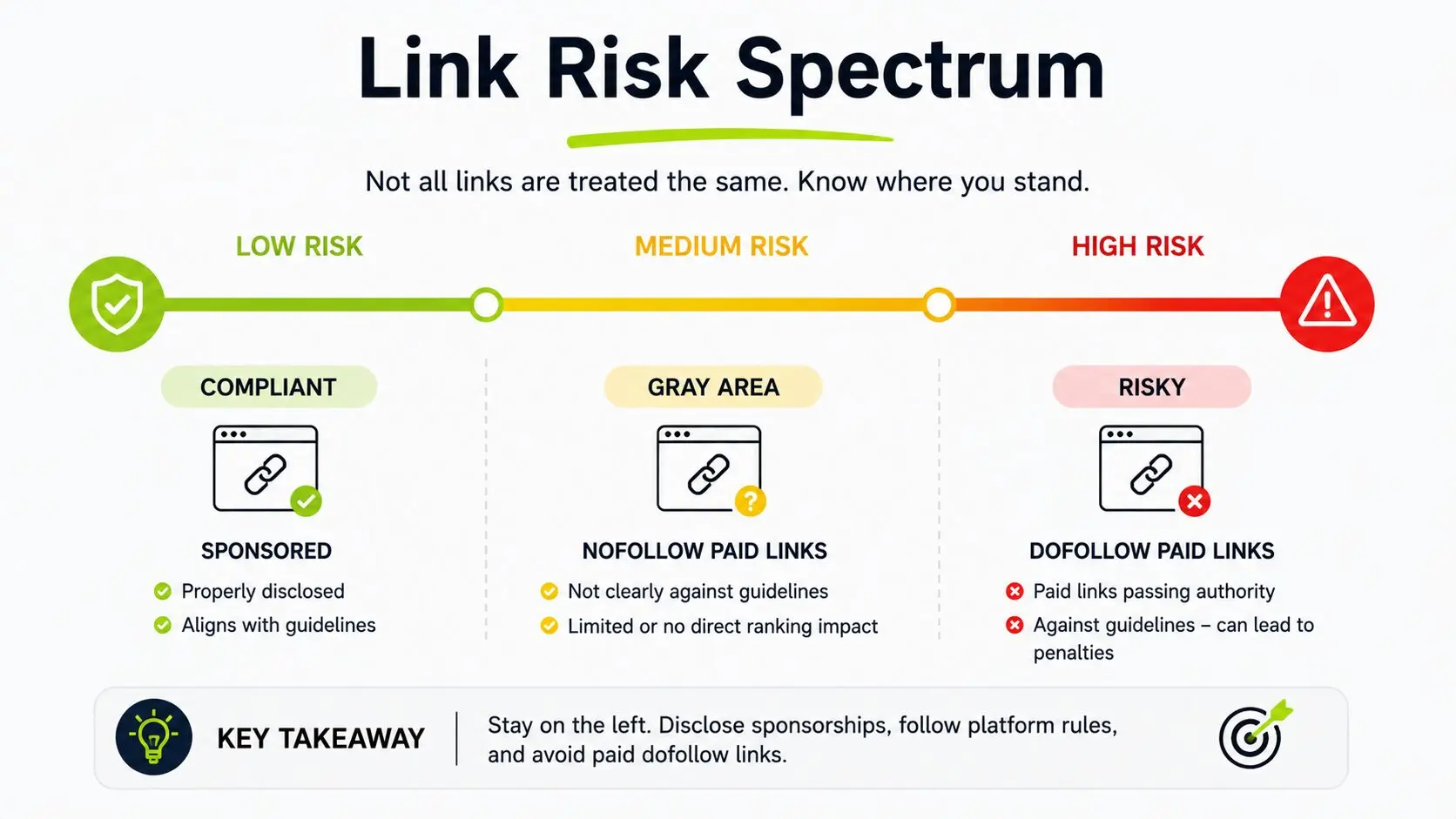
Yes, if the link the marketplace places for you is marked as paid.
Google’s link spam documentation states that buying or selling links intended to influence rankings violates its policies.
Paid articles with links that pass ranking credit are the specific pattern Google’s spam policy targets.
Google is fine with paid links as long as you don’t try to pass them off as unpaid recommendations
How to stay compliant:
- Add a rel=”sponsored” or rel=”nofollow” tag to the link. The tag tells Google the link was paid for. The marketplace handles this on request, often by default.
- A sponsored link still drives traffic, builds brand awareness, and shows in your backlink reports.
- What it won’t do is pass the ranking credit of a genuine editorial link.
Red Flag
Any platform promising “guaranteed dofollow” without disclosure sells links that violate the policy.
Google enforces this mostly through its algorithm. But any ranking gain rests on the bet that the algorithm misses the pattern, and with a small budget, that’s a bad bet.
For the broader questions of whether to buy backlinks at all, Google’s policy is one factor; this article focuses specifically on the marketplace channel.
The 4-Test Buyer Audit Before You Place an Order
The four tests are: random-listing test, editorial control test, all-in price test and pull-the-plug test (removal policy).
It will take ten minutes per platform and surface issues that headline metrics can’t show you.
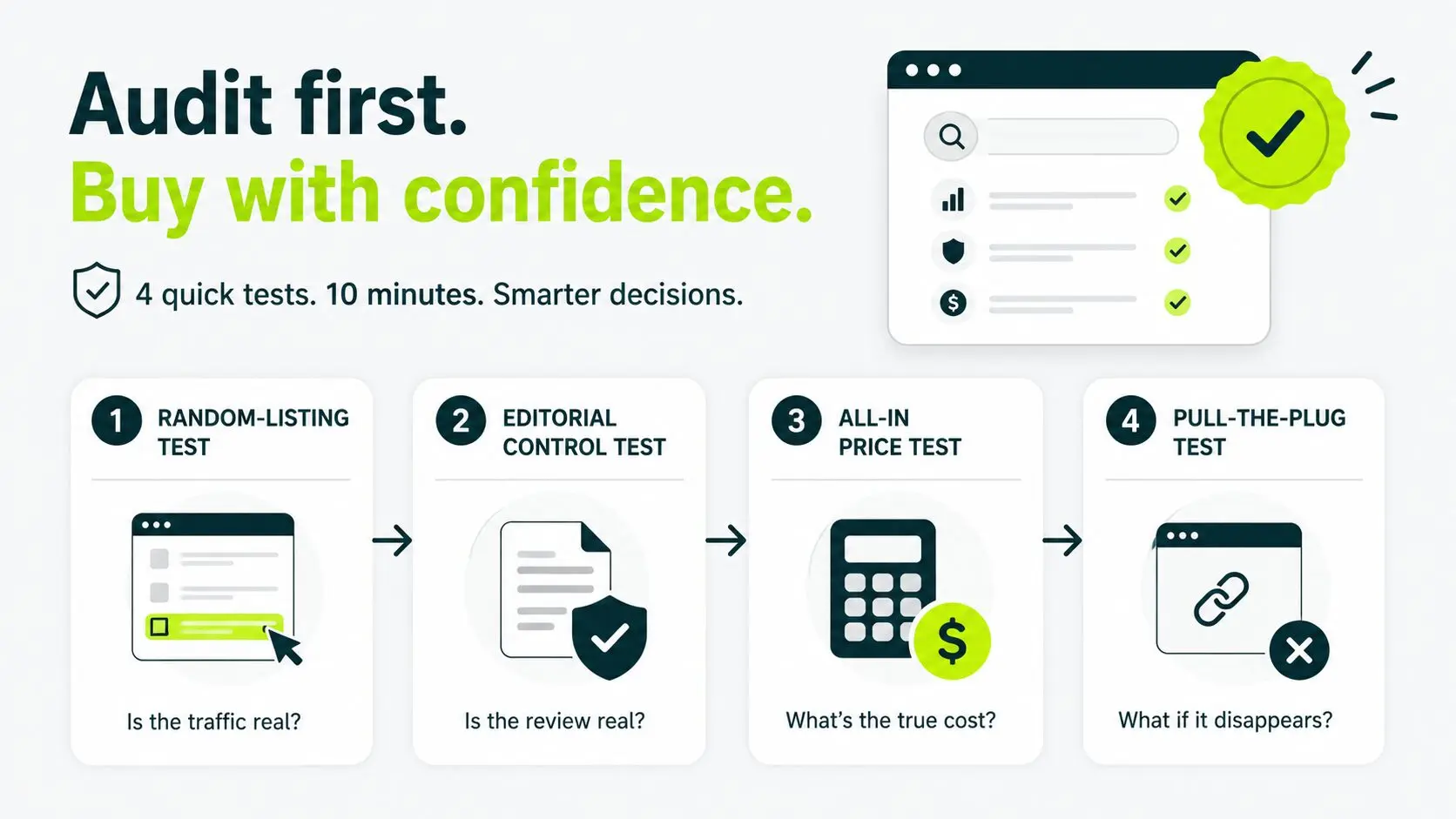
Overview of the four tests:
| TEST |
WHAT YOU ARE CHECKING |
|---|---|
| Test 1. Random-Listing Test | Whether inventory sites have real traffic. |
| Test 2. Editorial Control Test | Whether publishers actually review submissions. |
| Test 3. All-In Price Test | What does the placement truly cost after all fees. |
| Test 4. Pull-the-Plug Test | What happens if the link disappears. |
Test 1: The Random-Listing Test
Pick three sites at random from the marketplace’s inventory. Check each in a free traffic tool like Similarweb’s traffic checker.
While you’re auditing the site, run it through a free broken-link checker to spot maintenance issues that often signal neglected publishers.
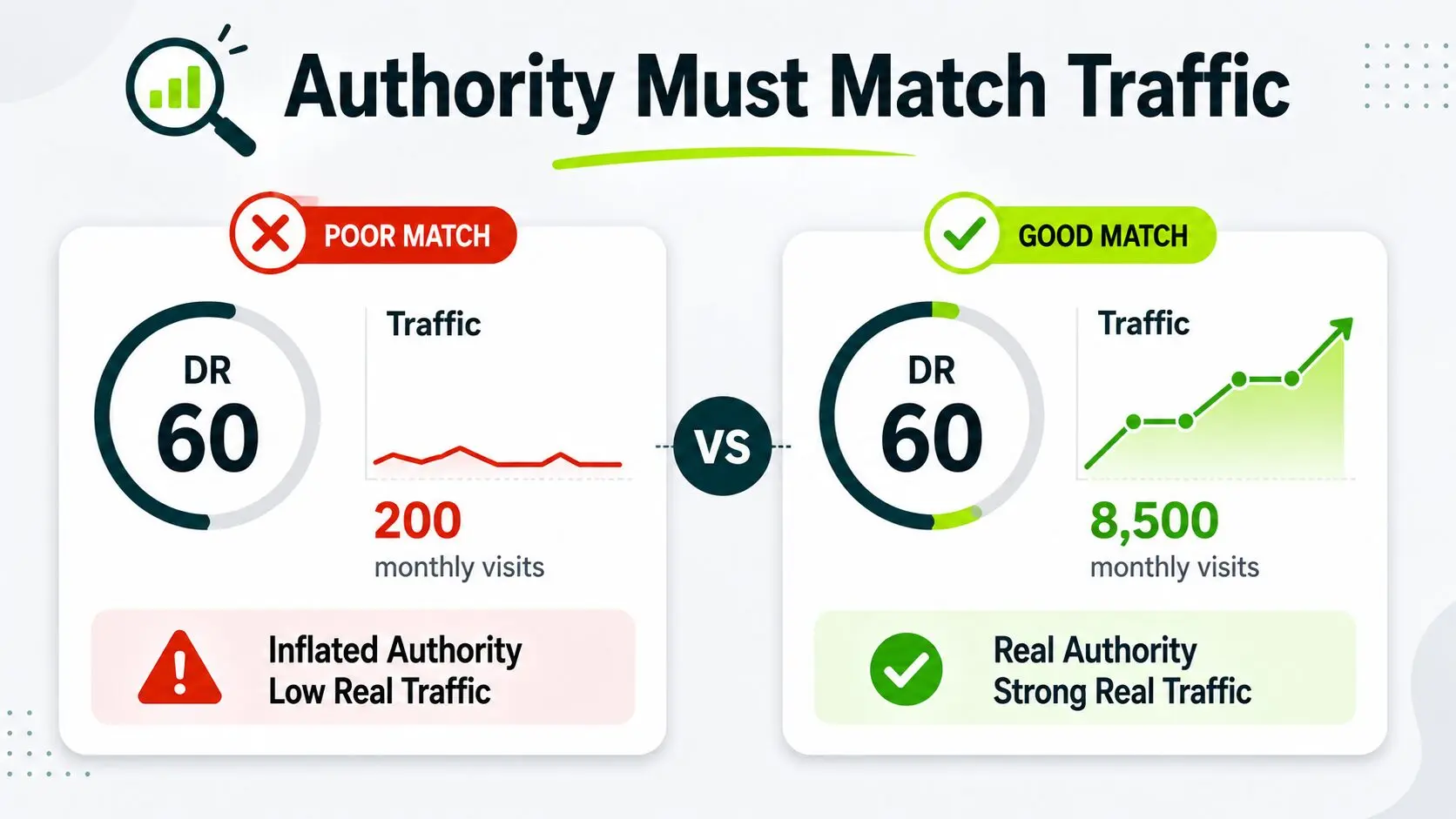
What you’re looking for is at least 1,000 organic visits per month from Google search, which are not from ads or direct traffic.
Then, check the Domain Rating (DR, a 0 to 100 score from Ahrefs that estimates how strong a website’s backlinks are), which should be roughly proportional to traffic.
If a site shows DR 60 but 200 monthly visits, the link profile is being inflated by tactics Google doesn’t credit. That’s a fake-authority site dressed up to look like a high-DR one.
If a marketplace passes the random spot check on all three sites, move to Test 2.
If two or more of the three fail, the marketplace has a quality problem you can’t fix from the buyer’s side. Walk away.
Test 2: The Editorial Control Test
Check the marketplace’s terms or FAQ for two answers:
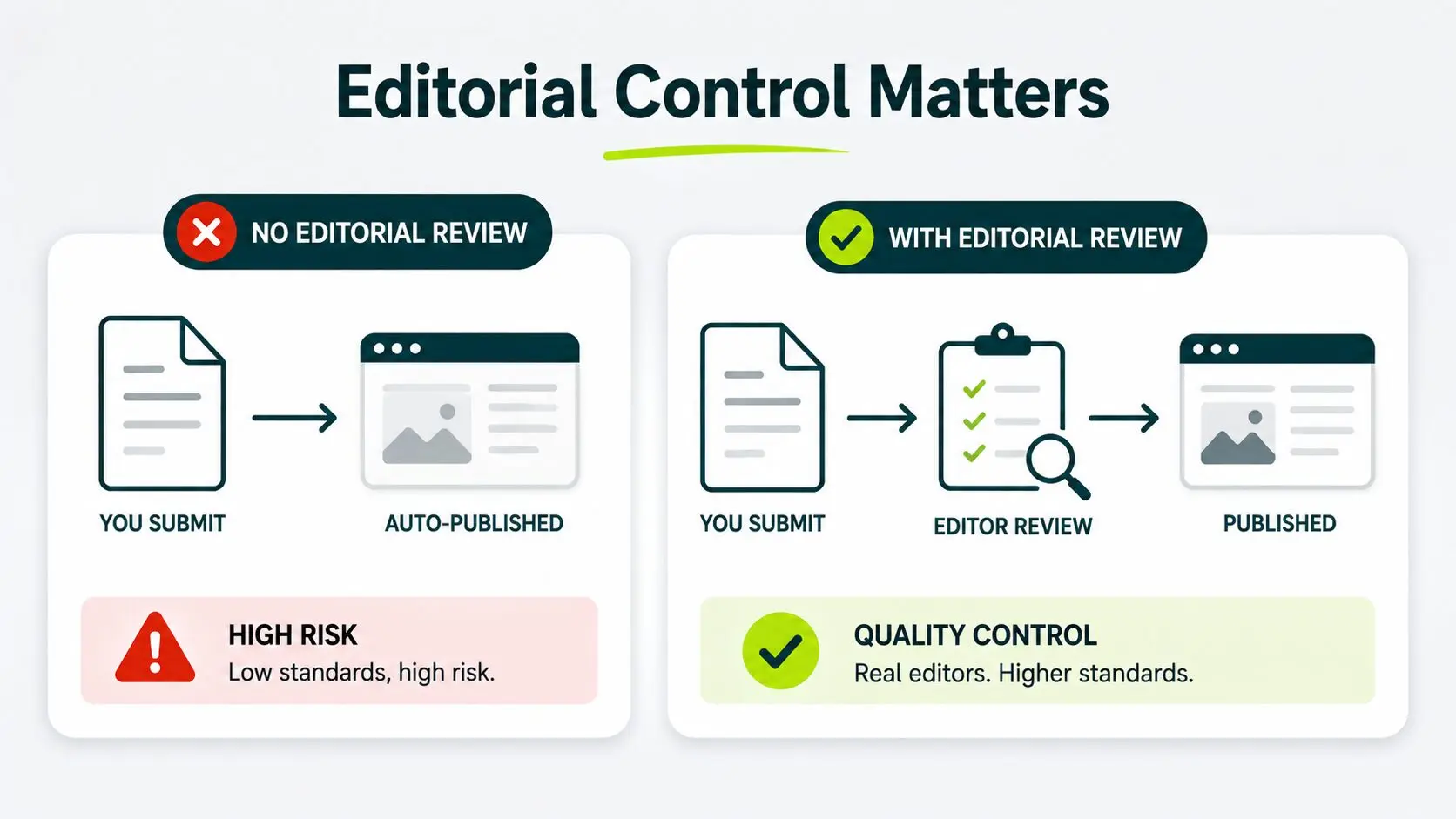
1. Can the publisher reject your article?
A Legitimate Publisher Reads What You Submit and Pushes Back on Weak Drafts. a Marketplace That “Guarantees Publication” is Selling You Placements on Sites Where the Publisher no Longer Cares.
2. Can you preview the live URL before indexing?
If yes, you can verify the link was placed in the body of an article (not in a sidebar, footer, or comment), and that the surrounding content is genuinely on your topic.
Confirms the link sits in the body, rather than in a sidebar or footer.
A marketplace that fails either of those questions is selling published-and-forgotten placements.
Those don’t pass the same ranking credit as an editorial link, and they’re the first ones algorithms downgrade.
Test 3: The All-In Price Test
The headline price on a marketplace is rarely the real price.
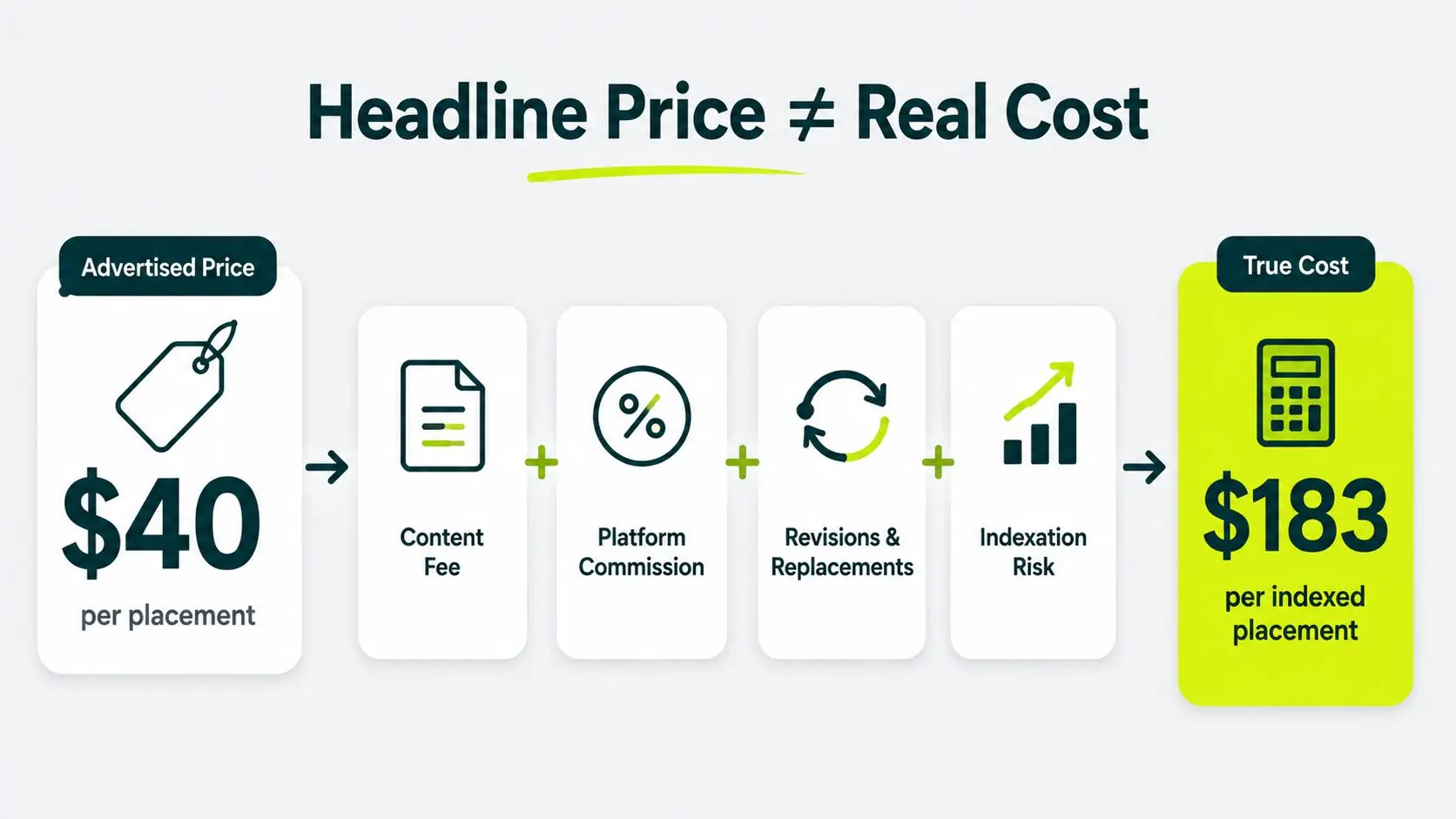
Add up every cost:
- Placement fee.
- Content fee.
- Platform’s commission (10 to 15%).
- Revision rounds.
- Replacement article (if the first is rejected).
Then divide the total by the chance that the link will be indexed by Google within 60 days.
If you don’t know the indexation rate, ask the marketplace. A platform that won’t share even a rough number knows its number is bad.
What Is an Indexation Rate?
It is the percentage of paid links that actually end up in Google’s search index.
A $40 self-serve placement that becomes $110 all-in, with a 60% indexation rate, has a true cost per indexed link of about $183.
That’s the number to compare against direct outreach or a managed service. You can also use our free backlink cost calculator to estimate whether a placement is priced fairly before you buy.
Test 4: The Pull-the-Plug Test
This test checks the marketplace’s removal policy. Ask the marketplace: “What happens if the link is removed in three months?”
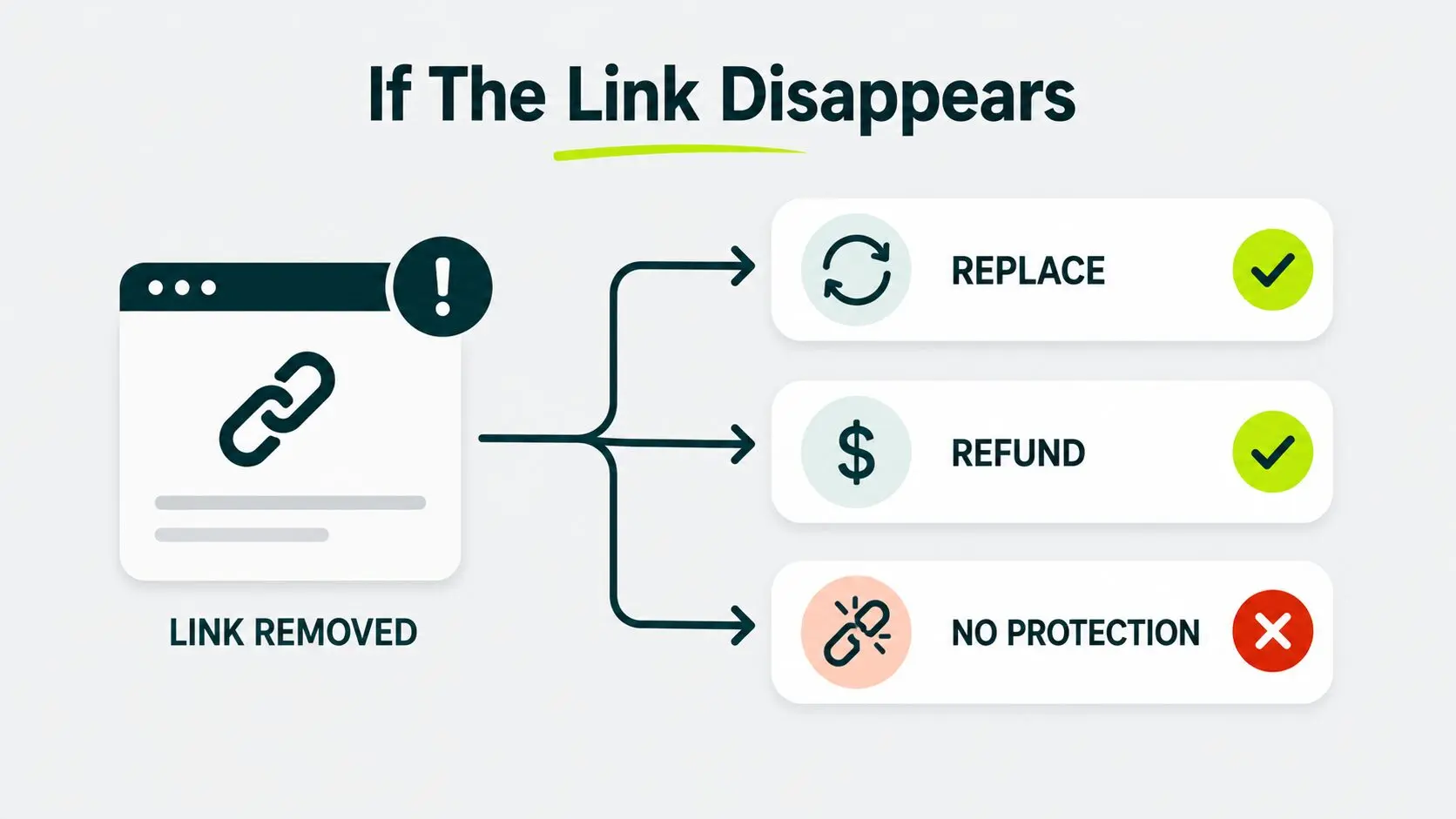
Two answers pass:
- The marketplace replaces it with a comparable placement at no extra cost.
- The marketplace refunds the placement fee.
Any other answer, or no answer, is a fail. It means their incentive ends the moment your payment clears. That’s the entire reason this test exists.
Run all four tests before placing any order over $80.
In informal internal reviews of marketplace inventories, we frequently encounter sites with traffic-to-authority mismatches.
Total Cost of a Guest Post Marketplace Placement
The “starting price” on a marketplace landing page is the loss leader. The real number is two to three times higher.
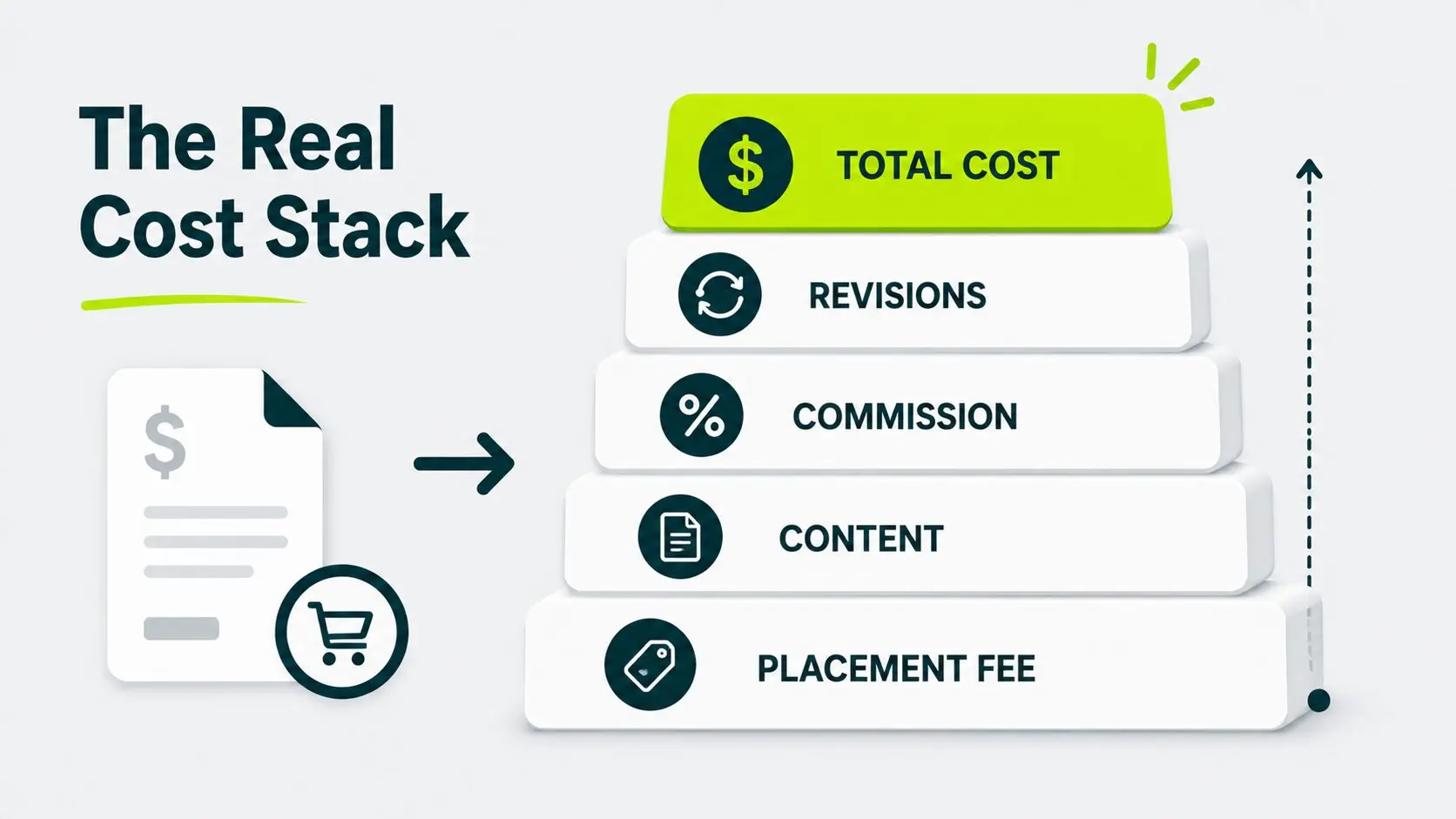
For example, a marketplace placement was advertised at $40. The $40 price usually covers only the link placement.
You’ll likely need to add:
Content creation
$30 to $80
Most self-serve marketplaces don’t include the article. You either write it yourself or pay for content.
Platform commission
10% to 15%
- $40 placement = $4 to $6 fee.
- $400 placement = $40 to $60 fee.
Revisions
Varies by platform
Some marketplaces include one revision round. Others charge extra.
Article replacement
$30 to $80 (if needed)
Publisher rejections are uncommon but do happen. A replacement article adds another cost.
The Real Cost Looks Like:
| COST ITEM |
AMOUNT |
|---|---|
| Link placement | $40 |
| Content | $30-$80 |
| Commission | $4-$6 |
| Revisions (replacement) | Variable |
| TOTAL COST |
$90-$160+ |
A placement advertised as “from $40” often ends up costing $90 to $160 once everything is included.
The Indexation Discount
Getting a link published is only part of the equation. Not every paid placement gets indexed by Google.
Realistic indexation rates for paid placements are 50% to 80% within 60 days, depending on the marketplace’s standards.
After a placement goes live, you can use our page indexing checker to verify whether Google has indexed the URL.
For example, if your all-in cost is $130 and the indexation rate is 70%, your true cost per indexed link is roughly $186.
To estimate whether that investment is likely to pay back, run the numbers through our ROI calculator for link building campaigns.
Managed Service Comparison
A managed service that quotes “from $150” often includes:
- Content creation
- Revisions
- Platform fees
- Project management
All-in cost comes down to $150. After dividing this all-in cost by an often higher indexation rate of 80% to 90%, the result is a true cost of about $175.
The managed guest post marketplace service that sounds expensive at $150 is often within 10% of the self-serve “from $40” once you finish the math.
For link building campaigns, the real trade-off is about control and speed.
For broader backlink pricing benchmarks beyond marketplace placements, the gap can widen further.
The Top 10 Guest Post Marketplaces (Ranked)
The top 10 guest post marketplaces are: Collaborator.pro, WhitePress, Adsy, PRNEWS.IO, Linkhouse, Getfluence, GuestPostLinks, Serpzilla, Icopify, and Bazoom.
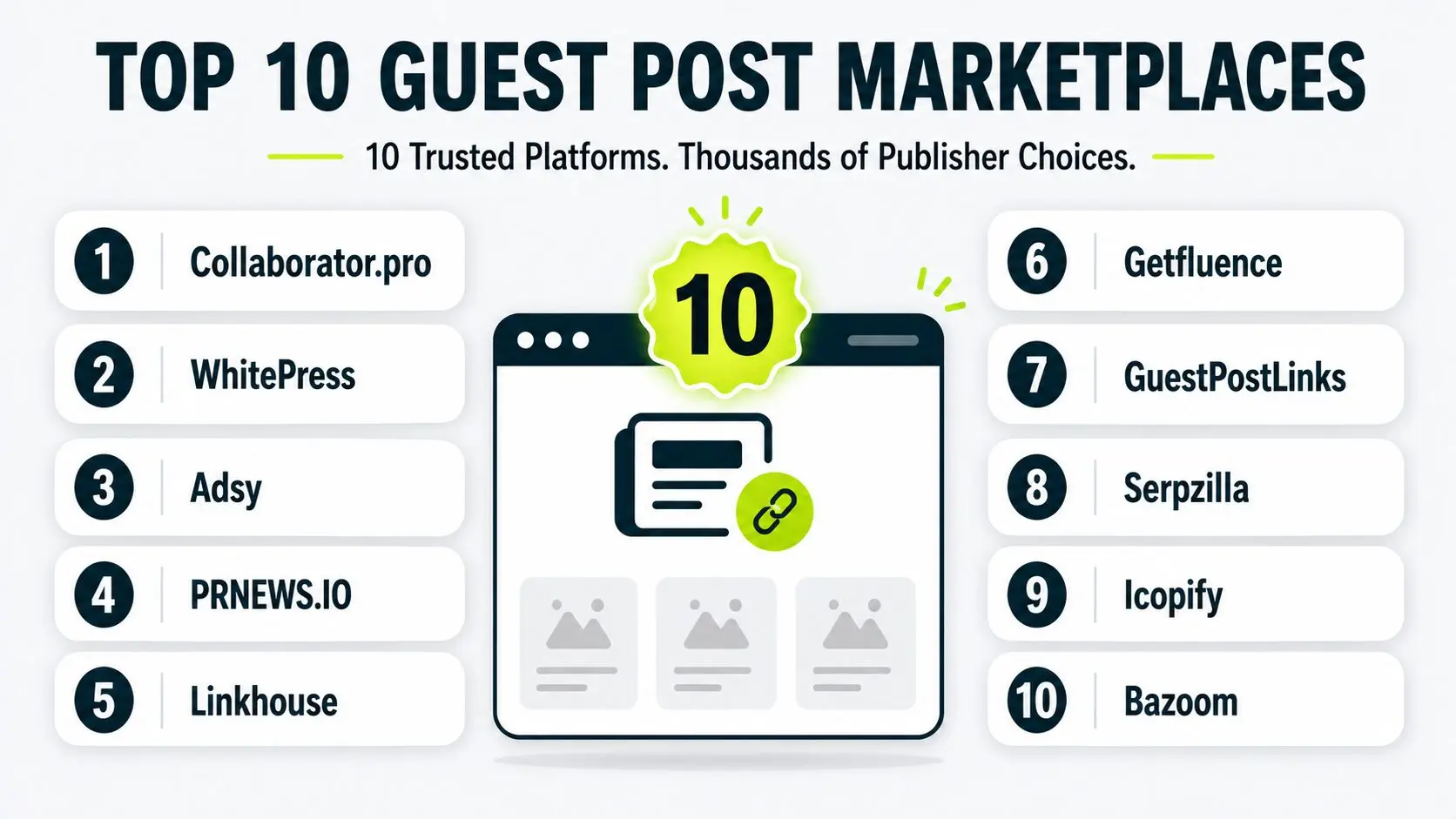
Quick Overview of the top 10 guest post marketplace platforms:
| RANK |
PLATFORM |
MODEL |
NETWORK SIZE |
STARTING PRICE |
BEST FOR |
|---|---|---|---|---|---|
| 1 | Collaborator.pro |
Self-serve | 38,000+ sites + 3,000+ Telegram channels | From $5 | Buyers who want filter depth and AI Overview eligibility data |
| 2 | WhitePress |
Self-serve | 113,000+ sites in 34+ languages | From $39 | International campaigns and non-English markets |
| 3 | Adsy |
Self-serve | 100,000+ vetted sites | From $14 | US-focused buyers who want manual publisher vetting |
| 4 | PRNEWS.IO |
Hybrid (PR + guest post) | 107,000 listings | Varies by publication | Press placement and guest post in one platform |
| 5 | Linkhouse |
Self-serve | 74,000+ sites | From $10+ | Polish and broader European market coverage |
| 6 | Getfluence |
Managed (sponsored content) | 45,000+ premium outlets | Quote-based | French market and premium-media campaigns |
| 7 | GuestPostLinks |
Self-serve | 55,000+ verified publishers | Not publicly disclosed | Larger publisher pool with transparent filtering |
| 8 | Serpzilla |
Automated marketplace | 150,000+ sites | From $1 | Speed and scale over per-site vetting |
| 9 | Icopify |
Self-serve | 100,579+ sites | From $1.99 | Smaller-budget tests, with the random-listing test applied |
| 10 | Bazoom |
Self-serve | 56,000+ sites | Quote-based | Scandinavian market and small-niche European coverage |
The HOTH, Loganix, and FatJoe are not in the ranking because they operate more as managed agencies than as buyer-facing marketplaces.
They belong in a different comparison, which the section after the per-platform reviews explains.
1. Collaborator.pro
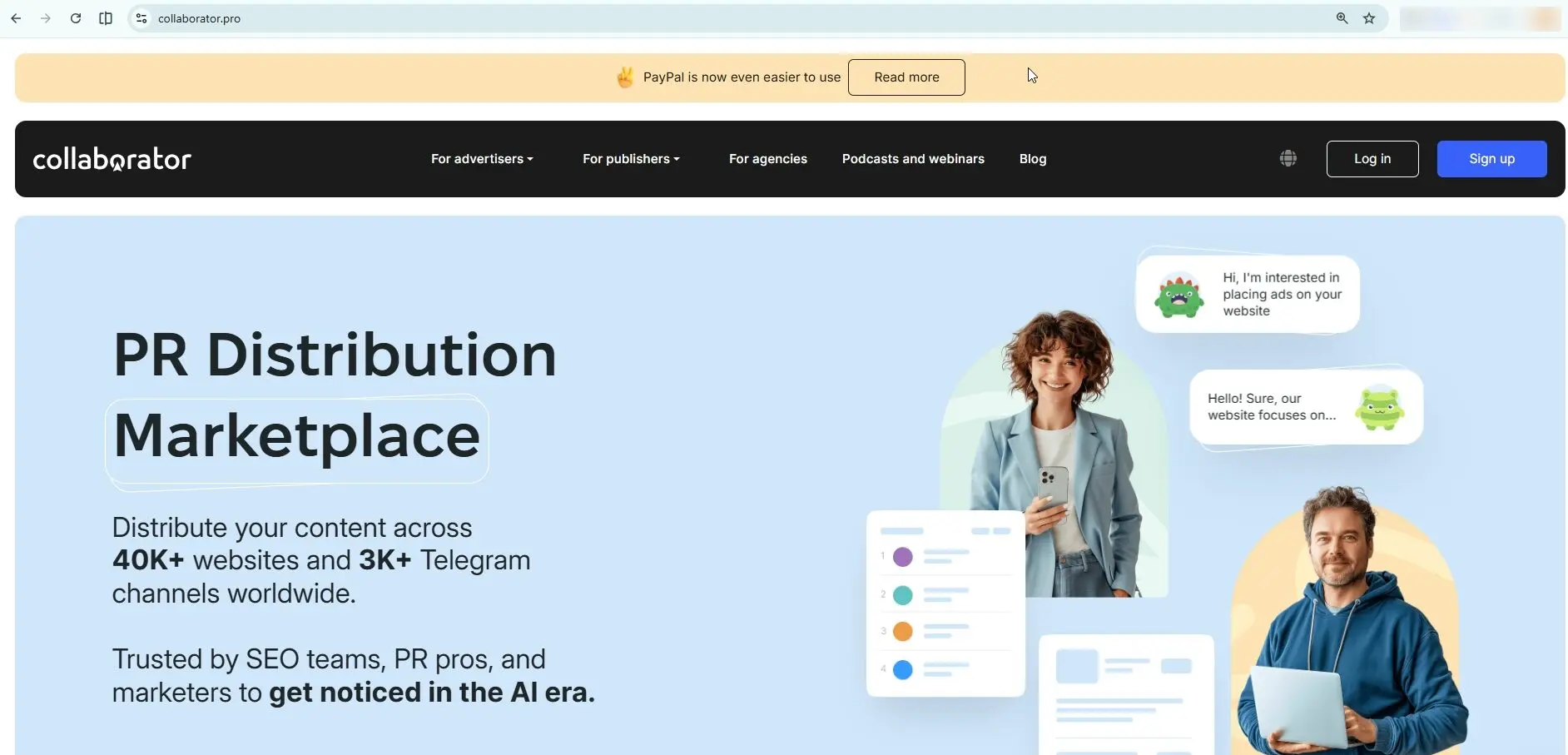
Collaborator.pro is a guest post marketplace and content distribution platform that connects advertisers with website publishers, bloggers, media outlets, and Telegram channel owners.
Why It Ranks First
- Filter depth is the differentiator.
- You can narrow down by price, traffic, country, and over 40 other variables.
- Includes Google AI Overview eligibility filtering, the closest thing in the market to a filter for sites Google might surface in AI search.
Pricing
- Copywriting starts at around $5 to $100.
- A platform commission of about 10% is added on top.
- Publisher-side editorial review is real: publishers can reject content that does not fit their blog.
Where to Focus in Your Audit
- Test 2: Does the publisher actually edit submissions?
- Test 4: What happens if a link is removed?
2. WhitePress
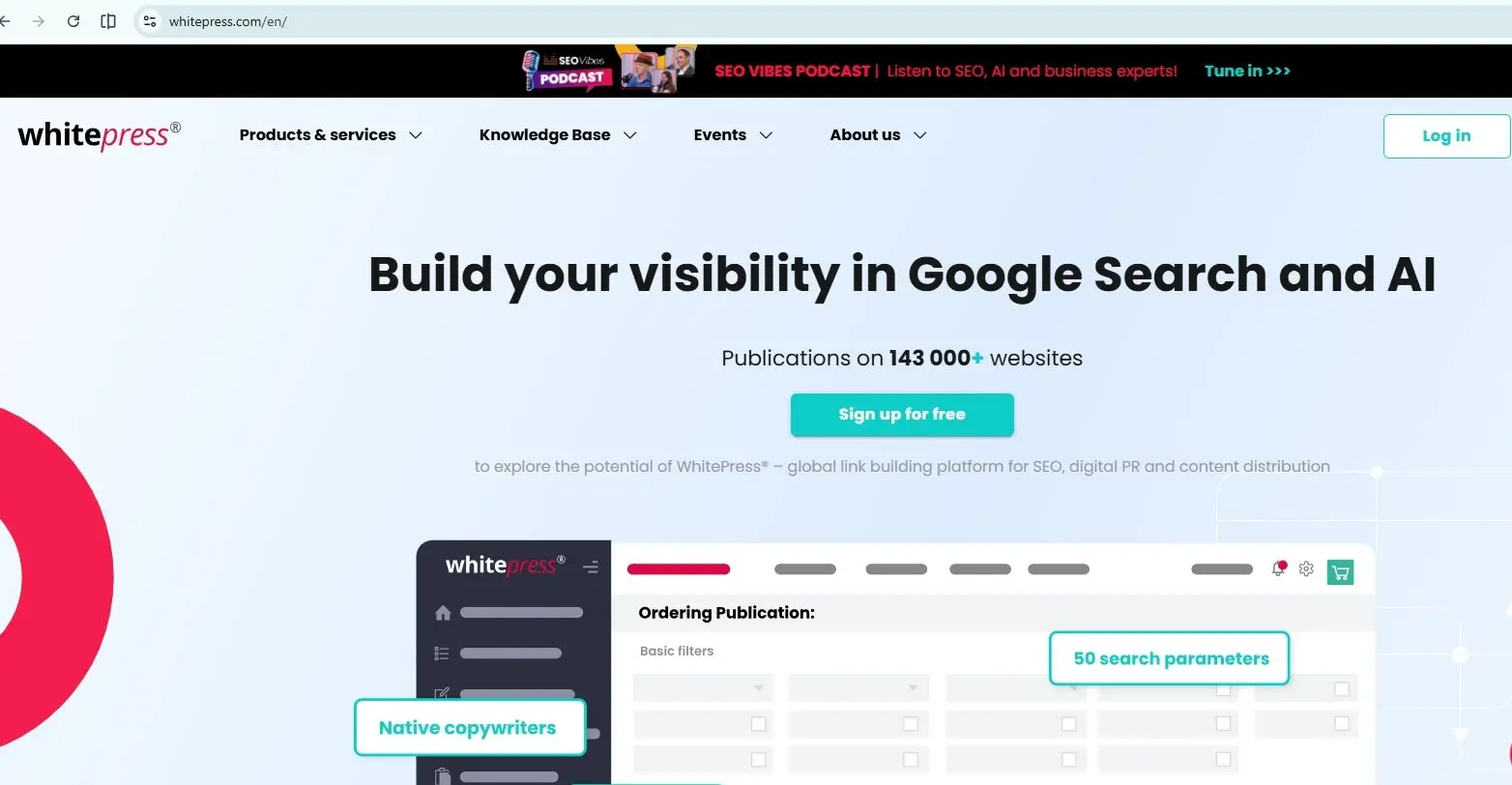
WhitePress is the guest post marketplace to consider when your campaign targets non-English markets.
Why It Stands Out
- International reach is the headline; few marketplaces offer usable inventory in non-English markets at this scale.
- WhitePress bundles the commission into the link price rather than adding it at checkout, which is cleaner.
Pricing
Starts around $39 and runs into the hundreds for higher-DR sites.
Editorial Controls
- Offers an editorial review process.
- Publishers can decline content, which gives Test 2 a head start.
Where to Focus in Your Audit
- Focus on test 1. Random-listing spot checks, especially for non-English sites where traffic tools are less reliable.
- Focus on test 3. All-in cost in your specific niche, since pricing varies more by market than the headline number suggests.
3. Adsy
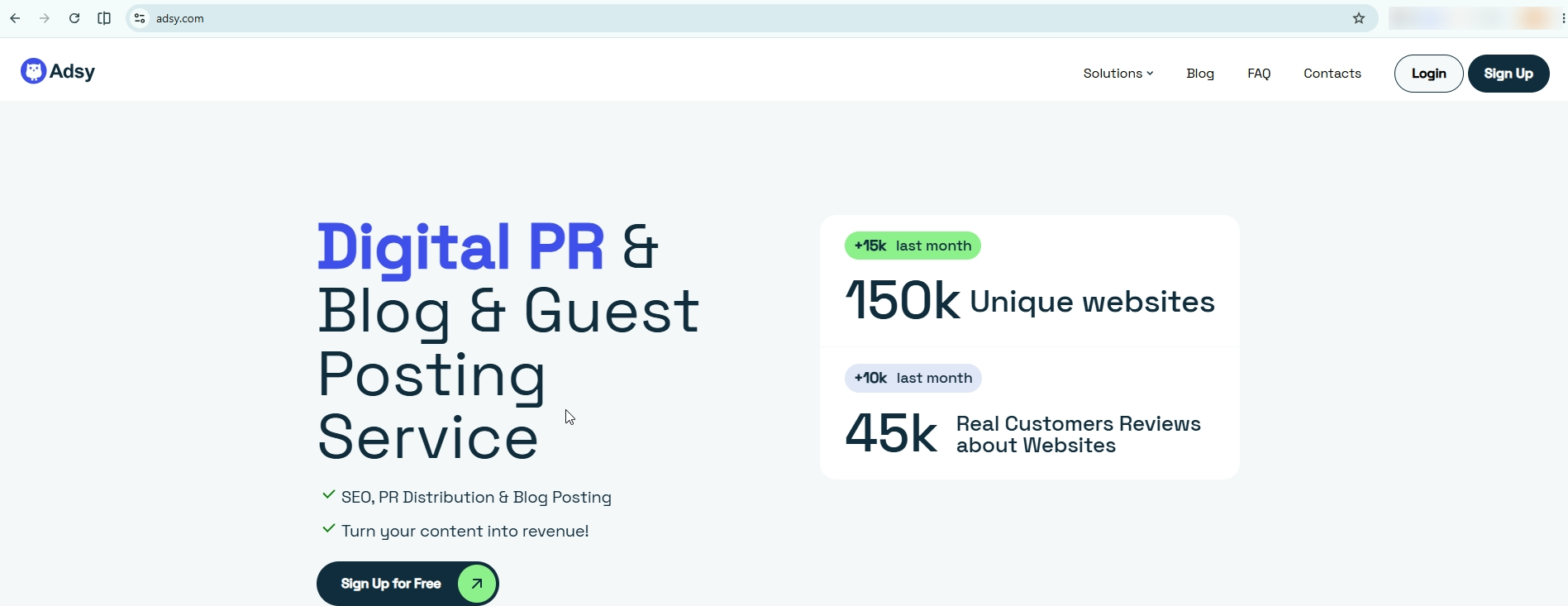
Adsy is a US-based self-serve marketplace with around 100,000 vetted websites in the inventory.
Why It Stands Out
- Manual publisher review and traffic analytics are shown before purchase.
- The vetting process sets Adsy apart from other marketplaces.
Pricing
Varies by niche and authority tier (verify current pricing on adsy.com)
Editorial Standards
- Publishers set their own editorial standards, so the same Test 2 questions apply: does the publisher push back on weak drafts, and can you preview the live URL?
Where to Focus in Your Audit
- Test 1: The vetting marketing claim deserves spot-check verification.
- Test 4: What is the replacement policy?
4. PRNEWS.IO
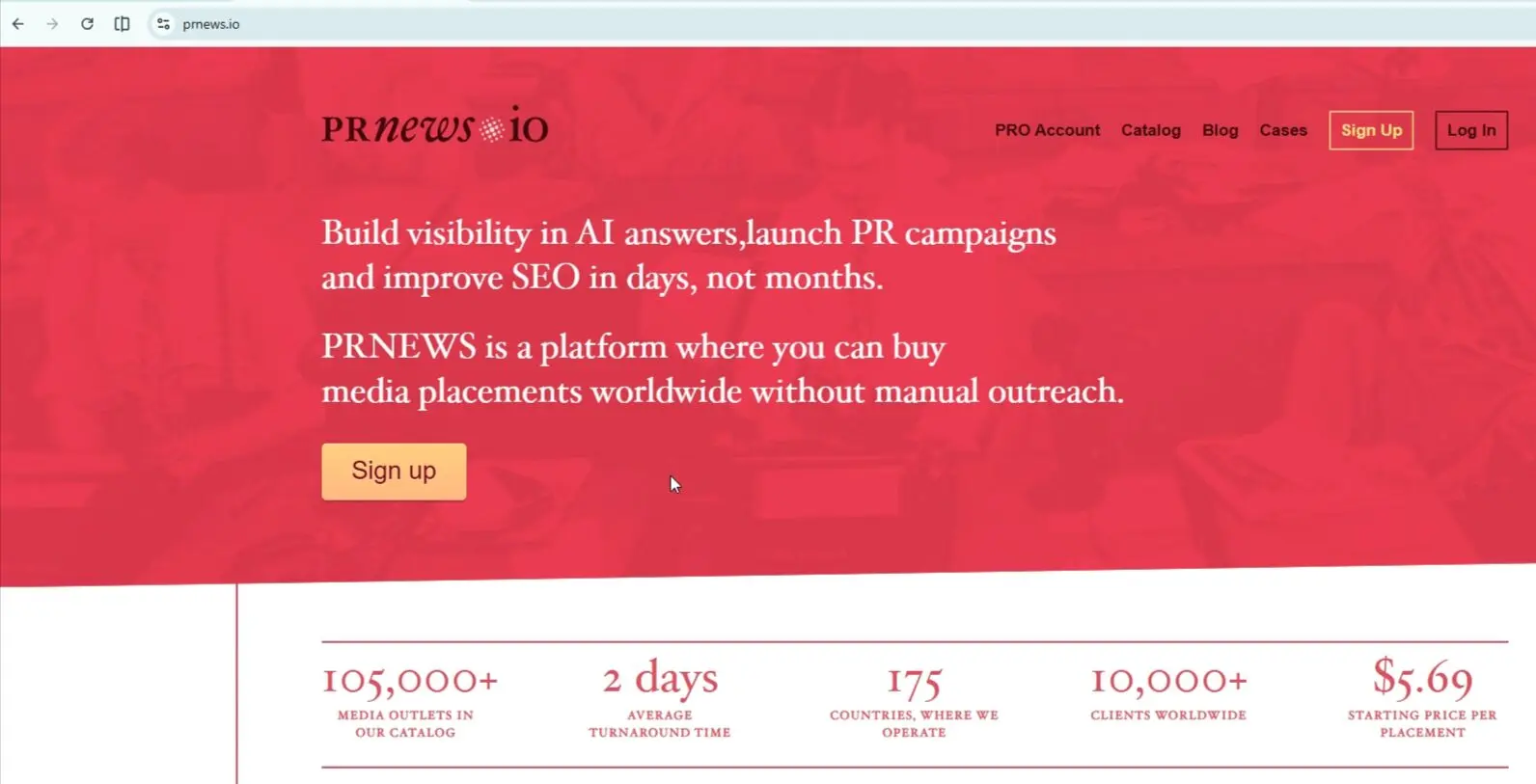
PRNEWS.IO is an Estonian platform that blends press distribution (getting press releases published across multiple news outlets) and guest post placement, with around 107,000 listings.
Why It Stands Out
- You can buy a guest post on a small blog or a press release on a major news outlet through the same platform.
- The press-distribution angle is genuinely useful for brand awareness and AI search citations.
The Key Caveat
- The inventory mixes editorial-grade media with paid-placement blogs in the same interface.
- Read each listing carefully before ordering.
Pricing
Commission is around 15%, added at checkout.
Where to Focus in Your Audit
- Test 1: Verify the listed traffic numbers match third-party tools for blog inventory, specifically.
- Test 3: The all-in cost varies wildly by listing tier.
5. Linkhouse
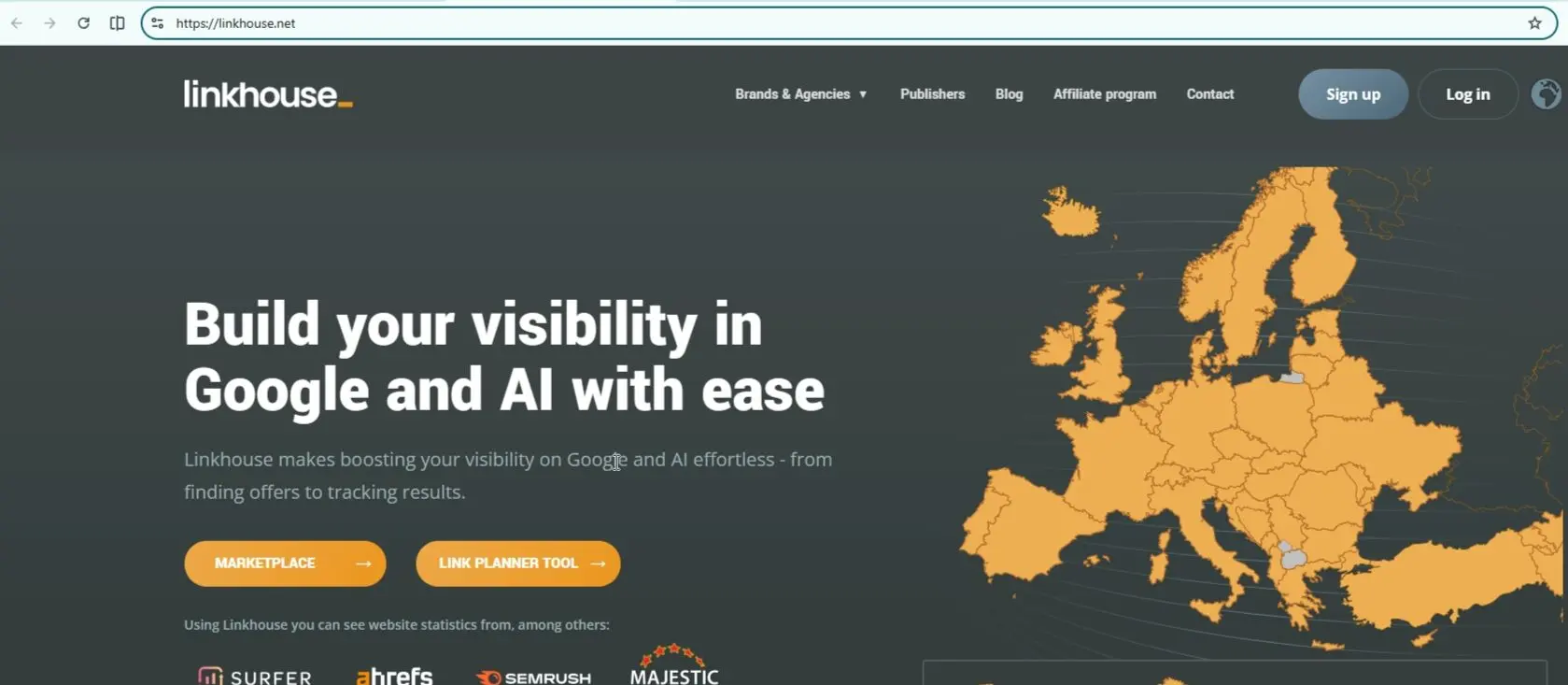
Linkhouse is a Polish self-serve marketplace covering the European market. The European publisher coverage is the draw, especially for Polish and Central European campaigns.
Where to Focus in Your Audit
- Test 1: Random-listing spot checks in your target language, since SEO tools are less reliable for some Eastern European top-level domains.
- Test 2: Editorial control on smaller-publisher networks tends to be looser than on larger platforms.
6. Getfluence
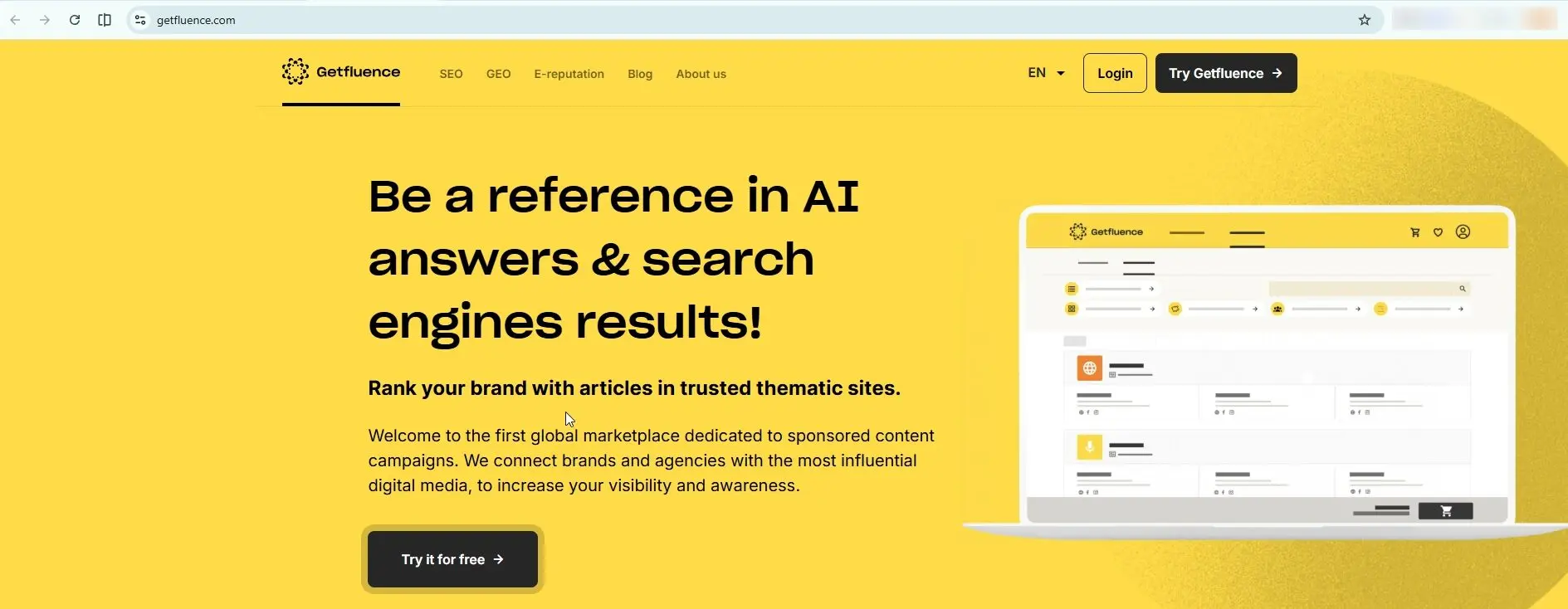
Getfluence is a French-managed marketplace for sponsored content with around 45,000 premium media outlets.
Why It Stands Out
- The premium-media positioning is genuine.
- The model is closer to PR or sponsored content than to classic SEO link building.
Pricing
Quote-based rather than self-serve.
The Key Caveat
- Getfluence explicitly marks links as paid and applies rel=’sponsored’ by default.
- Good for compliance; less good if you are specifically chasing ranking credit from a dofollow editorial link.
Where to Focus in Your Audit
- Test 3: What is the all-in cost, since “from” pricing does not exist on managed quotes?
- Test 4: What happens if a piece underperforms or the outlet changes its policy?
7. GuestPostLinks
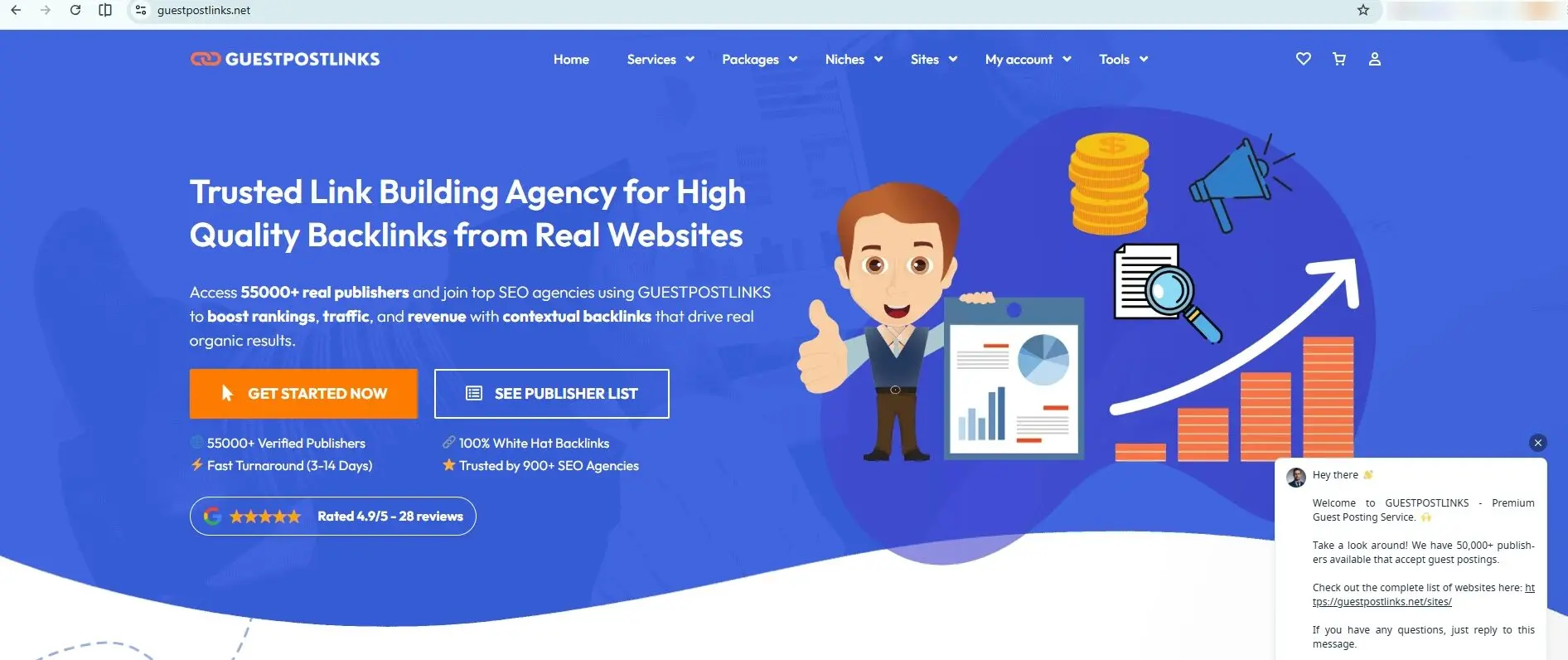
GuestPostLinks is a self-serve marketplace with around 55,000 verified publisher websites.
The volume is solid, and the platform leans toward in-content link placements in published articles rather than sidebars or footers.
Where to Focus in Your Audit
- Test 1: Spot-check the verified publisher claim; “verified” is a marketing word until you test it.
- Test 2: Find out who at the publisher actually reads what you submit.
8. Serpzilla
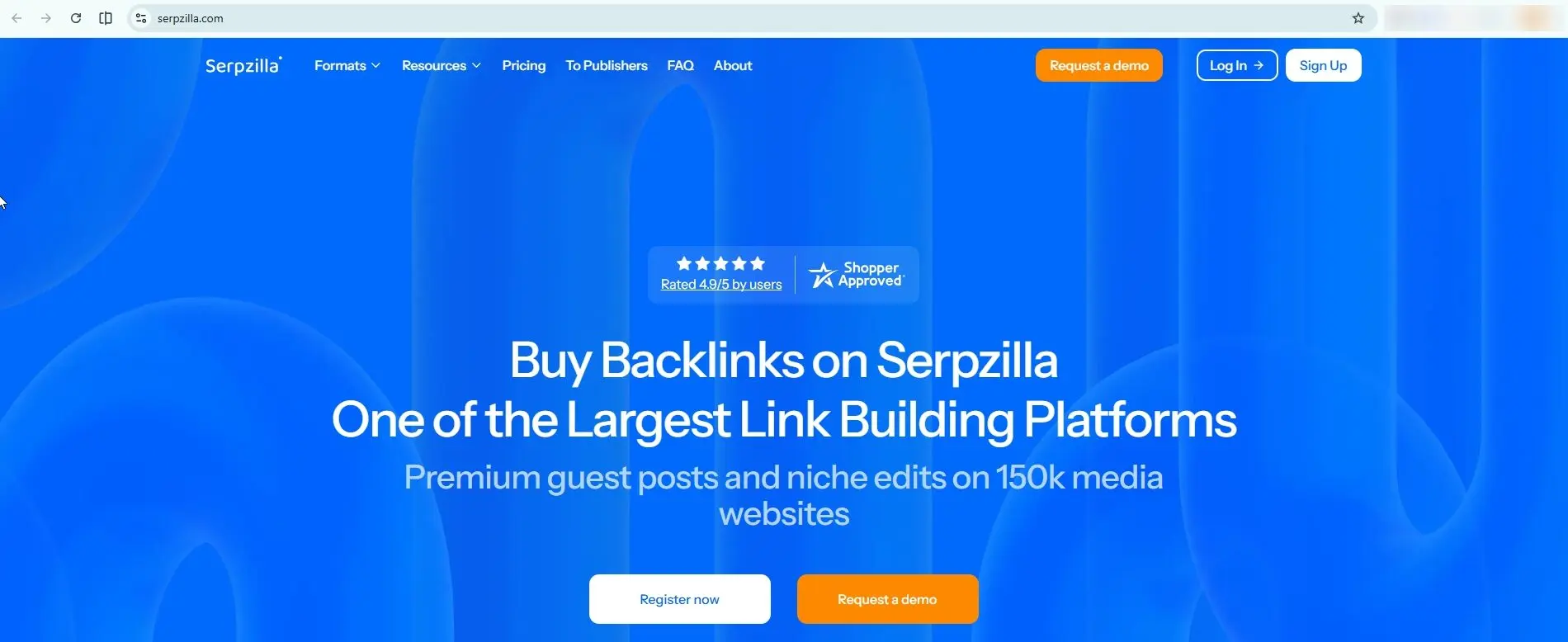
Serpzilla is a large automated guest post marketplace with around 150,000 websites, covering guest posts, niche edits, contextual insertions, and sitewide link packages.
Why It Stands Out
- Scale and automation are real.
- The platform handles high-order volume and turns placements around quickly.
The Key Caveat
- With 150,000 sites in the inventory, the platform cannot manually review every publisher the way a smaller curated platform can.
Where to Focus in Your Audit
- Test 1 is non-negotiable before any Serpzilla order.
- Pick three sites from the inventory in your niche and run them through Similarweb before ordering.
- Reject any that show DR-to-traffic mismatches typical of fake-authority sites.
- If Test 1 passes, the platform’s speed is genuinely useful for buyers who already know how to filter for quality.
9. Icopify
Icopify is a UK-based self-serve marketplace with a smaller inventory than the platforms above.

The Key Consideration
- The smaller scale is not necessarily a problem (smaller inventories are often more curated).
- But it makes Test 1 even more important.
- If your niche is not well represented, the marketplace is not useful for you, regardless of how well it scores on other tests.
Where to Focus in Your Audit
- Test 1: Spot-check the platform’s inventory in your specific niche before committing.
10. Bazoom
Bazoom is a Denmark-based marketplace with Scandinavian and small-niche European coverage.
The Key Consideration
- If you are not targeting a Scandinavian audience, Bazoom is unlikely to be your platform.
- Like Icopify, the smaller scale means Test 1 carries most of the audit weight.
Where to Focus in Your Audit
Focus on test 1. Random-listing spot check in your niche and geography.
Platforms Left Off the Top 10 Guest Post Marketplaces and Why
Two categories of platforms didn’t make the ranking: managed services and marketplaces that fail the spot check.
Managed Services Aren’t Marketplaces
The HOTH, Loganix, FatJoe, and similar brands are often grouped with guest post marketplaces, but they function primarily as managed link building agencies.
| FACTOR | MANAGED SERVICE | MARKETPLACE |
|---|---|---|
| Buying experience | Ordering from an agency | Browsing a self-serve database |
| Control over placement | Limited; agency selects sites | High; you filter and choose |
| Per-link cost | Higher (service included) | Lower (you do the work) |
| Best for | Done-for-you at a fixed price | Buyers who want flexibility |
Comparing FatJoe to Collaborator.pro is a category error. One is a managed agency with a small catalog of common placements. The other is a database of 38,000 publishers that you can filter and order directly from.
Marketplaces That Fail the Spot Check
A handful of mid-tier platforms fail the random-listing test: three randomly picked sites show DR-to-traffic mismatches typical of fake-authority sites.
If a marketplace appears on longer lists elsewhere but is not in the top 10 here, that is a likely reason. Run Test 1 yourself before placing any order.
When You Should Skip the Guest Post Marketplace and Go Direct
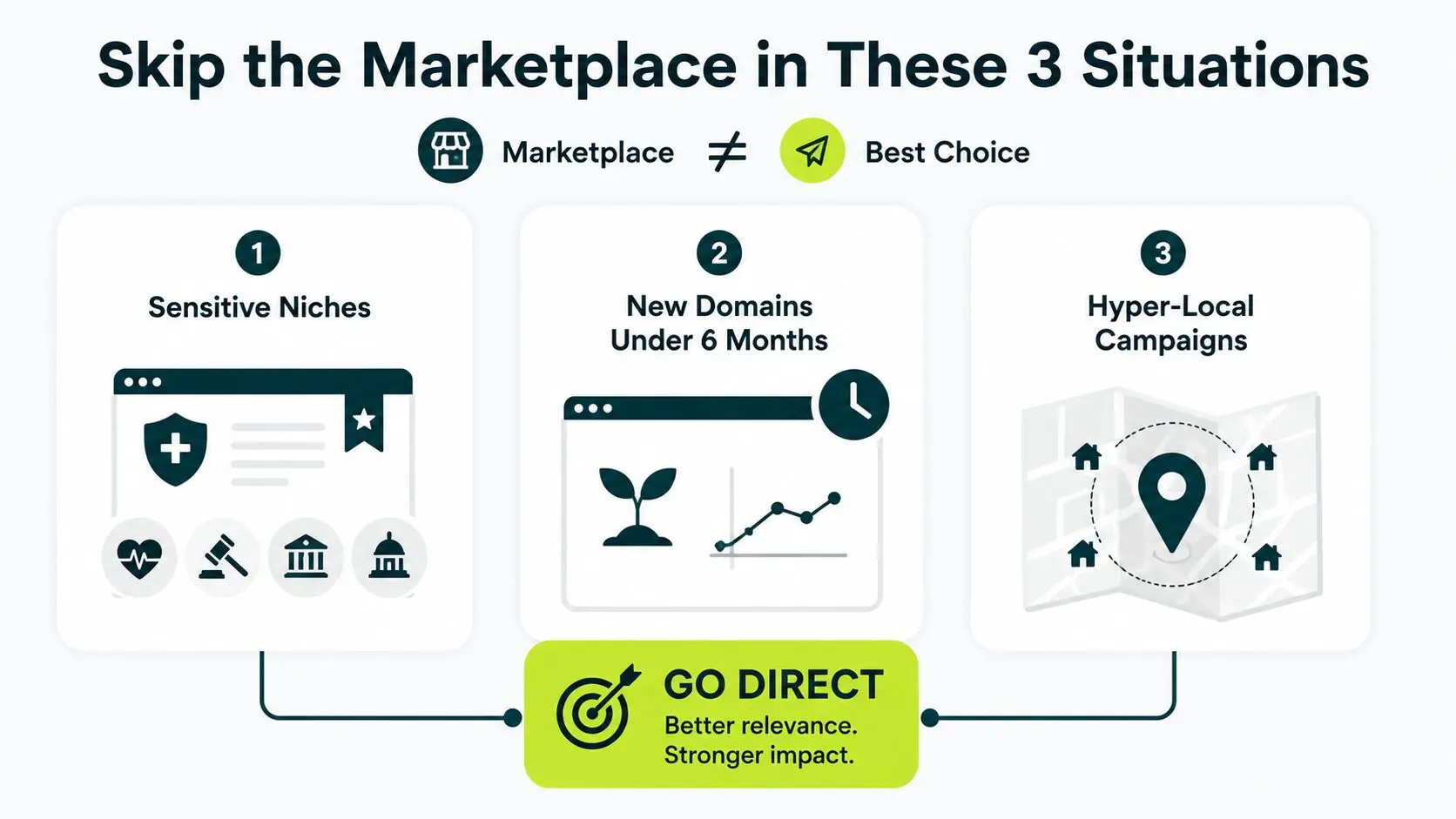
You should skip the marketplace and go direct in these three situations: sensitive niches, new domains under 6 months and hyper-local campaigns.
A marketplace is the wrong tool for some campaigns, no matter how cleanly it passes the 4-test audit. Three situations call for manual blogger outreach instead.
Situation 1: Sensitive Niches
Health advice, legal information, financial security, and government and civic content sit inside Google’s “Your Money or Your Life” category.
Here, ranking signals are weighted heavily toward author expertise and publisher reputation.
Why Marketplaces Fall Short Here
A paid placement on a generic health blog will not move rankings in this niche, regardless of marketplace quality.
The links that move the needle in sensitive niches have three specific traits:
- The author has visible credentials.
- The publisher has an editorial standards page.
- The page itself cites primary sources.
Marketplaces rarely have that kind of inventory at scale.
Situation 2: New Domains
New websites often need to establish trust, visibility, and brand signals before large-scale guest post campaigns become cost-effective.
Buying a Stack of Paid Placements at This Stage Means Paying for Links That Google Often Won’t Count.
Instead, for your new domain, the first ten links should come from sites that vouch for the brand specifically.
Examples are founder interviews, industry directories, partner mentions, and other assets that help early-stage companies earn backlinks naturally . No buyer can purchase these slots; they belong specifically to your brand.
When Guest Post Marketplaces Start to Make Sense
- Around months four to six of the domain’s life.
- Once the site has started building a consistent backlink profile.
Many SEO practitioners view this stage as a sign that a site has started building a healthy backlink profile.
Situation 3: Hyper-Local Campaigns
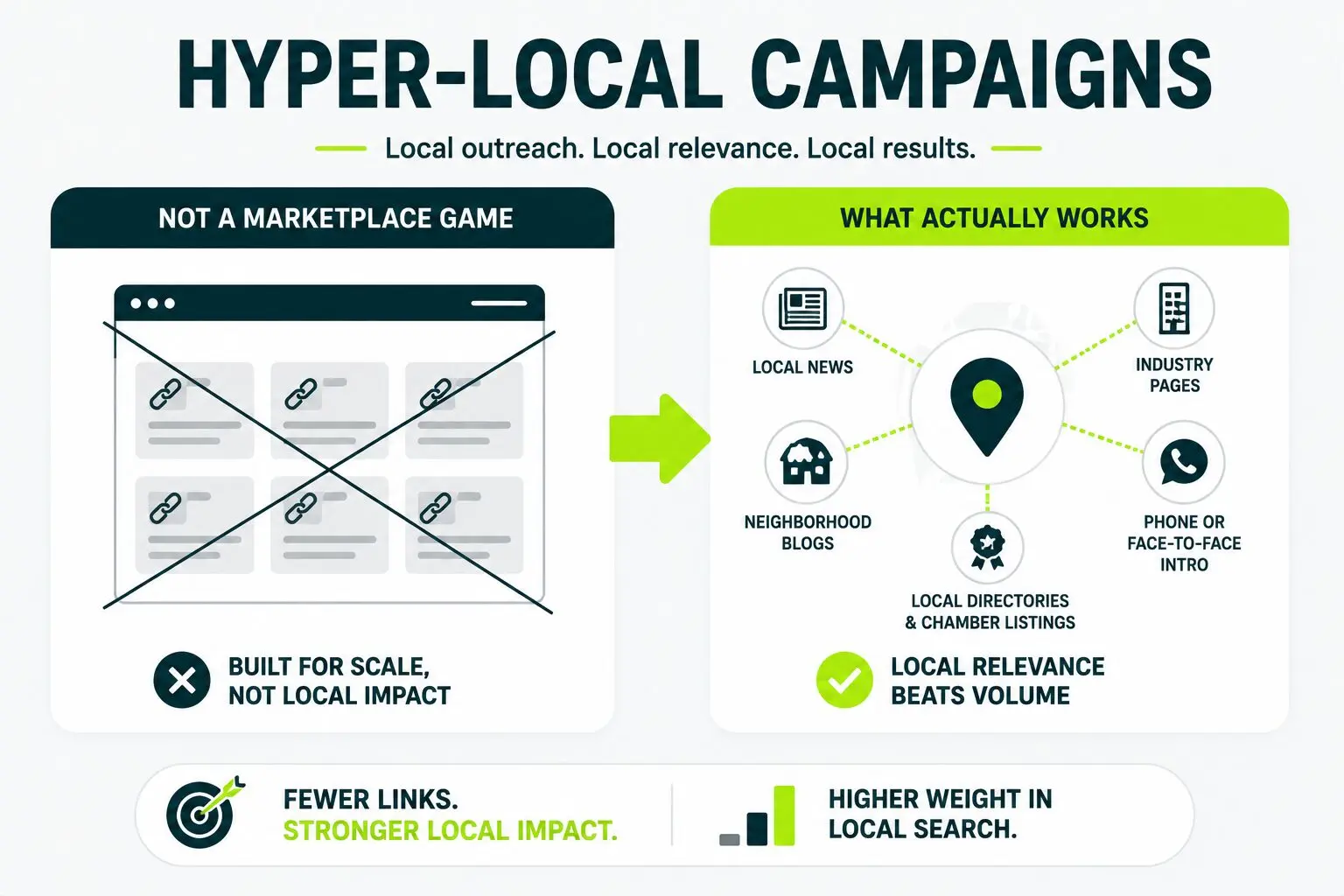
Direct outreach in the local market, often with a face-to-face or phone introduction rather than a cold email, is the right channel here.
Why Guest Post Marketplaces Do Not Work Here
- Marketplaces are built for scale, which is the opposite of what a hyper-local campaign needs.
- For example, a local plumbing company doesn’t need links from generic national blog networks.
What a Hyper-Local Campaign Actually Needs
- In a hyper-local campaign, a plumbing company benefits most from backlinks on websites that are relevant to its service area and local audience.
- The local plumbing company also needs mentions on local news sites, neighborhood blogs, vertical industry pages, and chamber of commerce listings.
- And it needs a face-to-face or phone introduction rather than a cold email.
The Trade-Off
- Direct local outreach produces fewer links per month.
- But each link carries more weight in the local search algorithm than ten national placements would.
Quick Summary of Marketplace vs Direct Outreach:
Use this table to match your situation to the right channel before auditing any platform.
| SITUATION | RIGHT CHANNEL | WHY |
|---|---|---|
| Sensitive niche (health, legal, finance) | Direct outreach to vertical publications | Marketplaces lack credentialed-author inventory at scale |
| New domain under six months old | Direct brand-specific outreach | Paid links from new domains often go unindexed |
| Hyper-local campaign | Local direct outreach | Marketplaces are built for scale. They aren’t built for geography. |
| All other situations | Marketplace (after the 4-test audit) | Faster, more flexible, lower per-link cost |
One Order Before You Commit a Budget
Most buyers spend weeks comparing platforms and ten minutes vetting the actual site they buy on. The platform matters less than the individual listing. Run the random-listing test on every order, not just once when you first sign up.
If this is your first campaign, our checklist for link building walks through the steps to complete before spending budget on placements.
Not sure a marketplace is the right fit?
Get a personalized outreach plan if your situation is a sensitive niche, a new domain, or a hyper-local campaign. A marketplace is the wrong starting point for all three.
Are guest post marketplaces safe to use?
You can use marketplaces safely as long as they tag the links as sponsored or nofollow, which is what Google’s link spam policy requires for paid links.
Most reputable marketplaces will apply the tag on request. The ones that promise “guaranteed dofollow” without disclosure are selling links that violate the policy.
How much does a guest post actually cost?
Headline prices on self-serve guest post marketplaces start around $40 for low-traffic sites and range from $500 to $2000+ for high-authority publications.
The all-in price (placement + content + commission + revisions + indexation discount) usually runs 2 to 3 times the headline.
A “from $40” placement often ends up costing between $90 and $160 in total.
Do guest post marketplaces still work for SEO in 2026?
They can still support visibility, referral traffic, brand awareness, and content distribution when used carefully.
SEO outcomes depend on publisher quality, relevance, editorial standards, and compliance with Google’s spam policies.
Guest posts on relevant, trusted publishers can drive referral traffic, brand visibility, citations, and audience reach.
Any ranking impact depends on how Google interprets the link and whether it complies with Google’s spam policies.
Recent link building statistics reinforce the importance of publisher quality, relevance, and authority in modern link building campaigns.
What’s the difference between a guest post marketplace and a guest post service?
A guest post marketplace is a database where publishers list their blogs, and buyers self-serve to filter and place orders.
A guest post service is an agency that sources publishers for you, often with a fixed catalog of common placements.
Marketplaces give you more control and usually a lower per-link cost. Services give you a done-for-you placement at a fixed price.
How do I choose between marketplaces?
Run the 4-test buyer audit on two or three platforms that most closely match your situation. The audit catches issues that headline rankings cannot show you.
Should I use a guest post marketplace on a brand-new website?
No. Domains under six months old should build their first ten backlinks through founder-led direct outreach before investing in a scalable authority-building campaign.
Marketplaces start to make sense once the domain has been around for roughly 4 to 6 months and has 20 to 30 referring domains. Until then, a specialist link building agency running founder-led outreach typically produces stronger early placements than self-serve marketplaces can.