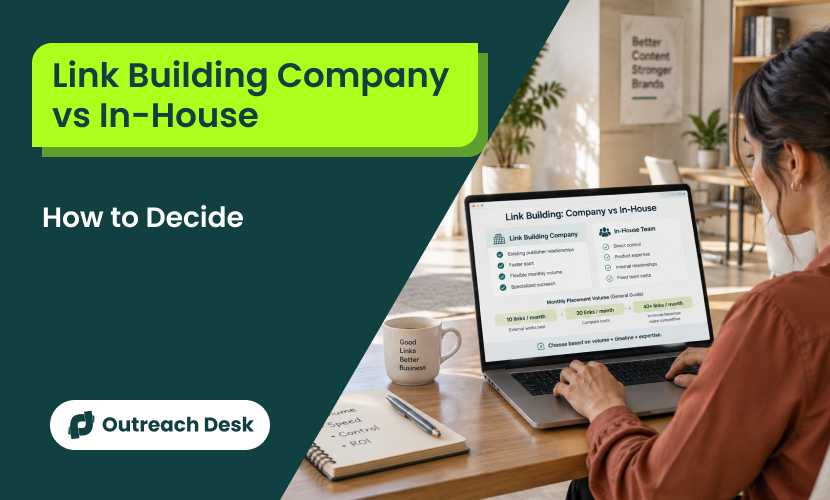
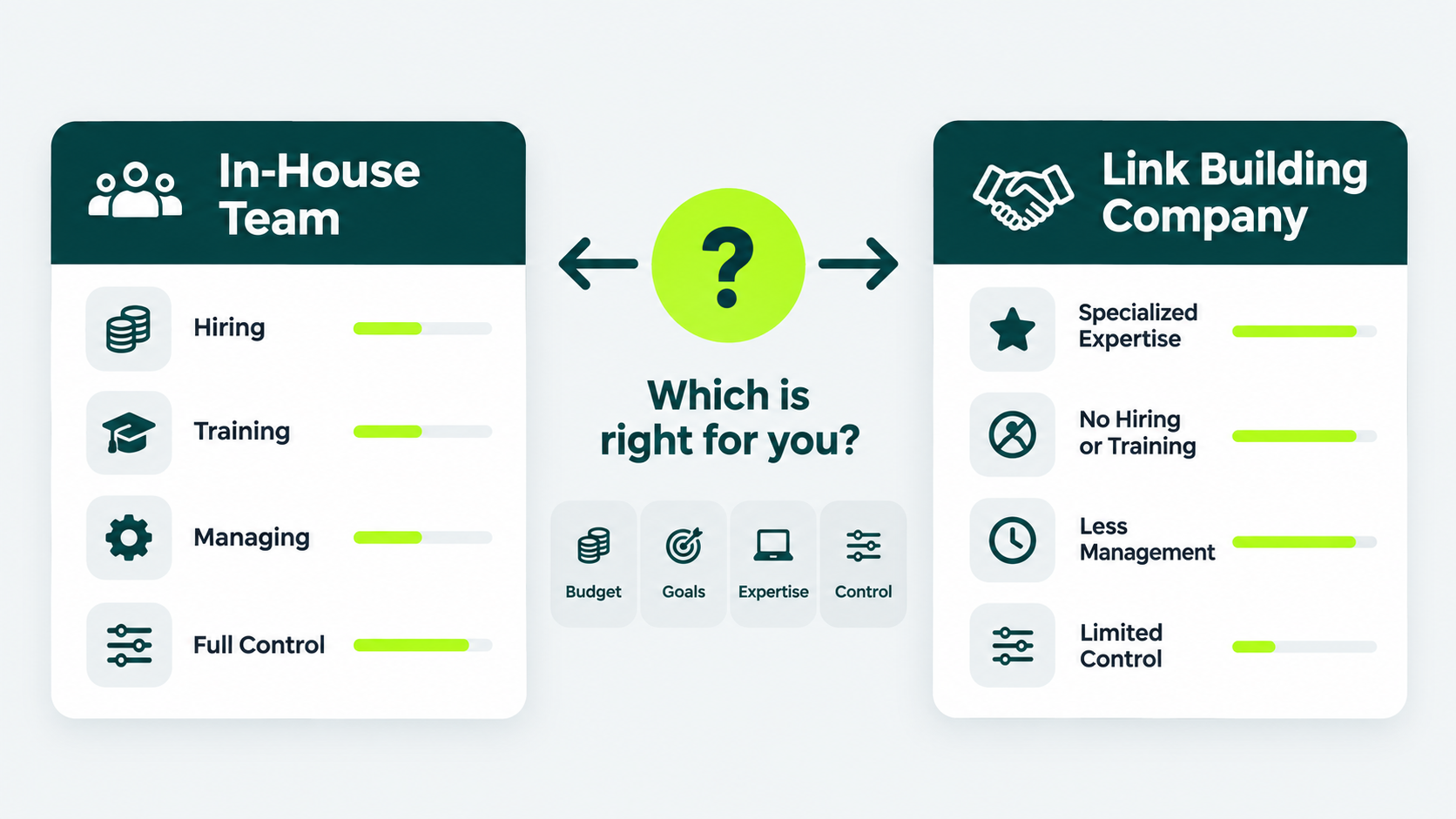
You can build an in-house link building team and control every part of the process, but that control comes with the costs of hiring, training, and managing staff.
A link building company gives you access to specialized expertise without requiring you to build that infrastructure yourself. The better choice depends on your budget, link goals, internal expertise, and how much control you need over the work.
Before you decide, it helps to see what each model actually requires from your business.
Quick Summary
- Companies offer speed and expertise; in-house teams offer direct control.
- In-house becomes competitive as volume approaches 40 consistent monthly placements.
- Outsourcing costs less upfront and works better for lower volume.
- Internal teams suit complex products needing deep context and relationships.
- Hybrid models work when strategy stays internal and execution external.
What You’re Choosing Between
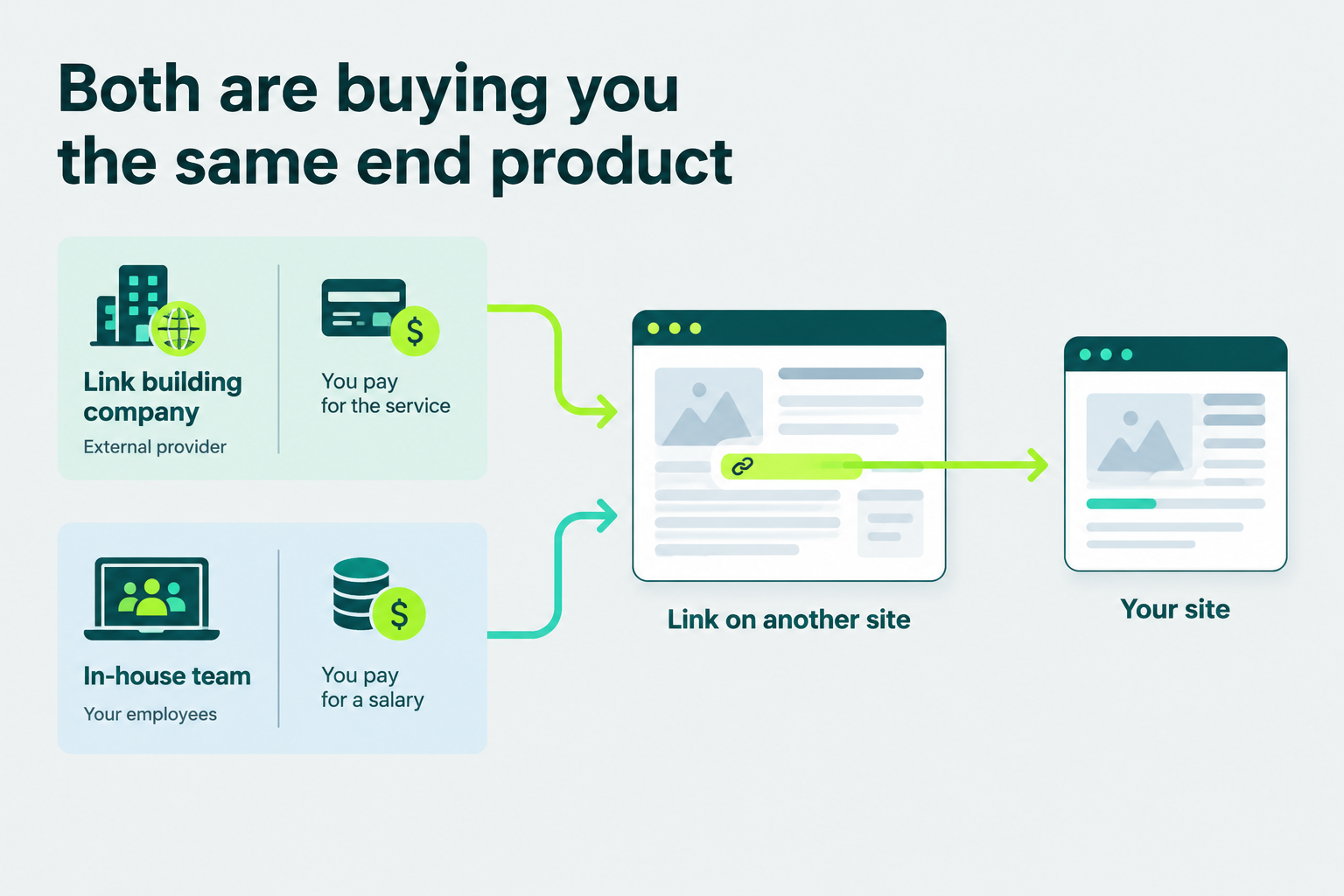
A link building company is an external provider you pay to publish links on other websites. An in-house team is your own employees doing that same work for a salary.
Both are buying you the same end product: a link from someone else’s site pointing to yours.
What differs is who does the work and how you pay for it.
What a Link Building Company Delivers
When you choose a company, you gain genuine access to existing relationships.
A link building company has spent years building relationships with publishers, so their emails don’t land as cold outreach, and editors are more likely to actually read them. That’s most of what you’re paying for.
The process includes personalized outreach, content writing, and follow-up with site owners to earn links to your page.
You approve the sites, and they do the outreach.
The Work Building In-House Actually Involves
Building in-house means hiring candidates for the role and managing the work yourself. You can watch the process live and control it.
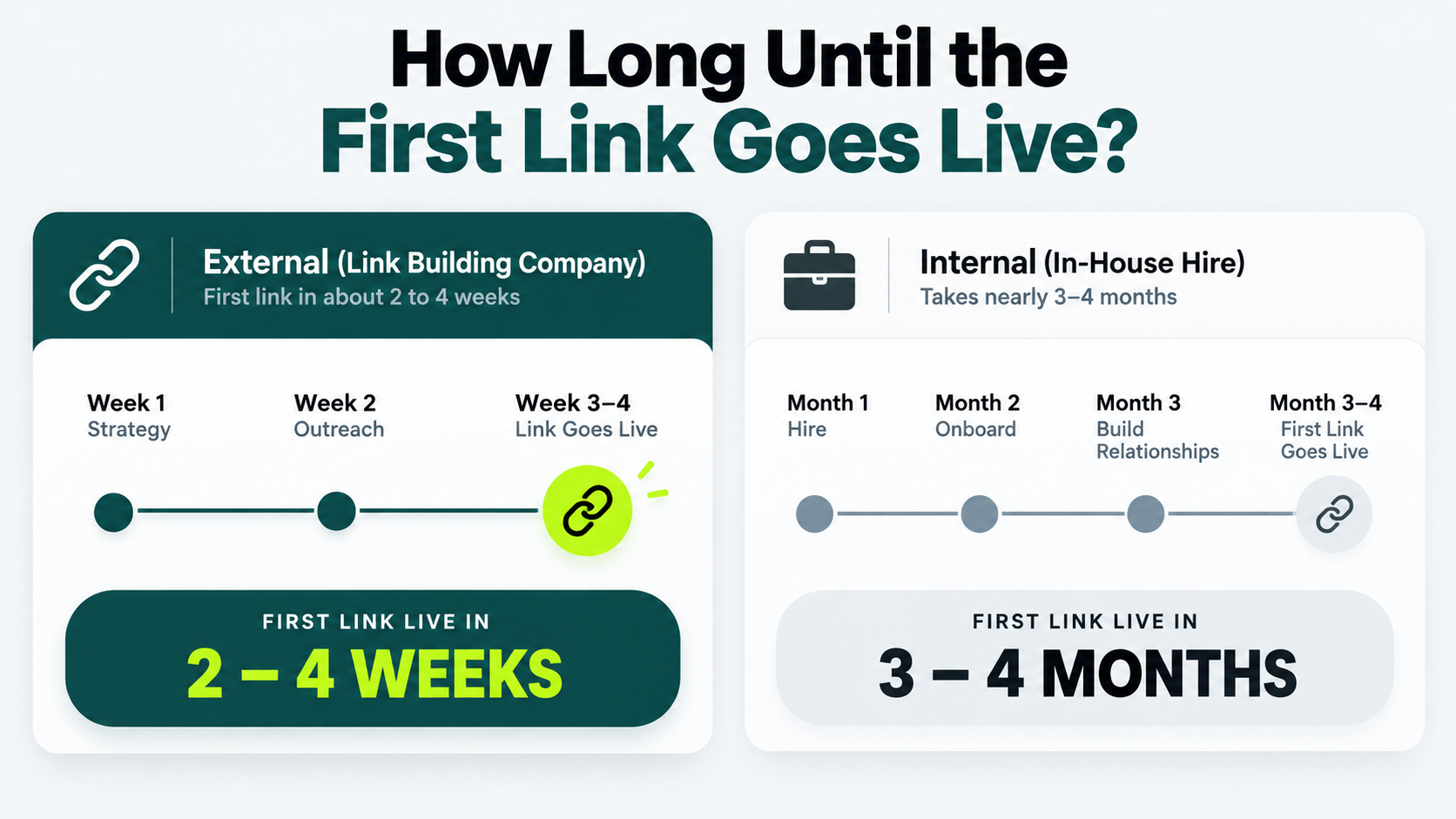
Companies get results in a few weeks; in-house takes 3 to 4 months.
This difference arises because companies already have established relationships, but in-house candidates don’t have that privilege. They start from scratch.
The in-house process goes like this:
- Running software to find relevant sites and identify the right contacts.
- Writing a personalized pitch designed to get a reply and sending it to those contacts.
- Following up with site owners who do not respond.
- Creating content that publishers will accept.
Remember
Cold outreach reply rates run low everywhere. Patience and volume make up the difference.
Our approach to link building outreach covers the operational side in more detail.
What Each One Costs Before You Get a Single Link
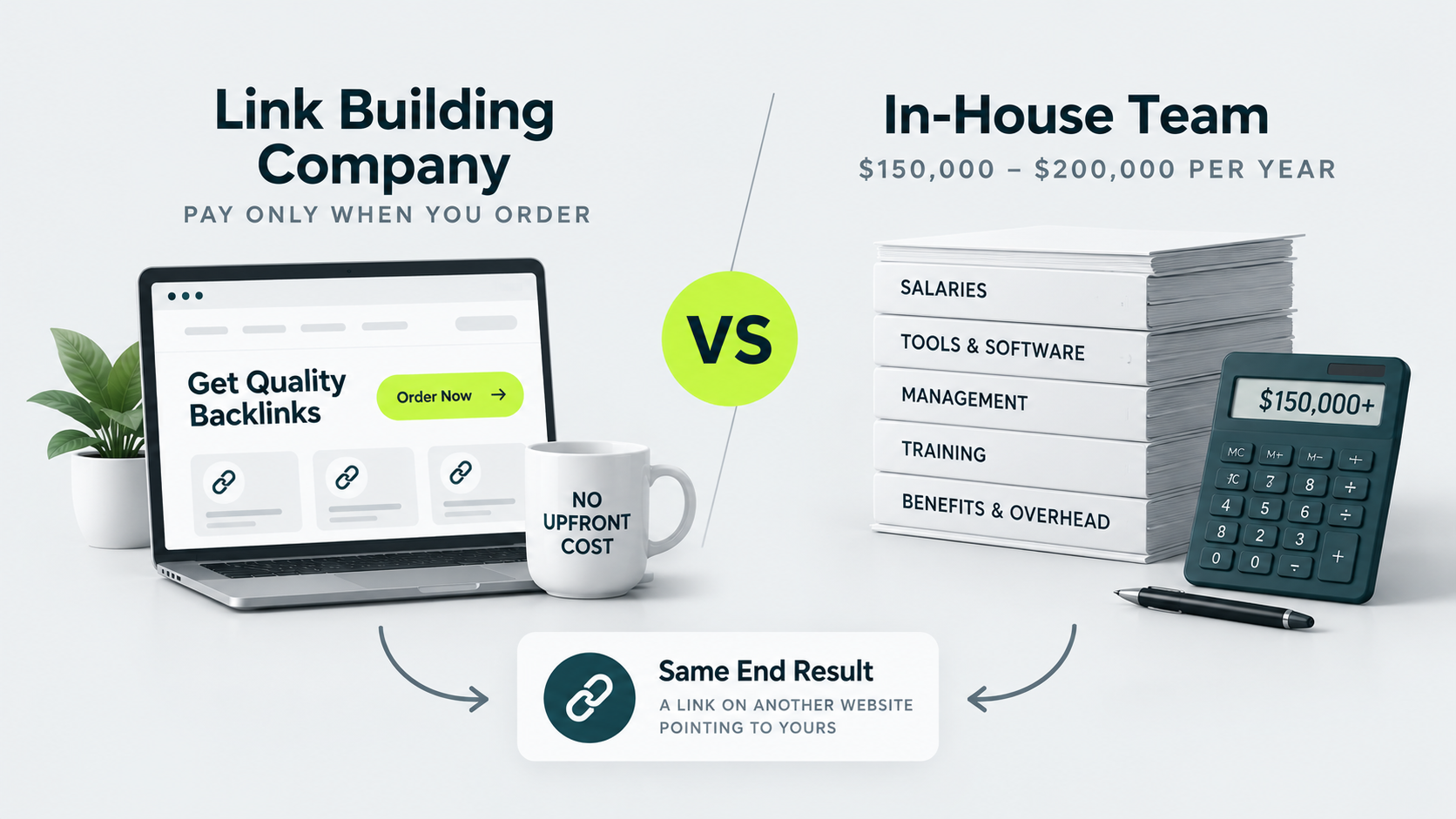
A link building company lets you pay as you order, while an in-house team can cost $150,000 to $200,000 a year.
That gap makes the whole decision, and most people compare the wrong two numbers. The common mistake is to weigh a monthly agency fee against a single salary.
A salary isn’t the cost of an in-house function.
The Two Cost Shapes
There are two costs: variable and fixed.
The company bills per placement or a monthly retainer, meaning a set fee for an agreed number of links.
It’s simple: order fewer links and pay less.
An internal team bills you the same amount in a quiet month as it costs in a busy one.
That isn’t necessarily a drawback, but it means that the team needs a steady workload to justify the cost.
What Appears Inside the In-House Number
An in-house link building team needs more than one person.
As an in-house team, you need:
- A manager to run the campaign
- Outreach support to contact publishers and follow up
- A writer to create the content
- SEO (Search Engine Optimization) software to find and evaluate link opportunities
- A placement budget to cover the cost of securing links
Our guide to what backlinks cost breaks down that stack role by role.
In-house ranges from $150,000 to $200,000 per year for a US-based team.
Prospecting software can cost thousands of dollars because many tools are priced for agency-level use.
Ahrefs is an SEO tool that shows which sites link to any page. That’s how you find publishers worth pitching.
What You’re Comparing on the Other Side
Per-link pricing from a company usually depends on the site’s authority. Most providers price based on Domain Rating (DR).
Domain rating is a 0 to 100 score from Ahrefs that estimates the strength of a website’s backlink profile.
A DR 30 site costs less than a DR 60 site because lower-authority publishers are more likely to accept pitches. Typical market rate ranges from $400 to $600 per link for sites with real traffic.
The Link Volume Where In-House Starts Winning
An in-house team becomes the stronger option when you consistently need around 40 or more placements each month.
Why? Because the team’s salaries and tool costs are fixed. The more links the team builds, the lower the cost per placement becomes.
You can calculate this for your own business in two simple steps:
- Find the monthly team cost
- A $150,000 annual team costs about $12,500 per month.
- A $200,000 annual team costs about $16,700 per month.
- Divide that monthly cost by the number of links you need
Formula: Monthly team cost ÷ monthly links.
For example, if your team costs $12,500 a month and builds 40 links, your cost works out to about $313 per placement.
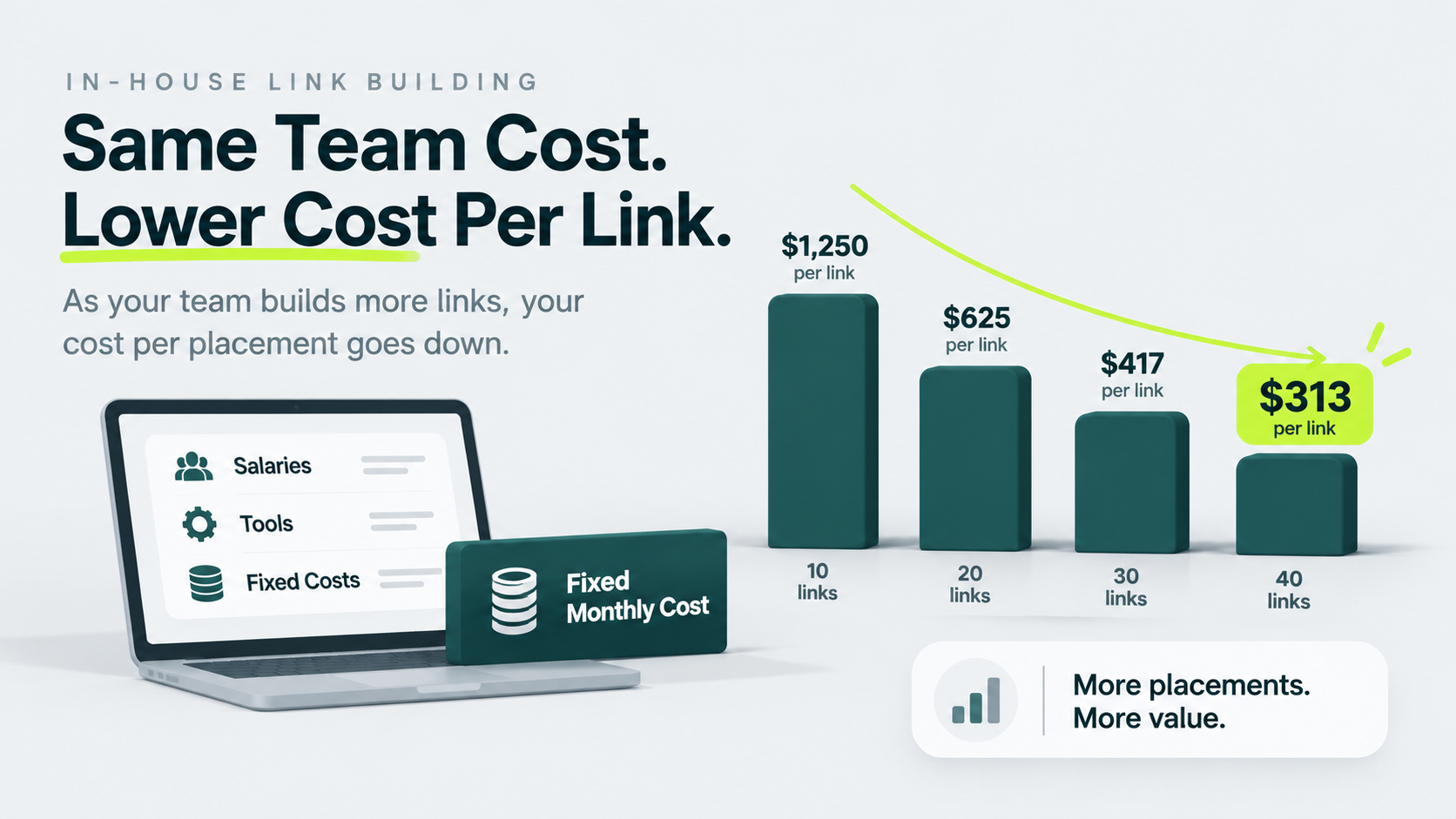
What the Math Looks Like at Four Volumes
| LINKS PER MONTH |
YOUR COST PER LINK |
AGAINST $400 TO $600 MARKET RATES |
|---|---|---|
| 10 | $1,250 to $1,670 | Two to three times the market rate |
| 20 | $625 to $835 | Still above what a company charges |
| 30 | $417 to $557 | Inside the market range |
| 40 | $313 to $418 | More budget-friendly than buying them |
The crossover appears at 30 because that’s where the two lines meet. Move the salary assumption, and the crossover moves with it.
The Assumption Buried in That Math
The math only works if your team actually builds 30 links every month.
If your team produces fewer links, your cost per link increases because salaries and other costs remain the same.
For example, if your team costs $12,000 a month but only builds 12 links, you’re effectively paying $1,000 per link.
That’s the number worth checking before you decide to build an in-house team.
Your in-house cost per link rises when the team delivers fewer placements than planned. A $12,500 monthly team that builds 40 links costs about $313 per placement, but at 30 links, the cost rises to about $417 per placement.
Use your expected monthly placement capacity, rather than an ideal target, when calculating your true in-house cost per link.
How Long Until the First Link Goes Live
A link building company places the first link in about 2 to 4 weeks. An in-house hire adds a hiring cycle and takes nearly 3 to 4 months just to establish a genuine relationship.
Speed is usually the factor people underestimate, and it’s the one that most affects the decision.
Speed: The External Timeline
With a team like Outreach Desk, the first placement often goes live within two to four weeks of kickoff, depending on the site and the person.
Outreach starts from day one, using publishers that are already active and responsive.
You don’t have to spend weeks hiring someone, training them, or building publisher relationships from scratch.
After the first placement, the campaign settles into a regular monthly rhythm.
Speed: The Internal Timeline
An in-house team takes time to become productive. The process usually looks like this:
- Write the job description, post it, interview candidates, and make a decision.
- Wait for them to start. Most new hires are finishing a notice period first.
- Onboard them and introduce them to your company, product, processes, and tools.
- Train them on outreach. They must understand your offer well enough to pitch it to publishers.
- Build a prospect list. They start researching relevant websites and finding publishers to contact.
- Then start the outreach; then the first pitch goes out.
And the first pitch doesn’t mean the first backlink.
A new outreach sender has no reply history or publisher relationships yet. Early outreach takes longer to turn into placements.
That means your first backlink appears behind both the hiring process and the ramp-up period. You’re paying for those months before the team reaches full productivity.
What Happens When Your Link Builder Quits
An in-house link building program loses its publisher relationships with the person who built them.
Workers aged 25 to 34 had a median U.S. employee tenure of 2.7 years as of January 2024, according to BLS employee tenure data.
That figure comes from the Bureau of Labor Statistics, and it reframes the in-house case as a repayment question.
The question shifts from whether a team is cheaper at volume to whether it turns cheaper before the person leaves.
What Transfers and What Walks Out
When an in-house link builder leaves, not everything they built stays with the company.
Some assets remain yours. Others leave with the person who built them.
| WHAT YOU KEEP |
WHAT LEAVES WITH THEM |
|---|---|
| The links already published | The editors who reply to their emails |
| The prospect spreadsheet | The context behind each relationship |
| The software subscriptions | The pitch angles that got accepted |
| Your published content | Knowing which sites say no and why |
The spreadsheet survives.
The relationship knowledge behind that spreadsheet often doesn’t.
You may still have the editor’s name and email. What you lose is the context: why they agreed to a pitch last March, what they prefer to publish, and what made them trust your outreach.
Nobody budgets for that part. It doesn’t look like a cost until the person who built those relationships walks out the door.
What this Means in Practice
A two-person function is more durable than a one-person function, and considerably more expensive.
If one person owns every relationship, their notice period is also your campaign’s notice period.
Plan the handover before you need it, or accept that a departure resets part of the ramp you paid for.
Where an In-House Team Wins Outright
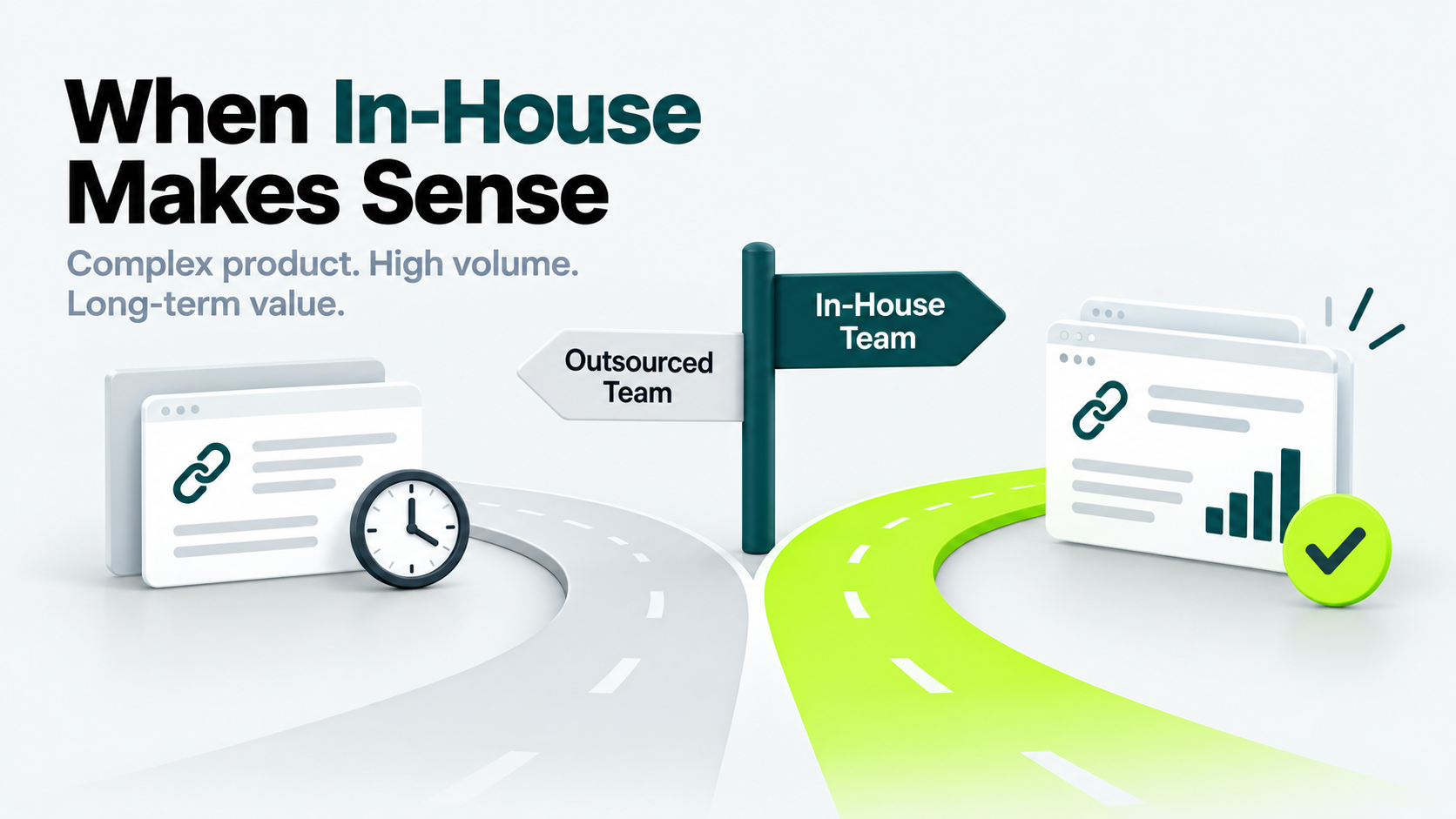
An in-house team makes the most sense for a complex product. An outsider would need months to understand it properly.
It also makes sense when you need 30 or more placements every month and have enough consistent work to keep the team busy.
When both conditions apply, building an in-house team can be more cost-effective than outsourcing. But if your link volume is lower or your product is easy to understand, the economics can favor an external team.
Your Volume is 40 Links a Month or More
An in-house team becomes more cost-effective than paying per placement once you consistently need 40 or more placements every month.
At that volume, more placements spread the team’s fixed salary and software costs, reducing cost per link.
The more consistently the team stays at that volume, the more those fixed costs work in your favor.
Your Product is Genuinely Technical
An in-house link builder has a real advantage when your product requires deep technical knowledge to explain its value.
An employee who sits in product meetings and knows how customers use the software writes more relevant pitches. An outsider starting from a product brief can’t match that.
That product knowledge can make a meaningful difference when you’re pitching publishers in a specialized industry.
The Links Need to Point at the Right Pages
An internal team already knows which pages drive revenue, generate leads, or support key products.
That makes it easier to decide where each backlink should point and which pages deserve more authority.
That context can be difficult to explain to an external team, especially when the right target changes with your business priorities.
You Want to Keep the Relationships for Years
Publisher relationships become more valuable the longer you maintain them.
If the same employee manages those relationships for years, the knowledge and trust they build can stay within your company.
That can make an in-house team especially valuable when long-term relationships with publishers are a core part of your link building strategy.
Your Niche is Small and Closed
Some industries have only a few dozen relevant publishers.
When the market is that small, an in-house specialist can learn the key publications, editors, and outreach history over time.
They can build a clear understanding of who is worth pitching, who has already said no, and which relationships are worth maintaining.
You Already Own the Tools and the Content
If you’re already paying for tools for link building and publishing content regularly, you’ve already covered two major parts of the process.
Adding outreach to your existing setup may cost less than building an entire link building operation from scratch.
In that case, you’re mainly adding the people and time needed to turn your existing content and tools into backlinks.
Where Hiring a Link Building Company Wins
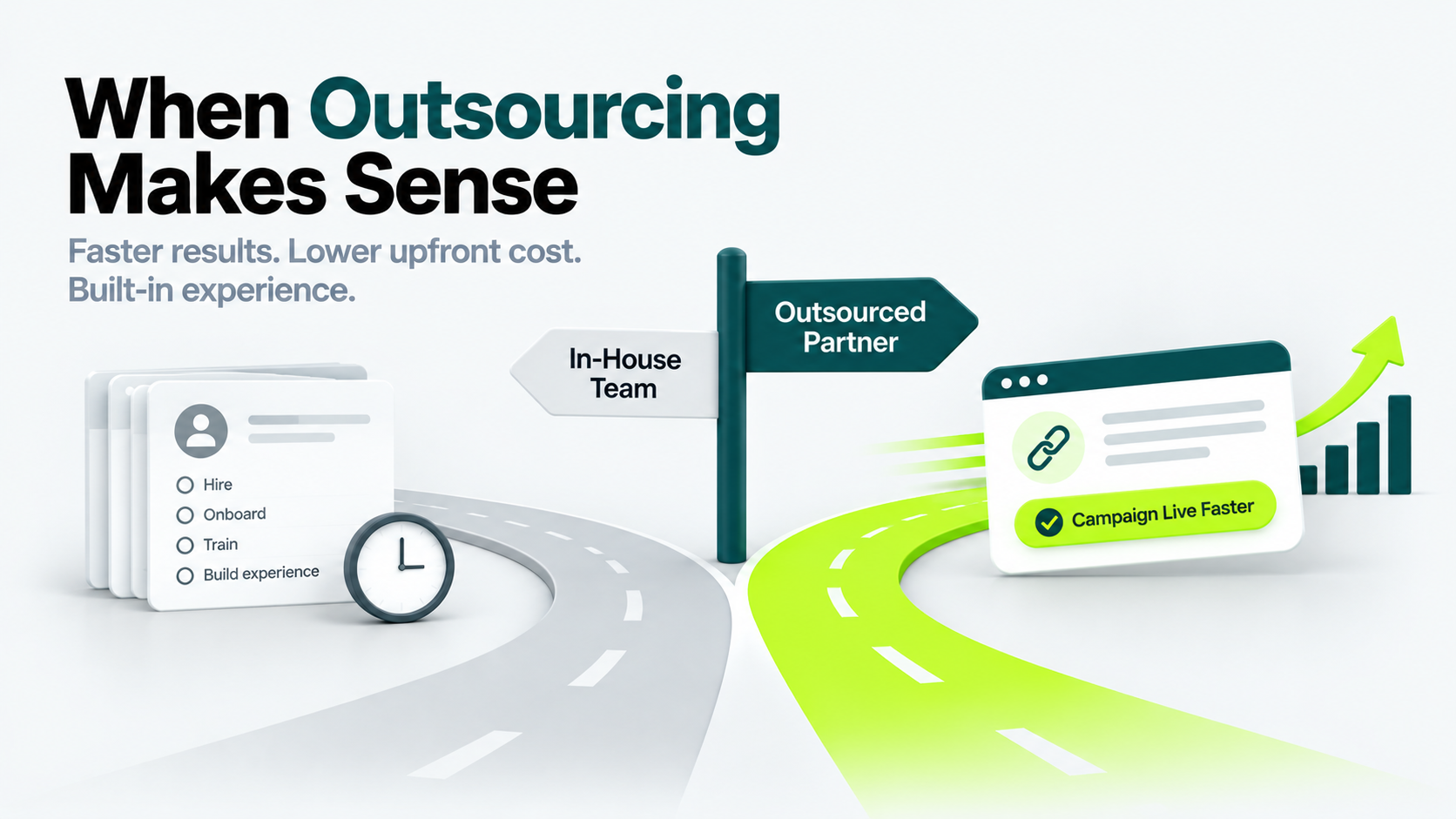
A link building company wins on speed, lower upfront cost, or experience when you don’t already have an outreach team.
If you need backlinks before you can hire, onboard, and train an employee, working with an external team gets the campaign moving sooner.
And if nobody on your team has experience with link building outreach, you avoid having to build that expertise from scratch.
These are the situations where outsourcing has a clear advantage.
You Need Fewer Than 40 Links a Month
Outsourcing beats maintaining a full-time in-house team when you need fewer than 30 placements a month.
At just 10 placements a month, the difference can be significant because you’re paying an internal team even when there isn’t enough work to keep them fully occupied.
With an external provider, you pay only for the placements you need, rather than bearing the full cost of a team.
You Need Results This Quarter
An external team starts outreach much sooner, which matters when you need backlinks this quarter.
An external team can begin pitching in the first week, while an in-house hire may not start outreach until month three after hiring, onboarding, and ramp-up are complete.
When timing matters, outsourcing eliminates hiring and training delays.
Nobody In-House Has Done Outreach
A learning curve sets in when no one on your team has done link building outreach before.
Your team has to learn how to find the right publishers, write pitches that get replies, follow up, and turn conversations into placements.
That learning happens while they’re working through your own prospect list, which can slow down your results.
Hiring an experienced external team lets you skip that initial learning period.
Your Volume Moves Around
An external team gives you more flexibility as your link building needs change from month to month.
You can reduce or increase the number of placements you need as your priorities change.
With an in-house team, salaries and other fixed costs remain the same even during slower months.
Scaling a retainer down is a conversation. Scaling a salary down is a layoff.
You’re Testing Whether Links Work at All
Testing link building through an external provider is a lower-commitment option than hiring a full-time employee, especially when you’re not sure it will move your rankings.
You can run a three-month campaign, measure what happens, and decide what to do next.
If the results aren’t there, you can stop ordering placements without carrying the ongoing cost of an in-house team.
Where Outsourcing Carries Risk
The biggest risk with outsourcing is the quality of placement.
Quality varies widely between providers. A poor provider may deliver links from websites with little or no real readership, even though the placements look good on paper.
Guest posting is one area where that difference becomes especially important. Low-quality providers can use weak sites and thin content to secure placements, while stronger campaigns focus on relevant websites and genuine editorial standards.
Before you sign a contract, agree on what qualifies as a good placement.
Our guide on judging whether a placement worked covers the checks you can make part of the agreement.
Running Both at Once
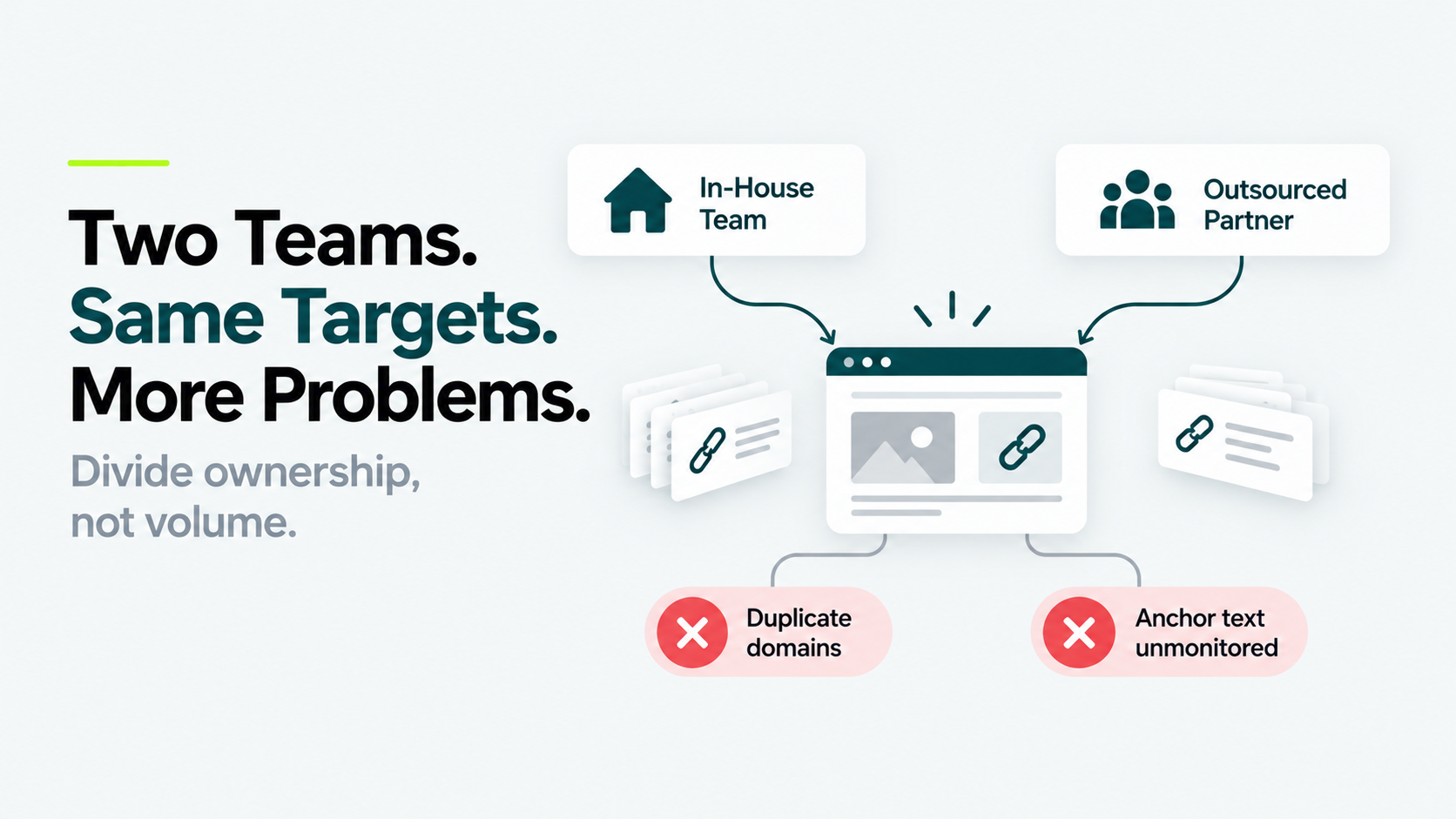
Yes, you can use a link building company alongside an in-house team, and the split that works divides ownership rather than volume. The failure mode is putting two suppliers on the same job.
When both sides are prospecting, you get duplicate domains and competing pitches to the same editor.
Nobody is watching the anchor text, meaning the clickable words that carry each link.
Splitting Ownership Without Duplicating Work
| INTERNAL SIDE OWNS |
EXTERNAL SIDE OWNS |
|---|---|
| Which pages need authority, and in what order | Finding and qualifying publishers |
| Anchor text strategy across the whole profile | Pitching and follow-up |
| Product accuracy in every pitch | Writing to each publisher’s guidelines |
| Approving or rejecting each site | Getting the piece published |
| Measuring what moved | Reporting what went live |
Your internal person becomes the strategist. The external team becomes the capacity.
That works because the two hardest things to outsource stay inside:
- Knowing your product.
- Knowing your money pages.
It also scales in one direction without a hiring cycle. Busy quarter, buy more, and if it’s a quiet quarter, buy less.
Agencies doing this for clients have a third option. White-label link building keeps the reporting unbranded, so the arrangement stays invisible to your client.
A Straight Answer for Five Common Situations
Most decisions fit one of five shapes, and the answer follows from the volume and the timeline.
| IF THIS IS YOUR SITUATION |
THE ANSWER IS |
|---|---|
| You need 5 to 10 links a month, and nobody is doing outreach today | Hire a company |
| You need 40 or more links every month, for the next two years | Build in-house |
| You need links live this quarter to support a launch | Hire a company |
| Your product is technical, and every pitch needs someone who understands it | Build in-house |
| You have an SEO lead who knows the strategy but no capacity to run outreach | Run both |
Two of those five say build, and one says run both. If your situation isn’t on this list, work out your monthly volume first, then your deadline.
Those two answers resolve most of the rest.
Start With the Number You Already Have
Work out how many links you need next month. If it’s under 30, the arithmetic has already answered you, and the only question left is who to buy from.
If it’s over 40 and it stays there, start writing the job description. Send us your target pages and your three closest competitors.
You’ll receive a publisher list vetted for authority, traffic, and niche fit on every entry. Then you can price both options with real numbers.
Need More Link Building Capacity Without Building a Team?
Get experienced outreach support without the overhead of building an in-house team.
Is it worth outsourcing if I already have an SEO person?
Usually yes, because the SEO person you have is rarely the outreach person you need.
Technical audits, content planning, and internal linking are different work from pitching strangers for a living. Whatever’s more urgent that week squeezes out outreach.
The link building never quite starts.
What should I ask a link building company before signing?
Ask to see the sites before you pay, ask what happens if the publisher removes a link, and ask who writes the content.
A provider who won’t show you domains in advance is asking you to buy blind.
The replacement policy matters more than people expect, because links do come down.
Can I start with a company and move in-house later?
Yes, and it’s a sensible order. Running an external campaign for six months teaches you what your volume actually needs to be.
That’s the number the whole in-house decision rests on.
You also learn which publishers work for your niche before you pay someone a salary to find them.
Do in-house teams build better links?
Not automatically, and the difference usually comes down to relevance rather than effort. An internal person understands the product better, so their pitches are more accurate.
An external team has more publisher relationships, so more pitches land at all. Quality follows whoever has both, which is why the hybrid split exists.
What does a link building company do that I can’t do myself?
Reach editors who don’t respond to cold emails. You can replicate the process, the software, and the writing.
What takes years to replicate is a list of people who open your messages because they recognize the sender.That’s the asset an established link building agency rents out, and a first-week hire genuinely doesn’t have it.
How do I know if the links I’m paying for are working?
Track referring domains, meaning separate websites that link to yours.
Watch the rankings of the pages you pointed links at, not just overall traffic.
Evaluate each link based on its relevance, authority, and impact on the pages it supports.
Traffic also moves for reasons that have nothing to do with links.
If you’ve never checked your existing profile, a link audit tells you what you’re building on.