VPN and cybersecurity link building is the process of earning backlinks for VPN providers, cybersecurity brands, and security-focused websites in an industry where trust, expertise, and authority matter more than most.
Earning backlinks in VPN and cybersecurity is harder than in any other niche.
Google treats every link signal here under YMYL rules, which means it scrutinizes the source, author, and page more heavily.
That changes which tactics work, which links hurt you, and how long results take to show up.
Key Takeaways
- Every backlink here is evaluated at a higher E-E-A-T threshold due to YMYL.
- VPN affiliates earn links through testing; cybersecurity brands earn them through threat research.
- Five link types drive rankings: editorial mentions, broken-link replacements, resource page inclusions, unlinked-mention reclamation, and expert source citations.
- PBNs, fake-review farms, and paid guest posts carry a higher manual action risk in YMYL.
- Expect 3 to 4 months for the first keyword gains and 6 months before evaluating ROI.
Why Link Building Works Differently in VPN and Cybersecurity
Link building works differently in VPN and cybersecurity because Google holds this entire niche to a higher trust bar than the rest of the web.

The trust bar shows up in three ways:
1. YMYL Requires Stronger Trust Signals
Most of this content falls within what Google calls YMYL, short for “Your Money or Your Life.”
That’s Google’s label for topics where inaccurate or untrustworthy content can directly harm someone’s safety, finances, or well-being.
2. Fewer Publishers Are Willing to Write About Security
Most blogs don’t cover ransomware or VPNs. A smaller pool of credible outlets carries the editorial weight, making placements harder to earn and worth more when you get them.
3. Penalty Risk for Sloppy Link Building Is Sharper
Google penalizes thin content everywhere, but the risk compounds on YMYL topics.
A few things Google flags are no original testing or methodology, no author credentials or transparency, and no added value over competing affiliate pages.
Google’s spam policy confirms affiliate sites aren’t penalized by topic. The risk is thin content, and that risk compounds in YMYL niches.
The combined effect is that the same backlink tactic can be safe in one niche and a manual action waiting to happen in this one. The rest of the playbook unpacks the specific rules that change.
What is a Manual Action?
A penalty issued by a human reviewer (not an algorithm) when a site violates Google’s spam policies. Google demotes or removes affected pages from search results until you fix the issue.
Two Audiences, Two Playbooks: VPN Affiliate Sites vs Cybersecurity Software Brands
The same link building approach doesn’t work for both VPN and cybersecurity audiences because they live in different parts of Google’s quality systems.
Both niches fall under YMYL, but it’s a higher-quality bar. Google applies scrutiny to different areas for each site type.
VPN Affiliate Review Site
A VPN affiliate review site exists to recommend products and earn commissions when readers buy.
| How Google evaluates it | Commercial editorial content |
|---|---|
| Google focuses on | Reviewer credibility. Does the author have real testing experience, or is the recommendation just commission-driven? |
| The trust problem | Thin or copied reviews fail Google’s quality threshold before backlinks ever matter. More links don’t move you past a content quality problem. |
| These factors move rankings | Original, experience-backed reviews that prove the site adds value beyond the merchant page. |
Cybersecurity Software Brand
A cybersecurity software brand exists to sell a product.
| How Google reads it |
Vendor site |
|---|---|
| Google focuses on |
Brand authority. Is this a recognized, legitimate player in the space? |
| The trust problem |
Generic vendor mentions don’t signal authority. Google wants third-party proof that the industry takes you seriously. |
| These factors move rankings |
Backlinks from publications covering your research, threat findings, or product news, and earned editorial coverage. |
Because most cybersecurity is sold company-to-company, the broader B2B link building patterns apply to the software side of this niche.
Here’s how that plays out in practice:
| AUDIENCE |
PRIMARY LINK GOAL |
WHAT EARNS COVERAGE |
WHAT KILLS THE CAMPAIGN |
|---|---|---|---|
| VPN affiliate review site |
Authority from independent test sites, comparison hubs, and tech editorial | Original speed, leak, and streaming tests with screenshots and methodology | Roundup pages with no testing, copied product descriptions, fake “expert” bylines |
| Cybersecurity software brand |
Authority from security press, analyst coverage, and integration partners | Original threat research, breach data, and named expert commentary | Generic vendor pitches, paid “DR 70+” guest posts on cybersecurity-themed blogs |
The pattern we see again and again is that the same outreach template lands at one type and bounces off the other.
Affiliate editors open your pitch asking one thing: Is this product worth recommending?
Security editors ask a different question: Does this company have something worth citing?
Send the same template to both and one replies. The other goes silent. No rejection, no pass, just nothing.
That silence is the tell. You answered the wrong question for the wrong audience.
Quick Overview
- If you run an affiliate site, do the testing first, then pitch the results. That’s the same logic as any ecommerce link building playbook.
- If you run a security software brand, publish the research first. Journalists and analysts cite you when you give them something worth citing.
How Google’s Higher Trust Bar Affects Your Backlinks
Google’s YMYL rules raise the trust bar for cybersecurity content, meaning the source of each backlink is judged more strictly than in other niches.
YMYL is Google’s name for content that can affect someone’s safety, finances, or health if it’s wrong. Cybersecurity is a YMYL category, and bad advice can lead someone to install spyware or hand over a password.
Google’s helpful-content guidance says it plainly. For YMYL topics, Google gives more weight to content that aligns with strong E-E-A-T.
E-E-A-T
E-E-A-T stands for Experience, Expertise, Authoritativeness, and Trustworthiness. It’s the framework Google’s quality raters use to assess whether a page deserves to rank.
Trust is the signal Google weighs most. The three layers below feed into it.
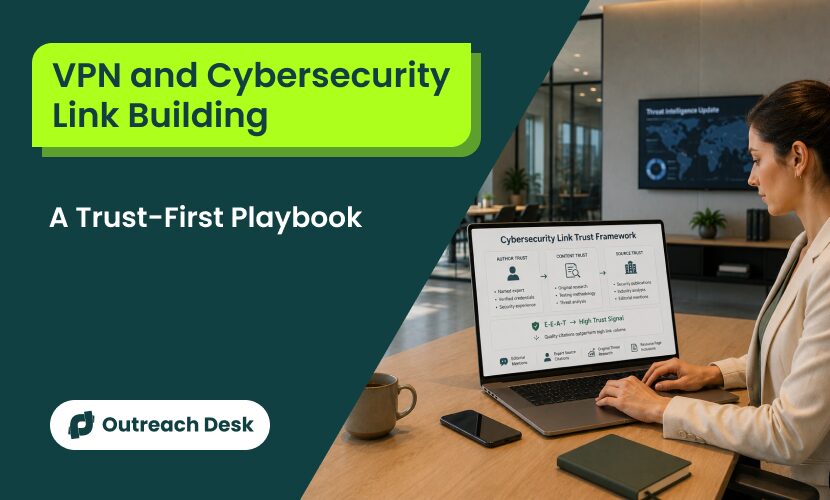
The Three Trust Layers Google Reads on Every Backlink
In YMYL, Google checks three things before deciding how much a backlink is worth. Score low on any one, and the link weakens, even if the site looks strong on paper.
| LAYER | QUESTION GOOGLE ASKS | FAILS | PASSES |
|---|---|---|---|
| Author Trust | Who actually wrote the page linking to you? | No byline, no bio, no credentials | Named expert with visible industry background |
| Content Trust | Is the linking page doing real editorial work? | 400-word generic listicle wrapped around a link | 2,000-word breach analysis that earns its place in the conversation |
| Link Source Trust | Does the linking site actually belong in this space? | Generic listicles churn across every niche | Consistent, topically focused coverage in one space |
The reality in YMYL isthat a weak page in fitness still passes some authority, but in cybersecurity, the same page passes almost nothing.
The same bar applies to financial link building and every other YMYL vertical.
Why Thin Affiliation Hurts You From Both Sides
Google’s spam policies on affiliate sites define “thin affiliation” as content that distributes affiliate links without adding real value. Good affiliate sites, Google says, add value through original reviews and meaningful content.
For link building, that has two effects:
| SIDE | THE PROBLEM | THE IMPACT |
|---|---|---|
| You receive a link from a thin affiliate | Google discounts the destination before passing authority | The link looks strong on paper but delivers less than it should |
| Your site links out to a thin affiliate | The affiliate’s quality problem splashes back onto you | Security publications avoid citing sites with thin outbound links. Reputation in this niche is cumulative |
The rule:
One link from a real security publication beats ten from generic tech blogs that happen to mention VPN once. That’s what makes a backlink high quality in this vertical.
The Link Types That Move VPN and Cybersecurity Rankings
Five link types do most of the work for VPN and cybersecurity websites: editorial mentions, broken-link replacements, resource page inclusions, unlinked-mention reclamation, and expert source citations.

Each one plays a role. None of them work alone. You need a mix to build lasting authority.
Editorial Mentions in Security Publications
Editorial mentions happen when a journalist or editor links to your page inside an article because it’s the right reference.
In 2025, Cyble earned editorial coverage in Infosecurity Magazine, which published their ICS vulnerability research: “Multiple ICS devices affected by vulnerabilities with severity up to 9.9 CVSS.”

What is Cyble?
Cyble is an AI-native global cybersecurity and threat intelligence company that helps enterprises, governments, and law enforcement agencies detect, protect against, and respond to cyber threats.
Journalists or editors wrote it independently, focusing on research data rather than product marketing.
Editorial mentions like this build E-E-A-T authority because journalists cite assets they find credible, which is why they outperform dozens of generic citations.
They’re the highest-trust links you can earn, since they pass all three trust signals at once: a named byline, a real article, and an on-topic publication.
Journalists or editors can place a new link in a fresh article using the contextual link building method.
Editors can also add a link to an already published article, which the industry calls a niche edit. Our guide on links added to existing pages walks through the full workflow.
The catch is you won’t get editorial mentions through cold outreach. You earn them by publishing something a journalist actually wants to cite, which is exactly what the linkable assets section below walks you through.
Broken Link Replacements on Niche Resource Pages
You earn a link on niche resource pages by finding a dead link on a relevant page and offering your page as the fix.
Keep your pitch short:
“I noticed your guide on home network security links to a tool that’s offline. I built something similar that covers the same use case, worth a look?“
This tactic works especially well in cybersecurity, since plenty of older resource pages have outlived the sites they once linked to. Our broken-link tactic walkthrough breaks down the full process step by step.
Resource Page Inclusions on Industry Hubs
You earn a link by getting your page added to a curated list of security tools, guides, or references on someone else’s site.
These hubs vet what they add, so landing one inclusion can outweigh dozens of generic directory links.
If you want to build a repeatable process for finding and earning these placements, check out our guide to earning links from resource pages .
Search “best [topic] resources” with a recent year filter to find pages that are still active. Select the custom range option under tools.

Set the custom date range from January 1 of the current year to today. You’ll see a result similar to the one in the image below.

Skip stale resource pages with outdated contact details; they’re not worth your time.
Unlinked-Mention Reclamation
Unlinked-mention reclamation is one of the highest-ROI tactics in cybersecurity because security writers regularly cite vendors and tools in news coverage without linking back.
An unlinked brand mention occurs when a publication adds your brand or product name without linking to your site. You reclaim it by reaching out to the editor and asking them to turn the plain text into a link.

Set up a weekly routine for monitoring mentions of your brand, and you’ll find a steady stream of these opportunities.
Expert Source Citations via Quote Requests
You earn expert source citations by answering a journalist’s request for a quote.
You become the named source for a stat, an opinion, or context, and the publication links back to credit you.

This works especially well if your cybersecurity brand has a named security leader or in-house researcher who can comment on breaking incidents.
For example, a journalist covering a new ransomware strain posts a request on a platform like Qwoted, asking for expert comment on attack vectors.
Your CISO replies within the hour with a two-sentence quote, their name, title, and a link to your site.
The journalist runs the quote, and the published piece credits you as the source.
Linkable Assets That Earn Links Without Asking
Linkable assets that earn you coverage in security and VPN niches are original threat research, vulnerability roundups, breach trackers, comparison matrices, and free utilities.
Each one gives journalists a reason to cite you without you having to pitch them.
This is the asset-first rule of cybersecurity link building. You publish the asset first, then launch outreach. Generic vendor stories don’t pick up coverage. Original data does.
Original Threat Research
You build an original threat report from data your team actually collected. Ask yourself:
- How many phishing campaigns did you block last quarter?
- What new ransomware variant did you spot?
- What credentials are circulating in the leaked data feeds you monitor?
The number needs to be original.
The image shows 2026 Data Breach Investigations Report by Verizon Business.

In our campaigns, the asset we aim for is a short write-up on a phishing trend a client is seeing. We break it down enough that a security journalist covering that trend would want to cite it.
Vulnerability Roundups
You create a vulnerability roundup by curating recently disclosed security flaws (the ones logged in the public vulnerability catalog) and explaining them in plain language for your audience.
The format works because journalists and security leads use it as a fast reference and link to it as a citation.
The image shows Cisco Talos’s 2026 vulnerability roundup report.

You add genuine value with severity ratings, real-world exploitation context, and remediation steps. A copy-paste of the public vulnerability database won’t earn you links.
Breach Trackers
You build a breach tracker as a continuously updated page listing publicly disclosed breaches by niche, vertical, or geography.
The image shows the 2026 data breaches page that is regularly updated by Privacy Rights Clearinghouse.

Maintaining it earns you repeat citations because journalists covering new incidents need a place to direct readers for historical context.
A breach tracker takes a long-term commitment. If you let the page go stale, your link equity fades with it.
Comparison Matrices
You build a comparison matrix as a side-by-side table that compares tools, frameworks, or protocols on the dimensions buyers care about.
If you run a VPN affiliate site, you compare providers on speed, leak protection, jurisdiction, and price.
The image shows a 2026 comparison matrix by Techradar on the best VPN service.

If you run a cybersecurity software brand, you compare categories such as endpoint protection tools, managed detection and response services, and security monitoring platforms.
You make the matrix linkable through methodology. Show how you scored each cell. Show your testing setup. Show your dates.
When you explain your scoring, you earn far more citations than a page that just lists features.
Free Utilities
You build a free utility as a small interactive tool:
- Password strength checker
- Phishing URL analyzer
- Breach lookup
The image shows a free data breach lookup tool by DataBreach.com.

Utilities earn you links because they’re useful in the moment, so writers reach for them when explaining a concept.
The build cost is real, but a well-built utility present on your site for years can quietly compound your link equity.
These five categories share one trait. They all give a third party a reason to cite you without you needing to ask.
That’s why an asset-led link-earning approach is the foundation of a cybersecurity link building strategy, especially if you’re a software brand.
If you run an affiliate site, you earn coverage by running the tests. If you run a software brand, you earn coverage by publishing the research. Either way, you build the asset first.
Pitch in Publication Tiers, Podcasts, and Source Platforms
The places worth pitching fall into three tiers, plus a separate lane for source platforms where journalists come to find you.

Each tier sets its own acceptance bar.
Top Security Press
Top security publications publish news, analysis, and original reporting on cybersecurity all day. These are the names that signal trust to Google and enterprise buyers in equal measure.
Cold pitches to this tier almost never land. What lands is the original work that the publication’s editor already wanted to cover. Do the research first, then send a one-paragraph note: “We just published [thing]. Happy to share the data on request.”
In our experience, top-tier security publications produce the lowest reply rates of any outreach tier.
Editors receive a constant stream of vendor pitches. They rarely engage unless the outreach includes exclusive data, original research, or findings that support a story they’re already working on.
Mid-Tier Security Blogs and Newsletters
Mid-tier outlets include independent security blogs, vertical newsletters, and the security sections of broader tech publications.
The acceptance bar is lower, but Google still reads the trust bar as high because named practitioners with real backgrounds write for these outlets.
Pitches work better here, especially when you offer a practitioner-written guest post with first-hand experience.
A security operations analyst writing about what they actually saw last quarter beats a vendor pitching a generic explainer every time.
Our outreach guide covers the mechanics of pitching independent publishers like these.
Vertical Publications and Trade Press
Vertical publications cover security inside a specific industry.
Examples: healthcare IT security, financial services security, government and defense security, and manufacturing OT security.
They earn fewer total backlinks, but they carry a strong relevance signal because the cited site matches the readership’s topic.
If your buyer is a healthcare security leader, a single placement in a healthcare security publication usually outperforms a generic security placement across every commercial metric.
Our broader strategy for earning healthcare backlinks follows the same logic.
HARO, Qwoted, and Equivalent Source Platforms
Source platforms are services where journalists post quote requests, and experts respond. They flip the link building dynamic. Instead of you pitching publications, publications ask for you.
In security, the win rate for earning links via source platforms is high if you field a named expert who can answer quickly. Journalists work on deadlines. The first credible response often wins the placement.
Anchor Text Discipline in High-Trust Niches
In YMYL niches, anchor text discipline matters more than in any other vertical because Google’s over-optimization filter compounds with the higher trust bar.
What is Anchor Text?
Anchor text is the clickable words inside a link. You can think of it as a small sign on a door describing what’s inside.
In the fitness niche, a backlink with the exact-match anchor “best running shoes” is noisy but absorbed.
In cybersecurity, an exact-match anchor like “best VPN service” immediately hits an already-watchful trust filter. Stack enough of those signals, and Google pushes the site into a manual review.
The 5-Part Anchor Discipline That Works

1. Keep Exact-Match Anchors Rare
If your money phrase is “best VPN for streaming,” only a small fraction of incoming anchors should match verbatim. The rest should read the way real publications actually write.
2. Lean on Branded Anchors
Branded means your company or product name. Google reads these as natural. That is how the rest of the web talks about real brands.
3. Use Partial-Match Anchors as the Workhorse
Partial means the anchor carries part of the topic without copying the target keyword verbatim.
- “How to pick a VPN” = partial (looks editorial)
- “Best VPN service” = exact (looks manufactured)
4. Mix in Descriptive Anchors
Descriptive anchors describe what the linked page covers without using its keyword. “Their guide on streaming setup” is a descriptive anchor. It reads like something a real editor would write.
5. Watch Your Link Velocity
Link velocity is the rate at which new backlinks hit your site. Sudden spikes of similar anchors trigger the over-optimization filter. In this niche, slow, varied, and named-source wins every time.
The bottom line is that the anchor profile shapes the long-term ranking ceiling more than most founders realize.
A site with great content and a sloppy anchor profile can sit just outside the top results for years and never understand why.
Tactics to Avoid (the Fastest Paths to a Manual Action)
The fastest way to a manual action in this vertical is to chase shortcuts that work elsewhere.

These five tactics cause significantly more damage in cybersecurity and VPN than in lighter niches.
1. Private Blog Networks
A set of websites that one party secretly owns and uses to fire links at a target site.
In a YMYL niche the trust filter compounds. A small network that quietly underperforms in a generic niche tends to get the entire target site filtered in cybersecurity.
Buying or building one directly violates Google’s spam guidelines. The fuller picture is in our tactics that violate guidelines breakdown.
2. Fake-Review Farms
Sites that publish product reviews without ever testing the product. Usually, stock images and templated copy.
Google’s thin-affiliation guidance flags this pattern as low quality. Links from these sites contribute close to nothing. Landing in their profile actively drags your own profile down.
3. Thin-Affiliate Roundups Without Original Tests
A “top 10 VPNs” or “best cybersecurity tools” page where every entry reads like a paraphrased press release.
Without screenshots, methodology, and visible test data, the page cannot clear Google’s affiliate quality bar. It does not matter how many backlinks point at it.
Note
For your own site, thin-affiliate roundups without original tests are the single most common failure mode in the VPN affiliate space.
4. Paid “DR 70+” Guest Post Farms
Services selling guest posts on cybersecurity-themed blogs with high Domain Rating scores. DR is a 0 to 100 score from Ahrefs. These blogs publish anything for a fee.
The DR is real. The editorial trust is fake. The trust filter reads past the DR and into the actual content on the page.
Fastest route to a manual action in this niche.
5. “As Seen On” Badge Swaps Without Coverage
Adding “as seen on TechCrunch” or “as featured in Forbes” badges to your site without any actual feature coverage. Some vendors sell these as a packaged service.
Real publications notice. The trust damage is permanent.
The pattern across all five:
They borrow credibility instead of earning it. In a YMYL niche, Google reads borrowed credibility as a downgrade signal and acts on it.
How to Measure if Your Link Building Is Working
Measure these five signals: referring domain growth, traffic from named publications, ranking movement on commercial keywords, brand-search lift, and citations inside AI Overviews.

Referring Domain Growth
Referring domain growth tracks the number of separate sites with high-quality content linking to you.
Fifty new referring domains from real security publications outperform five hundred from the same generic tech blogs. Our explainer on how many backlinks to rank goes deeper.
Traffic From Named Publications
When a top security site links to you, you see direct referral traffic.
That traffic is a leading indicator of the search rankings that follow weeks later.
Ranking Movement on Commercial Keywords
Track the keywords that map to buying intent (the ones with “best,” “compare,” “review,” and “vs” modifiers), along with informational queries.
Brand-Search Lift
More people search your brand name over time. Growing brand search volume means the work is building real awareness.
Citations Inside AI Overviews
As Google’s AI Overviews quote sources directly, the source the overview pulls from is becoming a measurable goal in its own right.
Based on campaign data across YMYL industries, meaningful ranking movement typically begins 3 to 4 months after links are placed. In non-YMYL sectors, the first signs of impact often appear within 4 to 6 weeks.
For either category, we recommend evaluating performance over at least a 6-month period to allow enough time for rankings and organic visibility to develop.
The mechanism is Google’s slower trust-signal refresh in high-scrutiny categories.
Link acquisition campaigns that quit at month three almost always quit right before results begin to compound.
The teams that stay disciplined through the lag are the ones running a year later with the rankings to show for it.
Build the Trust Profile This Niche Rewards
The teams that win at VPN and cybersecurity link building over a year-plus horizon treat trust as the product, not the byproduct.
That means publishing the research before pitching the placement, putting a named expert in front of every piece, and walking away from “DR 70+” offers that look like shortcuts.
The approach takes longer to execute, but it continues to build authority long after the campaign ends.
Need help building trust-first links in the cybersecurity space?
Get a personalized outreach plan built for YMYL niches, with publisher relationships and editorial standards already in place.
How much does cybersecurity link building cost?
More than generic SEO link building. The trusted publisher pool is smaller, and each placement demands more research, expertise, and editorial back-and-forth.
Most quality campaigns run in the four to five-figure range per month, depending on volume and tier targeted. Our link building pricing breakdown walks through the full cost picture.
Can you buy backlinks for a cybersecurity site safely?
No. Not if “buy” means paying a network to drop links on your behalf. That model violates Google’s link-spam guidelines in any niche, and Google polices it faster in YMYL.
What you can pay for: research design, content production, journalist outreach, and PR. The line is whether the publication makes the placement decision editorially or financially.
Our take on buying backlinks and the risks covers the full picture.
How long does it take to see results from cybersecurity link building?
This is how the results show up:
- Month 2: First referral traffic from new placements
- Months 3 to 5: Ranking movement begins
- Month 6: Minimum runway before judging whether a campaign works
Google updates YMYL trust signals more slowly than non-YMYL ranking factors. Most teams need at least six months before drawing conclusions. An established link building agency with security press relationships already in place typically compresses the early months significantly.
Are nofollow links from security publications worth pursuing?
Yes. Major security publications now mark outbound links as nofollow or sponsored as a matter of editorial policy.
Those placements still drive referral traffic, brand-search lift, and AI Overview citations,even when they don’t pass dofollow authority
In a YMYL niche where trust is the central signal, the right publications citing you matter even when the link attribute passes no direct authority.
Do you need to be a named expert to earn placements in the security press?
Yes for top-tier publications.
The strongest editorial placements come through digital PR that cites named experts with real credentials, named research with reproducible data, or named companies with publicly disclosed customer wins.
If your team doesn’t have a named expert yet, the path is to designate one and start publishing under their byline before you launch pitch campaigns.