When you support a cause for the right reasons, a backlink can become a byproduct of the relationship rather than the reason for it.
Link building with charities works when you create real value and let recognition follow.
You might sponsor a local event, fund a community program, support a nonprofit campaign, or help during an emergency.
Build the relationship first. Let any link come from the value you provide.
What You’ll Learn
- How to find charity partners that fit your business and local market.
- How to check a nonprofit before you commit money or your brand name.
- Four partnership models that can create real recognition opportunities.
- When a charity link needs rel=”sponsored” or another qualifying attribute.
- How to measure traffic, referring domains, local visibility, and business outcomes.
Why Charities Make Good Link Partners
Charities often publish sponsor and partner information as part of their regular communications, while local news outlets may cover charity events when the event has genuine local interest or news value.
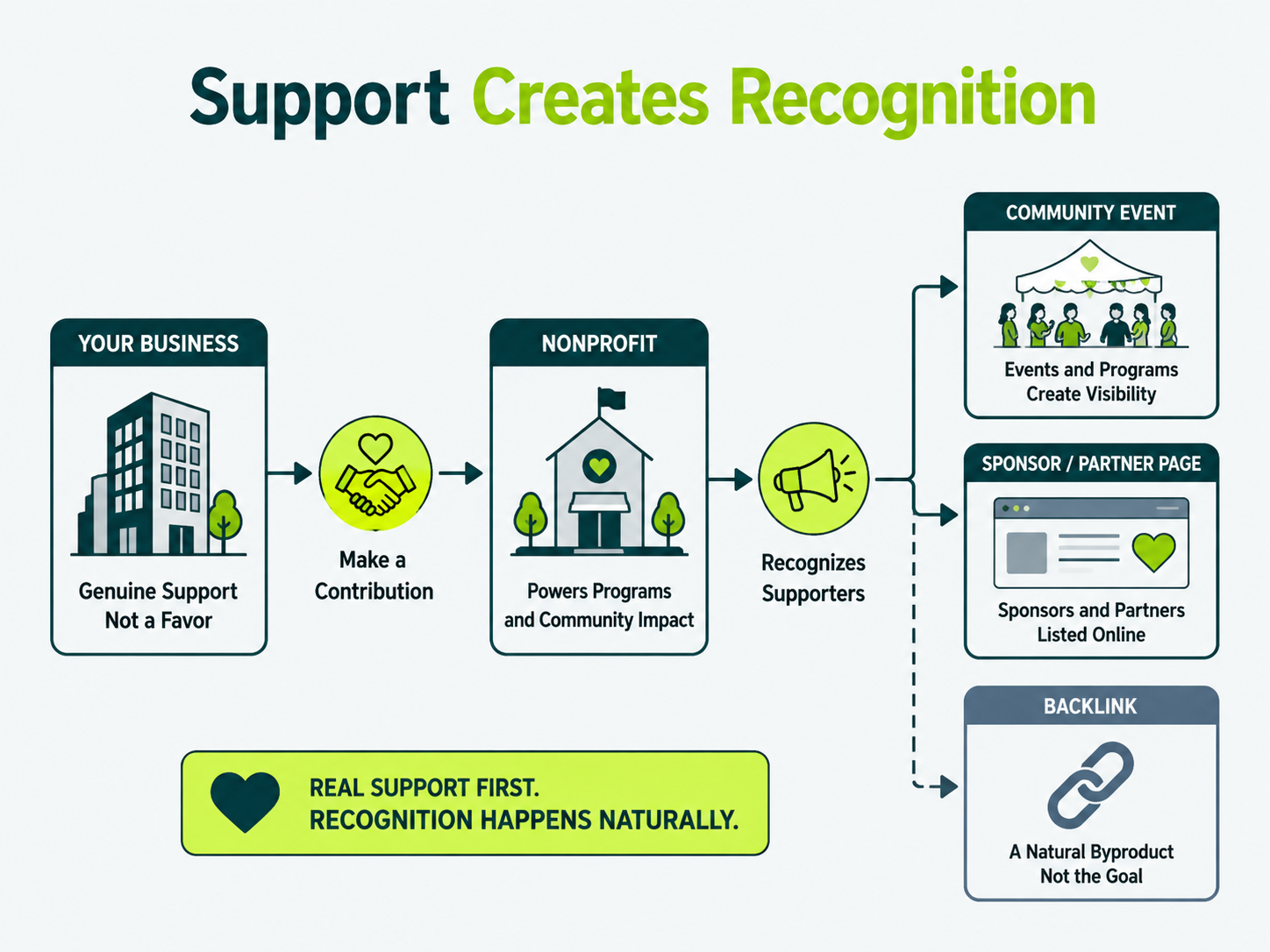
A backlink is one site vouching for another, similar to a friend recommending you for a job. Most sites are careful about who they vouch for.
Nonprofits are less careful with genuine supporters. A business that sponsors a food bank or funds a youth program has already proven it isn’t just there for a mention.
Corporate giving backs this up. U.S. corporate giving hit $44.4 billion in 2024, up 9.1% from the year before, according to Giving USA’s 2025 report.
That growth means more nonprofits are actively building relationships with businesses, so this door is open wider than it was a few years ago.
Charity partnerships are just one entry in a much broader playbook of link tactics worth knowing. But they’re one of the few where the other side wants to say yes.
Find a Charity Partner Worth Your Time
Start with charities whose mission already overlaps with what your business does or who your customers are.
A local landscaping company sponsoring a park cleanup is a natural fit because the event relates to its services and local community.
Sponsoring an unrelated national gala may still be worthwhile, but it doesn’t give people a clear reason to connect the sponsorship with the business.
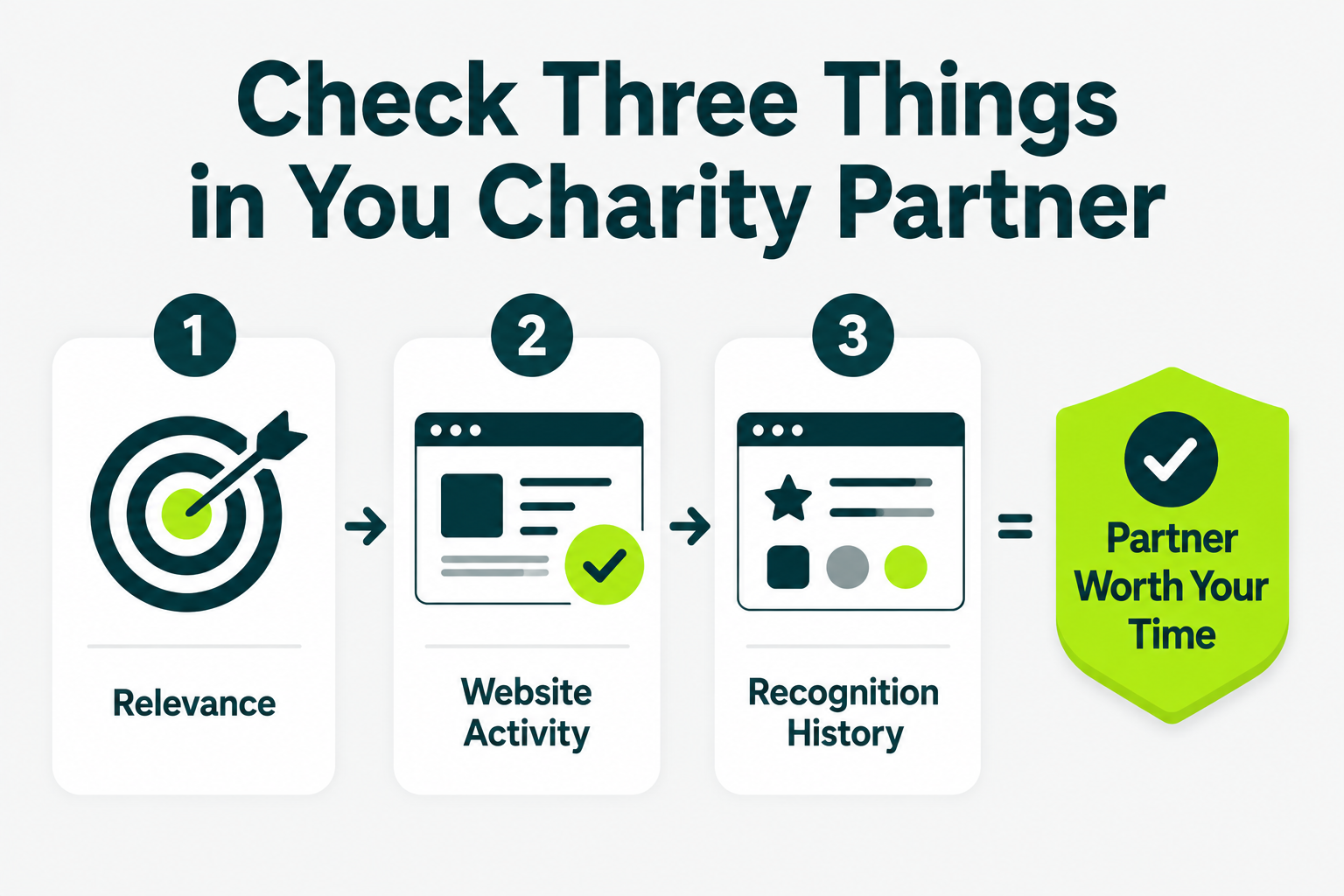
Do these three simple checks:
Relevance
Pick a nonprofit whose mission connects to your customers, your market, or your community. The connection doesn’t have to be perfect.
A local business can support a broader cause when the partnership still feels genuine to its customers.
A SaaS company in the Flatiron District could fund a nonprofit that provides free coding or tech training to students in the Bronx or Central Brooklyn.
Website Activity
Open the website and check whether the charity still publishes updates about its programs, events, sponsors, or partners.
An active site gives you more ways to receive legitimate recognition. It still doesn’t guarantee a link.
Recognition History
Before you spend a dollar, check atleast ten recent sponsors and partners.
Look at those supporters appear online. Are they linked, named, shown as logos, or not mentioned? That tells you more than assuming a sponsorship includes a link.
A legitimate nonprofit isn’t automatically a good partnership opportunity.
Before you sponsor, know how the organization treats its existing sponsors. Open recent event pages, sponsor directories, news posts, and partner listings.
If previous sponsors don’t get links, don’t count a link in your expected return.
The partnership can still be worthwhile. Just don’t count an unproven link as part of the return.
You can also build links locally to see how community relevance fits into a broader local strategy.
Vet the Charity Before You Commit
Vetting a charity protects your brand from being associated with an organization that lacks transparency or credibility.
A strong mission alone isn’t enough. Before you sponsor a nonprofit or attach your business name to its work, make sure the organization is legitimate, well-run, and a genuine fit for your partnership.
Vet the charity by reviewing its organizational basics, partnership fit, and public information rather than treating one database as a pass-or-fail test.
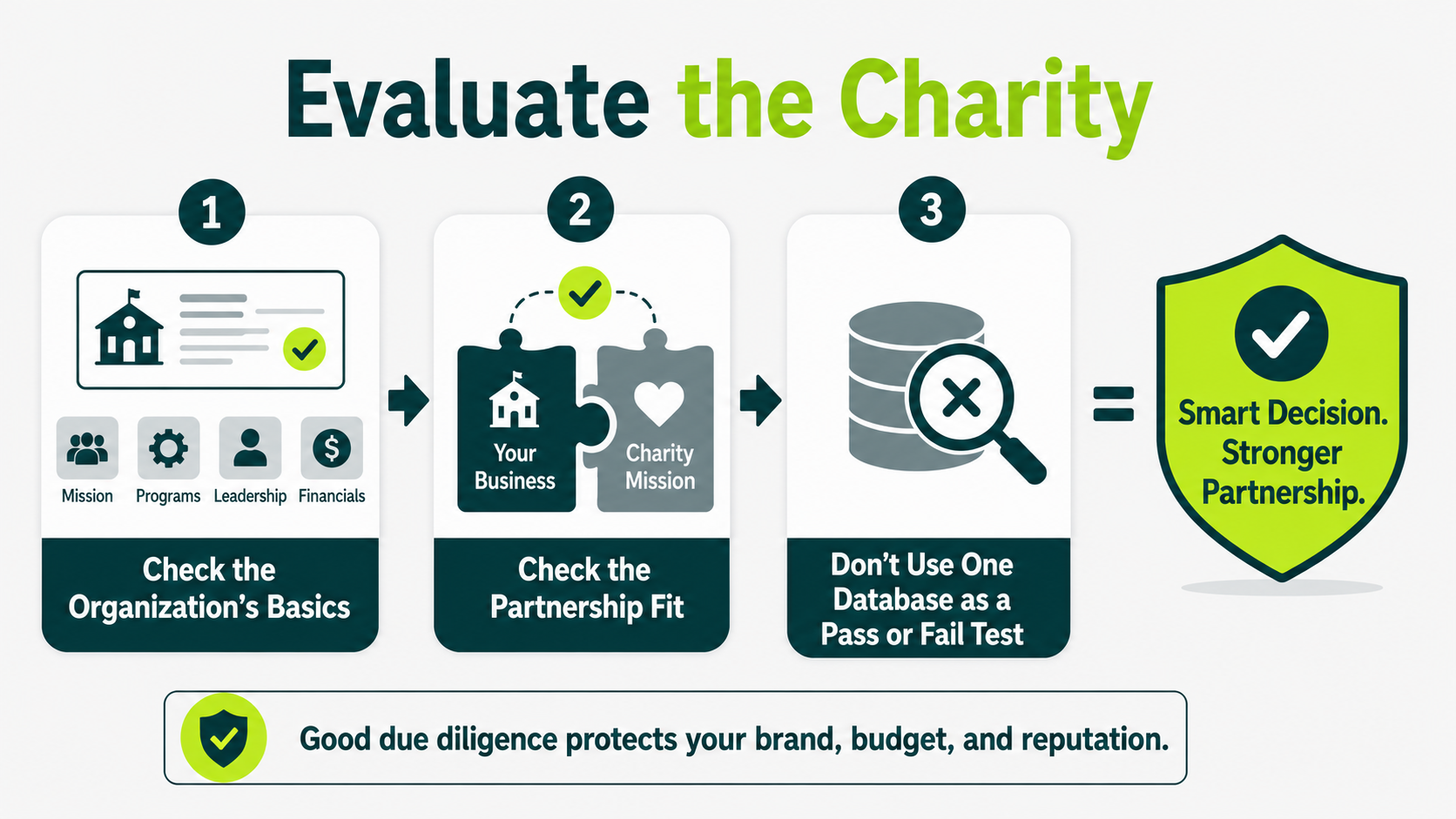
Candid’s 2026 nonprofit profiles provide information on an organization’s mission, programs, financials, and compliance details. Its search platform provides other nonprofit information.
Use the charity’s website first, then cross-check important details through independent sources. Look at its leadership, programs, financial information, and recent activity. If something is missing, outdated, or difficult to verify, investigate it before moving forward.
This isn’t about being cynical. It’s about protecting the brand you’re trying to build links for in the first place. A few minutes of due diligence can help you avoid attaching your business to a nonprofit that creates more reputational risk than partnership value.
Check the Organization’s Basics
Confirm the legal name, location, mission, and current contact information.
Review recent activity rather than relying on an outdated event page.
Look for current financial and organizational information when it is available.
Check the Partnership Fit
Ask what the sponsorship supports and how the organization normally recognizes businesses. That conversation tells you more than a generic sponsor package.
It also helps you separate a community partnership from a page that exists mainly to sell links.
Don’t Use One Database as a Pass or Fail Test
A missing profile on one nonprofit database isn’t proof that an organization is unsafe.
Check its mission, programs, leadership, financials, public filings, legal name, location, recent activity, and sponsorship practices.
Use these details together before putting your money or brand behind the organization.
How Link Building With Charities Creates Legitimate Opportunities
Link building with charities creates legitimate opportunities through four partnership models: local events or program sponsorship, co-branded cause campaigns, employee matching and volunteer programs, or disaster and crisis response.
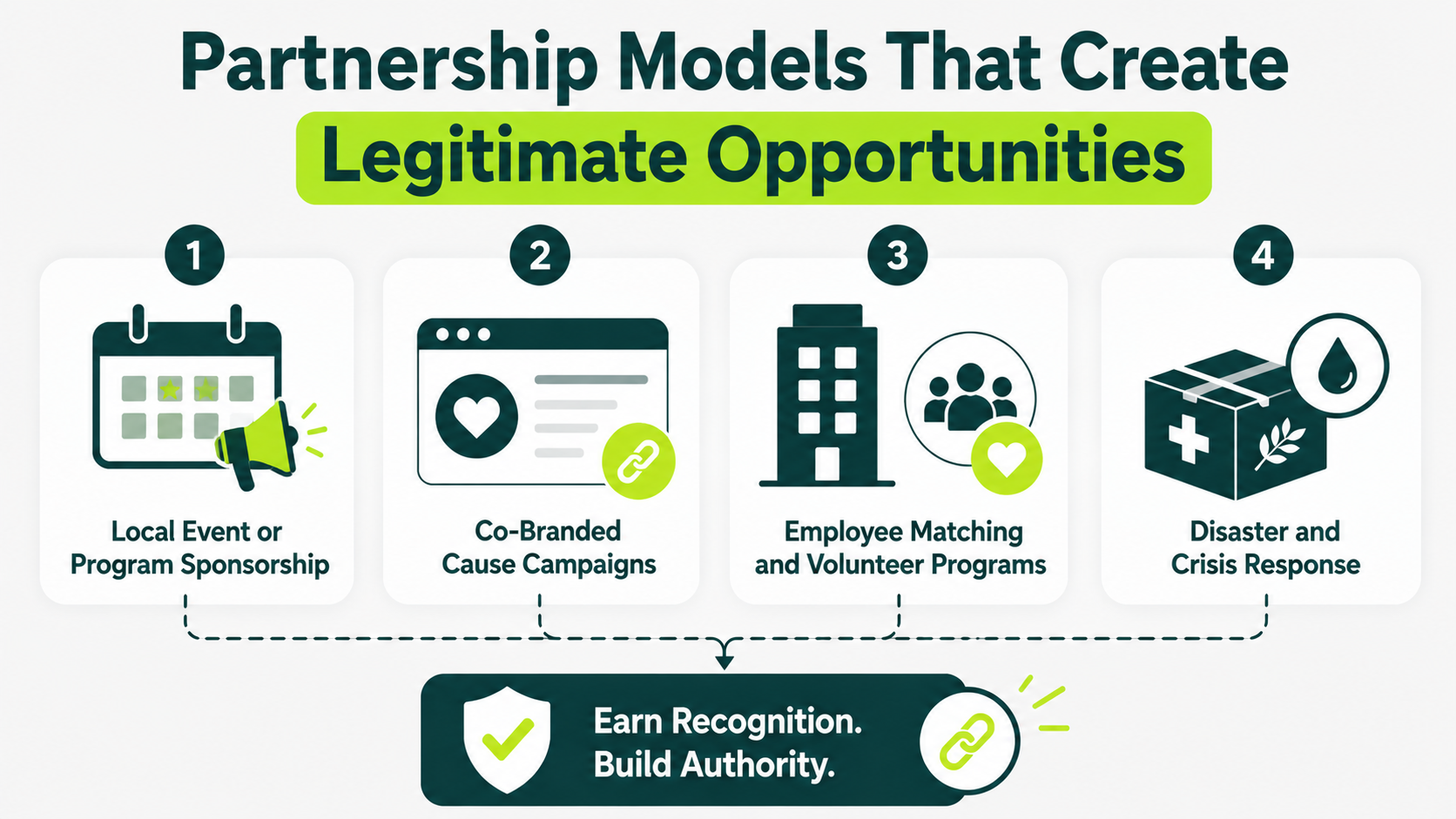
Local Event or Program Sponsorship
A local sponsorship gives the charity useful support and a reason to recognize your business.
The key is picking events where sponsor recognition actually leads to links. Learn which events actually publish links.
A 5K, food drive, youth program, community workshop, or local fundraiser can all create that opportunity.
Some organizations publish sponsor pages or event listings. Others mention businesses in recaps, newsletters, or local announcements.
Check how the organization normally publishes sponsor information before you expect a link.
For example, a home services company operating across Long Island City and Astoria could sponsor a community cleanup along the waterfront, a natural fit given its service area.
A healthcare supplier based in Midtown could support a nonprofit’s annual fundraising gala in Manhattan by providing equipment or in-kind funding, giving it visibility among other regional healthcare and wellness sponsors.
Co-Branded Cause Campaigns
A co-branded campaign connects a customer action to a charitable contribution.
You might donate a fixed amount for every sale during a campaign.
You might also match customer or employee donations up to a defined amount. Give the campaign a clear purpose that stands on its own.
The charity may promote it through its website or social channels when that fits its normal communications. Any link should come from that real promotion. Don’t make the link part of the deal.
Employee Matching and Volunteer Programs
Employee volunteering and donation matching give a nonprofit another reason to recognize your company.
Ask whether the organization recognizes corporate volunteers or matching-gift partners. Some nonprofits maintain supporter pages. Others include businesses in event reports or annual updates.
Any link is secondary to the relationship. That keeps the partnership useful even when no link appears.
Disaster and Crisis Response
A local emergency can offer a real opportunity to support organizations already engaged in response work.
You might provide supplies, funding, facilities, transportation, or volunteer time.
The nonprofit may later mention supporters in a recap or donor update.
Local media may also cover the response. Don’t turn a real emergency into a ranking campaign. Support comes first.
Ask for Recognition Without Making the Relationship Transactional
Start with what you actually contributed. Bring up the link after that. Tell the charity exactly what you’re sponsoring, donating, or providing. Then ask how it normally recognizes supporters online.
A short message is enough:
Subject: [Organization Name] Sponsorship Support
Hi [Name],
We’re supporting [specific event or program name] and would like to contribute [what you’re providing: financial sponsorship, equipment, in-kind support, or volunteer hours].
To support your materials and outreach, we can send our logo, company description, and website URL. Feel free to use these however works best for your team.
Quick question: Does your team maintain an online sponsor page or partner section on your website? If so, we’d be happy to have our information included if it’s a good fit.
Let me know if you need anything else.
Best,
[Your Name]
[Your Title]
[Company]
[Website]
That gives the organization an easy way to explain its normal process.
It also keeps the contribution from sounding like payment for a link.
Don’t start by dictating the anchor text, destination page, or exact placement. Let the charity decide how it describes your business in its own content.
A branded company name is usually a natural fit for a sponsor or partner page. Make accurate recognition easy, then let the charity choose the format. You don’t need to control every detail of the charity’s page.
Handle Sponsored Links Correctly
Paid sponsorships need rel=”sponsored” attribute because they involve a commercial arrangement, even when the money supports a nonprofit.
Unpaid editorial coverage doesn’t need this tag, while guest posts or other placements received in exchange for something should use rel=”sponsored” or rel=”nofollow”.
A rel=”sponsored” tag is a short piece of code that tells Google a link is paid. Google recommends it for paid placements and advertisements, with rel=”nofollow” accepted as an alternative.
Use the relationship to decide how the link should be qualified:
| IF THE LINK COMES FROM… |
THEN IT NEEDS… |
|---|---|
| A sponsorship, donation, or paid placement you arranged | rel=”sponsored” |
| Unprompted coverage from local news or the charity’s own recap of an event you weren’t paid to attend | Nothing. It’s a normal editorial link. |
| A guest post or article you contributed to the charity’s blog | rel=”sponsored” or rel=”nofollow”, since you gave something to get it |
A paid relationship should be disclosed accurately regardless of its charitable purpose. The link can still generate referral traffic and visibility.
Keep the Partnership Worthwhile Without the Link
A charity partnership should still make sense if the website never mentions you. That test keeps you from choosing a nonprofit just because its website might link back to you.
It also gives you a clear answer when a customer asks why you sponsored the organization.
This approach doesn’t assume charitable giving improves rankings or earns links. Keep the giving separate from any SEO expectations so your reporting is clearer and your brand remains credible.
When the partnership has a real community purpose, the recognition is easy to explain. If the only reason you’re sponsoring the organization is to get a link, walk away.
Track More Than the Link: Measure Traffic, Leads, and Conversions
Measure a charity partnership by tracking the link, traffic, visibility, and business response separately, not as one combined result.
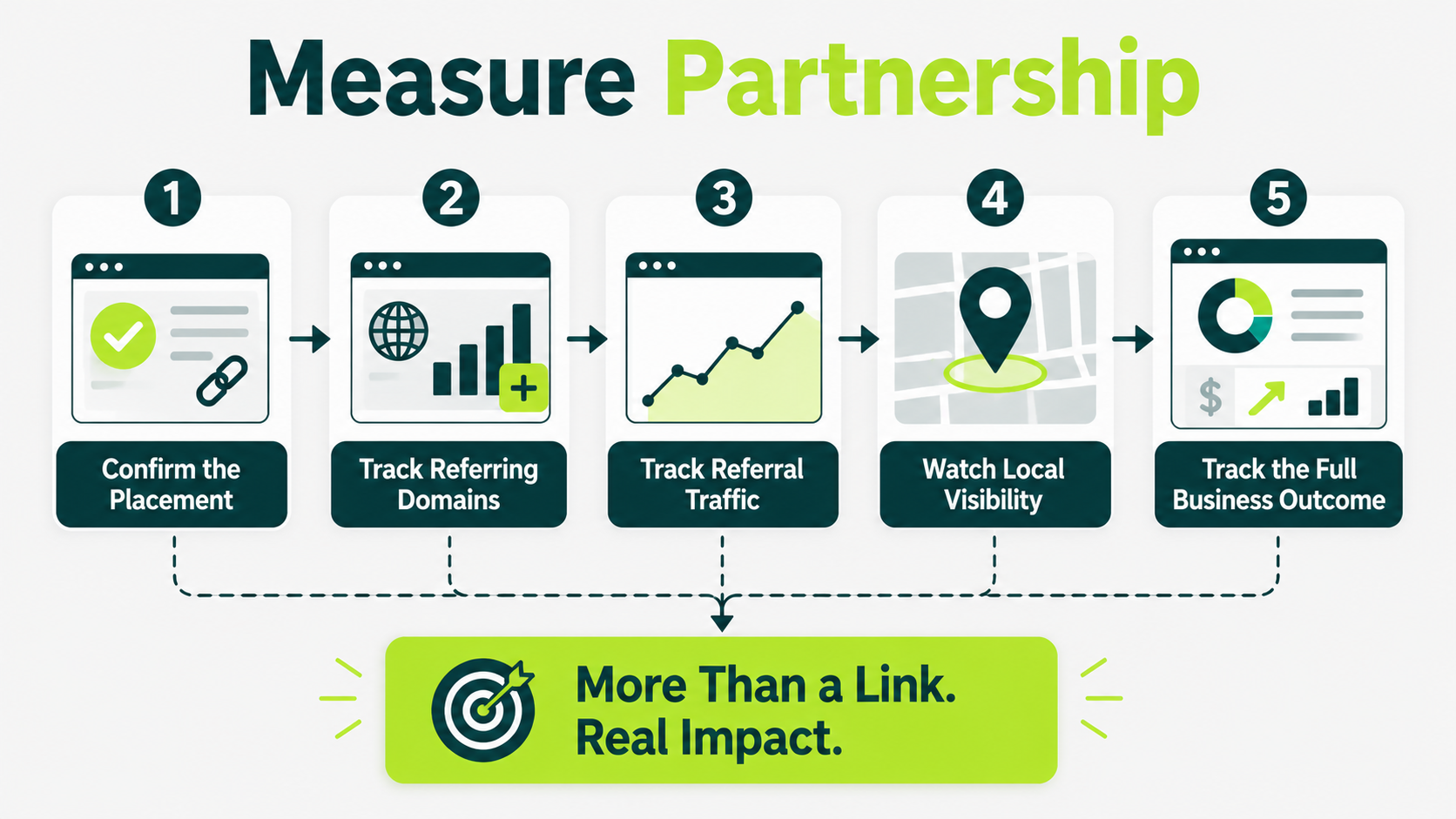
Confirm the Placement
Check that the page is live and that your business name, URL, and link attribute are correct.
Use a free tool for monitoring your backlinks to verify the link appeared and pull the exact URL where it lives. Record the date the placement appeared.
Track Referring Domains
A referring domain is a separate website that links to your site.
Record whether this is the charity’s first link to your site.
Don’t count multiple pages on the same website as multiple referring domains.
Track Referral Traffic
Use your analytics platform to see whether visitors arrived from the charity website.
Look at sessions, engaged visits, leads, or sales when traffic is sufficient to measure.
Watch Local Visibility
Track relevant local search terms when the partnership has a genuine local connection.
Watch the trend over time. Don’t pin every ranking change on one charity link.
Rankings also change because of your content, competitors, site updates, and other links.
Track the Full Business Outcome
Record the sponsorship cost, referral traffic, media coverage, new relationships, and measurable conversions.
A partnership can create useful business outcomes without moving your rankings at all. That gives you a clearer view of the return.
Don’t judge the campaign as “one backlink for a fixed cost.” Record what you paid, what you received, and what happened afterward.
Compare the results with other community partnerships you run.
Once you compare that, you’ll know which causes, events, and contribution levels fit your growth goals.
You might learn that community events generate strong referral traffic for a local service business, while volunteer programs create more useful relationships for a company that sells to other businesses.
That comparison gives you a better basis for your next sponsorship.
You can also compare that work with a broader relationship-based link building approach.
Choose the Partnership You’d Support Anyway
Start with local nonprofits that naturally connect with your customers or community.
Review the organization before you put money behind it.
See how it recognizes sponsors. Ask what your contribution supports. Then make your offer without attaching a link demand.
That’s the practical way to approach link building with charities. The partnership should still be worth doing when the link never appears.
If it also creates recognition, referral traffic, or media coverage, measure those outcomes and decide whether the relationship deserves another investment.
When the partnership has a story worth sharing with a wider audience, digital PR service can help you extend its reach.
Want a More Sustainable Approach to Link Building?
Get expert support for earning relevant backlinks through strategic publisher outreach.
Does a charity have to link back to a business that sponsors it?
No, it doesn’t. A sponsorship or donation doesn’t mean a nonprofit needs to link to you. Some organizations maintain sponsor pages as a standard practice; others recognize supporters through newsletters, social posts, or event mentions with no link at all. Ask how the organization typically handles recognition before assuming a link is part of the deal.
Does a charity link count differently for local SEO than a regular backlink?
Yes, somewhat. Local relevance is part of what search engines weigh, and a link from a nonprofit tied to your community signals a real connection to the area you’re targeting, which a generic industry backlink doesn’t carry.
Community-tied links help most alongside other local proof points, like citations, local news, and reviews. A scalable link building service provider can help earn those additional local mentions.
Should a charity sponsorship link use rel=”sponsored” or rel=”nofollow”?
Use rel=”sponsored” whenever you paid for the placement, whether through a sponsorship, a donation tied to recognition, or a contributed guest post.
Google recommends it for paid links; rel=”nofollow” is an acceptable alternative. A link from unprompted editorial coverage, like a news recap of an event you weren’t paid to attend, doesn’t need either attribute.
How do I know if a nonprofit is legitimate before I sponsor it?
Check the organization profile, confirm its legal name and current contact details, and review how it has recognized past sponsors. No single database should serve as a pass/fail test. Use a few sources together, and talk to the organization directly about what your contribution supports.
Will a charity backlink improve search rankings?
It can contribute to a broader link profile, for local relevance, but a single nonprofit link isn’t a ranking strategy on its own. Rankings depend on many factors, including your overall content and link profile. Treat any link as one possible outcome of a genuine partnership.
What’s a reasonable way to ask a charity about recognition without sounding transactional?
Lead with what you’re contributing, then ask how the organization recognizes supporters. A short, direct message works best. For example, offer your logo and a short description for their materials, and ask whether they maintain a sponsor or partner page. Avoid specifying anchor text, placement, or exact link requirements.