Every backlink strategy hits the same wall: outreach takes weeks, and prospects ignore half the pitches. But have you considered combining crowdfunding with link building?
Crowdfunding link building is an SEO strategy where you back a crowdfunding project or charity and get a listed backlink in return. It is one of the most underused ways to earn a real link.
Done properly, it strengthens the site for search while building trust and goodwill in your industry.
Key Takeaways
- Crowdfunding link building earns a real, live backlink the moment you donate to or launch a campaign.
- Google permits these links only when they carry a nofollow or sponsored tag.
- Kickstarter, Indiegogo, GoFundMe, and Patreon each fit a different campaign type and link type.
- A brief vetting check before donating separates a real backlink from a wasted contribution.
- The crowdfunding market is projected to reach $2.11 billion in 2026, so the pool of active campaigns keeps growing.
- This tactic works best as one piece of a larger program, not as a standalone strategy.
How Crowdfunding Link Building Actually Works
Crowdfunding link building works through a campaign’s backer or thank-you page, where creators list contributor names and add links. Most platforms give every campaign a page of that kind.
What Are Backer or Reward Pages?
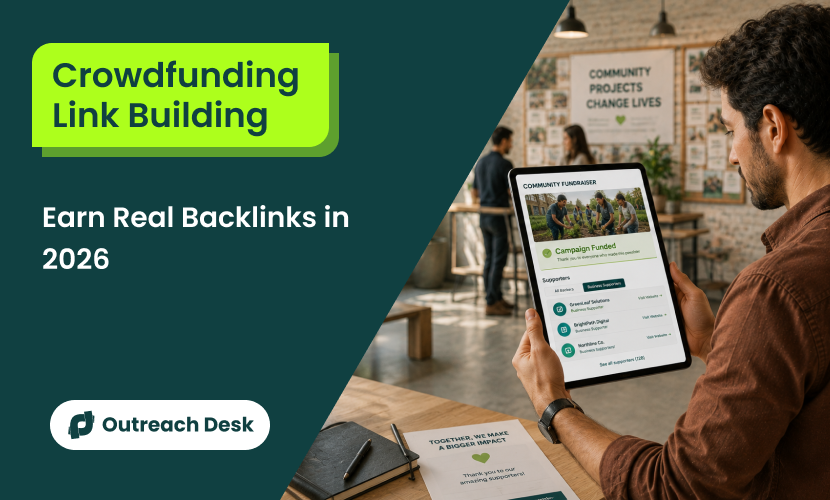
Backer and reward pages list a campaign’s contributors. Platforms often link back to each backer’s own site.
These pages carry high authority, which makes them a strong target in startup and product niches.
Kickstarter, the largest rewards-based crowdfunding platform, shows backer names on many campaign pages.
Larger campaigns often include a dedicated sponsor section for anyone who contributed more than a set amount. That is where the actual backlink lives. The creator adds your site’s URL next to your name, in exchange for your contribution.
You do not need a relationship with the campaign creator. You do not need to pitch anyone or write a guest post. Guest posting still works well for earning editorial backlinks, but this runs on a different mechanic.
Here, you find a relevant, active campaign and contribute at a tier that qualifies for a listed link. It sits alongside the other link building tactics you are probably already running.
It does not replace outreach or guest posting. It is a separate, lower-effort source that runs on a different mechanic entirely.
Is Crowdfunding Link Building Against Google’s Guidelines?
Crowdfunding link building does not violate Google’s guidelines by default. One easy-to-miss detail decides whether an individual link stays compliant.
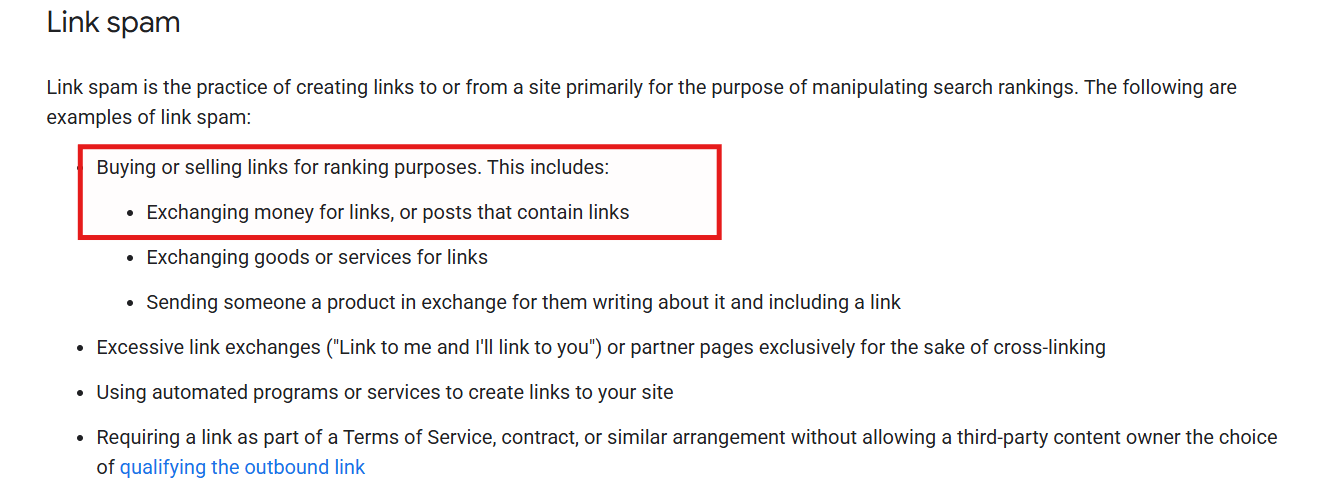
Google’s spam policies explicitly name paid and exchanged links.
Exchanging money, goods, or services for a link is a link scheme when the link passes ranking credit. That is exactly what a donation in exchange for a listed link amounts to.
That sounds like a dead end, except Google carries an explicit exception. A paid or exchanged link needs the rel=”nofollow” or rel=”sponsored” attribute. Those attributes tell Google not to count the link as a ranking vote.
So the real question was never whether crowdfunding link building breaks Google’s guidelines. It is whether the campaign page tagged its backer links correctly.
A nofollow or sponsored link still sends you a visitor when someone clicks the backer list. It still puts your brand next to a campaign your audience may care about. It does not pass the ranking signal a fully editorial link would.
Two Ways to Earn Links Through Crowdfunding
You can earn a crowdfunding backlink by backing someone else’s campaign, or by running your own. The right choice depends on whether you already have a product worth funding.
Backing Someone Else’s Campaign
Backing someone else’s campaign is the faster path. You find a live, relevant campaign, contribute at a tier that includes a listed backer link, and you are done.
The tradeoff is that you do not control the campaign.
If the creator never updates the backer page, your donation does not turn into a link. The same happens when a campaign stalls before it funds.
Without a fundable product of your own, this is the lower-lift option. It pairs well with the slower work of raising your domain authority while the product side catches up.
Launching Your Own Campaign
Launching your own campaign only makes sense if you already have something genuinely fundable. That can be a physical product, a creative project, or a cause people would back on its own merits.
Manufacturing a fake campaign to collect links wastes your time. It reads as inauthentic the moment a journalist or a backer looks closely, and crowdfunding audiences are unusually good at spotting that.
Run a real campaign for a real reason, and the links arrive as a side effect. Press coverage and backer shoutouts point to your campaign page, and crowdfunding aggregators add more links without any outreach.
Where to Find Campaigns Worth Backing
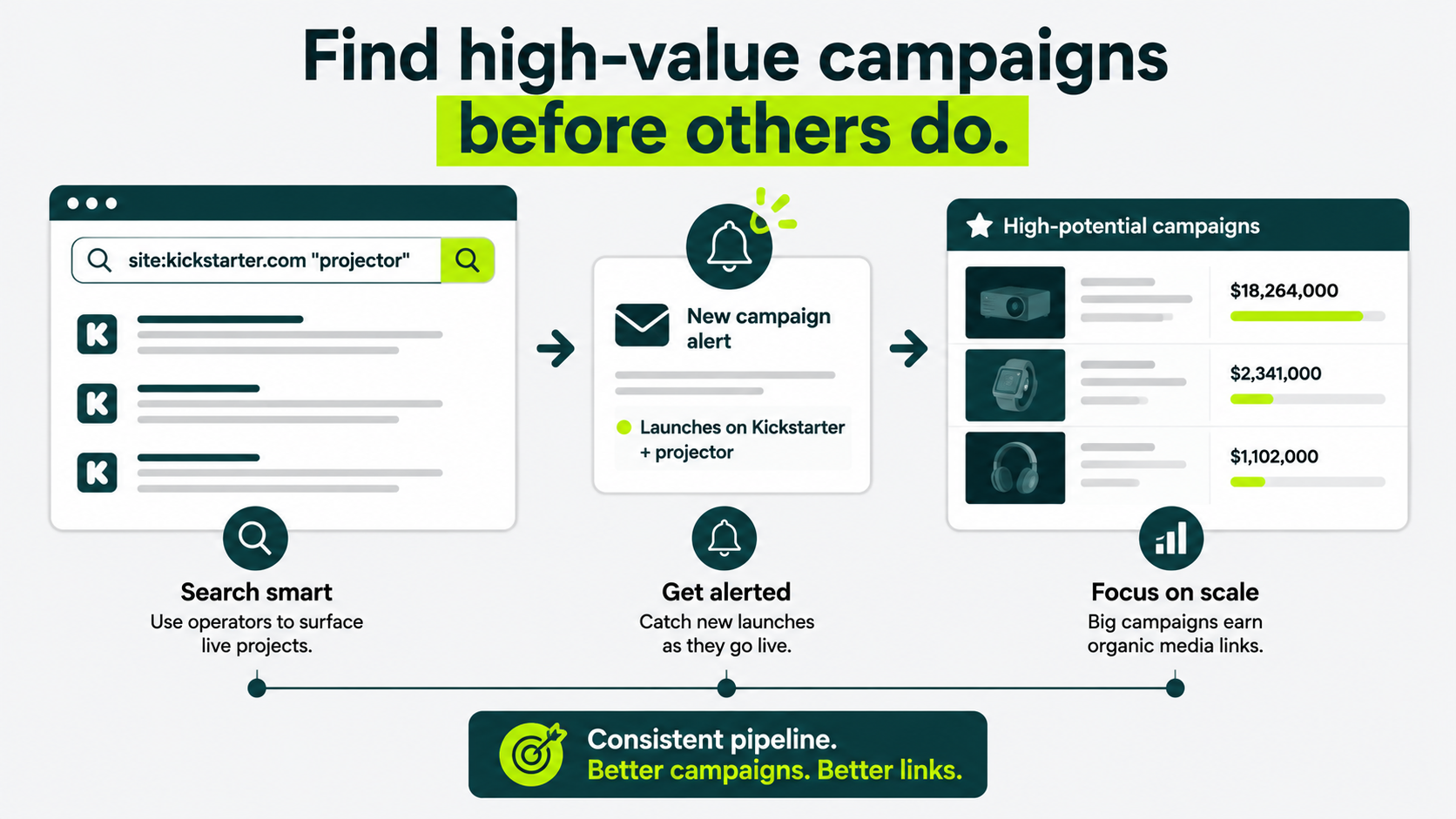
Find campaigns worth backing by searching each platform directly, not by browsing its discovery feed. Use an operator such as site:kickstarter.com plus your industry keyword. That surfaces live and recent project pages rather than whatever the platform is promoting that week.
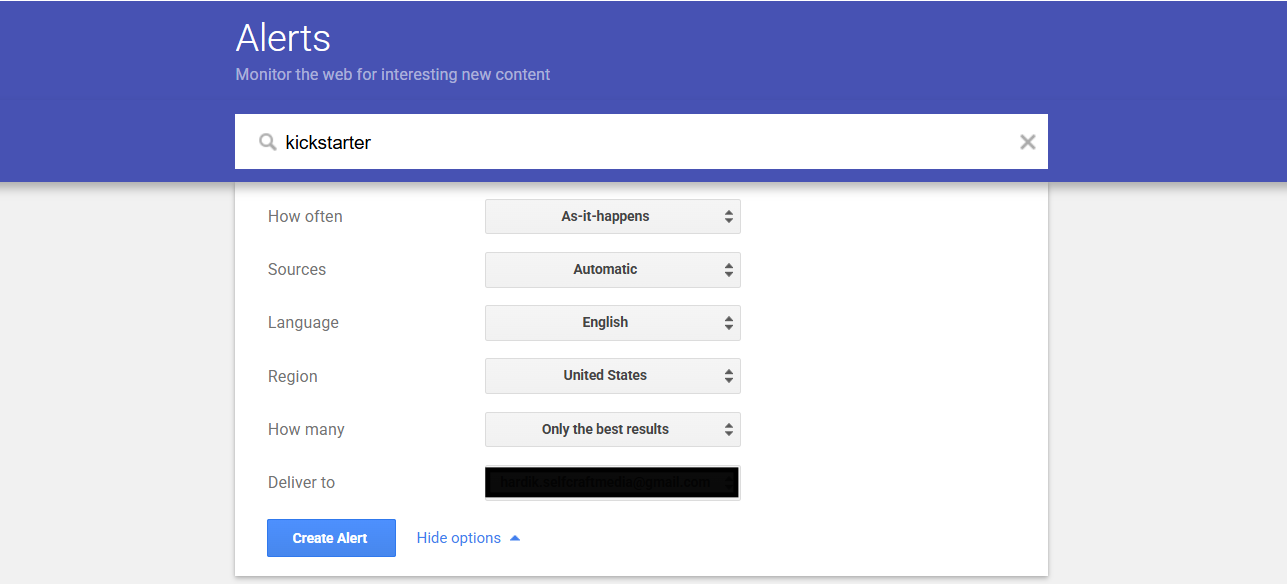
Google Alerts is a free tool that emails you when new pages matching a search term get indexed. Set it to a phrase such as “Kickstarter” plus your niche keyword. New campaigns then reach you before other link builders find them.
Scale matters more than you would think. The highest-funded Kickstarter campaign of 2026 raised over $18.8 million for a single projector launch.
Real publications cover campaigns at that scale, and those write-ups link back to the campaign page.
Run a weekly operator sweep and keep a standing alert. You get a running list of live campaigns without browsing platforms by hand. The same habit sits well alongside the other free link building tools you already check each week.
Picking the Right Crowdfunding Platform for Your Niche
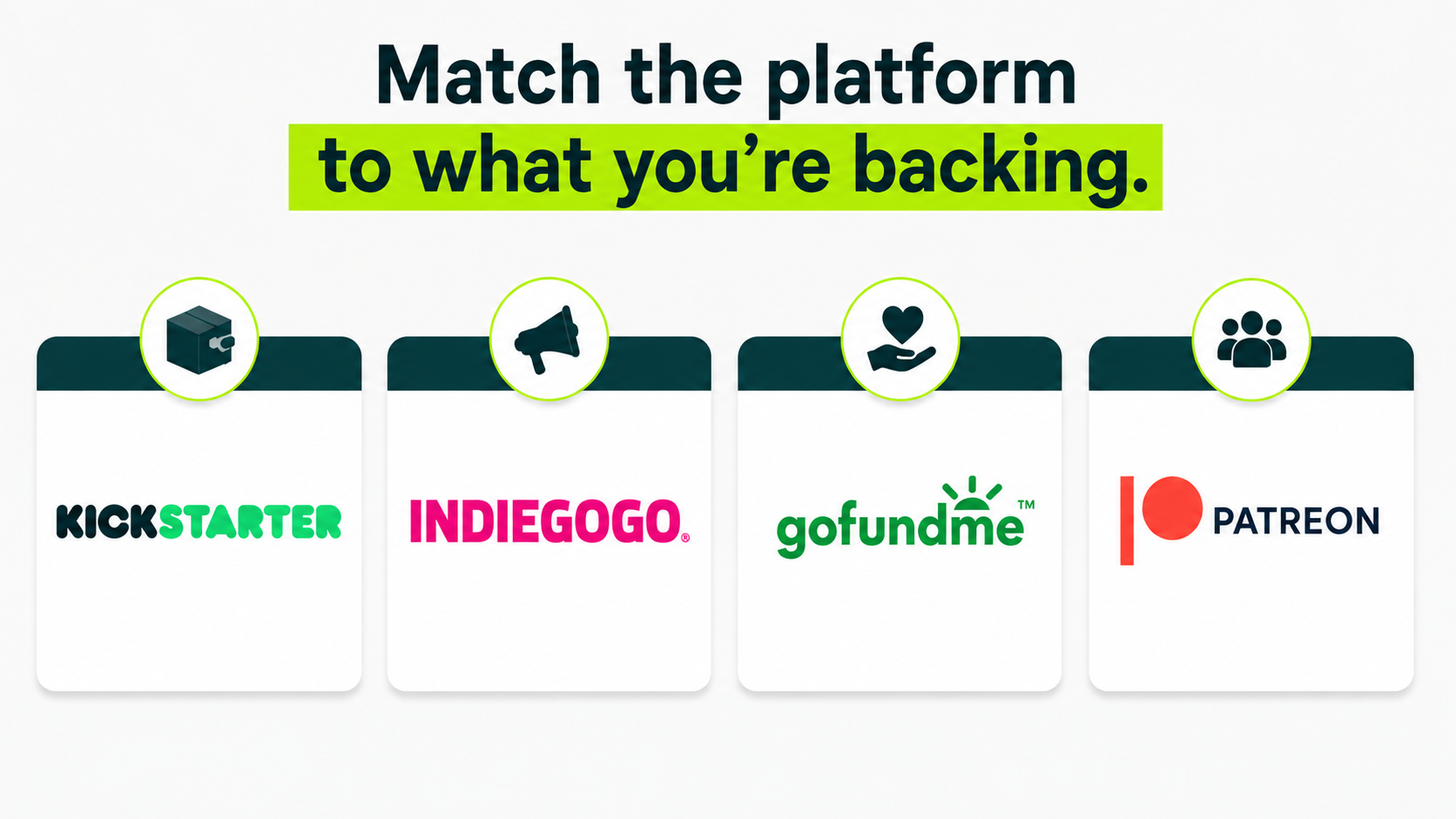
Pick the platform that matches your niche. Kickstarter and Indiegogo suit physical products and creative projects. GoFundMe suits genuine causes more than commercial brands, which makes it closer to links earned through charity work. Patreon suits ongoing creator support rather than one-off campaigns.
Picking the wrong platform wastes the search time from the last section. Match the platform to what you are actually backing before you start searching.
| PLATFORM | BEST FOR | BEFORE YOU BACK |
|---|---|---|
| Kickstarter | Products, creative projects | All-or-nothing funding |
| Indiegogo | Tech, rejected campaigns | Flexible funding |
| GoFundMe | Causes, nonprofits | Fewer outbound links |
| Patreon | Ongoing creator support | Recurring, not one-off |
Kickstarter backer pages are public and commonly list supporters by name. Indiegogo’s flexible funding lets a campaign keep what it raises even when it misses its goal, so more campaigns stay live longer.
GoFundMe fits best when your brand is genuinely tied to a cause rather than a product. Patreon is built for recurring funding, so it suits creators and content brands more than product launches.
This is not a niche tactic running out of room. The crowdfunding market is valued at $2.11 billion in 2026 and is projected to reach $5.91 billion by 2034.
New campaigns launch every day across every platform on this list, so the supply of relevant projects is not going away.
How to Vet a Campaign Before You Send Money
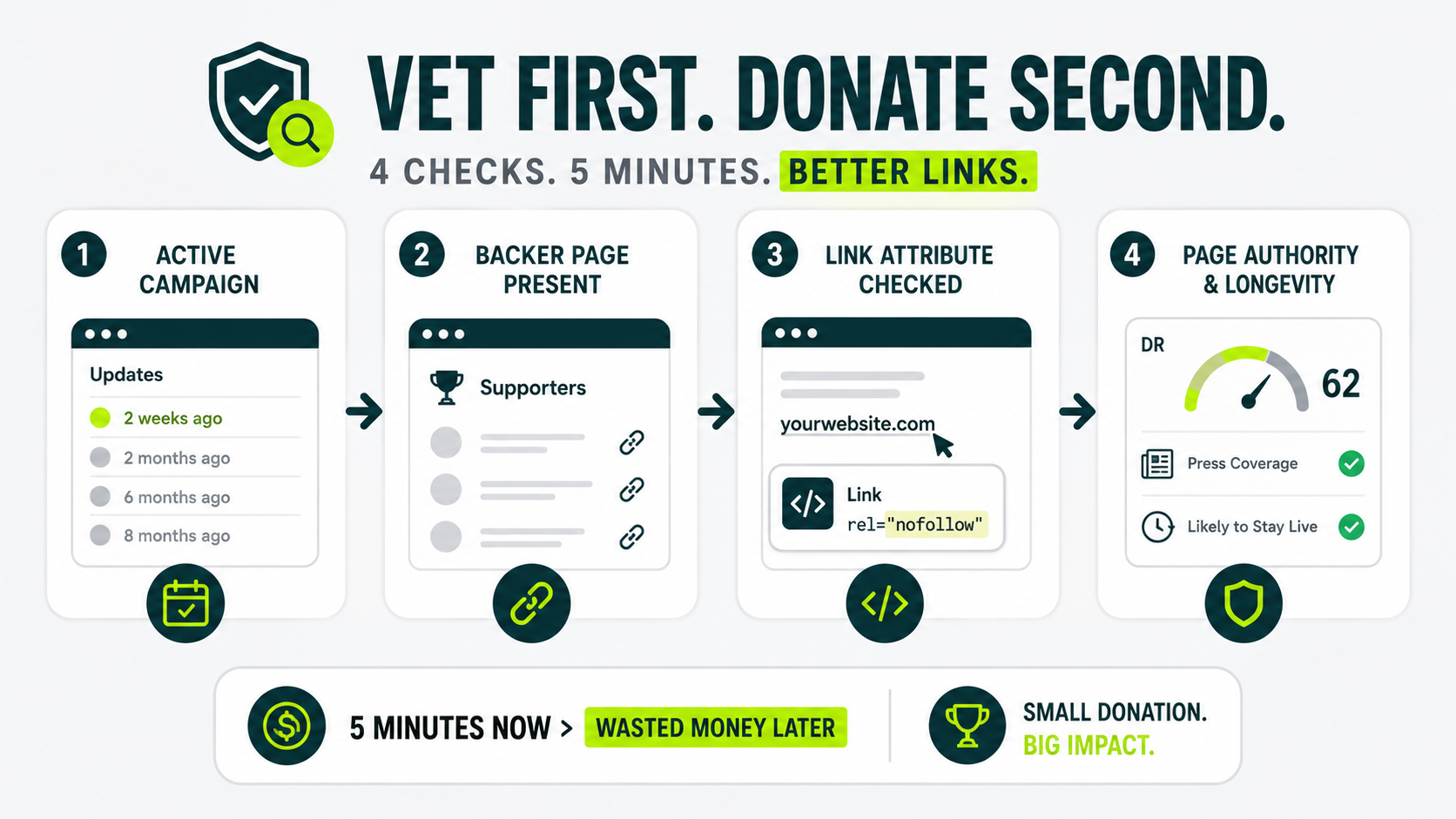
Vet a campaign by checking four things: update activity, backer page, link attribute, and page authority. A campaign qualifies only if it posted an update in the last few weeks. It also needs a public page willing to list your link.
Vetting takes minutes and stops most wasted donations. Run these four checks before you contribute anything.
Step 1: Confirm the Campaign Is Actually Active
Check the campaign’s update feed, not just its funding percentage.
A campaign that hit its goal 8 months ago and has not posted since is unmaintained. That includes its backer page.
Look for an update posted within the last few weeks. No recent activity means the backer page will not get touched again either, even if you contribute.
Step 2: Find the Actual Backer or Rewards Page
Not every campaign publishes a public backer list. Check the campaign page itself, and the creator’s own site, for a dedicated supporters or sponsors section.
If you cannot find a page listing backers with links, ask the creator before you contribute. A campaign with no public backer page has no way to give you a link at all.
Step 3: Check Whether the Link Is Nofollow or Sponsored
Right-click the link, or tap and hold on mobile, and inspect it. You can also ask the creator which attribute they use.
A link tagged nofollow or sponsored is still compliant and still worth having. It will not pass the ranking weight of a fully editorial link, so factor that into what you are willing to pay.
Step 4: Weigh the Page’s Own Authority Before You Pay
A backer page on a brand-new campaign with no press coverage carries less weight. A campaign already written up by several outlets carries more.
Check the platform’s own Domain Rating if you are unsure. DR is a 0 to 100 score from the Ahrefs website authority checker, and it estimates backlink profile strength. Weigh it against how likely that campaign page is to stay live and indexed a year from now.
None of these checks cost money. The real cost of crowdfunding link building is the five minutes of vetting, not the size of the donation.
A $10 contribution to a campaign you actually checked beats $50 to one you did not.
What This Actually Costs and What You Get Back
A crowdfunding backlink costs the campaign’s lowest link-eligible tier, typically between $10 and $100. Some campaigns set that tier much higher.
That is cheaper than what most placements cost. There is no outreach email to write and no pitch to get rejected.
Here is the catch: you do not get control. You cannot ask for specific anchor text. You cannot guarantee the link stays live, or demand a particular spot on the page.
What you get back is one link per campaign, on a page you do not control. Its strength comes mostly from the platform, not from the individual campaign page. Kickstarter, Indiegogo and similar sites carry strong domain-level authority.
Plan for 5 to 10 donations to land 2 or 3 links that stick. Some campaigns stall, some backer pages never get built, and some links turn out to be nofollow. That is normal, not a sign you are doing it wrong.
When Crowdfunding Link Building Fails
Crowdfunding link building fails three ways. The creator never builds the backer page. The page gets taken down later. Or you lean on the tactic as a primary strategy.
Each failure traces to a skipped check or bad allocation, not to a flaw in the tactic. All three are avoidable with vetting and volume discipline.
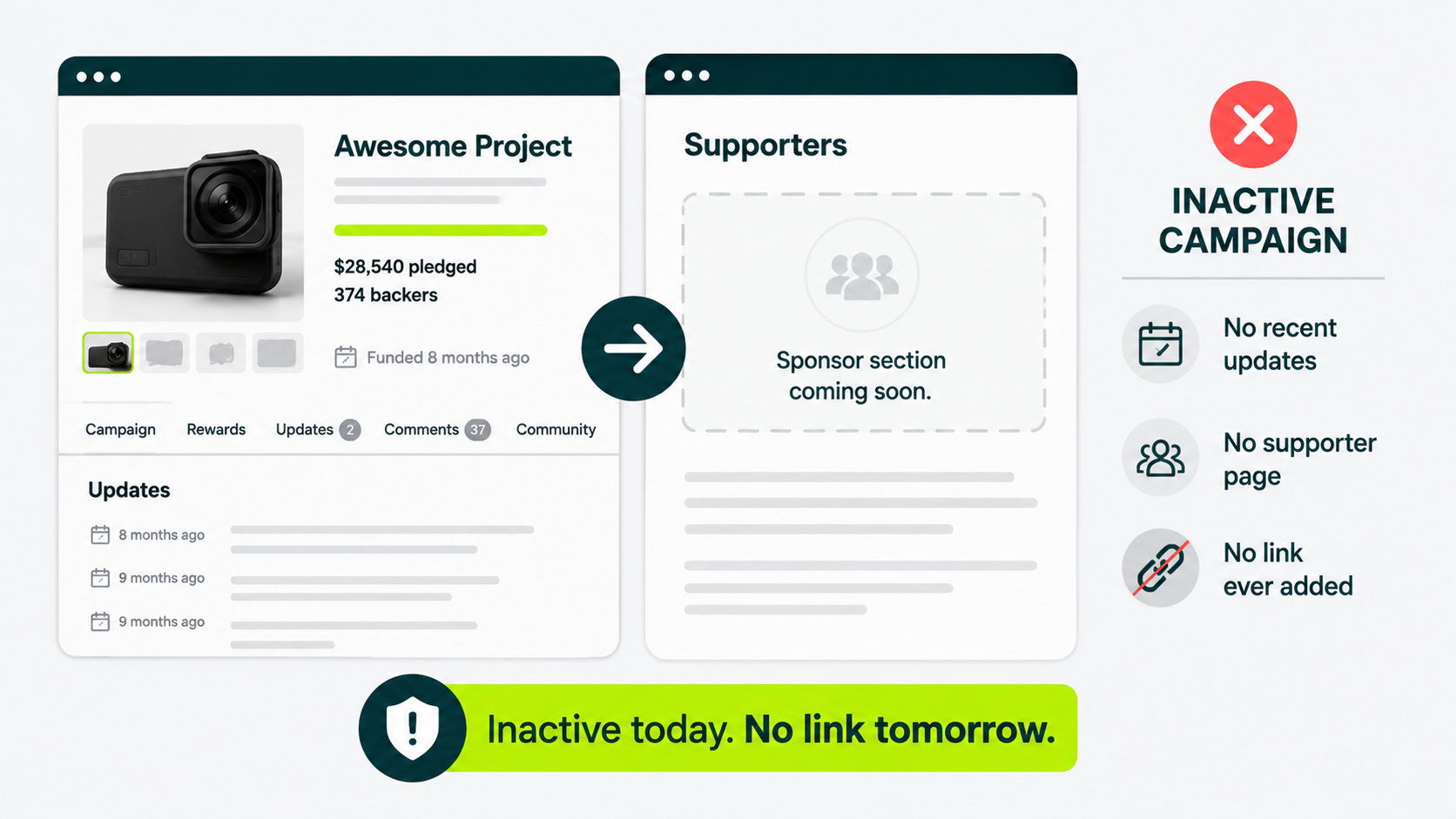
The Campaign Goes Inactive Before the Link Ever Gets Added
A campaign can go inactive before the backer page is ever built. Some creators talk about that page, but never build one. The campaign moves on anyway, gets funded, ships, or quietly dies, and that sponsor spot sits empty forever.
This is the single most common way a donation ends up doing nothing. Step 1 of the vetting check catches it, so treat that check as non-negotiable.
The Link Points to a Page That Later Gets Taken Down
Crowdfunding platforms do not always keep campaign pages up after a project wraps, especially during a later platform redesign. A link that was live and indexed in 2024 can be gone by 2026 with no notice.
There is no way to fully prevent this. Spread your crowdfunding links across several campaigns rather than one or two, which limits what you lose when a single page disappears.
You Lean on It as a Primary Strategy Instead of a Supplement
Leaning on crowdfunding as a primary strategy turns a safe tactic risky. A dozen crowdfunding links in one month, on top of your normal pace, creates an unnatural spike. Each link can be compliant and the pattern still looks wrong.
Know what a natural link pace looks like for a site your size. Check that before you add any single source in volume.
Crowdfunding link building was never meant to carry a program on its own. Treating a supplement as the main event is the fastest way to turn a safe tactic into a suspicious pattern.
Fitting This Into a Full Link Building Program
Crowdfunding link building fits as one low-cost line item in a broader program, not a standalone strategy. It earns a handful of solid links a quarter.
Run it in parallel with other single-source tactics rather than leaning on it alone. Treat it the way you would treat any single-source tactic: useful, low-cost, worth running alongside other underused channels.
Scholarship link building works on similar give-to-get logic. So does earning links through testimonials, where you trade a quote for a mention instead of a donation for a listing.
If crowdfunding links make up more than a small slice of one month’s new links, treat that as a pattern worth checking.
Outreach Desk’s own work happens mostly through editorial link building. It is built on real relationships with publishers, not on a donation and a backer page.
Crowdfunding link building will not replace that. It is a legitimate, low-cost addition, worth having in rotation precisely because so few competitors bother.
Start This Week
Start this week by opening Kickstarter or Indiegogo and searching your niche. Pick one live campaign and run it through the four checks above.
Contribute to the first one that passes. That single link will not move your rankings on its own. It is still a real, guideline-safe backlink from a channel few competitors use.
Start Your First Crowdfunding Campaign Search
Your competitors may not be using this channel yet. Get ahead with a link building approach built around relevant crowdfunding opportunities.
Is crowdfunding link building against Google’s guidelines?
No, as long as the campaign tags your link as nofollow or sponsored.
Google’s spam policies allow paid or exchanged links when they carry that attribute. Campaign backer pages are exactly the kind of exchanged link the rule covers.
The guideline risk is not the tactic itself. It is assuming a link is compliant without checking how it is tagged.
How do I find crowdfunding campaigns to back for links?
Find campaigns by searching the platform directly with an operator such as site:kickstarter.com plus your niche keyword.
Pair that with a standing Google Alert for a phrase such as “launches on Kickstarter” plus your industry term. New campaigns then land in your inbox as soon as they go live.
Which crowdfunding platform is best for link building?
The best platform depends on what you are backing. Kickstarter and Indiegogo suit physical products and creative projects, while GoFundMe fits genuine causes better than commercial brands. Patreon works better for ongoing creator support than for one-off campaign links.
Is crowdfunding link building still worth it in 2026?
Yes, mostly because so few site owners pursue it. The tactic will not replace outreach or guest posting.
A handful of low-cost, guideline-safe links from a channel most competitors ignore is still useful when campaigns are properly vetted.
How much does crowdfunding link building cost?
Most link-eligible backer tiers run between $10 and $100 per campaign. You will usually need several donations to land 2 or 3 links that stick.
Some campaigns go inactive, and some never build the backer page they promised. The real cost sits in vetting time as much as in the donation.